At a Glance
The Stefan-Boltzmann law gives the total thermal radiation from a surface: P = e σ A T^4, where e is emissivity (1 for a perfect blackbody), σ = 5.670374419 × 10⁻⁸ W/(m²·K⁴), A is the surface area and T the absolute temperature in kelvins. Because of the fourth power, a small rise in temperature makes a large rise in radiated power.
- Found by
- Josef Stefan, 1879, from experimental data
- Derived by
- Ludwig Boltzmann, 1884, from thermodynamics
- Formula
- P = eσAT4
- Constant
- σ = 5.670374419 × 10⁻⁸ W/(m²·K⁴), exact in the SI
- Temperature unit
- Kelvin only (absolute temperature)
- Applies to
- Total thermal radiation from any surface, summed over all wavelengths
On this page
- What Does the Stefan-Boltzmann Law Say?
- The Stefan-Boltzmann Law Explained Simply
- What Is the Stefan-Boltzmann Formula?
- Why Does Radiated Power Rise So Steeply With Temperature?
- What Is Emissivity, and How Does It Change the Law?
- How Do You Find the Net Radiation Between an Object and Its Surroundings?
- How Do Astronomers Use the Stefan-Boltzmann Law?
- Who Discovered the Stefan-Boltzmann Law?
- Going Deeper: Where Does σ Come From, and When Does the Law Need Care?
- Practice Stefan-Boltzmann Problems
- Common Misconceptions
- Key Facts
- Quiz
- FAQ
What Does the Stefan-Boltzmann Law Say?
Every object above absolute zero gives off electromagnetic radiation simply because its particles are jiggling. The Stefan-Boltzmann law tells you how much: the total power radiated from a surface equals its emissivity times a universal constant times its area times the fourth power of its absolute temperature.
The fourth power is the heart of the law. Raise the temperature from 300 K to 600 K and the radiated power does not double; it grows by a factor of
The law covers the total radiation summed over every wavelength. Where that radiation peaks in the spectrum is a separate question, answered by Wien's displacement law. Together the two laws describe the glow of anything from a warm hand to a blue-white star.
The Stefan-Boltzmann Law Explained Simply
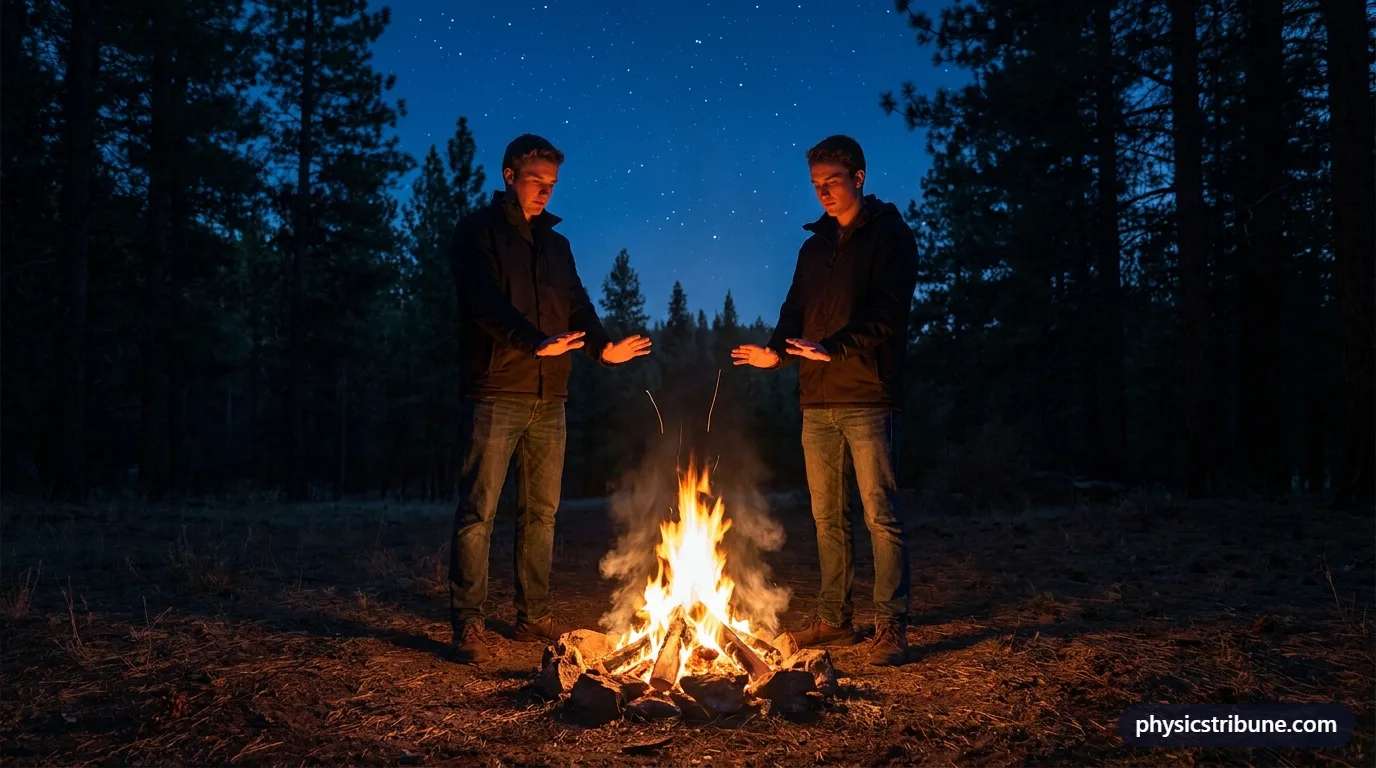
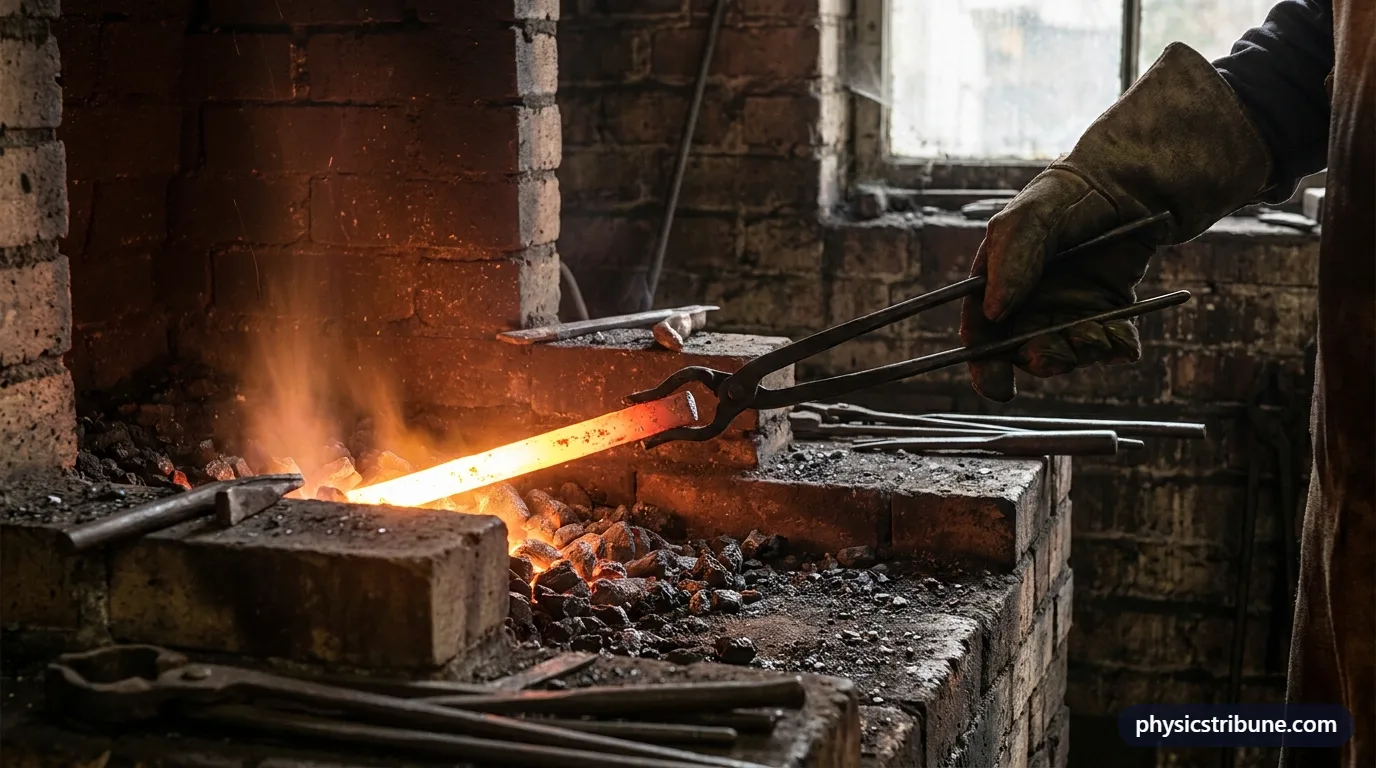
Hold your hand near a mug of hot tea and you feel a little warmth even without touching it. Hold it the same distance from a glowing campfire log and the warmth is almost painful. The log is only about three times hotter in kelvins, yet it radiates roughly a hundred times more power per square meter.
That is the law in action. Radiated power depends on temperature multiplied by itself four times, so small changes in temperature make big changes in glow. It also depends on surface size, because a bigger surface has more area to shine from, and on the surface finish, because dull dark surfaces radiate better than shiny ones.
One rule must never be broken: the temperature has to be in kelvins. Using Celsius would make a block of ice at 0 °C radiate nothing at all, which is wrong. Our page on absolute zero explains why the kelvin scale starts where it does.
What Is the Stefan-Boltzmann Formula?
The law is written
The Stefan-Boltzmann constant has the value
Divided by the area, the law gives the power per square meter,
Here is the Stefan-Boltzmann law with each variable and its SI unit, plus the forms solved for temperature, area and emissivity.
| Symbol | Quantity | SI unit |
|---|---|---|
| power radiated | watt (W) | |
| emissivity (1 for a blackbody) | dimensionless (1) | |
| Stefan-Boltzmann constant (5.670 × 10⁻⁸ W/(m²·K⁴)) | watt per square meter kelvin to the fourth (W/(m²·K⁴)) | |
| surface area | square meter (m²) | |
| absolute surface temperature | kelvin (K) |
Rearranged to find another variable:
Valid for: T in kelvin; net exchange with surroundings at T₂: P_net = eσA(T₂⁴ − T₁⁴).
Why Does Radiated Power Rise So Steeply With Temperature?
The table below shows the power radiated by one square meter of a perfect blackbody at a range of temperatures. Between a cool planet and the surface of the Sun, the temperature rises by a factor of about 23, but the radiated power rises by a factor of more than 260,000.
Two effects combine to produce the fourth power. A hotter body emits more photons, and each photon carries more energy on average, because the spectrum shifts toward shorter wavelengths. Counting both effects carefully, as Max Planck's radiation law does, gives exactly
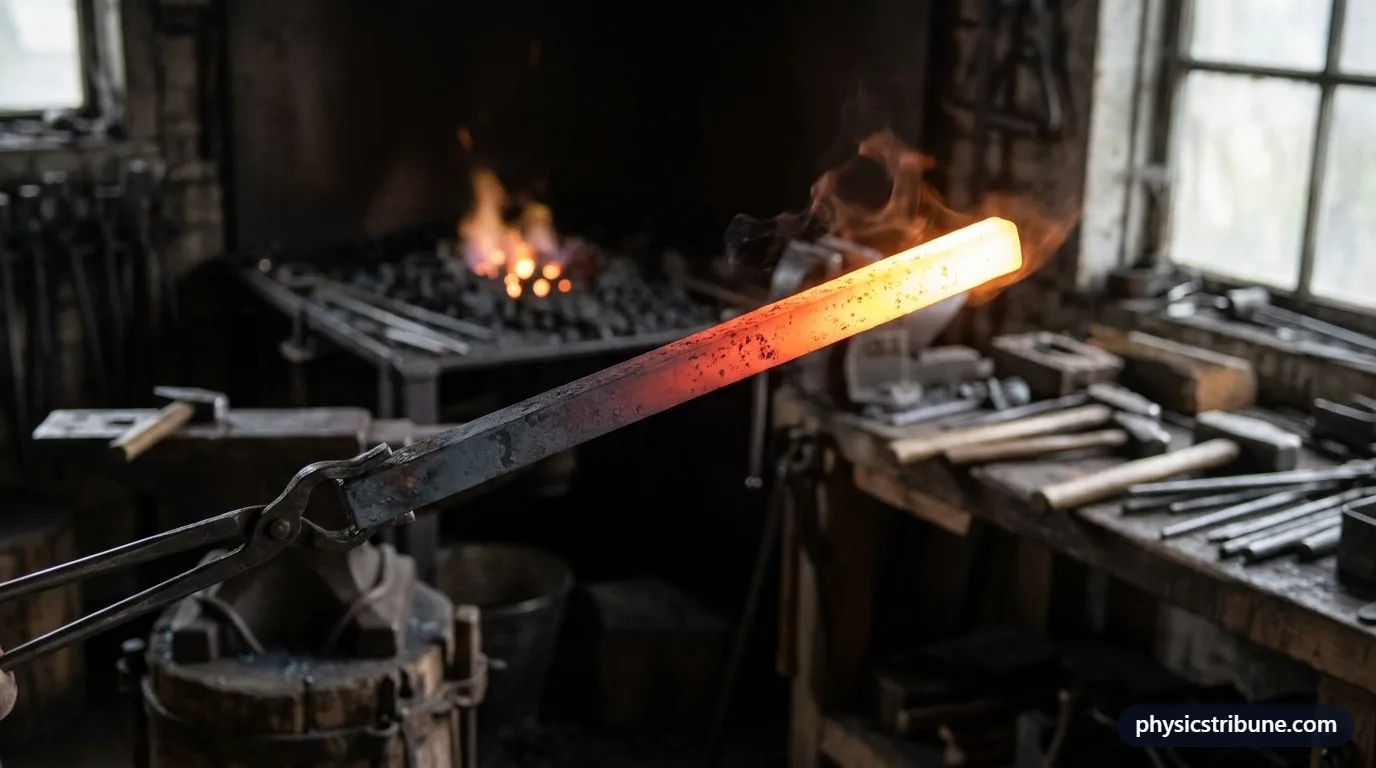
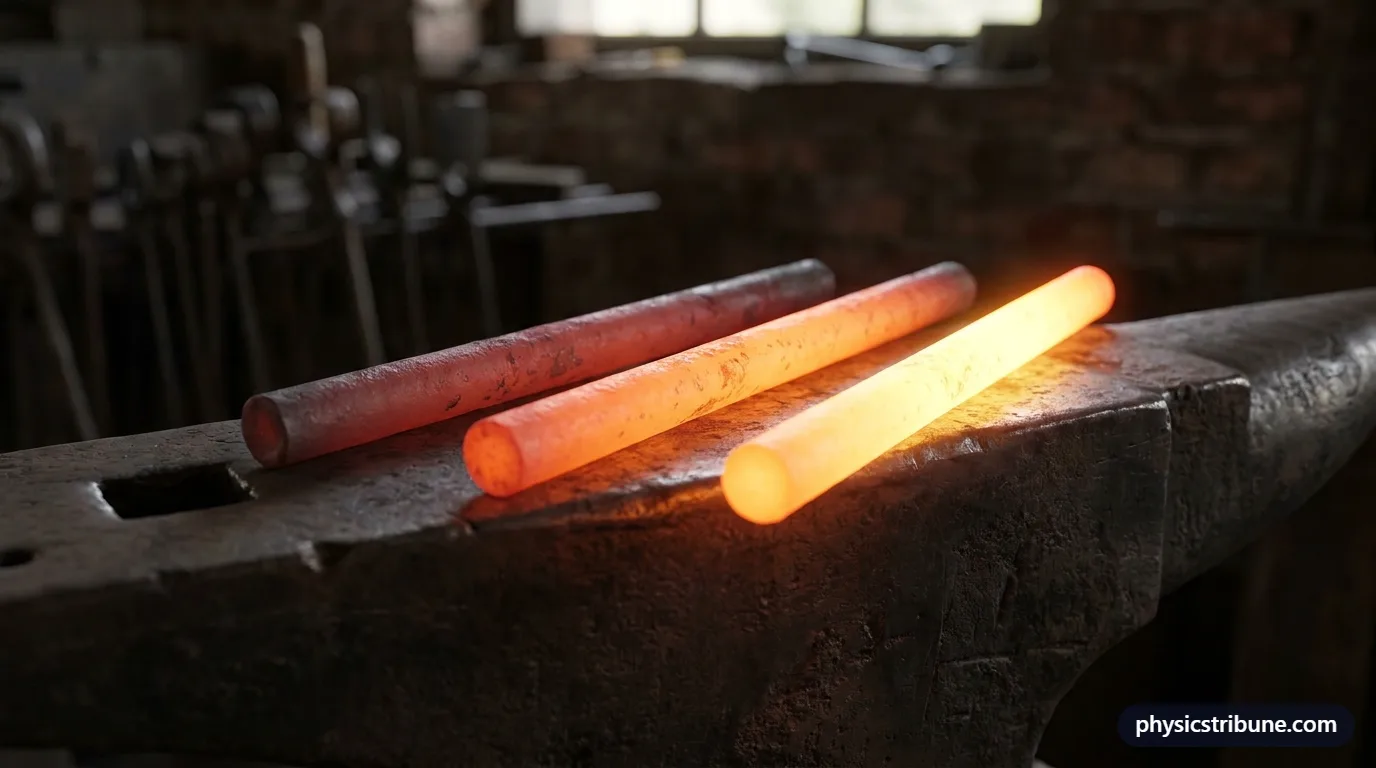
The practical result is that at everyday temperatures, conduction and convection often matter as much as radiation, but in a furnace, a light bulb filament or a star, radiation wins by a huge margin. The spectra after this section show it: the area under each curve is the total power, and it grows much faster than the temperature.
| Example | Temperature (K) | Power per m² (W/m²) | Compared with 300 K |
|---|---|---|---|
| Earth's effective radiating temperature | 255 | about 240 | 0.52× |
| Room-temperature object | 300 | about 459 | 1× |
| Boiling water | 373 | about 1,098 | 2.4× |
| Hot stove surface | 500 | about 3,544 | 7.7× |
| Dull red glowing metal | 1,000 | about 56,700 | 123× |
| Molten steel, roughly | 1,800 | about 595,000 | 1,296× |
| Incandescent bulb filament | 2,800 | about 3.49 million | 7,588× |
| Surface of the Sun | 5,772 | about 62.9 million | 137,000× |
| Source: Computed with P/A = σT⁴, σ = 5.670374419 × 10⁻⁸ W/(m²·K⁴) (NIST CODATA 2022) · example temperatures typical · Retrieved October 2026 | |||

What Is Emissivity, and How Does It Change the Law?
A perfect emitter, called a blackbody, has an emissivity of exactly 1. Real surfaces radiate less than a blackbody at the same temperature, and the emissivity
Polished metals are the opposite. Shiny aluminum or silver has an emissivity of only a few hundredths, so it radiates very little. That is why space blankets, oven linings and the inner walls of vacuum flasks are made shiny: they hold heat in by refusing to radiate it away.
A good emitter is also a good absorber at the same wavelengths, a rule known as Kirchhoff's law of thermal radiation, named for Gustav Kirchhoff. A surface that radiates poorly also absorbs poorly, and reflects the rest.

How Do You Find the Net Radiation Between an Object and Its Surroundings?
An object does not only send radiation out; it also soaks up radiation from everything around it. If an object at temperature
When the object is hotter than its surroundings, the net power is positive and the object cools. When it is colder, the net power is negative and it warms up. When the two temperatures match, the flows balance exactly and nothing changes, which is what thermal equilibrium looks like for radiation.
This form is the one to use for stoves, radiators, people and hot pipes. Using the outgoing power alone would wildly overstate the heat loss, because at room temperature the incoming radiation nearly cancels the outgoing radiation.
Example 1 A wood stove warming a cabin
The front and sides of a cast-iron wood stove have a combined surface area of 0.8 m² at 500 K, with an emissivity of 0.9. The cabin walls around it are at 295 K. Using P = eσA(T⁴ − T_env⁴) with σ = 5.670374419 × 10⁻⁸ W/(m²·K⁴), what net power does the stove deliver to the room by radiation?
- Given:
- emissivity (1 for a blackbody):
- Stefan-Boltzmann constant:
- surface area:
- absolute surface temperature:
- T_env:
- emissivity (1 for a blackbody):
- Formula:
- Substitute:
- Answer:
That is roughly the output of a large space heater, delivered without any fan, which is why a hot stove warms your face from across the room.
How Do Astronomers Use the Stefan-Boltzmann Law?
A star is close to a blackbody, and its surface area is
The law also sets the temperatures of planets. A planet warms until the infrared power it radiates matches the sunlight it absorbs. For Earth, that balance gives a temperature far colder than the one we actually experience, and the difference is the warming produced by the greenhouse effect.
The same balance governs spacecraft. Engineers choose paints and shiny foils with just the right emissivity and absorption so that a satellite stays within safe temperatures in full sunlight and in shadow.
Example 2 How much power does the Sun give off?
The Sun's photosphere has a radius of about 6.957 × 10⁸ m and an effective temperature of about 5,772 K. Treating it as a blackbody (e = 1) with σ = 5.670374419 × 10⁻⁸ W/(m²·K⁴) and a surface area of 4πR², what is its total radiated power?
- Given:
- emissivity (1 for a blackbody):
- Stefan-Boltzmann constant:
- R:
- absolute surface temperature:
- emissivity (1 for a blackbody):
- Formula:
- Substitute:
- Answer:
This matches the Sun's measured luminosity of about 3.83 × 10²⁶ W, and astronomers run the same calculation backward to find the sizes of distant stars.
Example 3 Earth's temperature without an atmosphere
Averaged over the whole globe and over day and night, Earth absorbs about 240 W of sunlight per square meter. If each square meter (A = 1 m²) radiated that same 240 W away as a blackbody (e = 1), with σ = 5.670374419 × 10⁻⁸ W/(m²·K⁴), what would its temperature be?
- Given:
- power radiated:
- emissivity (1 for a blackbody):
- Stefan-Boltzmann constant:
- surface area:
- power radiated:
- Formula:
- Substitute:
- Answer:
That is about −18 °C, well below the real average surface temperature of roughly 15 °C. The gap of about 33 K is the warming provided by the greenhouse effect.

Who Discovered the Stefan-Boltzmann Law?
The Slovene-Austrian physicist Josef Stefan proposed the law in 1879. He noticed that published measurements of heat radiated by a glowing platinum wire fit a fourth-power rule far better than the rules in use at the time. He then used the relation to make one of the first sensible estimates of the temperature of the Sun's surface.
In 1884, his former student Ludwig Boltzmann showed why the rule must hold. He treated radiation trapped in a cavity as a thermodynamic system, used the fact that light exerts pressure, and derived the fourth power from first principles. The law has carried both their names ever since.
About sixteen years later, Max Planck found the full formula for the blackbody spectrum. Adding up his spectrum over all wavelengths reproduces the Stefan-Boltzmann law and gives the constant in terms of more basic constants of nature.
Going Deeper: Where Does σ Come From, and When Does the Law Need Care?
Integrating Planck's law gives
The simple law assumes a single emissivity at all wavelengths, a so-called gray body. Many real materials, such as glass, have an emissivity that changes strongly with wavelength, so precise work integrates the emissivity across the spectrum. The law also assumes the object is much larger than the wavelengths it emits.
Strange things happen across gaps narrower than a fraction of a micrometer. There, heat can tunnel between two surfaces and exceed the blackbody limit by a large factor. For anything from a coffee cup to a star, though, the familiar
Practice Stefan-Boltzmann Problems
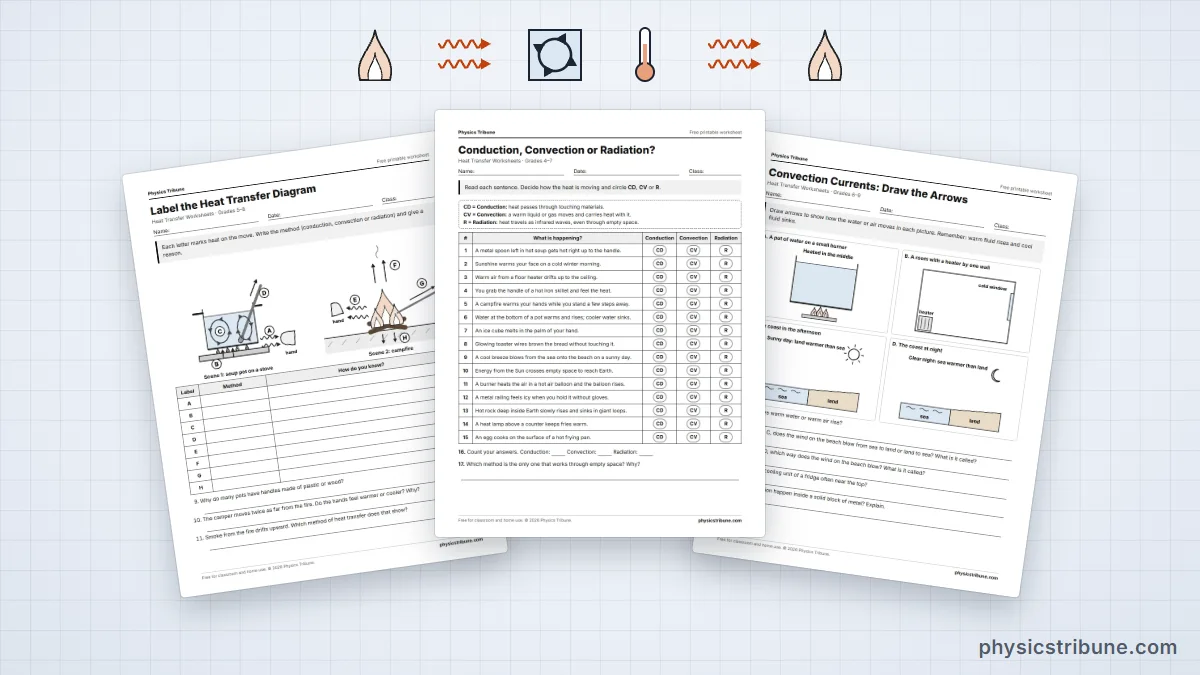
Try radiation questions alongside conduction and convection in our heat transfer worksheets, which come with answer keys. For the broader topic, read thermal radiation and compare the three heat-transfer routes on conduction vs convection vs radiation.
Common Misconceptions
Myth: You can use degrees Celsius in the Stefan-Boltzmann law.
Physics: The law needs absolute temperature in kelvins. In Celsius, anything at 0 °C would appear to radiate nothing, and negative temperatures would make no sense.
Myth: Doubling an object's temperature doubles the power it radiates.
Physics: Power goes as the fourth power of kelvin temperature, so doubling T multiplies the power by 2⁴ = 16.
Myth: Only hot, glowing objects give off thermal radiation.
Physics: Everything above absolute zero radiates. Cool objects radiate mostly invisible infrared, which is why thermal cameras can see people and buildings in the dark.
Myth: A shiny object radiates more because it looks brighter.
Physics: A shiny surface looks bright because it reflects light. Its emissivity is low, so it radiates far less of its own heat than a dull black surface at the same temperature.
Key Facts
- The Stefan-Boltzmann law says radiated power is P = eσAT⁴, proportional to the fourth power of absolute temperature.
- Doubling the kelvin temperature of a surface multiplies its radiated power by 16.
- The Stefan-Boltzmann constant is σ = 5.670374419 × 10⁻⁸ W/(m²·K⁴), exact in the SI since 2019.
- Emissivity e runs from about 0.02 for polished silver to nearly 1 for matte black surfaces and human skin.
- Net radiation between an object and its surroundings is eσA(T⁴ − T_env⁴).
- Josef Stefan found the law from experimental data in 1879, and Ludwig Boltzmann derived it in 1884.
- Applied to the Sun, the law gives a total power of about 3.8 × 10²⁶ W.
Quick Quiz: How Well Do You Know Stefan-Boltzmann Law?
6 questions. Tap an answer to check it.
The kelvin temperature of a blackbody doubles. By what factor does its radiated power change?
Power goes as T⁴, and 2⁴ = 16.
Which temperature scale must you use in P = eσAT⁴?
The law uses absolute temperature, which is measured in kelvins.
Which surface has the lowest emissivity?
Polished metals reflect most radiation and emit very little, with emissivities of a few hundredths.
An object is at the same temperature as its surroundings. What is its net radiated power?
With T equal to T_env, the term T⁴ − T_env⁴ is zero, so emission and absorption balance.
Who first derived the Stefan-Boltzmann law from thermodynamics?
Stefan found the law from data in 1879; Boltzmann derived it theoretically in 1884.
Two stars have the same surface temperature, but one has twice the radius. How do their luminosities compare?
Luminosity scales with area 4πR², so doubling the radius gives four times the power.
Frequently Asked Questions
What is the Stefan-Boltzmann law in simple terms?
It says that the hotter something is, the much more energy it radiates. The radiated power depends on temperature raised to the fourth power, so a modest rise in temperature brings a huge rise in glow. It also grows with surface area and is larger for dull, dark surfaces than for shiny ones.
What is the formula for the Stefan-Boltzmann law?
The formula is P = eσAT⁴. P is radiated power in watts, e is emissivity from 0 to 1, σ is the Stefan-Boltzmann constant of 5.670374419 × 10⁻⁸ W/(m²·K⁴), A is surface area in square meters and T is absolute temperature in kelvins. For a perfect blackbody, e equals 1.
Why is temperature raised to the fourth power?
Two effects multiply together. A hotter body emits more photons, and those photons carry more energy each, because the spectrum shifts toward shorter wavelengths. When Max Planck's spectrum is added up over every wavelength, the result grows exactly as the fourth power of absolute temperature, which is the Stefan-Boltzmann law.
What is the value of the Stefan-Boltzmann constant?
The Stefan-Boltzmann constant is σ = 5.670374419 × 10⁻⁸ W/(m²·K⁴). Since the 2019 SI redefinition it is exact, because it is calculated from the Boltzmann constant, the Planck constant and the speed of light, which all have fixed values. Its decimal digits continue without end, so tables show it truncated.
What is emissivity?
Emissivity is the fraction of blackbody radiation a real surface actually emits at the same temperature. It is a pure number from 0 to 1. A perfect blackbody has emissivity 1, matte black paint and human skin are close to it, and polished metals have values of only a few hundredths, which is why shiny surfaces lose little heat by radiation.
Does the Stefan-Boltzmann law apply to humans?
Yes. Human skin has an emissivity near 0.98 in the infrared, so people radiate strongly. An adult with bare skin sends out several hundred watts of infrared but also absorbs most of that back from the surrounding walls, so the net loss in a cool room is closer to 140 W (computed for 33 °C skin and 20 °C walls). Clothing and warmer rooms reduce it further.
How is the Stefan-Boltzmann law used in astronomy?
Astronomers treat stars as near-blackbodies with surface area 4πR². The law then links a star's luminosity, radius and surface temperature, so knowing two gives the third. It is the standard way to estimate the radius of a star that is too far away to be seen as a disk, and to estimate planet temperatures.
What is the difference between the Stefan-Boltzmann law and Wien's law?
The Stefan-Boltzmann law gives the total amount of power a hot body radiates, summed over all wavelengths. Wien's displacement law gives the wavelength where that radiation is strongest. As an object heats up, its total output rises as T⁴ while its peak slides to shorter wavelengths, which is why heated metal glows red, then orange, then white.