
At a Glance
Blackbody radiation is the thermal glow of a perfect absorber, and its spectrum is set by temperature alone. The peak wavelength follows Wien's law, λ_max = b / T with b ≈ 2.898 × 10⁻³ m·K, and the total power per square meter rises as σT⁴.
- Ideal emitter
- A blackbody absorbs all incoming radiation and emits the most a body can at its temperature
- Peak wavelength
- λmax = b / T (Wien's displacement law)
- Wien constant b
- 2.897 771 955… × 10⁻³ m·K (CODATA 2022, exact)
- Total power per area
- σT⁴, with σ = 5.670 374 419… × 10⁻⁸ W/(m²·K⁴)
- Depends on
- Absolute temperature only, not material or shape
- Explained by
- Max Planck in 1900, using energy quanta
On this page
- What Is Blackbody Radiation?
- Blackbody Radiation Explained Simply
- How Does Temperature Set the Peak Wavelength?
- Why Does the Color of a Hot Object Change With Temperature?
- What Does a Blackbody Spectrum Look Like?
- How Much Energy Does a Blackbody Radiate?
- Are Real Objects Perfect Blackbodies?
- Where Do You See Blackbody Radiation in Everyday Life?
- Why Was Blackbody Radiation So Important in Physics History?
- Going Deeper: Planck's Law
- Practice Blackbody Radiation Problems
- Common Misconceptions
- Key Facts
- Quiz
- FAQ
What Is Blackbody Radiation?
Every object warmer than absolute zero gives off electromagnetic radiation because its charged particles jiggle with thermal energy. A blackbody is the ideal case: a surface that soaks up every wavelength that lands on it and reflects nothing. Because it absorbs perfectly, it also emits as strongly as any object at its temperature can, and the light it sends out is called blackbody radiation.
The striking feature is that the spectrum of this light depends on one number only, the absolute temperature. A blackbody made of carbon and one made of iron at the same temperature glow identically. That makes blackbody radiation a universal yardstick, and it is the reason a glance at the color of a glowing object tells you how hot it is.
Blackbody radiation is one form of thermal radiation, the heat transfer that needs no medium and crosses empty space. It sits alongside conduction and convection, which you can compare on our conduction vs convection vs radiation page.
Blackbody Radiation Explained Simply
Picture a sealed metal box with a tiny pinhole, heated in a furnace. Light that wanders into the hole bounces around inside until it is absorbed, so the hole looks perfectly black when the box is cool. When the box gets hot, the same hole glows, and that glow is almost exactly blackbody radiation.
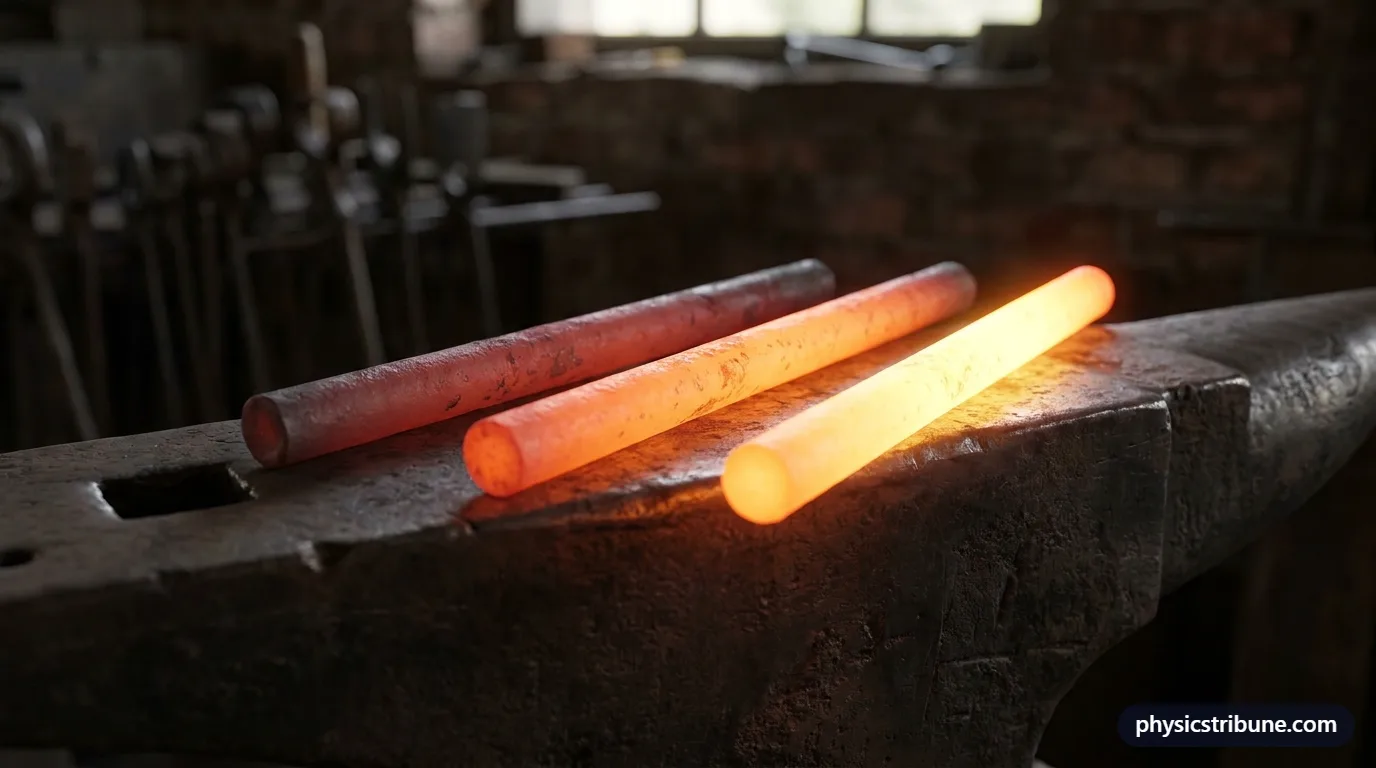
Now turn the furnace up step by step. At first you feel warmth but see nothing, because the light is all infrared. Around 800 K a dull red appears, then orange, yellow and finally a bluish white as the temperature climbs. The glow also gets far brighter at every step.
So two simple rules capture the idea: hotter means brighter, and hotter means bluer. The rest of this page puts numbers on both rules.
How Does Temperature Set the Peak Wavelength?
A blackbody spectrum rises from long wavelengths, reaches a single peak and falls off steeply on the short side. The wavelength of that peak is inversely proportional to the absolute temperature, a rule called Wien's displacement law:
The constant
The first worked example applies the law to the Sun. For more practice with rearranging it, see our full list of thermodynamics formulas.
Wien's displacement law links the peak of a blackbody spectrum to its absolute temperature. Here are the variables and the two rearranged forms.
| Symbol | Quantity | SI unit |
|---|---|---|
| wavelength of peak emission | meter (m) | |
| absolute temperature | kelvin (K) | |
| Wien displacement constant (2.898 × 10⁻³ m·K) | meter kelvin (m·K) |
Rearranged to find another variable:
Valid for: blackbody radiation.
Example 1 Where does sunlight peak?
The visible surface of the Sun behaves roughly like a blackbody at about 5,772 K. Using b = 2.897771955 × 10⁻³ m·K, at what wavelength, in nanometers, does its emission peak?
- Given:
- absolute temperature:
- Wien displacement constant:
- absolute temperature:
- Formula:
- Substitute:
- Answer:
That lands in the blue-green part of the visible band, yet the Sun looks white because it also pours out plenty of every other visible color.
Why Does the Color of a Hot Object Change With Temperature?
Your eyes only see wavelengths between roughly 400 and 700 nm. An object at room temperature peaks near 10 micrometers, far into the infrared, so it emits essentially nothing you can see. As it heats, the short-wavelength tail of its spectrum creeps into the red end of the visible band first, which is why the first visible glow is always red.
Keep heating and more of the curve spills into the visible range. Once orange, yellow and green are all present in strength, the mix looks white. Only very hot objects, above about 10,000 K, have so much blue that they look blue-white. The table below shows how far the peak moves across a huge range of temperatures.
The two worked examples here go in both directions: from a known temperature to a peak wavelength, and from a measured peak back to a temperature. Astronomers use the second method on stars every night.
Example 2 Why thermal cameras use long infrared
The skin on a person's forearm sits at about 306 K (33 °C). Treating skin as a near-perfect blackbody with b = 2.897771955 × 10⁻³ m·K, at what wavelength, in micrometers, is its glow strongest?
- Given:
- absolute temperature:
- Wien displacement constant:
- absolute temperature:
- Formula:
- Substitute:
- Answer:
Thermal cameras are built to see the 8 to 14 micrometer band for exactly this reason: people and buildings shine brightest there.
Example 3 Reading a star's temperature from its color
A spectrograph shows that a blue-white star's light peaks at 290 nm, in the near ultraviolet. Taking b = 2.897771955 × 10⁻³ m·K, what is the star's surface temperature?
- Given:
- wavelength of peak emission:
- Wien displacement constant:
- wavelength of peak emission:
- Formula:
- Substitute:
- Answer:
Astronomers estimate the temperatures of millions of stars this way, without ever touching them.
| Object (approximate temperature) | Temperature (K) | Peak wavelength | Band of the peak | Power per m² (W) |
|---|---|---|---|---|
| Cosmic microwave background | 2.725 | 1.06 mm | Microwave | 0.0000031 |
| Room-temperature wall | 293 | 9.89 µm | Infrared | 418 |
| Human skin | 306 | 9.47 µm | Infrared | 497 |
| Hot oven wall | 500 | 5.80 µm | Infrared | 3,544 |
| Dull red iron | 1,000 | 2.90 µm | Infrared | 56,700 |
| Lava flow | 1,450 | 2.00 µm | Infrared | 250,700 |
| Candle flame soot | 1,900 | 1.53 µm | Infrared | 739,000 |
| Tungsten bulb filament | 2,800 | 1.03 µm | Near infrared | 3,485,000 |
| Surface of the Sun | 5,772 | 502 nm | Visible (blue-green) | 62,940,000 |
| Blue-white star | 20,000 | 145 nm | Ultraviolet | 9,073,000,000 |
| Source: Computed with λ_max = b/T and σT⁴ using b and σ from NIST CODATA 2022; temperatures are typical values · Retrieved October 2026 | ||||

What Does a Blackbody Spectrum Look Like?
Plot brightness against wavelength for a blackbody and you get a lopsided hump. The left side, toward short wavelengths, drops almost like a cliff, while the right side trails off slowly into the infrared and radio. Every temperature gives the same basic shape, only shifted and scaled.
A hotter curve sits above a cooler one at every wavelength. That means a hot object is brighter than a cooler one even at the cooler object's own peak. The curves never cross, which is a handy check when you sketch them.
The diagram below places these peaks on the electromagnetic spectrum. Humans and buildings peak in the infrared, the Sun peaks inside the band of visible light, and the hottest stars peak in the ultraviolet.

How Much Energy Does a Blackbody Radiate?
The total power a blackbody radiates from each square meter of surface grows with the fourth power of absolute temperature. This is the Stefan-Boltzmann law,
The fourth power makes a dramatic difference. A square meter at 1,000 K radiates about 56,700 W, while the same area of the Sun's surface sends out roughly 63 million W (computed with
Wien's law and the Stefan-Boltzmann law describe two different features of the same curve. Wien tells you where the peak is; Stefan-Boltzmann tells you the total area under the whole curve.
Are Real Objects Perfect Blackbodies?
No real surface absorbs absolutely everything, so physicists describe real objects with an emissivity between 0 and 1. A polished silver spoon has an emissivity close to 0.02, while soot, matte black paint and human skin come in above 0.9. A surface with emissivity 0.9 radiates 90% of what a blackbody at the same temperature would.
The key rule here was found by Gustav Kirchhoff: a good absorber at a given wavelength is an equally good emitter at that wavelength. Shiny materials reflect well, so they also radiate poorly. That is why thermos flasks and emergency blankets are silvered, while radiators and heat sinks are often painted dark.
Some objects come extremely close to the ideal. Stars, a small opening into a hot furnace and the faint microwave glow left over from the early universe all follow the blackbody curve to impressive precision.
Where Do You See Blackbody Radiation in Everyday Life?
Once you know the pattern, you notice it everywhere:
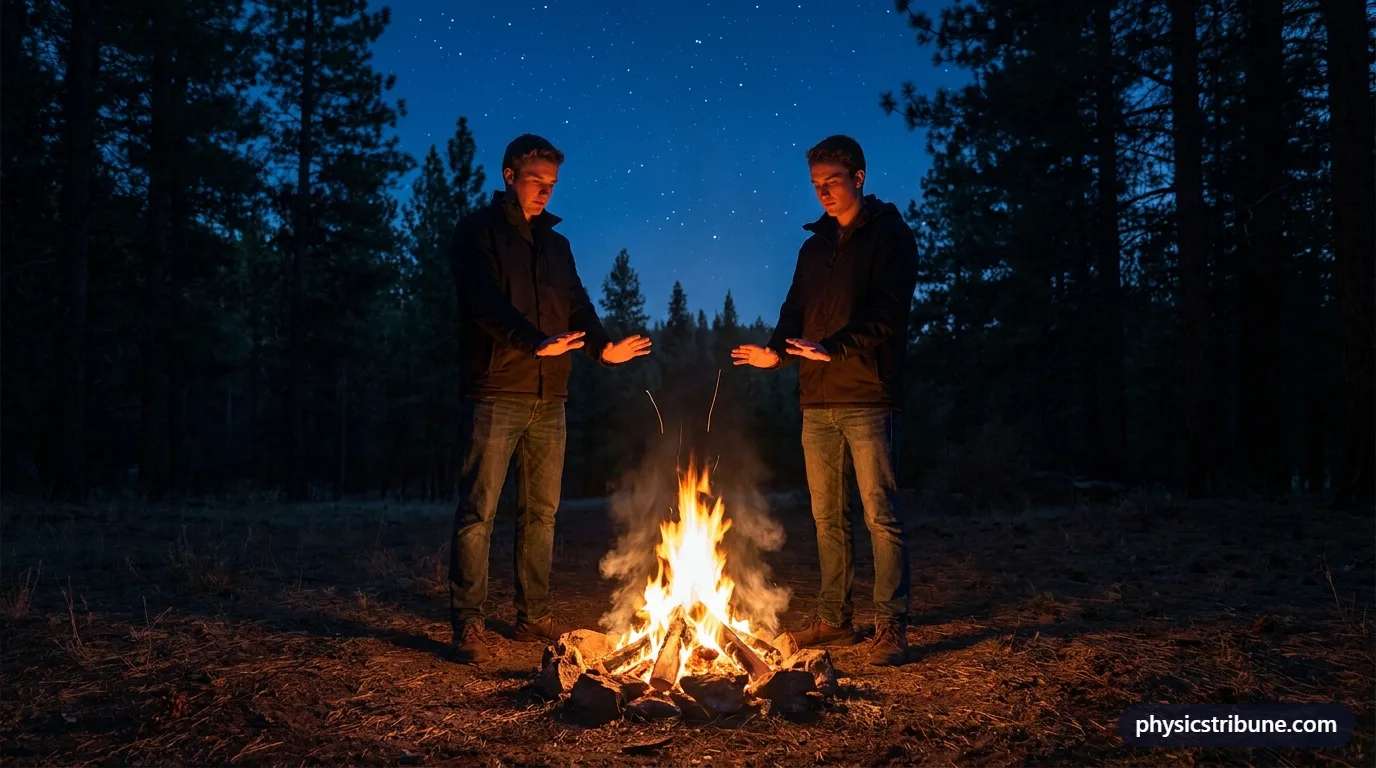
- Electric stove coils. A coil on high glows orange-red, while one on low feels hot but shows no color at all.
- Incandescent bulbs. A tungsten filament near 2,800 K peaks in the infrared, so most of its energy is heat, not light. That poor efficiency is why such bulbs were largely replaced by LEDs.
- Blacksmiths and potters. Craftspeople judge metal and kiln temperatures by eye, reading the glow from cherry red to bright yellow.
- Thermal cameras. They detect long infrared and turn the blackbody glow of people, animals and leaky windows into an image.
- Stars. Red stars are cooler than the Sun, and blue-white stars are much hotter.
- The cosmic microwave background. The whole sky glows like a blackbody at about 2.725 K, the cooled afterglow of the young universe.

Why Was Blackbody Radiation So Important in Physics History?
In the late 1800s, physicists tried to predict the blackbody curve from classical physics. One approach worked well at long wavelengths but predicted that a hot object should pour out unlimited energy at short, ultraviolet wavelengths. That impossible result was later called the ultraviolet catastrophe.
In 1900, Max Planck found a formula that matched the measured curve at every wavelength. To justify it, he assumed that energy is exchanged in small packets of size
Planck saw this at first as a mathematical trick. A few years later, Einstein treated the packets as real particles of light, now called photons. Blackbody radiation had opened the door to quantum physics, and Planck received the 1918 Nobel Prize for the discovery of energy quanta.
Going Deeper: Planck's Law
The full curve is described by Planck's law, which gives the spectral radiance at each wavelength:
Find the maximum of this function with calculus and Wien's law falls out. Add up the area under it over all wavelengths and you recover the Stefan-Boltzmann law. In other words, both simpler laws are shortcuts packed inside Planck's single formula.
Practice Blackbody Radiation Problems
Try reworking the examples with your own numbers: a candle flame near 1,900 K, a lava flow near 1,450 K or a cold winter sky. Our electromagnetic spectrum worksheets include printable practice with answer keys, and the photon energy calculator shows how much energy each photon near the peak carries. Then test yourself with the quiz below.
Common Misconceptions
Myth: A blackbody is always black.
Physics: A blackbody only looks black when it is cool. Heated, it glows brightly, and the Sun is a good approximation of one.
Myth: Cold objects do not give off any radiation.
Physics: Every object above absolute zero radiates. Cool objects simply peak in the infrared or microwave range, where our eyes cannot see.
Myth: Red-hot is hotter than white-hot.
Physics: It is the reverse. Red glow appears first at lower temperatures; white and blue-white glow need much higher temperatures.
Myth: Wien's law works with temperatures in Celsius.
Physics: The law needs absolute temperature in kelvin. Using Celsius gives wrong answers and even negative wavelengths below 0 °C.
Key Facts
- Blackbody radiation is the thermal glow of an ideal object that absorbs every wavelength, and its spectrum depends only on temperature.
- Wien's displacement law gives the peak wavelength as λ_max = b / T, with b about 2.898 × 10⁻³ m·K.
- The total radiated power per square meter rises as σT⁴, so doubling the temperature gives sixteen times the power.
- Hot objects glow red first, then orange, yellow and white as their temperature climbs.
- Real surfaces radiate a fraction of the blackbody amount set by their emissivity, from near 0 for polished silver to above 0.9 for skin.
- Max Planck explained the blackbody curve in 1900 by assuming energy comes in quanta of size hf, which launched quantum physics.
- The cosmic microwave background matches a blackbody at about 2.725 K.
Quick Quiz: How Well Do You Know Blackbody Radiation?
6 questions. Tap an answer to check it.
What single property sets the spectrum of an ideal blackbody?
A blackbody's spectrum depends only on its absolute temperature.
If a blackbody's absolute temperature doubles, what happens to its peak wavelength?
Wien's law says λ_max = b / T, so doubling T halves the peak wavelength.
If a blackbody's absolute temperature doubles, how does its total radiated power change?
Power grows as T⁴, and 2⁴ = 16.
Which glowing object is the hottest?
Bluer glow means a shorter peak wavelength and so a higher temperature.
In which band does a room-temperature object radiate most strongly?
At about 293 K the peak falls near 10 micrometers, deep in the infrared.
Who explained the blackbody spectrum in 1900 by introducing energy quanta?
Max Planck assumed energy comes in packets of size hf and won the 1918 Nobel Prize for it.
Frequently Asked Questions
What is blackbody radiation in simple terms?
Blackbody radiation is the light and heat that a perfectly absorbing object gives off simply because it is warm. Its color and brightness depend only on its temperature. Cool objects glow invisibly in the infrared, while very hot ones glow red, yellow, white or even blue. Stars, glowing coals and the inside of a furnace all come close to this ideal.
What is a perfect blackbody?
A perfect blackbody is an idealized object that absorbs every bit of radiation that hits it, at every wavelength, and reflects none. Because it is the best possible absorber, it is also the best possible emitter at its temperature. No real material is perfect, but a small hole into a large heated cavity behaves almost exactly like one.
What is Wien's displacement law?
Wien's displacement law says the wavelength at which a blackbody shines brightest is inversely proportional to its absolute temperature: λ_max = b / T, where b is about 2.898 × 10⁻³ meter kelvin. A hotter object peaks at a shorter wavelength. The law lets you find a star's surface temperature from the color of its light.
Why is the Sun considered a blackbody?
The Sun's hot, dense gas absorbs light so effectively that very little passes through without being absorbed and re-emitted. As a result, the light leaving its visible surface closely follows a blackbody curve for a temperature of about 5,772 K. Absorption lines and the solar atmosphere cause small differences, but the overall shape matches well.
Do humans emit blackbody radiation?
Yes. Human skin has an emissivity above 0.9, so it radiates almost like a blackbody at about 306 to 310 K. The peak lies near 9 to 10 micrometers in the infrared, which is invisible to our eyes. Thermal cameras and forehead thermometers detect this glow to measure body temperature without touching anyone.
What is the ultraviolet catastrophe?
The ultraviolet catastrophe was the failure of classical physics to describe blackbody radiation. A classical calculation predicted that a hot object should emit unlimited energy at short, ultraviolet wavelengths, which is clearly false. Max Planck fixed the problem in 1900 by assuming energy comes in discrete quanta, an idea that grew into quantum mechanics.
How is blackbody radiation related to temperature?
Temperature controls both the color and the brightness of blackbody radiation. The peak wavelength shrinks in proportion to 1/T, following Wien's law, so hotter objects look bluer. The total power per square meter grows as T⁴, following the Stefan-Boltzmann law, so a modest rise in temperature makes an object far brighter.
Why do stars have different colors?
Stars glow roughly like blackbodies, so their color reveals their surface temperature. Cooler stars near 3,000 K peak in the infrared and look orange or red. Stars like the Sun look white or yellowish. The hottest stars, above about 10,000 K, peak in the ultraviolet and look blue-white because their visible light is weighted toward blue.
Keep Exploring





Sources
Constants come from NIST CODATA 2022 (public domain) and unit definitions from the BIPM SI Brochure (CC BY 4.0). Text, diagrams and illustrations are original work by Physics Tribune.