At a Glance
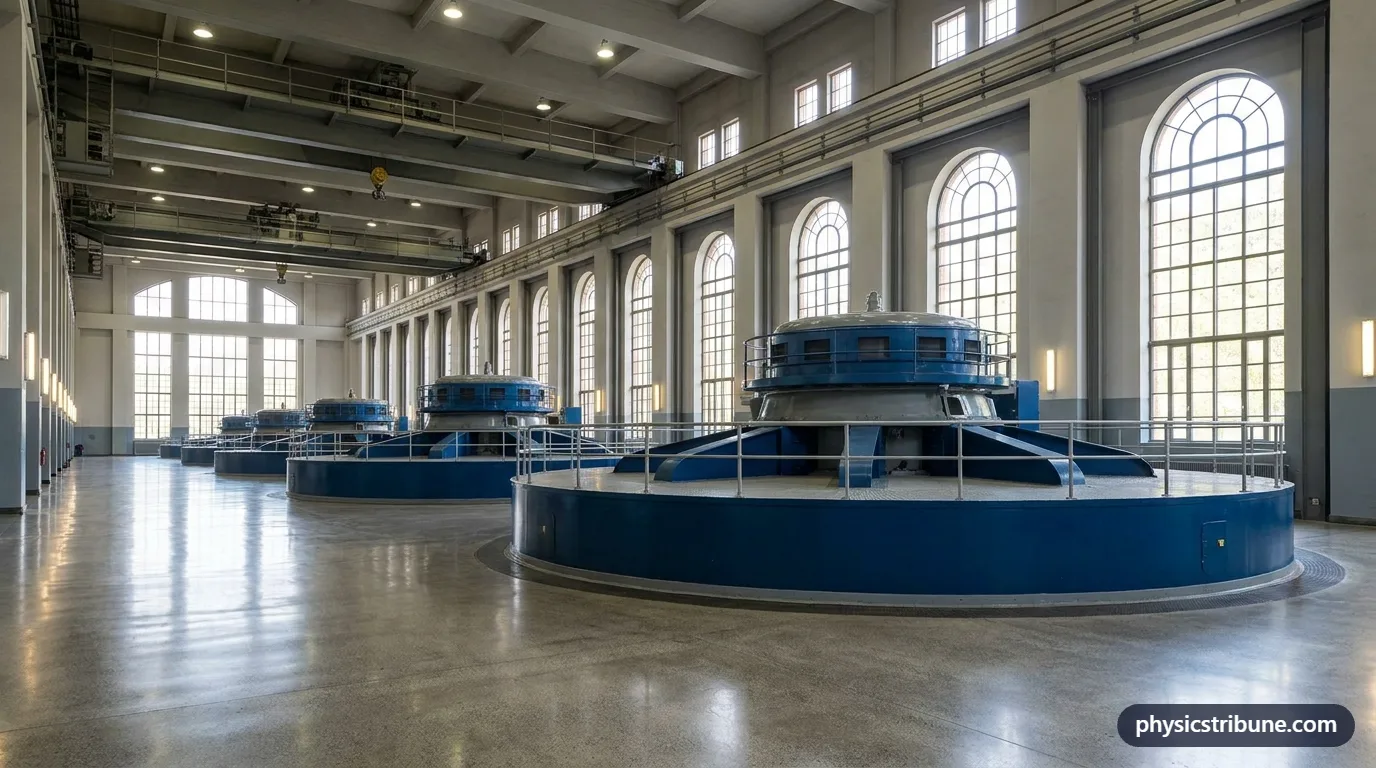
The transformer equation is Vs / Vp = Ns / Np. In a step-up transformer Ns is greater than Np, so the output voltage is higher and the output current is lower; in a step-down transformer Ns is less than Np, so the output voltage is lower and the current is higher. Power stations use step-up units for long-distance lines, and homes and chargers use step-down units.
- Step-up
- Ns > Np, output voltage higher than input
- Step-down
- Ns < Np, output voltage lower than input
- Shared equation
- Vs / Vp = Ns / Np
- Current (ideal)
- Is / Ip = Np / Ns, so current changes the opposite way
- Works on
- Alternating current only
- Power (ideal)
- Vp Ip = Vs Is, input power equals output power
On this page
- What Is the Difference Between Step-Up and Step-Down Transformers?
- How Does the Turns Ratio Set the Voltage?
- What Happens to Current in Each Type?
- Why Do Power Lines Use Step-Up Transformers?
- How Do the Output Waves Compare?
- Where Are Step-Up and Step-Down Transformers Used?
- Who Discovered the Physics Behind Transformers?
- Common Misconceptions
- Key Facts
- Quiz
- FAQ
What Is the Difference Between Step-Up and Step-Down Transformers?
A transformer is two coils of wire wound on a shared iron core. Alternating current in the first coil, the primary, makes a changing magnetic field in the core, and that changing field induces a voltage in the second coil, the secondary. Nothing moves, and the two coils are not electrically connected.
The only design difference between the two types is which coil has more turns. A step-up transformer has more turns on the secondary, so it raises the voltage. A step-down transformer has fewer turns on the secondary, so it lowers the voltage.
Because energy is conserved, a transformer cannot raise voltage and current together. When the voltage goes up, the current goes down, and the reverse. In fact, the same transformer can work as either type, depending on which coil you connect to the supply.
| Feature | Step-up transformer | Step-down transformer |
|---|---|---|
| Job | Raises voltage | Lowers voltage |
| Turns | Ns > Np | Ns < Np |
| Turns ratio Ns / Np | Greater than 1 | Less than 1 |
| Output voltage | Higher than input | Lower than input |
| Output current (ideal) | Lower than input | Higher than input |
| Secondary wire | Many turns of thinner wire | Few turns of thicker wire |
| Power in vs out (ideal) | Equal | Equal |
| Frequency of output | Same as input | Same as input |
| Works with DC? | No | No |
| Grid location | At the power station | At substations and street transformers |
| Main reason used | Cut current and line losses | Deliver safe, usable voltage |
| Everyday examples | Microwave oven, neon sign supply | Doorbell, adapter, welder |
| Source: Transformer equation from our formula data; ideal (lossless) transformer assumed · Retrieved October 2026 | ||
How Does the Turns Ratio Set the Voltage?
Every turn of wire wrapped around the core feels the same changing magnetic flux, so each turn picks up the same small voltage. The total voltage of a coil is that per-turn voltage times its number of turns. That simple idea gives the transformer equation,
The ratio
To check a transformer quickly, divide the secondary turns by the primary turns and multiply by the input voltage. The two worked examples below do exactly that for a step-up unit and a step-down unit.
Both kinds of transformer obey this equation; only the size of the turns ratio decides whether the voltage goes up or down.
| Symbol | Quantity | SI unit |
|---|---|---|
| secondary voltage | volt (V) | |
| primary voltage | volt (V) | |
| number of secondary turns | dimensionless (1) | |
| number of primary turns | dimensionless (1) |
Rearranged to find another variable:
Valid for: ideal transformer (no losses), AC only; currents satisfy I_s / I_p = N_p / N_s.
Example 1 A power station step-up transformer
A power station generator supplies 20,000 V to the primary coil of a transformer with 400 turns. The secondary coil has 8,000 turns. What voltage leaves the transformer for the transmission line?
- Given:
- primary voltage:
- number of secondary turns:
- number of primary turns:
- primary voltage:
- Formula:
- Substitute:
- Answer:
The secondary has 20 times as many turns as the primary, so the voltage is raised 20 times.
Example 2 A doorbell step-down transformer
A doorbell transformer is wired to a 120 V household supply. Its primary coil has 1,200 turns and its secondary coil has 160 turns. What voltage reaches the doorbell?
- Given:
- primary voltage:
- number of secondary turns:
- number of primary turns:
- primary voltage:
- Formula:
- Substitute:
- Answer:
This low voltage is much safer for the thin wires that run to a doorbell button.
What Happens to Current in Each Type?
In an ideal transformer, the power going in equals the power coming out:
This explains why the wires look different. The low-voltage side of a step-down transformer carries more current, so it uses fewer turns of thicker wire. The high-voltage side carries less current and uses many turns of thinner, well-insulated wire. For more on how power links voltage and current, see electric power.
Real transformers lose a little energy as heat, mainly from the resistance of the copper and from eddy currents in the core. Large grid transformers are still very efficient, often converting well over 95 percent of the input power.
Why Do Power Lines Use Step-Up Transformers?
Electric current heats the wires it flows through, and the heating power in a line of resistance
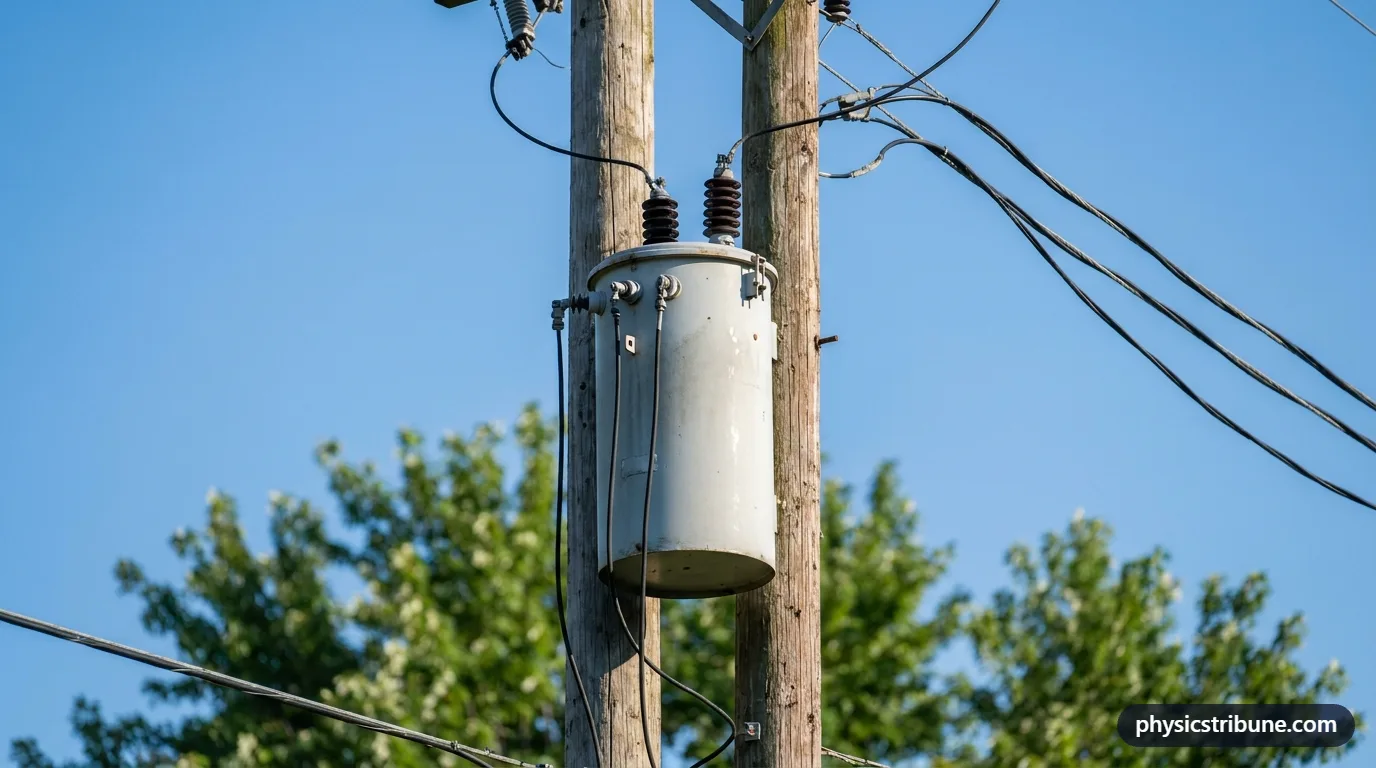
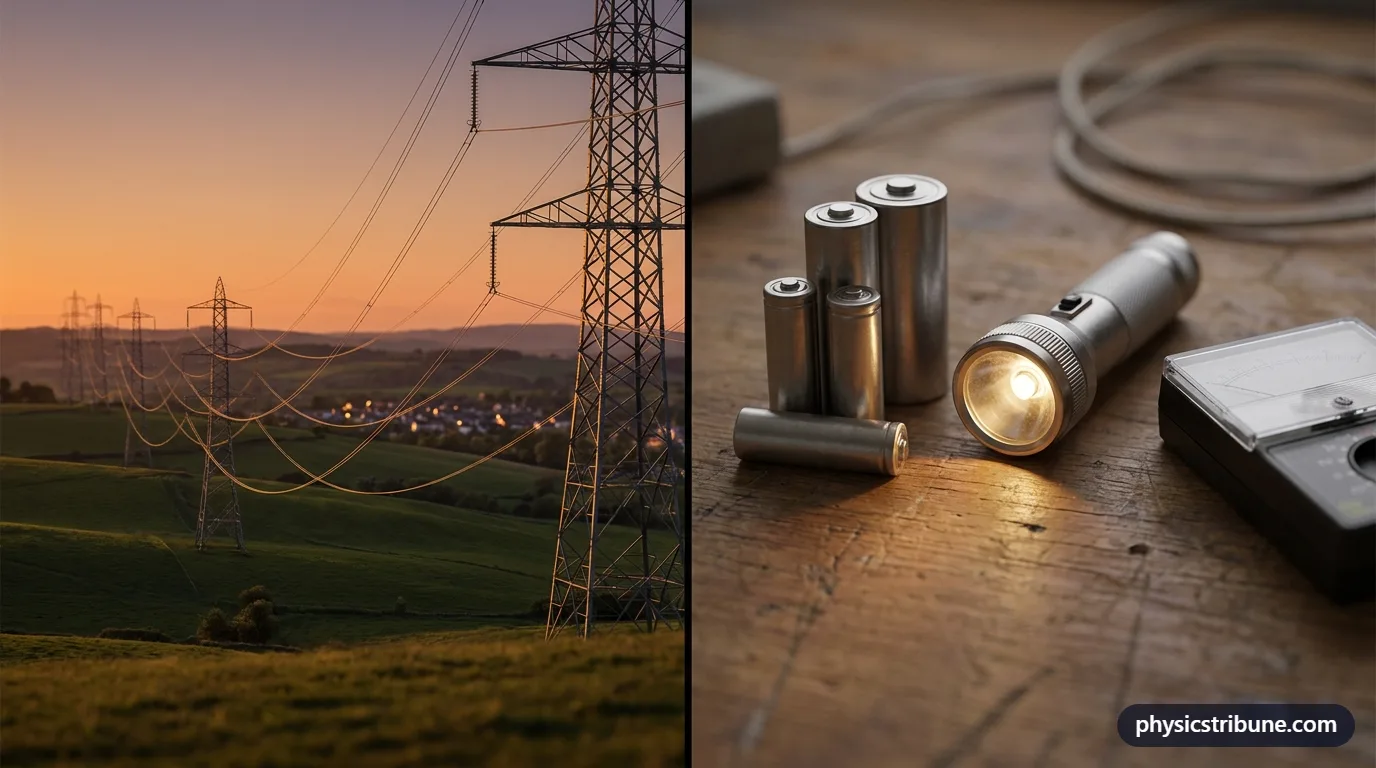
That is why the national grid uses step-up transformers at power stations to raise the voltage to hundreds of thousands of volts for long-distance lines. Near towns, step-down transformers at substations lower it in stages, and a final step-down transformer on a pole or in a green street box brings it to the voltage used in homes.
Example 3 Line current after stepping up
A transmission line carries 50,000,000 W (50 MW) at 400,000 V after the step-up transformer. Ignoring losses, what current flows in the line?
- Given:
- power:
- voltage:
- power:
- Formula:
- Substitute:
- Answer:
Sending the same power at the generator's 20,000 V would need 2,500 A (computed), 20 times more current.
How Do the Output Waves Compare?
A transformer changes the size of an alternating voltage but not its frequency. The graph below shows a 60 Hz primary voltage alongside the outputs of a 2:1 step-up transformer and a 1:4 step-down transformer. All three waves rise and fall together; only their heights differ.
This is also why transformers need AC. A steady direct current makes a steady magnetic field, and a steady field induces nothing in the secondary coil. The comparison between the two kinds of current is on our AC vs DC page.

Where Are Step-Up and Step-Down Transformers Used?
Step-up transformers are used where a higher voltage is needed:
- at power stations, to feed long-distance transmission lines
- inside microwave ovens, to drive the part that makes the microwaves
- in old cathode-ray televisions and in some X-ray machines
- in neon sign supplies
Step-down transformers are used where a lower voltage is safer or more useful:
- at substations and on utility poles, to bring grid voltage down for homes
- in doorbells, thermostats and garden lighting
- in many older chargers and power adapters
- in welding machines, which need very high current at low voltage
Modern phone chargers often use small high-frequency transformers with electronic switching, but the same turns-ratio rule still sets their voltage.
Who Discovered the Physics Behind Transformers?
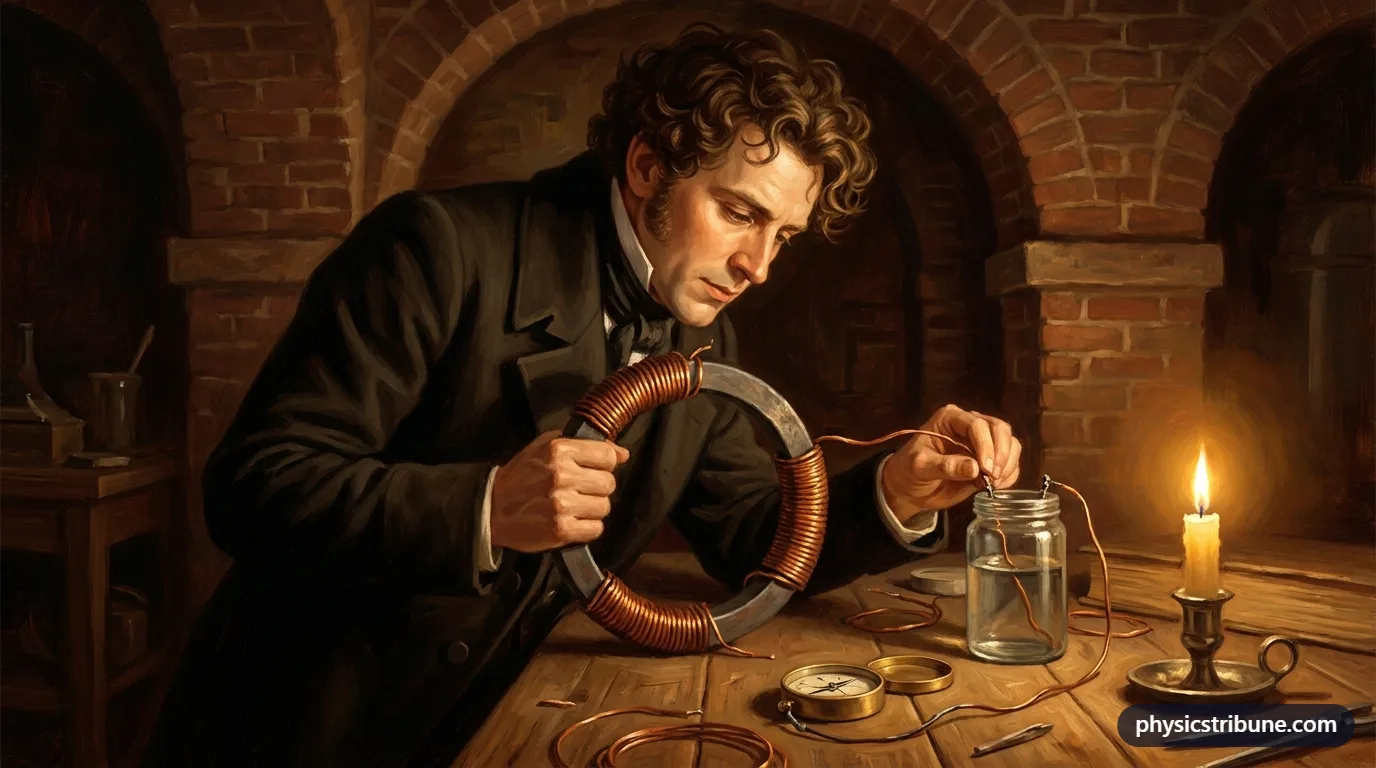
Transformers rest on electromagnetic induction, which Michael Faraday demonstrated in 1831 with two coils wound on an iron ring. When he switched on the current in one coil, a brief current appeared in the other. You can repeat a version of it with our Faraday induction ring experiment.
Practical transformers for power systems were developed in the 1880s, and they became a major reason alternating current won out over direct current for public electricity supply. The law behind every transformer is covered on the Faraday's law page.
Common Misconceptions
Myth: A step-up transformer gives you more power for free.
Physics: It raises voltage only by lowering current. At best, output power equals input power, and in a real transformer a little is lost as heat.
Myth: Transformers can change the voltage of a battery.
Physics: A battery gives steady DC, which makes an unchanging magnetic field. With no change in flux, no voltage is induced in the secondary coil.
Myth: Step-up and step-down transformers are built in completely different ways.
Physics: They have the same parts: two coils on an iron core. Only the turns ratio differs, and reversing the connections turns one type into the other.
Myth: Current flows from the primary coil into the secondary coil through the wires.
Physics: The coils are not electrically connected. Energy passes from one to the other through the changing magnetic field in the core.
Key Facts
- A step-up transformer has more turns on the secondary coil and raises the voltage.
- A step-down transformer has fewer turns on the secondary coil and lowers the voltage.
- Both obey the transformer equation Vs / Vp = Ns / Np.
- In an ideal transformer, current changes in the opposite direction to voltage, so power stays the same.
- Transformers only work with alternating current, and the output frequency equals the input frequency.
- Stepping voltage up for transmission reduces current and cuts heating losses in the wires.
- The same transformer can step up or step down depending on which coil is connected to the supply.
Quick Quiz: How Well Do You Know Step-Up vs Step-Down Transformers?
6 questions. Tap an answer to check it.
A transformer has 100 turns on the primary and 500 on the secondary. What type is it?
The secondary has more turns, so the output voltage is higher.
A step-down transformer with a turns ratio of 1:10 is fed 230 V. What is the output voltage?
The voltage is divided by 10, giving 23 V.
In an ideal step-up transformer, what happens to the current on the secondary side?
Power is conserved, so a higher voltage means a lower current.
Why can't a transformer change the voltage of a battery?
Induction needs a changing flux, and steady DC does not provide one.
Where are step-up transformers used in the power grid?
They raise the voltage before electricity travels along long-distance lines.
What does a transformer leave unchanged?
The output wave has the same frequency as the input wave.
Frequently Asked Questions
What is the main difference between a step-up and a step-down transformer?
A step-up transformer raises the AC voltage because its secondary coil has more turns than its primary coil. A step-down transformer lowers the voltage because its secondary has fewer turns. Both use the same equation, Vs / Vp = Ns / Np, and in both the current changes in the opposite direction to the voltage.
How can you tell if a transformer is step-up or step-down?
Compare the turns on the two coils, or the voltages printed on its label. If the secondary, or output, has more turns or a higher voltage than the primary, it is step-up. If it has fewer turns or a lower voltage, it is step-down. A turns ratio Ns / Np above 1 means step-up.
Does a step-up transformer increase current?
No, it decreases current. In an ideal transformer the input power Vp Ip equals the output power Vs Is, so if the voltage goes up 10 times, the current goes down 10 times. A step-down transformer does the reverse: it lowers voltage and raises the current available on the secondary side.
Why are step-up transformers used in power transmission?
Raising the voltage lowers the current needed to carry the same power. Heating loss in a wire depends on the current squared, so a smaller current wastes far less energy over long lines. Step-down transformers then lower the voltage again before the electricity reaches homes and businesses.
Can a step-down transformer be used as a step-up transformer?
In principle yes. If you connect the supply to the coil with fewer turns, the other coil delivers a higher voltage. In practice, each coil's insulation and wire thickness are designed for a certain voltage and current, so reversing a transformer beyond its ratings can damage it or be unsafe.
Why don't transformers work with DC?
A transformer needs a changing magnetic flux in its core to induce a voltage in the secondary coil. Direct current produces a steady magnetic field, so after the moment it is switched on, nothing changes and no voltage is induced. Only alternating current keeps the flux changing all the time.
What kind of transformer is on a utility pole?
The cylinder you see on a utility pole is usually a step-down transformer. It takes the medium voltage of the local distribution line, often several thousand volts, and lowers it to the voltage supplied to nearby homes, such as 120 V and 240 V in North America.