At a Glance
Faraday's law says the emf induced in a coil equals the number of turns times the rate of change of magnetic flux through it: ε = −N ΔΦ/Δt. The emf is in volts, flux in webers and time in seconds, and the minus sign (Lenz's law) means the induced current opposes the change that caused it.
- Discovered by
- Michael Faraday (Joseph Henry independently)
- Year
- 1831
- Formula
- ε = −N ΔΦB/Δt
- SI units
- emf in volts (V), flux in webers (Wb), time in seconds (s)
- Key condition
- The magnetic flux through the circuit must be changing
- Applies to
- Generators, transformers, induction cooktops, wireless chargers, guitar pickups
On this page
- What Does Faraday's Law Say?
- Faraday's Law Explained Simply
- What Is the Formula for Faraday's Law?
- How Can You Increase the Induced EMF?
- What Is Motional EMF?
- Who Discovered Faraday's Law?
- Where Is Faraday's Law Used in Everyday Life?
- Why Do Generators Make Alternating Current?
- Going Deeper: What Are the Limits of Faraday's Law?
- Practice Faraday's Law Problems
- Common Misconceptions
- Key Facts
- Quiz
- FAQ
What Does Faraday's Law Say?
Faraday's law describes electromagnetic induction: the way a changing magnetic field produces a voltage in a conductor. The voltage it produces is called an electromotive force, or emf, and it is measured in volts. If the conductor forms a closed loop, the emf drives a current around it.
The word that matters most is changing. A strong magnet sitting still inside a coil induces nothing at all. Move the magnet, rotate the coil, squeeze the loop or switch a nearby current on or off, and an emf appears for exactly as long as the change continues.
The size of the emf depends on how fast the change happens. Push a magnet into a coil slowly and you get a small voltage for a long time; push it in quickly and you get a large voltage for a short time. Faraday's law turns that observation into a precise equation.
Faraday's Law Explained Simply
Imagine the magnetic field as invisible lines streaming through a loop of wire, like rain falling through a hoop. The total amount passing through the hoop is the magnetic flux. Faraday's law says the wire only notices when that amount changes.
You can change the flux in three ways: make the field stronger or weaker, make the loop bigger or smaller, or tilt the loop so fewer lines pass through it. Any of these makes charges in the wire start to move.
Now wind the wire into a coil with many loops. Each loop feels the same change and produces its own small voltage, and because the loops are connected in a row, those voltages add. That is why the formula has an N in front: more turns, more voltage.

What Is the Formula for Faraday's Law?
Faraday's law is written
The flux itself is
The minus sign carries the direction. It says the induced emf pushes current in the direction that fights the change in flux. That rule has its own name, Lenz's law, and it is a direct consequence of energy conservation.
Here is Faraday's law with each variable and its SI unit, plus the rearranged forms.
| Symbol | Quantity | SI unit |
|---|---|---|
| induced emf | volt (V) | |
| number of turns | dimensionless (1) | |
| change in magnetic flux through one turn | weber (Wb) | |
| time interval | second (s) |
Rearranged to find another variable:
Valid for: minus sign expresses Lenz's law (induced emf opposes the change in flux); average emf over Δt.
Example 1 Pulling a magnet out of a coil
A 150-turn coil surrounds a bar magnet. When the magnet is pulled out, the flux through each turn falls by 0.0024 Wb (so ΔΦ_B = −0.0024 Wb) over 0.12 s. What average emf is induced in the coil?
- Given:
- number of turns:
- change in magnetic flux through one turn:
- time interval:
- number of turns:
- Formula:
- Substitute:
- Answer:
Pushing the magnet back in at the same speed would give an emf of the same size with the opposite sign.
How Can You Increase the Induced EMF?
Every part of the formula points to a way of getting more voltage:
- More turns. The emf is proportional to N, so doubling the turns doubles the voltage.
- A stronger magnet. A larger field means a larger flux and a larger change when it moves.
- A larger coil area. More area captures more flux.
- Faster change. Halving the time for the same flux change doubles the emf. This is why generators spin fast.
- An iron core. Iron concentrates the field lines through the coil, raising the flux.
The table below shows the speed effect for a 200-turn coil whose flux changes by the same amount each time, only faster. The total change is fixed, so the faster you do it, the higher the voltage but the shorter it lasts.
Example 2 How many turns does the pickup coil need?
A designer wants a coil to produce an average emf of 6 V when the flux through each turn drops by 0.002 Wb (ΔΦ_B = −0.002 Wb) in 0.05 s. How many turns must the coil have?
- Given:
- induced emf:
- change in magnetic flux through one turn:
- time interval:
- induced emf:
- Formula:
- Substitute:
- Answer:
Halving the time for the same flux change would halve the number of turns needed.
| Time for the change Δt (s) | Rate of flux change per turn (Wb/s) | Size of average emf (V) |
|---|---|---|
| 1 | 0.003 | 0.6 |
| 0.5 | 0.006 | 1.2 |
| 0.25 | 0.012 | 2.4 |
| 0.1 | 0.03 | 6 |
| 0.05 | 0.06 | 12 |
| Source: Computed with |ε| = N ΔΦ_B / Δt for N = 200 and ΔΦ_B = 0.003 Wb · Retrieved October 2026 | ||
What Is Motional EMF?
A conductor moving across a magnetic field also has an emf induced in it, even if no loop is obvious. Picture a metal rod sliding along two rails in a field. As it moves, the loop formed by the rod, the rails and the connecting wire grows, so the flux through it grows. Faraday's law then gives an emf of
You can also explain this with forces. The free electrons in the rod move along with it through the field, so each feels a magnetic force on a moving charge that pushes it toward one end of the rod. The two explanations always agree. Our page on motional emf works through more cases.
Aircraft show this effect on a large scale. A metal wing flying through Earth's magnetic field has a small emf between its tips, typically a fraction of a volt, though it drives no useful current.
Example 3 A metal rod sliding across a magnetic field
A 0.25 m metal rod slides at 4 m/s along two rails, cutting straight across a uniform 0.6 T magnetic field. What emf is induced between the ends of the rod?
- Given:
- magnetic field:
- length of the moving rod:
- speed of the rod:
- magnetic field:
- Formula:
- Substitute:
- Answer:
This is Faraday's law in disguise: the rod sweeps out area, so the flux through the circuit grows steadily.
Who Discovered Faraday's Law?
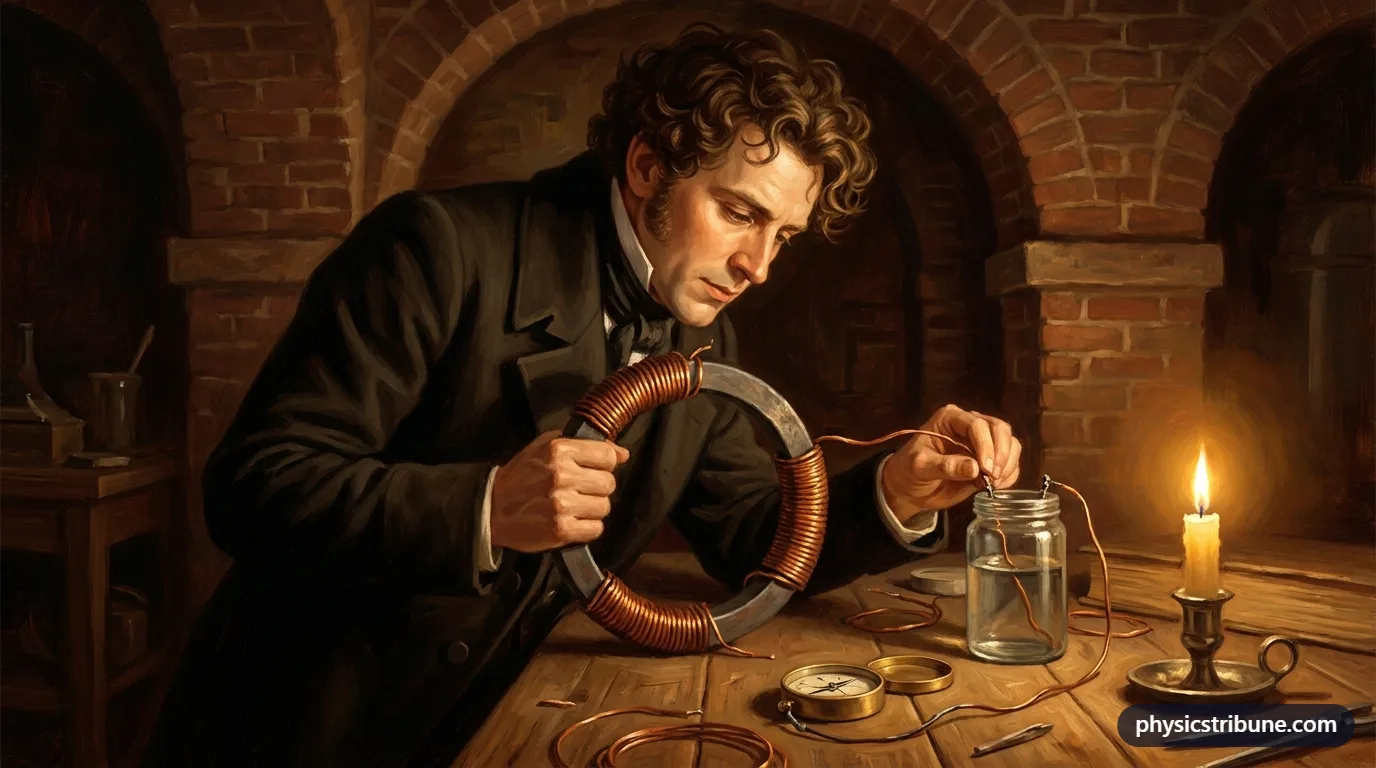
The English scientist Michael Faraday discovered electromagnetic induction on 29 August 1831. He wound two separate coils of wire on an iron ring. When he connected or disconnected a battery to one coil, a needle connected to the other coil twitched, then settled back. A steady current did nothing; only switching it on or off produced the effect. You can read about the setup on our induction ring experiment page.
Within weeks, Faraday showed that moving a magnet in and out of a coil also produced a current, and he built a spinning copper disk that gave a continuous current, the first generator. The American physicist Joseph Henry observed induction independently in 1832, which is why the unit of inductance, the henry, carries his name.
Faraday described his results in words and pictures of field lines, without equations. James Clerk Maxwell later gave the law its mathematical form and made it one of Maxwell's equations.
Where Is Faraday's Law Used in Everyday Life?
Faraday's law is the reason electricity reaches your home. Some of its most important applications are:
- Electric generators. A coil spins in a magnetic field, the flux through it rises and falls, and an alternating emf appears. Almost all grid electricity is made this way.
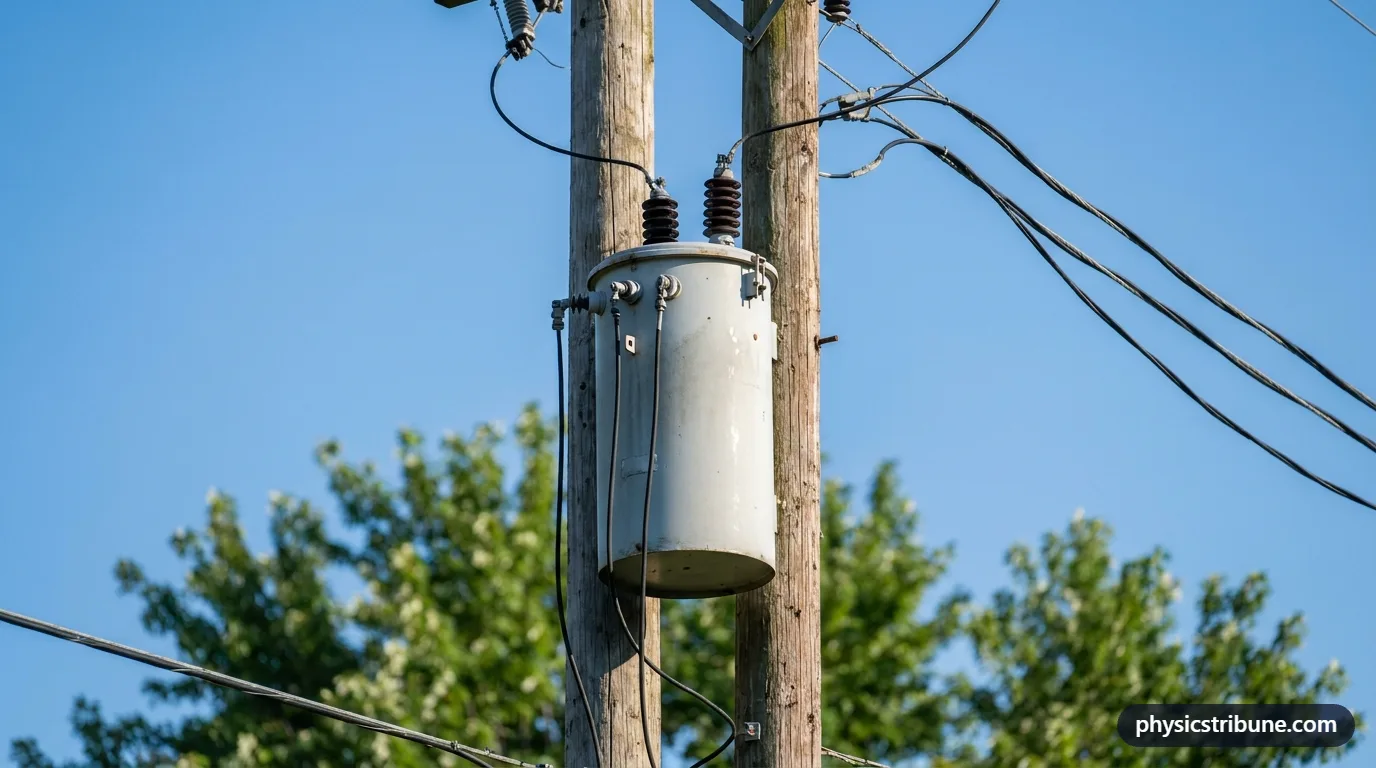
- Transformers. An alternating current in one coil makes a changing flux in an iron core, which induces a voltage in a second coil with a different number of turns.
- Induction cooktops and wireless chargers. A rapidly changing field induces currents in a pan base or in a phone's receiver coil.
- Electric guitar pickups. A vibrating steel string changes the flux through a small coil, which turns the vibration into an electrical signal.
- Dynamic microphones. Sound moves a coil in a magnet's field, inducing a voltage that copies the sound wave.
- Traffic sensors. A loop of wire under the road detects the change when a car's metal body passes over it.

Why Do Generators Make Alternating Current?
When a coil rotates at a steady rate in a uniform field, the flux through it follows a cosine curve: largest when the coil faces the field, zero when it is edge-on, then largest again in the opposite direction. The emf depends on how fast the flux changes, so it follows a sine curve, peaking when the coil is edge-on and the flux is changing fastest.
The result is alternating current. The graph below shows the output of a generator like the ones feeding North American homes, with a peak of 170 V at 60 cycles per second. The peak grows with the number of turns, the coil area, the field and the spin rate.

Going Deeper: What Are the Limits of Faraday's Law?
The simple form
The law also hides a deep idea. A changing magnetic field creates an induced electric field that curls around it, even in empty space with no wire present. The wire simply gives the charges a path to follow. This field is what makes light possible: changing electric and magnetic fields keep regenerating each other as an electromagnetic wave.
A few tricky setups, such as Faraday's own spinning disk, need care, because the circuit itself changes shape as it moves. Physicists handle those cases with the full force law on moving charges, which always gives the right answer.
Practice Faraday's Law Problems
Work through mixed induction problems on our magnetism worksheets, which include printable answer keys. For every formula in this branch on one page, see the magnetism formulas sheet, then test yourself with the quiz below.
Common Misconceptions
Myth: A strong magnet inside a coil produces a current.
Physics: Only a changing flux induces an emf. A magnet resting inside a coil produces no current, however strong it is.
Myth: The induced emf depends on how much flux passes through the coil.
Physics: It depends on how fast the flux changes. A small flux that changes quickly can induce a larger emf than a large flux that changes slowly.
Myth: Induction creates energy from nothing.
Physics: The energy of the induced current comes from the work done moving the magnet or coil. Lenz's law guarantees you must push against a resisting force.
Myth: Faraday's law and the Faraday constant describe the same thing.
Physics: The Faraday constant is the charge on one mole of electrons, used in chemistry and electrolysis. It is unrelated to the law of induction.
Key Facts
- Faraday's law states that a changing magnetic flux through a circuit induces an emf equal to the rate of change of that flux.
- For a coil of N turns the induced emf is ε = −N ΔΦ_B/Δt, measured in volts.
- A steady magnetic field, no matter how strong, induces no emf in a circuit that is not moving.
- The minus sign in the law is Lenz's law: the induced current opposes the change that produced it.
- Michael Faraday discovered induction on 29 August 1831; Joseph Henry found it independently in 1832.
- Generators, transformers, induction cooktops and wireless chargers all work by Faraday's law.
- Maxwell later wrote the law as one of his four equations of electromagnetism.
Quick Quiz: How Well Do You Know Faraday's Law of Induction?
6 questions. Tap an answer to check it.
What must happen for Faraday's law to induce an emf in a coil?
Only a changing flux induces an emf; a steady field does nothing.
A coil's number of turns is doubled while the rate of flux change per turn stays the same. What happens to the induced emf?
The emf is proportional to N, the number of turns.
What does the minus sign in Faraday's law represent?
The sign shows that the induced current's field opposes the flux change.
Which unit equals one weber per second?
From ε = ΔΦ/Δt, a weber per second is a volt.
The same flux change happens in 0.1 s instead of 0.5 s. How does the emf change?
The emf is inversely proportional to the time, so one fifth of the time gives five times the emf.
Which device does NOT rely on Faraday's law?
A battery produces voltage by chemical reactions, not by changing magnetic flux.
Frequently Asked Questions
What is Faraday's law in simple terms?
Faraday's law says that whenever the magnetic field passing through a loop of wire changes, a voltage appears in the loop. The faster the change, the bigger the voltage, and a coil with more turns gives proportionally more. Moving a magnet near a coil, spinning a coil near a magnet or switching a nearby current on and off all produce this effect.
What is the formula for Faraday's law?
The formula is ε = −N ΔΦ_B / Δt. Here ε is the induced emf in volts, N is the number of turns, ΔΦ_B is the change in magnetic flux through one turn in webers and Δt is the time taken in seconds. The minus sign shows the induced current opposes the change, which is Lenz's law.
What is magnetic flux in Faraday's law?
Magnetic flux measures how much magnetic field passes through a surface. For a flat loop in a uniform field it equals the field strength times the loop area times the cosine of the angle between the field and the loop's perpendicular. It is measured in webers. Faraday's law depends on how quickly this quantity changes, not on its size.
What is the difference between Faraday's law and Lenz's law?
Faraday's law gives the size of the induced emf: the rate of change of flux times the number of turns. Lenz's law gives its direction: the induced current always flows so its own magnetic field opposes the change in flux. Together they are written as one equation, with Lenz's law appearing as the minus sign.
Why is there a negative sign in Faraday's law?
The negative sign represents Lenz's law. It shows that the induced emf drives a current whose magnetic field opposes the change in flux. If the sign were positive, the induced current would strengthen the change, which would feed on itself and create energy from nothing. The sign is therefore required by conservation of energy.
What are some examples of Faraday's law?
Power station generators, the transformers on utility poles, induction cooktops, wireless phone chargers, electric guitar pickups, dynamic microphones and the metal-detecting loops under traffic lights all use Faraday's law. Even regenerative braking in electric cars relies on it, turning the car's motion back into electrical energy by spinning the motor as a generator.
Does Faraday's law work with DC?
A steady direct current produces a steady magnetic field, so it induces nothing in a nearby stationary coil. Induction happens only at the moments a DC current is switched on, switched off or changed. That is why transformers need alternating current, whose field changes continuously, while a DC supply connected to a transformer gives no output once it settles.
What unit is induced emf measured in?
Induced emf is measured in volts, the same unit as any voltage. From Faraday's law, one volt equals one weber per second, so a flux change of one weber per second through a single turn induces one volt. A coil with 100 turns would give 100 volts for the same rate of change in each turn.