
At a Glance
Joseph Henry (born December 17, 1797, died May 13, 1878) was an American physicist who discovered self-inductance, the way a coil resists any change in its own current. That effect is written ε = −L ΔI/Δt, where L is the inductance measured in henries, the SI unit named in his honor.
- Born
- December 17, 1797, Albany, New York, United States
- Died
- May 13, 1878, Washington, D.C., age 80
- Nationality
- United States
- Known for
- Self-inductance, powerful electromagnets and early telegraph work
- Unit named after him
- henry (H), the SI unit of inductance
- Key equation
- ε = −L ΔI / Δt (self-induced emf)
On this page
Who Was Joseph Henry?
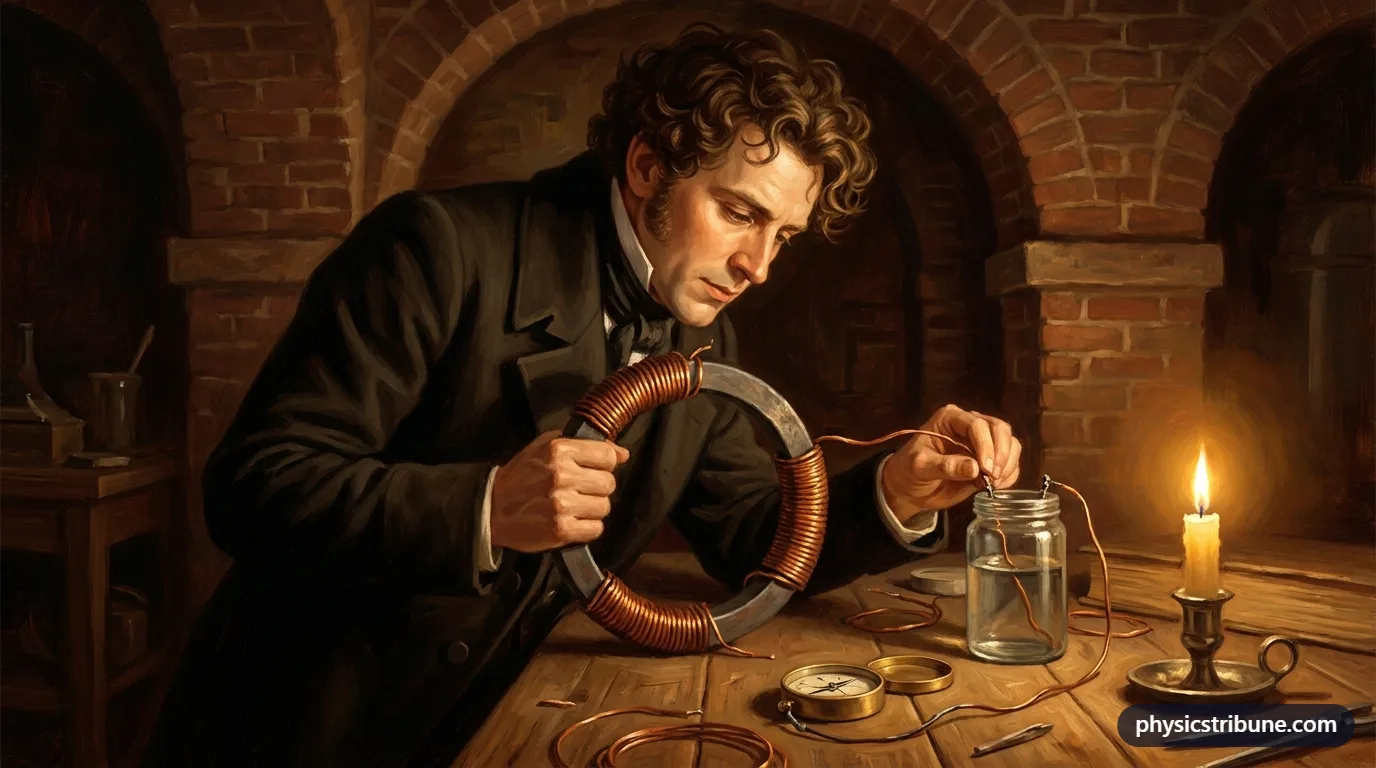
Joseph Henry was one of the first great American experimental physicists. Working at a school in Albany, New York, with few resources, he learned how to wind electromagnets so strong they could lift more than a ton. Along the way he found that a coil of wire pushes back against any change in its own current, an effect now called self-inductance.
His magnets and his experiments on sending current through long wires helped lay the groundwork for the electric telegraph. He also built one of the earliest electric motors, a rocking device driven by electromagnets.
Later in life he became the founding Secretary of the Smithsonian Institution in Washington, where he spent more than thirty years shaping how science was organized and shared in the United States. The SI unit of inductance, the henry, honors his discoveries.
Early Life and Education
Henry was born in Albany, New York, in 1797 to a family of modest means with Scottish roots. His father died when he was young, and he spent part of his childhood living with relatives in the nearby village of Galway. He worked in a store and was drawn for a time to the theater.
As a teenager he came across a popular book of science lectures, and it changed his direction. He enrolled at the Albany Academy, studied hard, and supported himself with tutoring and surveying work, including a survey for a state road.
In 1826 he became professor of mathematics and natural philosophy at the Albany Academy. Teaching took most of his day, so much of his early research happened during the summer break, when the school's rooms were free.
| Year | Event |
|---|---|
| 1797 | Born in Albany, New York (December 17) |
| 1826 | Becomes professor of mathematics and natural philosophy at the Albany Academy |
| About 1829 to 1831 | Builds powerful electromagnets with insulated, tightly wound coils |
| 1831 | Builds a magnet for Yale College able to lift more than a ton |
| 1831 | Rings a bell through a long wire and describes a rocking electromagnetic motor |
| 1832 | Publishes his observations of self-induction; joins the College of New Jersey (Princeton) |
| 1846 | Becomes the first Secretary of the Smithsonian Institution |
| 1868 | Elected president of the National Academy of Sciences |
| 1871 | Becomes chairman of the U.S. Lighthouse Board |
| 1878 | Dies in Washington, D.C., on May 13, aged 80 |
| 1893 | The henry is adopted as the unit of inductance |
| Source: Birth and death dates from our physicists data file (Wikidata, CC0); other years are standard biographical dates · Retrieved October 2026 | |
How Did Joseph Henry Improve the Electromagnet?
The first electromagnets, built in England in the 1820s, used a few loose turns of bare wire around an iron bar. They had to be wound sparsely so the turns would not touch and short-circuit. Henry's key improvement was to insulate the wire, wrapping it in silk thread, so he could wind many tightly packed turns, layer upon layer.
He also experimented with how the coils were connected to the battery. Many coils joined side by side worked best with a low-voltage cell close by, while one long continuous coil worked best when the current had to come from far away through a long wire. That insight would prove vital for the telegraph.
By 1831 Henry had built a magnet for Yale College that could lift more than a ton of iron, a sensation at the time. Our page on the solenoid explains why more turns and more current make a stronger field, and you can test the idea with our build an electromagnet experiment.
What Is Self-Inductance and How Did Henry Find It?
While working with long coils of wire around 1832, Henry noticed something odd. When he broke the circuit, a bright spark jumped at the break, much stronger than the battery alone could explain. The longer the coil, the bigger the spark.
He realized the coil itself was producing the extra push. When the current suddenly drops, the magnetic field inside the coil collapses, and that changing field induces an emf in the same coil, trying to keep the current going. This is self-inductance: a coil resists changes in its own current, much as a heavy object resists changes in its motion.
Around the same time Henry also observed that a changing current in one coil can induce a current in a separate coil nearby. Michael Faraday in London published that discovery first, in 1831, so Faraday is credited with electromagnetic induction, while Henry is credited with self-induction. The full story is on our page asking who discovered electromagnetic induction.
Did Joseph Henry Invent the Telegraph?
Not the commercial telegraph, but he proved the key idea behind it. Around 1831 he showed his students that a current sent through a long stretch of wire could work an electromagnet at the far end and ring a bell. Using a long-coil magnet matched to a battery of many cells made this possible over distances that had defeated others.
Henry chose not to patent his work, believing scientific discoveries should be shared freely. Samuel Morse and others developed the practical telegraph system in the 1830s and 1840s, drawing on these principles, and Henry gave Morse advice. Later disagreements over how much credit each deserved soured their relationship.
In 1831 Henry also described a small machine in which an electromagnet rocked back and forth on a pivot, switching its own current at each swing. It is one of the earliest electric motors, a forerunner of the devices on our electric motor page.
Henry at Princeton and the Smithsonian
In 1832 Henry became a professor of natural philosophy at the College of New Jersey, now Princeton University. There he continued his research on induction, studied the discharge of Leyden jars, and noticed hints that an electric discharge sends out disturbances that can act at a distance.
In 1846 he was chosen as the first Secretary of the newly founded Smithsonian Institution, a post he held until his death. He insisted the Smithsonian should support original research and spread its results, not just collect objects. He set up a network of volunteer observers who reported the weather by telegraph, producing daily weather maps that helped lead to a national weather service.
He also served on the national Lighthouse Board, later as its chairman, and was president of the National Academy of Sciences for the last decade of his life. In 1875 he encouraged a young Alexander Graham Bell, who visited him to describe his early ideas for transmitting speech.
Henry's Key Equation
Henry described self-inductance in words and through experiments. The modern law is
A coil with an inductance of one henry produces an emf of one volt when its current changes at one ampere per second. Inductors built on this principle smooth currents in power supplies, store energy in switching circuits, and help tune radios. The graph below shows how a coil slows the rise of current when a circuit is switched on.
Here is the self-induced emf in its modern form, the effect Henry discovered, with each symbol and its SI unit.
| Symbol | Quantity | SI unit |
|---|---|---|
| induced emf | volt (V) | |
| inductance | henry (H) | |
| change in current | ampere (A) | |
| time interval | second (s) |
Rearranged to find another variable:
Valid for: minus sign: emf opposes the change in current.
Example 1 Switching off a coil
A coil with an inductance of 0.25 H carries a steady 3 A. When a switch opens, the current drops to zero in 5 ms (0.005 s). What is the size of the emf the coil produces while the current falls?
- Given:
- inductance:
- change in current:
- time interval:
- inductance:
- Formula:
- Substitute:
- Answer:
This is the size of the emf; the minus sign in the full law only says it opposes the change. A voltage this large from a small circuit is why Henry saw a spark when he broke the connection to a long coil.
Example 2 Energy waiting in the coil
How much energy is stored in the magnetic field of the same 0.25 H coil while it carries a steady 3 A?
- Given:
- inductance:
- current:
- inductance:
- Formula:
- Substitute:
- Answer:
This stored energy is what drives the spark when the current is suddenly interrupted.

Joseph Henry's Legacy
Henry died in Washington, D.C., in May 1878, at age 80. Leading figures of the national government attended his funeral, a sign of how highly he was regarded. A bronze statue of him stands outside the Smithsonian's original building on the National Mall.
In 1893 an international congress of electrical scientists adopted the henry as the unit of inductance, placing his name alongside those of Ohm, Volta, Ampère and Faraday. His work on electromagnets runs through modern transformers, relays, motors and MRI scanners.
Just as important, he showed that serious experimental physics could be done in the young United States, and he built institutions that helped American science grow.
Key Facts
- Joseph Henry was born on December 17, 1797, in Albany, New York, and died on May 13, 1878, in Washington, D.C.
- He made electromagnets far stronger by winding many turns of insulated wire around an iron core.
- He discovered self-inductance, the tendency of a coil to oppose changes in its own current.
- Faraday published mutual induction first in 1831, though Henry observed similar effects around the same time.
- His long-distance magnet experiments helped make the electric telegraph possible.
- He was the first Secretary of the Smithsonian Institution, serving from 1846 until his death.
- The SI unit of inductance, the henry (H), is named after him.
Quick Quiz: How Well Do You Know Joseph Henry?
6 questions. Tap an answer to check it.
What did Henry use to make his electromagnets much stronger?
Insulating the wire let him pack in many layers of turns, multiplying the field.
What is self-inductance?
A changing current in a coil induces an emf in that same coil that opposes the change.
In ε = −L ΔI/Δt, what happens to the emf if the current changes twice as fast?
The emf is proportional to the rate of change of current, so a faster change gives a larger emf.
Which institution did Henry lead as its first Secretary?
He served as the Smithsonian's first Secretary from 1846 until 1878.
Who published the discovery of mutual induction first?
Faraday published in 1831, so he is credited with electromagnetic induction between two coils.
What does the SI unit henry measure?
The henry is the SI unit of inductance.
Frequently Asked Questions
What did Joseph Henry discover?
Joseph Henry discovered self-inductance, the effect by which a coil produces an emf that opposes any change in its own current. He also built record-breaking electromagnets, showed that electromagnets could be worked through long wires, which helped make the telegraph possible, and built one of the first electric motors. He observed mutual induction at about the same time as Faraday.
What is the henry unit?
The henry, symbol H, is the SI unit of inductance. A coil has an inductance of one henry if a current changing at one ampere per second induces an emf of one volt in it. In base units, 1 H equals 1 kg·m²/(s²·A²). Typical inductors in electronics range from microhenries to a few henries.
Did Joseph Henry invent the telegraph?
He did not build the commercial telegraph, but he demonstrated its central principle. Around 1831 he used a current sent through a long wire to work an electromagnet and ring a bell. Samuel Morse and others turned the idea into a working system in the following years, and Henry advised Morse, though they later disagreed about credit.
Who discovered electromagnetic induction, Henry or Faraday?
Both made the discovery at about the same time, working independently. Faraday published his results on induction between two coils first, in 1831, so he is usually credited with electromagnetic induction. Henry is credited with discovering self-induction, the effect of a coil on its own current, which he published in 1832.
What did Joseph Henry do at the Smithsonian?
As the first Secretary from 1846 to 1878, Henry shaped the Smithsonian into an institution that supported research and published results. He organized a network of volunteer weather observers who reported by telegraph, which produced some of the first daily weather maps in the country, and he arranged the international exchange of scientific publications.
How strong were Joseph Henry's electromagnets?
His most famous magnet, built in 1831 for Yale College, could lift more than a ton of iron while running on a modest battery. That was far stronger than any earlier electromagnet. The secret was many layers of insulated wire wound tightly around a soft iron core, which multiplied the magnetic effect of the current.
Why is self-inductance important?
Self-inductance makes coils resist sudden changes in current. That lets inductors smooth out currents in power supplies, store energy in switching converters, set the frequency of tuned radio circuits, and limit current surges. It also explains why switching off a motor or relay can cause a spark, a problem engineers design circuits to handle.
Keep Exploring
 magnetismInductance (Self and Mutual)
 unitsHenry (H): SI Unit of Inductance
 magnetismElectromagnets
 magnetismElectromagnetic Induction
 magnetismLenz's Law
 compareDifference Between Electromagnet and Permanent Magnet
 questionsWho discovered electromagnetic induction?
 physicistsMichael Faraday
 physicistsHans Christian Ørsted