At a Glance
Inductance L measures how much voltage a coil induces in response to a changing current: emf = −L ΔI/Δt. Its unit is the henry (H), equal to one volt-second per ampere. A long air-core solenoid has L = μ0 N^2 A / ℓ, and an inductor carrying current I stores energy U = 1/2 L I^2.
- Symbol
- L (self-inductance), M (mutual inductance)
- SI unit
- henry (H) = 1 V·s/A = 1 Wb/A
- Defining formula
- ε = −L ΔI/Δt
- Solenoid
- L = μ₀N²A/ℓ
- Stored energy
- U = ½LI²
- Scalar or vector
- Scalar, always positive for a single coil
On this page
- What Is Inductance?
- Inductance Explained Simply
- What Is the Formula for Inductance?
- What Is the Difference Between Self and Mutual Inductance?
- What Determines the Inductance of a Coil?
- How Does an Inductor Behave in a Circuit?
- How Much Energy Does an Inductor Store?
- Where Do You See Inductance in Everyday Life?
- Going Deeper: Why Do Iron-Core Coils Behave Differently?
- Who Discovered Inductance?
- Common Misconceptions
- Key Facts
- Quiz
- FAQ
What Is Inductance?
Inductance is the electrical version of inertia. A heavy cart resists changes in its speed; a coil with inductance resists changes in its current. It does not oppose current itself, only changes in current. Once the current is steady, an ideal inductor behaves like a plain piece of wire.
The resistance comes from electromagnetic induction. Any current makes a magnetic field. When the current changes, the field changes, and so does the magnetic flux through the coil's own turns. By Faraday's law that changing flux induces a voltage, and by Lenz's law the voltage pushes against the change.
Inductance is a scalar measured in henries (H). It depends only on geometry and materials: the number of turns, the size and shape of the coil, and what is inside it. It does not depend on how much current is flowing, at least for coils without iron.
Inductance Explained Simply
Think of water in a long, heavy pipe with a paddle wheel inside. When you open the tap, the wheel and the water take a moment to get moving. When you close the tap suddenly, the moving water keeps pushing and can bang the pipe. A coil does the same thing to electric current.
Switch a coil on and the current climbs gradually instead of jumping. Switch it off and the coil tries to keep the current going, sometimes so hard that a spark jumps across the switch. The bigger the inductance, the stronger this stubbornness.
The energy for that push comes from the magnetic field around the coil. While current builds up, the coil stores energy in its field; when current falls, it hands that energy back.
What Is the Formula for Inductance?
Self-inductance is defined by the voltage a coil makes when its current changes:
An equivalent definition uses flux. If a current I through a coil of N turns produces a flux Φ through each turn, the inductance is
The rearranged form
This is the defining relation for self-inductance, with each symbol and its SI unit.
| Symbol | Quantity | SI unit |
|---|---|---|
| induced emf | volt (V) | |
| inductance | henry (H) | |
| change in current | ampere (A) | |
| time interval | second (s) |
Rearranged to find another variable:
Valid for: minus sign: emf opposes the change in current.
Example 1 Switching off a coil
A coil with an inductance of 0.50 H carries 2.0 A. A switch cuts the current to zero in 0.010 s (so ΔI = −2.0 A). What average emf does the coil induce while the current falls?
- Given:
- inductance:
- change in current:
- time interval:
- inductance:
- Formula:
- Substitute:
- Answer:
The positive sign means the induced emf pushes in the direction of the original current, trying to keep it flowing. That is why switching off a coil can produce a spark.
What Is the Difference Between Self and Mutual Inductance?
Self-inductance (L) is a coil reacting to its own changing current. The changing field of the coil threads its own turns and induces a back voltage in the same circuit.
Mutual inductance (M) is one coil reacting to the changing current in a different coil nearby. If a current changing at rate ΔI₁/Δt in coil 1 induces an emf in coil 2, then
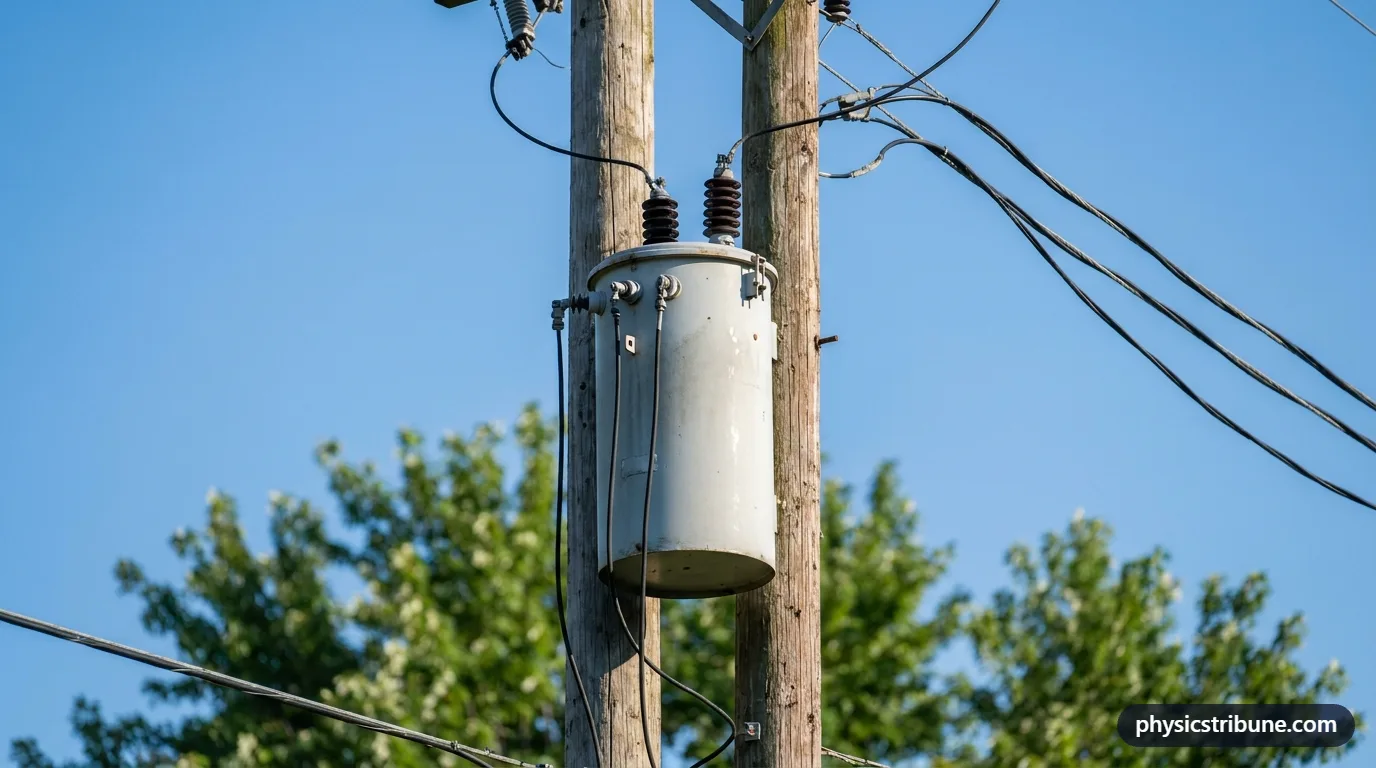
Mutual inductance is the working principle of the transformer, wireless phone chargers and induction cooktops. It is largest when the two coils share an iron core so nearly all the flux from one passes through the other. See step-up vs step-down transformers for how the turns ratio changes the voltage.

What Determines the Inductance of a Coil?
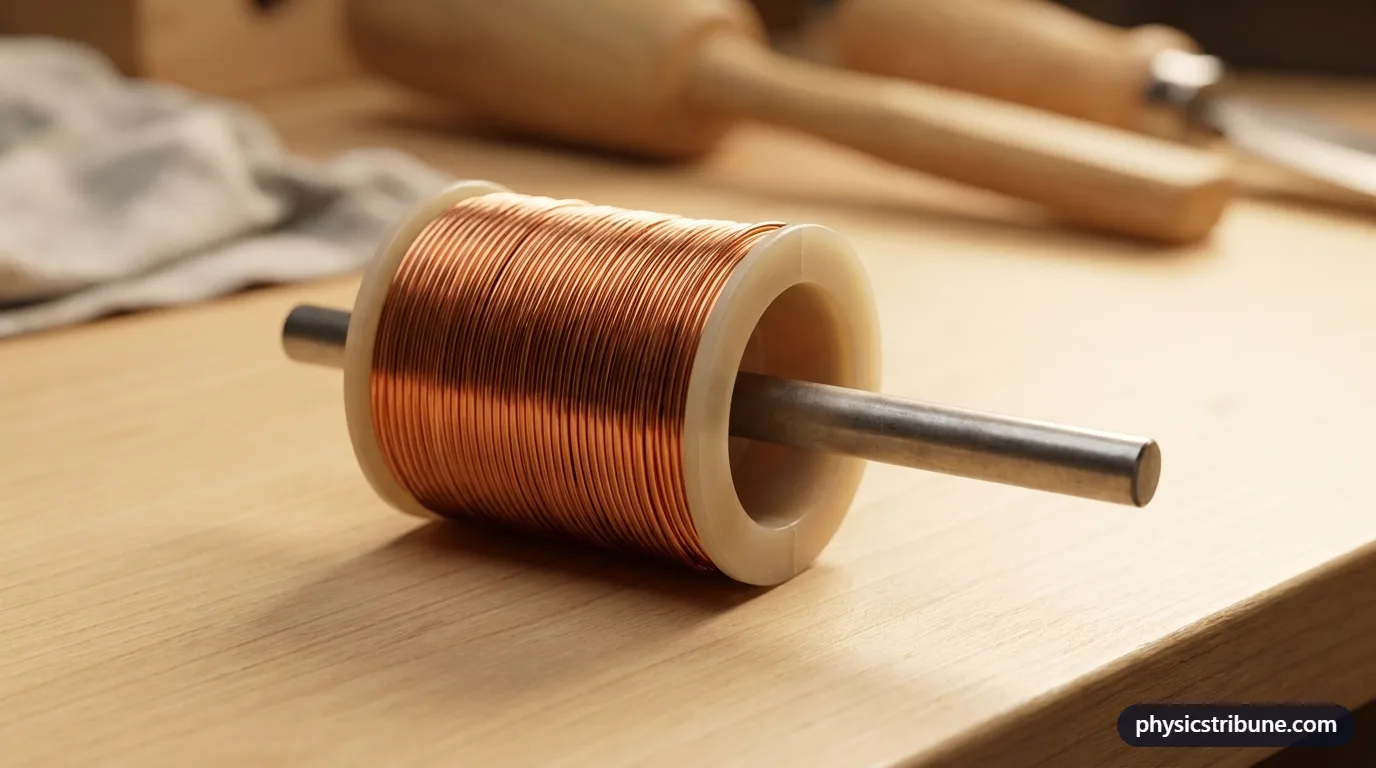
For a long air-core solenoid, the inductance is
- Turns count twice. More turns make more flux, and that flux links more turns. Doubling N multiplies L by four.
- Wider coils catch more flux. Doubling the diameter quadruples the area and so quadruples L.
- Longer coils, same turns, are weaker. Spreading the same turns over twice the length halves L.
- The core multiplies everything. Iron or ferrite can raise L by a factor of hundreds or more.
The table compares several example coils, all with air cores.
Example 2 Inductance of a homemade coil
A student winds 500 turns of wire evenly along a 0.10 m plastic tube with a cross-sectional area of 3.14 × 10⁻⁴ m² (a tube about 2 cm across). The core is air. Using μ₀ = 1.25663706127 × 10⁻⁶ T·m/A, what is the coil's inductance?
- Given:
- permeability of free space:
- number of turns:
- cross-sectional area:
- length of the solenoid:
- permeability of free space:
- Formula:
- Substitute:
- Answer:
The answer is in henries; it is about one millihenry, typical of a small air-core coil. Doubling the turns would make it four times larger.
| Coil | Turns N | Diameter | Length ℓ | Inductance L |
|---|---|---|---|---|
| A | 100 | 2 cm | 5 cm | 0.079 mH |
| B (double the turns of A) | 200 | 2 cm | 5 cm | 0.316 mH |
| C (double the turns of B) | 400 | 2 cm | 5 cm | 1.26 mH |
| D (C with double diameter) | 400 | 4 cm | 5 cm | 5.05 mH |
| E (C with double length) | 400 | 2 cm | 10 cm | 0.632 mH |
| F | 1,000 | 3 cm | 15 cm | 5.92 mH |
| Source: Computed with L = μ₀N²A/ℓ, μ₀ from NIST CODATA 2022; long-coil approximation, so short coils will measure somewhat lower · Retrieved October 2026 | ||||
How Does an Inductor Behave in a Circuit?
Connect a coil in series with a resistor and a battery, then close the switch. The current does not jump to its final value V/R. It rises along a smooth curve, because the coil's back emf fights every increase. The time scale is set by
After one time constant the current reaches about 63% of its final value, and after five it is within 1%. In the example graphed below, a 30 mH coil in series with 6 Ω on a 12 V supply has τ = 5 ms and a final current of 2 A. Switching off reverses the story: the current dies away over a similar time, provided it has a path to flow through. Our RL circuits page covers the equations in detail.
With alternating current the coil keeps fighting, so it limits AC more strongly at higher frequencies. This frequency-dependent opposition is called inductive reactance, and it lets inductors filter out unwanted high-frequency noise.


How Much Energy Does an Inductor Store?
Building up current in a coil takes work against the back emf, and that work is stored in the magnetic field. The stored energy is
Because the current is squared, doubling it stores four times the energy. When the current is cut, the field collapses and the energy has to go somewhere. Without a safe path it can produce a high-voltage spike, which is why relay coils and motors often have a diode connected across them. Compare it with a capacitor, which stores energy in an electric field instead; see capacitance.
Example 3 Energy waiting in a choke
A 0.25 H choke in a power supply carries a steady current of 3.0 A. How much energy is stored in its magnetic field?
- Given:
- inductance:
- current:
- inductance:
- Formula:
- Substitute:
- Answer:
About a joule is small, but if it is released in a microsecond the power is enormous, which is why inductive circuits need protection when switched off.
Where Do You See Inductance in Everyday Life?
- Transformers on power poles and in chargers rely on mutual inductance between two windings.
- Wireless charging pads transfer energy from a coil in the pad to a coil in the phone through their mutual inductance.
- Car ignition coils interrupt the current in one winding so quickly that a second winding produces the thousands of volts needed for a spark.
- Traffic sensors buried in the road are large loops whose inductance drops when a metal car body sits above them.
- Metal detectors notice small changes in a search coil's inductance caused by nearby metal.
- Power supplies use inductors to smooth current and store energy between switching cycles.
Going Deeper: Why Do Iron-Core Coils Behave Differently?
For an air-core coil, the flux is strictly proportional to the current, so L is a fixed number. Iron changes that. At low currents its magnetic domains line up easily and multiply the flux enormously. At high currents the iron saturates, the extra flux per ampere falls, and the effective inductance drops.
Iron also wastes some energy every cycle as heat, through hysteresis and through eddy currents swirling in the metal. That is why transformer and inductor cores are built from thin insulated sheets or from ferrite, a ceramic that conducts poorly.
Who Discovered Inductance?
In the early 1830s, Michael Faraday in England and Joseph Henry in the United States both found that a changing current in one coil induces a current in another. Henry is generally credited with first describing self-induction, the spark seen when a long coil is disconnected. The SI unit of inductance, the henry, is named after him.
To practice, work through the magnetism worksheets, and use the magnetic field calculator to see how a coil's turns and current set the field that its inductance depends on.
Common Misconceptions
Myth: An inductor opposes current the way a resistor does.
Physics: An ideal inductor opposes only changes in current. With a steady DC current it acts like a plain wire and drops no voltage.
Myth: Inductance depends on how much current flows through the coil.
Physics: For an air-core coil, inductance is set by the geometry alone. Current affects the stored energy and induced voltage, not L itself.
Myth: Doubling the number of turns doubles the inductance.
Physics: Turns count twice: more turns make more flux and that flux links more turns, so doubling N quadruples L.
Myth: Mutual inductance only matters when the coils touch.
Physics: Coils only need to share magnetic flux. Wireless chargers and traffic loops work across air gaps.
Key Facts
- Inductance is the property of a coil that opposes changes in the current through it.
- Self-induced emf is ε = −L ΔI/Δt, where L is the inductance in henries.
- One henry gives one volt of emf when the current changes by one ampere per second.
- Mutual inductance M links two coils, so a changing current in one induces an emf in the other.
- A long air-core solenoid has L = μ₀N²A/ℓ, so inductance grows with the square of the number of turns.
- An inductor carrying current I stores energy U = ½LI² in its magnetic field.
- In an RL circuit the current changes with a time constant τ = L/R.
Quick Quiz: How Well Do You Know Inductance (Self and Mutual)?
6 questions. Tap an answer to check it.
What does inductance oppose?
Inductance resists changes in current; a steady current flows freely through an ideal inductor.
What is the SI unit of inductance?
Inductance is measured in henries, named after Joseph Henry.
A solenoid's number of turns is doubled while its length and area stay the same. Its inductance becomes:
L = μ₀N²A/ℓ depends on N squared, so 2² = 4.
A 2.0 H coil has its current change by 3.0 A in 0.5 s. What is the size of the induced emf?
|ε| = L ΔI/Δt = 2.0 × 3.0 ÷ 0.5 = 12 V.
Which device works mainly by mutual inductance?
A transformer's changing primary current induces an emf in the secondary coil.
If the current in an inductor doubles, the stored energy:
U = ½LI², so doubling I multiplies U by four.
Frequently Asked Questions
What is inductance in simple words?
Inductance is a coil's tendency to resist any change in the current flowing through it. When current tries to increase, the coil pushes back; when current tries to decrease, the coil tries to keep it going. It works through the coil's own changing magnetic field. A coil with large inductance makes current change slowly and can produce a big voltage when switched off.
What is the unit of inductance?
The SI unit is the henry, symbol H. A coil has one henry of inductance if a current changing at one ampere per second induces one volt across it. In base terms 1 H = 1 V·s/A = 1 Wb/A. Real components range from nanohenries in radio circuits to several henries in large chokes, so mH and μH are common.
What is the formula for self-inductance?
The defining formula is ε = −L ΔI/Δt: the induced emf equals the inductance times the rate of change of current, with a minus sign showing opposition. An equivalent form is L = NΦ/I, flux linkage per ampere. For a long air-core solenoid, L = μ₀N²A/ℓ, where N is the number of turns, A the cross-sectional area and ℓ the length.
What is mutual inductance?
Mutual inductance M describes how a changing current in one coil induces an emf in a second coil nearby: ε₂ = −M ΔI₁/Δt. It depends on how much of the first coil's flux passes through the second, so it is largest when the coils are close, aligned and share an iron core. Transformers and wireless chargers rely on mutual inductance.
What factors affect the inductance of a coil?
Four main factors set it: the number of turns, the cross-sectional area, the length of the coil, and the material inside. Inductance rises with the square of the turns and in proportion to the area, and falls as the same turns are spread over a longer length. An iron or ferrite core can increase it hundreds of times or more.
How much energy is stored in an inductor?
An inductor carrying current I stores U = ½LI² joules in its magnetic field. A 0.10 H coil carrying 2 A stores 0.2 J, for example. The energy is released when the current falls. Because the release can be very fast, an interrupted inductor can produce a large voltage spike, so circuits often include a diode or snubber to absorb it.
Why does an inductor cause a spark when switched off?
Opening the switch tries to drop the current to zero almost instantly. Since ε = −L ΔI/Δt, a very large rate of change produces a very large emf. That voltage can exceed the breakdown strength of the air gap in the switch, so a spark jumps across it, carrying the current briefly and releasing the energy stored in the coil's field.
Is inductance the same as inductive reactance?
No. Inductance L is a fixed property of the coil, measured in henries. Inductive reactance is the opposition the coil offers to alternating current, measured in ohms, and it equals 2πfL. It grows with frequency, so the same coil blocks high-frequency signals far more than low-frequency ones, and it offers no reactance at all to steady DC.
What is the difference between an inductor and a capacitor?
An inductor stores energy in a magnetic field and opposes changes in current; a capacitor stores energy in an electric field and opposes changes in voltage. With steady DC, an ideal inductor acts like a wire and a capacitor acts like a gap. With AC, inductors block high frequencies while capacitors pass them, so the two are often paired in filters.