At a Glance
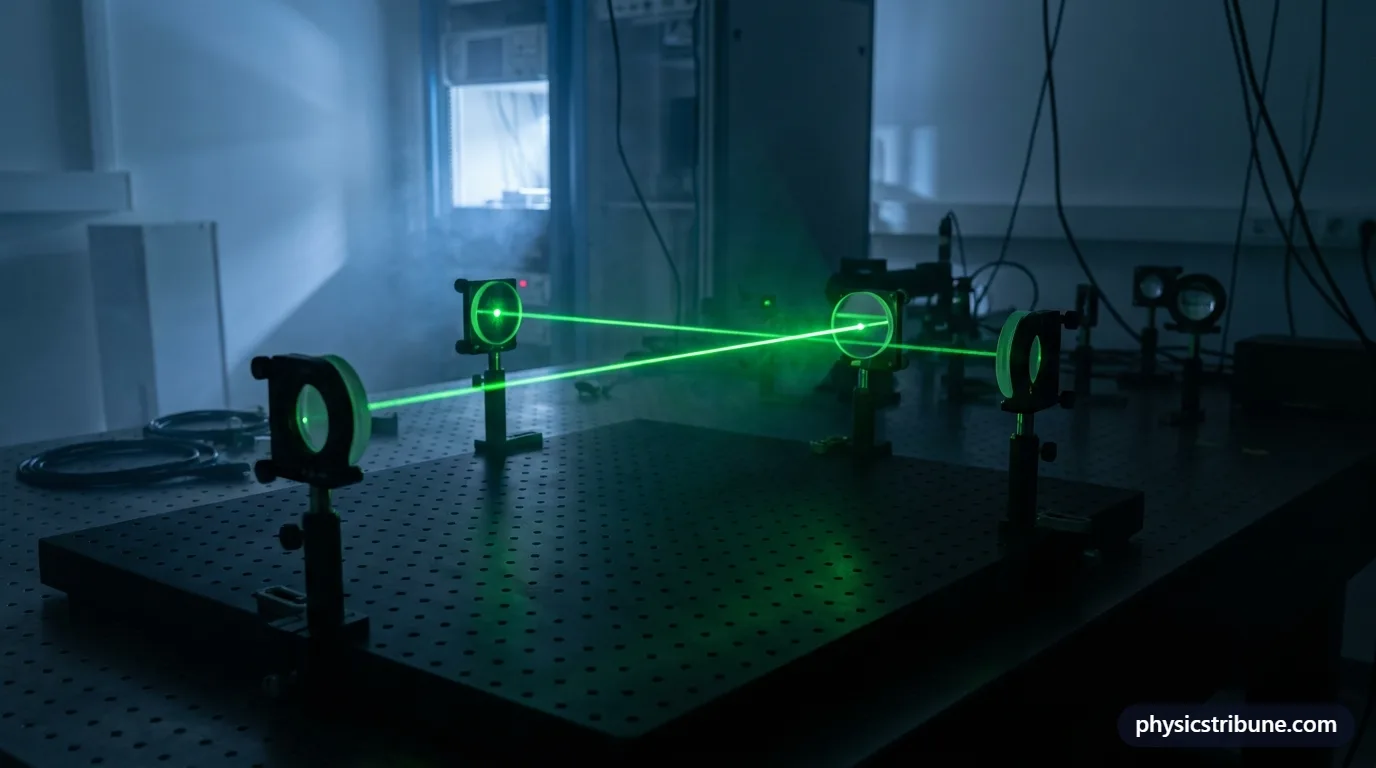
James Clerk Maxwell (born June 13, 1831, died November 5, 1879) was a Scottish physicist whose equations describe how electric and magnetic fields create each other. They predict electromagnetic waves moving at c = 1/sqrt(μ0 ε0), which matches the speed of light, so light itself is an electromagnetic wave obeying c = f λ.
- Born
- June 13, 1831, Edinburgh, Scotland
- Died
- November 5, 1879, Cambridge, England, age 48
- Nationality
- United Kingdom of Great Britain and Ireland (Scottish)
- Known for
- Maxwell's equations of electromagnetism; kinetic theory of gases
- Key work
- A Dynamical Theory of the Electromagnetic Field (1865); Treatise on Electricity and Magnetism (1873)
- Key equation
- c = f λ for every electromagnetic wave, with c = 1/sqrt(μ0 ε0)
On this page
- Who Was James Clerk Maxwell?
- Early Life and Education
- What Did Maxwell Discover About Color and Saturn's Rings?
- How Did Maxwell Explain the Behavior of Gases?
- What Are Maxwell's Equations?
- How Did Maxwell Show That Light Is an Electromagnetic Wave?
- Maxwell's Key Equation
- The Cavendish Laboratory and Final Years
- Why Is Maxwell So Important Today?
- Key Facts
- Quiz
- FAQ
Who Was James Clerk Maxwell?
James Clerk Maxwell was the physicist who showed that electricity, magnetism and light are three faces of a single thing. Before him, scientists had a scattered set of rules for charges, currents and magnets. He gathered those rules into one mathematical theory of the electromagnetic field and used it to predict waves that no one had yet detected.
That was only part of his work. He explained how the speeds of gas molecules are spread out, made the first color photograph, proved what Saturn's rings must be made of, and set up the Cavendish Laboratory at Cambridge. Many physicists rank him just behind Newton and Einstein for the size of his influence.
He was also a modest, funny and deeply religious man who wrote comic verse for his friends. He died young, at 48, before anyone had confirmed his most famous prediction.
Early Life and Education
Maxwell was born in Edinburgh in 1831 and grew up on his family's country estate, Glenlair, in the southwest of Scotland. He was an endlessly curious child who wanted to know "the particular go" of every machine, stream and bell rope he found. His mother died when he was eight, and he was sent back to Edinburgh to attend the Edinburgh Academy.
His talent showed early. At 14 he wrote a paper on drawing oval curves with pins and string, and it was read to the Royal Society of Edinburgh because he was considered too young to present it himself. He studied at the University of Edinburgh from 1847 and moved to Cambridge in 1850, where he graduated in mathematics in 1854 near the top of his year.
After Cambridge he took a professorship at Marischal College in Aberdeen in 1856. There he married Katherine Mary Dewar in 1858, and she later helped him with experiments on color and on the viscosity of gases.
| Year | Event |
|---|---|
| 1831 | Born in Edinburgh, Scotland, on June 13 |
| 1846 | His paper on oval curves is read to the Royal Society of Edinburgh |
| 1850 | Moves from the University of Edinburgh to Cambridge |
| 1856 | Becomes professor of natural philosophy at Marischal College, Aberdeen |
| 1859 | Wins the Adams Prize for his essay on the stability of Saturn's rings |
| 1860 | Publishes his statistical theory of gas molecule speeds; moves to King's College London |
| 1861 | First color photograph shown at the Royal Institution |
| 1865 | Publishes A Dynamical Theory of the Electromagnetic Field |
| 1871 | Appointed first Cavendish Professor of Experimental Physics at Cambridge |
| 1873 | Publishes the Treatise on Electricity and Magnetism |
| 1874 | The Cavendish Laboratory opens |
| 1879 | Dies in Cambridge on November 5, aged 48 |
| Source: Birth and death dates from our physicists data file (Wikidata, CC0); other years are standard biographical dates · Retrieved October 2026 | |
What Did Maxwell Discover About Color and Saturn's Rings?
Maxwell's first big success was a prize essay on Saturn's rings, completed in the late 1850s. He showed with careful mathematics that a solid ring would break apart and a liquid ring would break into blobs. The only stable option was a huge swarm of separate small bodies, each orbiting the planet on its own, which space probes later confirmed.
At the same time he studied how we see color. Using spinning tops painted with adjustable colored sectors, he showed that most colors we perceive can be matched by mixing red, green and blue light. In 1861 he put the idea to work by having a tartan ribbon photographed three times through red, green and blue filters, then projecting the three images on top of each other. The result was the first color photograph, and the same three-color principle runs every phone and TV screen today. Our page on the color of light explains why three colors are enough to fool the eye.
How Did Maxwell Explain the Behavior of Gases?
Around 1860 Maxwell attacked an old puzzle: how can the pressure and temperature of a gas come from billions of tiny molecules flying around? He realized that the molecules cannot all have the same speed. Collisions constantly shuffle energy between them, so the only sensible description is statistical: a spread of speeds with a most likely value and a long tail of fast movers.
The shape of that spread is now called the Maxwell-Boltzmann distribution, after Maxwell and the Austrian physicist Ludwig Boltzmann, who generalized it. It is a cornerstone of the kinetic theory of gases, and Maxwell used it to predict, to his own surprise, that a gas's viscosity does not depend on its pressure. He and his wife then confirmed this in experiments at home.
He also invented a thought experiment about a tiny being who sorts fast and slow molecules through a trapdoor, seemingly making heat flow from cold to hot. This "Maxwell's demon" puzzled physicists for a century and helped reveal deep links between information, entropy and the second law of thermodynamics.
What Are Maxwell's Equations?
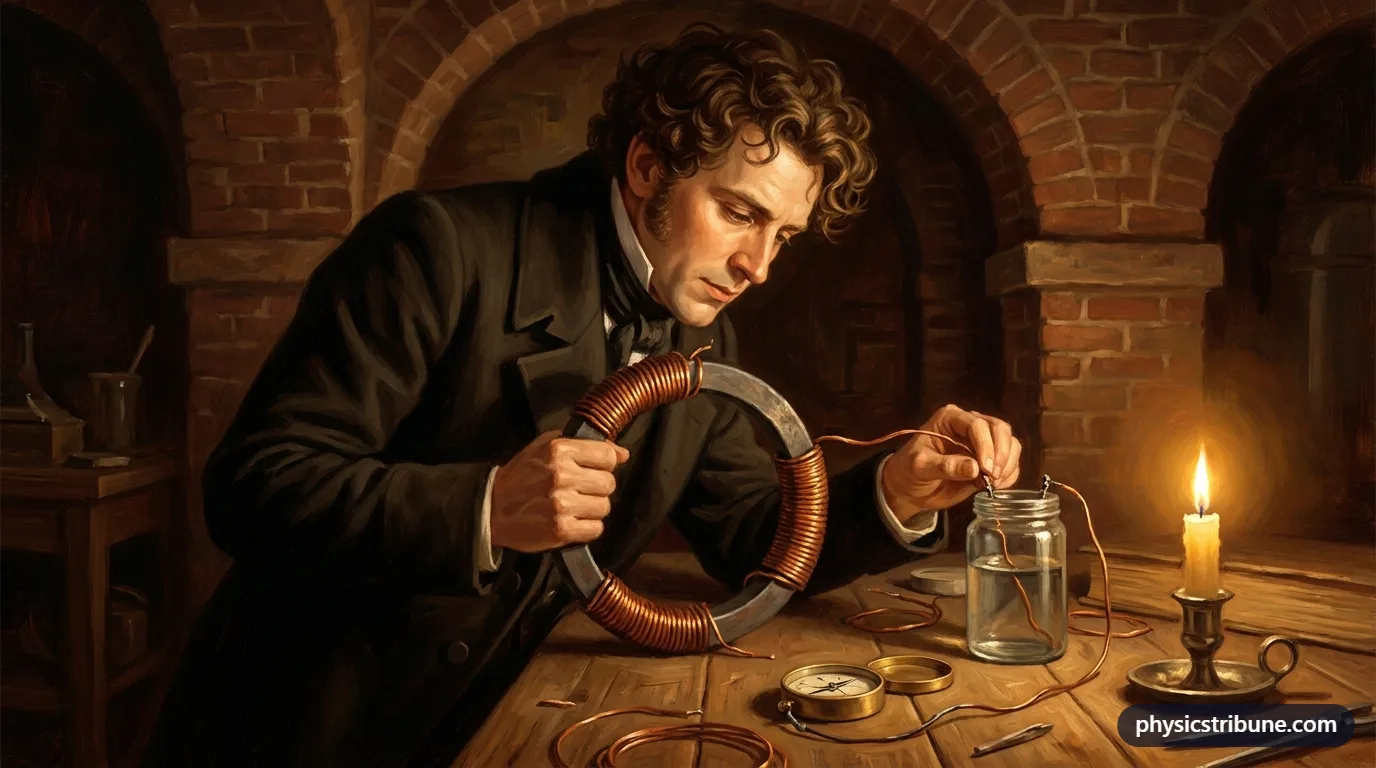
Maxwell started from the experimental discoveries of Michael Faraday, who pictured invisible lines of force around magnets and currents. Maxwell set out to turn those pictures into mathematics. In papers from 1861 to 1865 he built a complete theory of electric and magnetic fields, and he collected it in his Treatise on Electricity and Magnetism in 1873.
In today's compact form, usually credited to Oliver Heaviside, the theory is four equations:
- Gauss's law: electric charges are sources of electric field. See Gauss's law.
- Gauss's law for magnetism: there are no isolated magnetic poles, so magnetic field lines always close on themselves.
- Faraday's law: a changing magnetic field creates an electric field, the basis of electromagnetic induction.
- The Ampere-Maxwell law: currents and changing electric fields create magnetic fields.
The final piece, the "displacement current" term saying a changing electric field acts like a current, was Maxwell's own addition. Without it the equations contradicted the conservation of charge. With it, they made a stunning prediction.
How Did Maxwell Show That Light Is an Electromagnetic Wave?
Once a changing electric field makes a magnetic field and a changing magnetic field makes an electric field, the two can keep regenerating each other and travel through empty space as a wave. Maxwell worked out the speed of this wave from his equations. It depended only on two constants measured in electrical labs, the permittivity and permeability of free space.
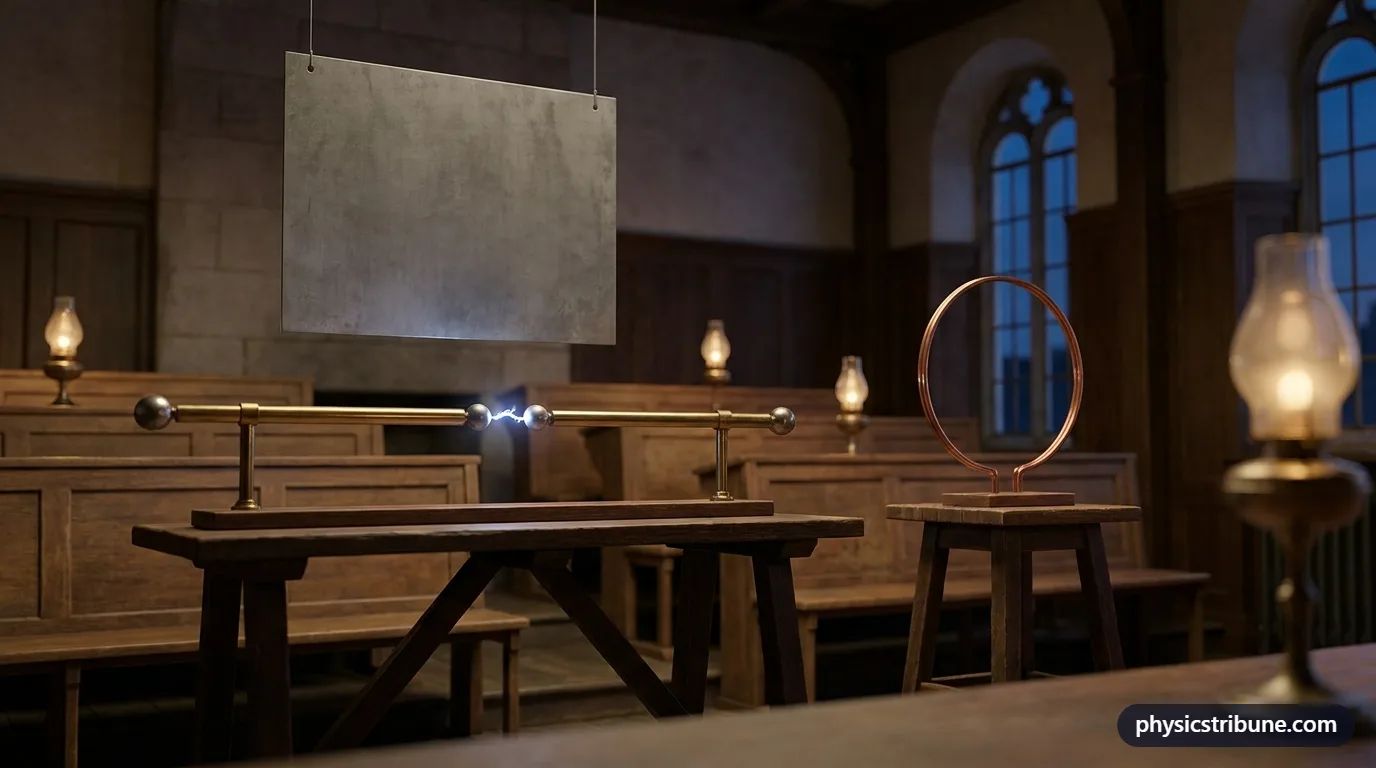
When he put in the measured numbers, the speed came out very close to the known speed of light. He concluded that light is an electromagnetic wave, and that waves of other wavelengths should exist as well. In 1887 and 1888 Heinrich Hertz produced and detected such waves in his lab, as described in our write-up of Hertz's radio wave experiment. Today the whole family, from radio waves to gamma rays, is called the electromagnetic spectrum.

Maxwell's Key Equation
The full field equations need vector calculus, but their most practical consequence fits on one line. Every electromagnetic wave in a vacuum moves at the same speed,
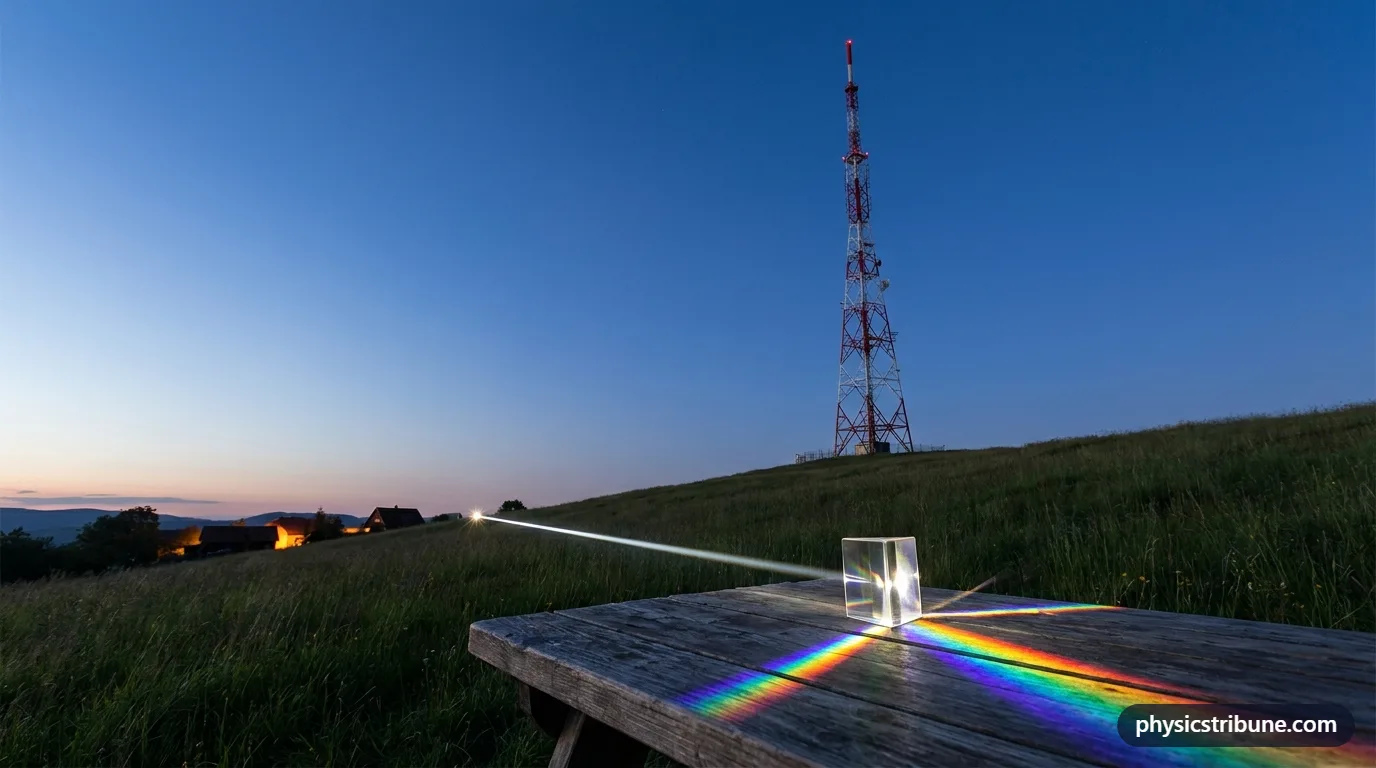
Engineers use this relation to size antennas, choose radio bands and design fiber optic links. Our frequency and wavelength calculator does the conversion for any band.
Every wave his theory predicts, from radio to gamma rays, obeys this simple link between speed, frequency and wavelength.
| Symbol | Quantity | SI unit |
|---|---|---|
| speed of light in vacuum (2.998 × 10⁸ m/s (exact: 299 792 458 m/s)) | meter per second (m/s) | |
| frequency | hertz (Hz) | |
| wavelength in vacuum | meter (m) |
Rearranged to find another variable:
Valid for: electromagnetic waves in vacuum.
Example 1 The frequency of red light
Maxwell's theory says light is an electromagnetic wave moving at c. Red light from a laser pointer has a wavelength of 650 nm (6.5 × 10^-7 m). Taking c = 299,792,458 m/s, what is its frequency?
- Given:
- speed of light in vacuum:
- wavelength in vacuum:
- speed of light in vacuum:
- Formula:
- Substitute:
- Answer:
Hundreds of trillions of oscillations every second: light obeys exactly the same rule as a radio wave, only with a far shorter wavelength, just as Maxwell's theory predicts.
Example 2 The wavelength of a local radio station
A small-town FM station broadcasts at 94.3 MHz. Taking c = 299,792,458 m/s, how long is one wavelength of its signal?
- Given:
- speed of light in vacuum:
- frequency:
- speed of light in vacuum:
- Formula:
- Substitute:
- Answer:
A wavelength of about three meters is why car and home FM antennas are a meter or so long, a fraction of the wave they catch.
The Cavendish Laboratory and Final Years
Maxwell taught at King's College London from 1860 to 1865, the period of his greatest electromagnetic papers. He then retired to Glenlair to write, until Cambridge invited him back in 1871 as its first Cavendish Professor of Experimental Physics. He designed the new Cavendish Laboratory, which opened in 1874 and later produced discoveries such as the electron and the structure of DNA.
In 1879 he fell ill with abdominal cancer, the same disease that had killed his mother at the same age. He died in Cambridge on November 5, 1879, and was buried near Glenlair in Scotland.
Why Is Maxwell So Important Today?
Maxwell's equations are the foundation of radio, television, radar, Wi-Fi, mobile phones, electric motors and power grids. Every time a signal leaves an antenna, it follows the rules he wrote down. His idea of a physical field filling space, carrying energy and momentum, became the model for all later field theories in physics.
His work also set the stage for relativity. The equations say light always moves at the same speed, and Albert Einstein took that seriously in 1905, which led to his two postulates. Einstein kept a picture of Maxwell on his study wall, next to Newton and Faraday.
Key Facts
- James Clerk Maxwell was born in Edinburgh on June 13, 1831, and died in Cambridge on November 5, 1879.
- His equations show that electric and magnetic fields are linked and can travel together as a wave.
- He calculated that these waves move at the speed of light and concluded that light is an electromagnetic wave.
- He described the spread of molecular speeds in a gas, now called the Maxwell-Boltzmann distribution.
- He produced the first color photograph in 1861 using red, green and blue filters.
- He proved that Saturn's rings must be made of many separate small particles.
- He was the first director of the Cavendish Laboratory at Cambridge.
Quick Quiz: How Well Do You Know James Clerk Maxwell?
6 questions. Tap an answer to check it.
Which quantity did Maxwell calculate from electrical constants and find equal to the speed of light?
His equations gave a wave speed of 1/sqrt(μ0 ε0), which matched the speed of light.
What did Maxwell add to the existing laws of electricity and magnetism?
The displacement current says a changing electric field produces a magnetic field, and it made electromagnetic waves possible.
What did Maxwell conclude about Saturn's rings?
Solid and liquid rings would be unstable, so the rings must be swarms of separate orbiting bodies.
Which three colors of light did Maxwell use for the first color photograph?
Mixing red, green and blue light can match most colors the eye sees.
Who first produced and detected the waves Maxwell predicted?
Hertz generated and detected radio waves in 1887 and 1888, after Maxwell's death.
If the frequency of an electromagnetic wave doubles in a vacuum, what happens to its wavelength?
Because c = f λ and c is fixed, wavelength is inversely proportional to frequency.
Frequently Asked Questions
What is James Clerk Maxwell best known for?
Maxwell is best known for his equations of electromagnetism, which unite electricity, magnetism and light in a single theory. They predicted electromagnetic waves traveling at the speed of light. He is also famous for the statistical theory of gas molecule speeds, the first color photograph, and his proof that Saturn's rings are made of countless small pieces.
What did Maxwell discover about light?
Maxwell found that his equations allowed waves of linked electric and magnetic fields to travel through empty space. The predicted speed matched the measured speed of light, so he concluded that light is one of these electromagnetic waves. He also expected waves with longer and shorter wavelengths, which were later found as radio waves, X-rays and the rest of the spectrum.
How many equations did Maxwell write?
In his 1865 paper Maxwell wrote about twenty equations in many variables. The tidy set of four that students learn today was condensed by Oliver Heaviside and others in the 1880s using vector notation. The physics is the same: Gauss's law for electricity, Gauss's law for magnetism, Faraday's law and the Ampere-Maxwell law.
Did Maxwell invent color photography?
Maxwell proposed and demonstrated the three-color method in 1861. A photographer took three pictures of a tartan ribbon through red, green and blue filters, and the images were projected together to recreate the colors. The method is the basis of later color photography and of the red, green and blue pixels in modern screens.
What is Maxwell's demon?
Maxwell's demon is a thought experiment from 1867. A tiny creature guards a door between two boxes of gas and lets only fast molecules pass one way and slow ones the other, so one side heats up without any work being done. Explaining why this cannot break the second law of thermodynamics led to modern ideas linking information and entropy.
How did Maxwell influence Einstein?
Maxwell's equations say light in a vacuum always travels at the same speed. Einstein took this as a basic rule of nature, and reconciling it with mechanics led him to special relativity in 1905. Einstein greatly admired Maxwell and described his field theory as the most important change in physics since Newton.
How did James Clerk Maxwell die?
Maxwell died of abdominal cancer on November 5, 1879, in Cambridge, at age 48. His mother had died of the same illness at almost the same age. He was buried in the churchyard at Parton, near his family estate of Glenlair in southwest Scotland, where a memorial now marks the grave.
Is there a unit named after Maxwell?
Yes. The maxwell, symbol Mx, is a unit of magnetic flux in the older centimeter-gram-second system, equal to one hundred-millionth of a weber. It is rarely used today because the SI unit of magnetic flux is the weber. Several telescopes and a mountain range on Venus also carry his name.