
At a Glance
Heinrich Hertz (born February 22, 1857, died January 1, 1894) was a German physicist who generated and detected radio waves between 1886 and 1888, confirming that light and radio are the same kind of wave. His waves obey c = f λ: wave speed equals frequency times wavelength. The unit of frequency, the hertz (Hz), honors him.
- Born
- February 22, 1857, Hamburg
- Died
- January 1, 1894, Bonn, age 36
- Nationality
- Hamburg (German)
- Known for
- First production and detection of radio waves
- Key work
- Electromagnetic wave experiments at Karlsruhe (1886 to 1888)
- Key equation
- c = f λ (speed of an electromagnetic wave)
On this page
Who Was Heinrich Hertz?
Heinrich Rudolf Hertz was the experimenter who turned a pen-and-paper prediction into something you could see spark in a dark room. In the 1860s James Clerk Maxwell had written equations saying that changing electric and magnetic fields should ripple outward as waves at the speed of light. For twenty years many physicists admired the theory, but nobody had made or caught such a wave on purpose.
Hertz did it between 1886 and 1888 with an induction coil, a pair of metal rods ending in small brass balls, and a simple loop of wire. He showed that the invisible waves reflect, bend and line up just like light. That settled the question and set the stage for radio, television, radar and wireless data.
His career was short, because he died just before his 37th birthday. Yet in under a decade of independent work he also found the first sign of the photoelectric effect and wrote an important book on the foundations of mechanics.
Early Life and Education
Hertz was born in Hamburg, a free city-state that joined the new German Empire in 1871. His father was a lawyer and later a senator in the city government. As a boy he was good with his hands as well as with books, and he enjoyed building instruments on a lathe.
He first trained to become an engineer, but he soon found that he cared more about why things work than about building bridges. He moved to Berlin and studied physics under Hermann von Helmholtz, one of the leading scientists in Germany, and attended lectures by Gustav Kirchhoff. Helmholtz quickly saw his talent and made him his assistant.
Hertz earned his doctorate in 1880 with a study of electrical currents in rotating spheres. In 1883 he became a lecturer at Kiel, and in 1885 he was appointed professor at the technical college in Karlsruhe, where he did his most famous work.
| Year | Event |
|---|---|
| 1857 | Born in Hamburg on February 22 |
| 1878 | Moves to Berlin to study physics under Hermann von Helmholtz |
| 1880 | Earns his doctorate and becomes Helmholtz's assistant |
| 1883 | Becomes a lecturer at the University of Kiel |
| 1885 | Appointed professor at the technical college in Karlsruhe |
| 1886 to 1888 | Produces and detects electromagnetic waves and shows they behave like light |
| 1887 | Observes that ultraviolet light helps sparks jump, the first sign of the photoelectric effect |
| 1889 | Becomes professor of physics at the University of Bonn |
| 1892 | Shows that cathode rays can pass through thin metal foil |
| 1894 | Dies in Bonn on January 1, aged 36 |
| Source: Birth and death dates from our physicists data file (Wikidata, CC0); other years are standard biographical dates · Retrieved October 2026 | |
How Did Hertz Discover Radio Waves?
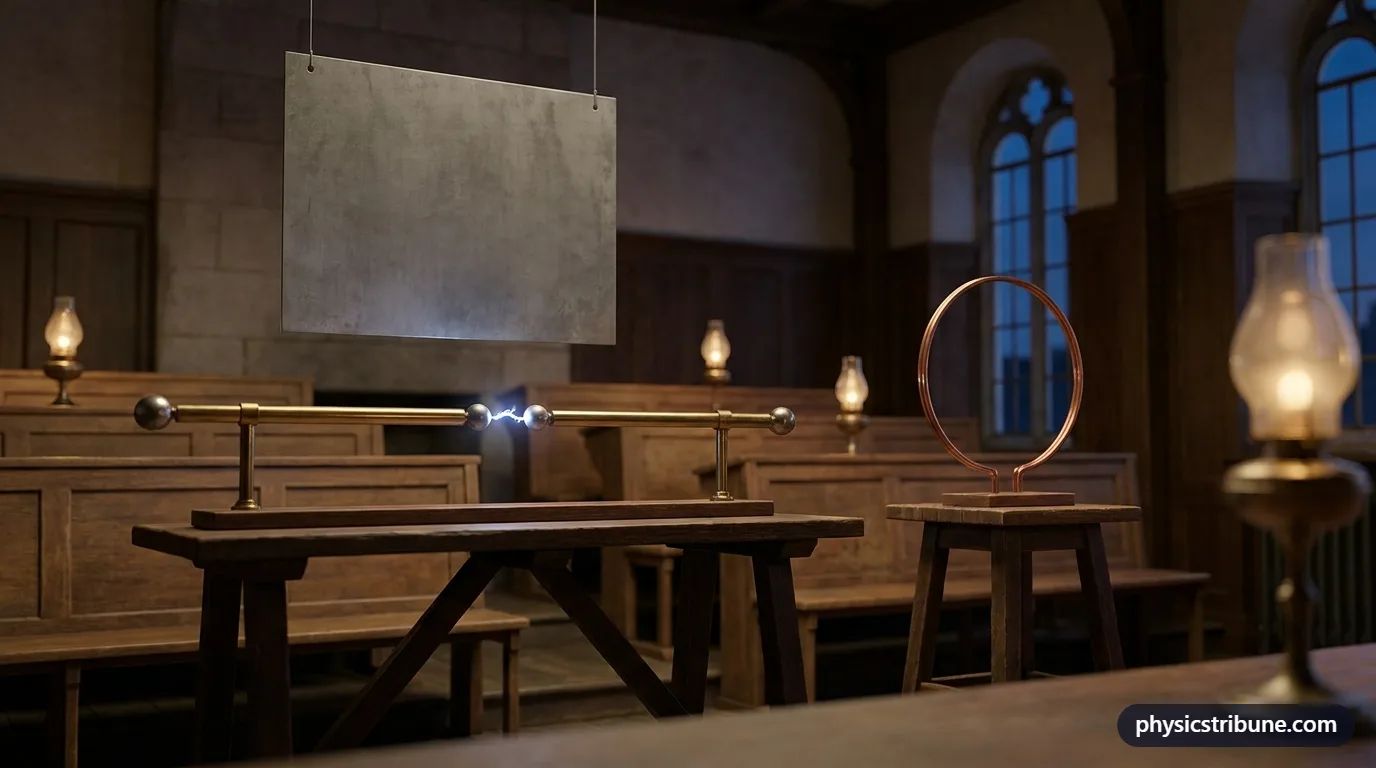
At Karlsruhe, Hertz built a transmitter from an induction coil connected to two metal rods with a tiny air gap between them. When the coil charged the rods, a spark jumped the gap, and the current sloshed back and forth very rapidly. This oscillating current sent electromagnetic waves out into the room.
His receiver was even simpler: a loop of wire with its own small gap, with no battery at all. When the waves reached the loop, they pushed current around it, and a faint spark appeared across the gap. Hertz often had to work in a darkened room and peer closely to see these tiny flashes, sometimes meters away from the transmitter.
By moving the receiver around, he mapped where the effect was strong and where it vanished. That pattern was the fingerprint of a wave traveling through empty air, and the frequencies he used fall in the range we now call radio waves.
How Did Hertz Prove Maxwell Right?
Detecting a spark was not enough; Hertz needed to show the waves behave like light. He hung a large metal sheet on the wall of his lecture hall and let the waves reflect from it. The outgoing and returning waves combined into a standing wave, with fixed spots of strong and weak response that he could measure with his loop.
The distance between those spots gave him the wavelength. Combined with the frequency he worked out from the size of his circuit, it gave a wave speed close to the speed of light. He also showed that his waves could be focused by curved metal mirrors, bent by a large prism made of pitch, and blocked or passed by a grid of parallel wires depending on its angle, which is polarization.
Reflection, refraction, polarization and the right speed together made a strong case. Visible light and his invisible waves were two members of one family, the electromagnetic spectrum.
| Behavior | How it was shown | What it proved |
|---|---|---|
| Reflection | Waves bounced off a large metal sheet on the wall | The waves carry energy and bounce like light from a mirror |
| Standing waves | Fixed spots of strong and weak sparking in front of the sheet | The disturbance is a wave with a measurable wavelength |
| Refraction | A large prism of pitch bent the beam | The waves change direction in a material, as light does in glass |
| Focusing | Curved metal mirrors concentrated the waves | The waves follow the same geometry as light rays |
| Polarization | A grid of parallel wires passed or blocked the waves by angle | The waves are transverse, like light |
| Speed | Wavelength times frequency came out close to light speed | Radio waves and light are the same kind of wave |
| Source: Summary of Hertz's Karlsruhe experiments written by our editors · Retrieved October 2026 | ||

Did Hertz Discover the Photoelectric Effect?
Yes, he made the first clear observation of it, in 1887, almost by accident. While working with his spark gaps, he noticed that the receiver sparked more easily when ultraviolet light from the transmitter spark could shine on it. When he put a sheet of glass in the way, which blocks ultraviolet, the effect weakened.
Hertz reported what he saw carefully but did not explain it, since electrons had not yet been discovered. His assistant Philipp Lenard later studied the effect in detail and found that light knocks charged particles out of metal surfaces.
The puzzle grew into one of the starting points of quantum physics. In 1905 Albert Einstein explained the photoelectric effect by treating light as packets of energy, so Hertz's side observation helped prepare both the wave picture and the particle picture of light.
Hertz's Key Equation
The relation at the heart of Hertz's work links three quantities: the speed of the wave, how many waves pass each second, and the length of one wave. For any electromagnetic wave in a vacuum, the speed is the fixed value c, so a higher frequency always means a shorter wavelength.
Hertz used this the other way around: he measured the wavelength and estimated the frequency, and then checked that their product matched the speed of light. Below are two worked examples, and our frequency and wavelength calculator does the same arithmetic for any wave.
Every electromagnetic wave Hertz made obeys this relation between speed, frequency and wavelength, shown with each variable and its unit.
| Symbol | Quantity | SI unit |
|---|---|---|
| speed of light in vacuum (2.998 × 10⁸ m/s (exact: 299 792 458 m/s)) | meter per second (m/s) | |
| frequency | hertz (Hz) | |
| wavelength in vacuum | meter (m) |
Rearranged to find another variable:
Valid for: electromagnetic waves in vacuum.
Example 1 How long is a 450 MHz wave?
A small spark oscillator in a classroom demonstration produces waves with a frequency of 450 MHz (4.5 × 10^8 Hz). What is the wavelength of these waves in air, taking their speed as the speed of light?
- Given:
- speed of light in vacuum:
- frequency:
- speed of light in vacuum:
- Formula:
- Substitute:
- Answer:
A wavelength of well under a meter is short enough to reflect off a sheet of metal on a lab wall, which is how standing waves can be set up and measured indoors.
Example 2 From a measured wavelength back to frequency
A student sets up standing waves in front of a metal sheet and finds that the waves have a wavelength of 3.0 m. What is their frequency?
- Given:
- speed of light in vacuum:
- wavelength in vacuum:
- speed of light in vacuum:
- Formula:
- Substitute:
- Answer:
That is close to 100 million hertz, the same range used by FM radio stations today.
What Did Hertz Do in His Last Years?
In 1889 Hertz moved to the University of Bonn as professor of physics. There he turned to cathode rays, the glowing beams inside evacuated glass tubes. He found that they could pass through very thin sheets of metal foil, a result that suggested to him they were waves rather than particles.
He also spent much time writing a book on the principles of mechanics, which tried to rebuild the subject without the idea of force as a basic quantity. It was published shortly after his death.
From around 1892 he suffered from a painful illness that caused severe swelling and infections. He died in Bonn on January 1, 1894, at the age of 36. His teacher Helmholtz wrote a tribute for the mechanics book, praising the young scientist he had trained.
What Is Hertz's Legacy?
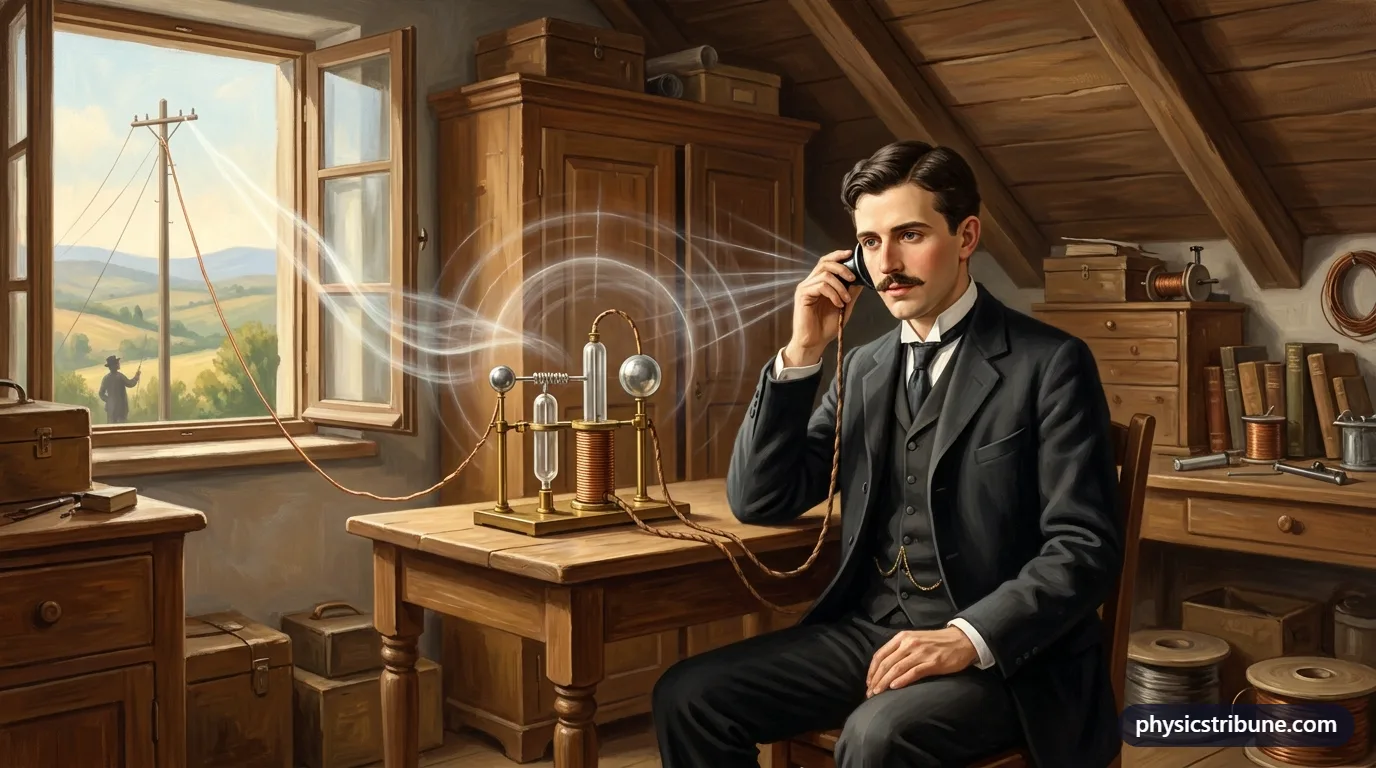
Within a few years of his death, inventors such as Guglielmo Marconi were sending wireless messages using spark transmitters based on Hertz's design. Radio, radar, mobile phones and Wi-Fi all descend from the waves he first made in a lecture hall.
The SI unit of frequency, the hertz, equals one cycle per second and is named in his honor. It was adopted by an international electrical standards body around 1930 and became part of the SI in 1960. Every time a radio station is listed in megahertz or a computer chip in gigahertz, his name is in use.
The family tradition continued: his nephew Gustav Hertz shared a Nobel Prize in Physics in 1925 for experiments on electrons colliding with atoms. To repeat a simple version of the famous experiment, see our Hertz radio waves experiment.
Key Facts
- Heinrich Hertz was born in Hamburg on February 22, 1857, and died in Bonn on January 1, 1894, aged 36.
- Between 1886 and 1888 he became the first person to produce and detect radio waves on purpose.
- He showed his waves reflect, refract, focus and polarize like light and travel at about light speed.
- His results confirmed James Clerk Maxwell's theory that light is an electromagnetic wave.
- In 1887 he made the first observation of the photoelectric effect.
- The SI unit of frequency, the hertz (one cycle per second), is named after him.
Quick Quiz: How Well Do You Know Heinrich Hertz?
6 questions. Tap an answer to check it.
Whose theory did Hertz's experiments confirm?
Maxwell predicted electromagnetic waves traveling at light speed, and Hertz produced and measured them.
What did Hertz use to detect his waves?
The incoming waves drove current around the loop, making a tiny spark jump its gap.
What is one hertz equal to?
The hertz is the SI unit of frequency, one cycle or event per second.
What did Hertz notice in 1887 that later became important to quantum physics?
That observation was the first sign of the photoelectric effect.
If a radio wave's frequency doubles, what happens to its wavelength?
With c = f λ and c fixed, wavelength is inversely proportional to frequency.
How old was Hertz when he died?
He was born in February 1857 and died on January 1, 1894, at 36.
Frequently Asked Questions
What is Heinrich Hertz famous for?
Hertz is famous for being the first person to deliberately generate and detect electromagnetic waves, which we now call radio waves. His experiments in Karlsruhe between 1886 and 1888 proved Maxwell's prediction that light is an electromagnetic wave. He also first observed the photoelectric effect, and the unit of frequency, the hertz, is named after him.
Did Heinrich Hertz invent the radio?
No. Hertz discovered and studied the waves that radio uses, but he did not build a communication system. He was interested in testing physics, not in sending messages. Inventors such as Guglielmo Marconi later improved spark transmitters and detectors based on his work and turned them into practical wireless telegraphy in the late 1890s.
How did Hertz detect radio waves?
He used a loop of wire with a very small gap and no power supply. When radio waves from his spark transmitter reached the loop, they drove a tiny current around it and a faint spark jumped across the gap. By moving the loop and watching where sparks appeared or vanished, he could map the waves in the room.
What is a hertz in physics?
A hertz is the SI unit of frequency, equal to one cycle or one event per second. A wave with a frequency of 100 Hz completes 100 full oscillations every second. Larger multiples are common: kilohertz for sound, megahertz for FM radio and gigahertz for Wi-Fi and computer processors. The unit is named after Heinrich Hertz.
How did Hertz die?
Hertz became seriously ill around 1892 with a painful condition that caused swelling and repeated infections, which doctors of the time could not treat. Despite several operations his health kept getting worse. He died in Bonn on January 1, 1894, at only 36 years old, still working on his book about the principles of mechanics.
What did Hertz prove about Maxwell's theory?
Maxwell's equations predicted that electric and magnetic fields could travel together as waves at the speed of light. Hertz made such waves and showed that they reflect, refract, can be focused and polarized, and move at roughly the speed of light. That gave the theory the experimental support it had lacked for more than twenty years.
Who discovered the photoelectric effect?
Heinrich Hertz made the first recorded observation in 1887, noticing that ultraviolet light made sparks jump more easily across a gap. His assistant Philipp Lenard later showed that light knocks charged particles out of metal. Albert Einstein explained the effect in 1905 by treating light as packets of energy, work cited in his 1921 Nobel Prize.
Was Gustav Hertz related to Heinrich Hertz?
Yes, Gustav Hertz was Heinrich Hertz's nephew. He became a physicist too and shared the 1925 Nobel Prize in Physics with James Franck for showing that electrons lose energy to atoms only in fixed amounts. That result gave strong support to the idea of quantized energy levels inside atoms.
Keep Exploring
 lightRadio Waves
 lightElectromagnetic Waves
 unitsHertz (Hz): SI Unit of Frequency
 experimentsHertz's radio wave experiments
 modern physicsPhotoelectric Effect
 physicistsJames Clerk Maxwell
 physicistsGuglielmo Marconi
 calculatorsFrequency ↔ Wavelength Converter
 compareDifference Between Frequency and Wavelength