At a Glance
Guglielmo Marconi (born April 25, 1874, died July 20, 1937) was an Italian radio pioneer who built the first practical long-distance wireless telegraph and sent a signal across the Atlantic in December 1901. He shared the 1909 Nobel Prize in Physics with Karl Ferdinand Braun. Radio waves obey c = f λ, so a station's frequency fixes its wavelength.
- Born
- April 25, 1874, Bologna, Italy
- Died
- July 20, 1937, Rome, Italy, age 63
- Nationality
- Kingdom of Italy
- Known for
- Long-distance radio transmission and wireless telegraphy
- Nobel Prize
- Physics, 1909 (shared with Karl Ferdinand Braun)
- Key equation
- c = f λ (frequency and wavelength of radio waves)
On this page
- Who Was Guglielmo Marconi?
- Early Life and First Experiments
- Why Did Marconi Move to Britain?
- How Did Marconi Send a Signal Across the Atlantic?
- How Did Marconi's Wireless Telegraph Work?
- What Role Did Marconi's Radio Play in the Titanic Disaster?
- The Key Equation Behind Marconi's Radio
- Later Life and Legacy
- Key Facts
- Quiz
- FAQ
Who Was Guglielmo Marconi?
Guglielmo Marconi was the person who made radio useful. Physicists already knew that electromagnetic waves existed: James Clerk Maxwell had predicted them and Heinrich Hertz had produced them in his laboratory. What nobody had done was send them far enough, and reliably enough, to carry messages.
Marconi did exactly that. Starting with experiments at his family's country house in his early twenties, he pushed the range of his signals from across a garden to across the Atlantic Ocean in about seven years. Along the way he built a company that supplied wireless equipment to ships and governments around the world.
He was more an inventor and engineer than a theorist, and he improved his systems mainly by bold trial and error. In 1909 he shared the Nobel Prize in Physics with the German physicist Karl Ferdinand Braun for their contributions to wireless telegraphy.
Early Life and First Experiments
Marconi was born in Bologna, Italy, on April 25, 1874. His father was a well-off Italian landowner and his mother came from an Irish family, so he grew up speaking both Italian and English. He was taught mostly at home and by private tutors rather than at a university.
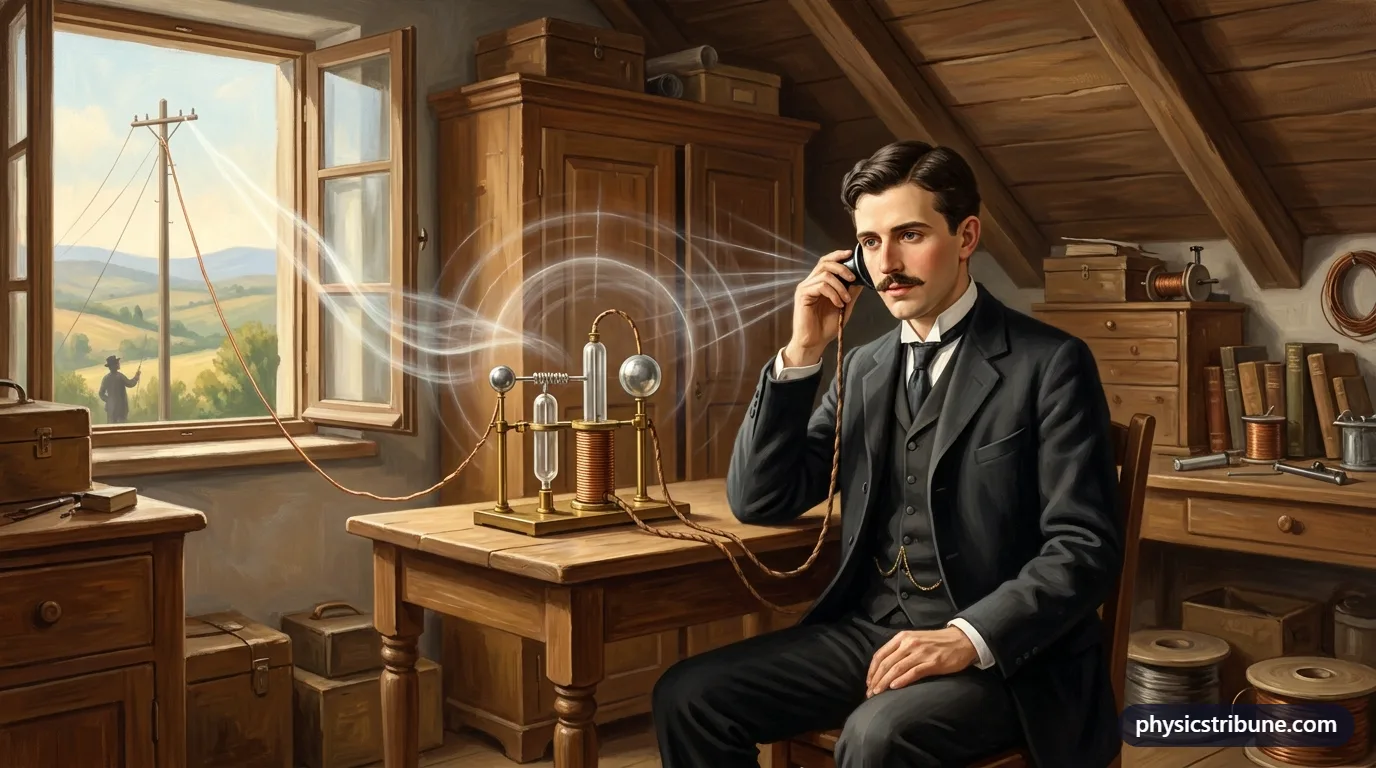
He read eagerly about electricity and was especially struck by reports of Hertz's experiments with radio waves. Around 1894 and 1895, at the family estate near Bologna, he began building his own transmitters and receivers in an attic workroom.
His key improvements were practical ones. He connected one side of his spark transmitter to a tall raised wire, an antenna, and the other to the ground. That simple change greatly increased the range, and by 1895 he could send signals over roughly two kilometers, even past a hill that blocked the line of sight.
| Year | Event |
|---|---|
| 1874 | Born in Bologna, Italy, on April 25 |
| 1894 to 1895 | Builds his first transmitters and receivers at the family estate |
| 1896 | Moves to London and files a British patent for wireless telegraphy |
| 1897 | Sends signals across the Bristol Channel and founds his wireless company |
| 1899 | Signals cross the English Channel between England and France |
| 1901 | Reports receiving the letter S in Newfoundland from Cornwall on December 12 |
| 1909 | Shares the Nobel Prize in Physics with Karl Ferdinand Braun |
| 1912 | Radio calls from the Titanic bring the Carpathia to the rescue |
| 1920s | Develops short-wave beam systems for long-distance links |
| 1937 | Dies in Rome on July 20 |
| Source: Birth and death dates from our physicists data file (Wikidata, CC0); Nobel year from nobelprize.org; other years are standard biographical dates · Retrieved October 2026 | |
Why Did Marconi Move to Britain?
Marconi hoped the Italian authorities would support his work, but they showed little interest. In 1896 he traveled to London with his mother, whose family connections helped open doors. There he found a strong supporter in William Preece, the chief engineer of the British Post Office.
He filed a British patent for his wireless system in 1896, and it was granted the following year. Public demonstrations followed, including signals sent across the Bristol Channel in 1897, several kilometers over open water.
Also in 1897 he founded a company to develop and sell his equipment, later known as Marconi's Wireless Telegraph Company. In 1899 his signals crossed the English Channel between England and France, and ships began to carry his sets so they could keep in touch with the shore.
How Did Marconi Send a Signal Across the Atlantic?
Many scientists doubted that radio could cross an ocean. They reasoned that radio waves travel in straight lines like light, so the curve of the Earth should block them after a few hundred kilometers at most. Marconi decided to try anyway.
He built a powerful transmitting station at Poldhu in Cornwall, England, and set up a receiver at Signal Hill in St. John's, Newfoundland, with its antenna wire lifted by a kite. On December 12, 1901, he reported hearing the faint repeated clicks of the Morse code letter S, three short dots, sent from Cornwall about 3,500 km away.
Some experts questioned whether he had really heard it, but later tests on ships and between permanent stations confirmed that long-distance radio worked. The explanation came later: a layer of charged gas high in the atmosphere, now part of the ionosphere, bends radio waves back toward the ground so they can travel around the curve of the Earth. Marconi also noticed that his signals traveled much farther at night than by day, a clue to how that layer changes with sunlight.
How Did Marconi's Wireless Telegraph Work?
Marconi's early transmitters used a spark gap. A high voltage jumped across a small gap between two metal balls, and each spark set up rapid electrical oscillations in the antenna. Those oscillations launched electromagnetic waves that spread outward at the speed of light.
An operator tapped a Morse key to turn the sparks on and off in short and long bursts, spelling out letters as dots and dashes. At the receiver, another antenna picked up a tiny current from the passing waves, and a detector turned it into clicks or marks an operator could read.
Spark signals were noisy and spread across many frequencies, so nearby stations interfered with each other. Tuned circuits, which made transmitter and receiver respond mainly to one frequency, were a major improvement, and Braun's work on such circuits is part of why the two men shared the Nobel Prize. Our page on analog and digital signals shows how Morse code compares with later ways of carrying information.

What Role Did Marconi's Radio Play in the Titanic Disaster?
By 1912 many large ships carried wireless operators employed by Marconi's company. When the Titanic struck an iceberg in April 1912, its operators sent distress calls by radio. The ship Carpathia picked them up and raced to the scene, rescuing the survivors in the lifeboats.
The disaster showed both the power and the gaps of wireless. Afterward, new international rules required ships to keep a radio watch around the clock, and wireless became standard safety equipment at sea.
In later years Marconi turned to shorter wavelengths. In the 1920s he developed beam systems that used short waves and directional antennas to link distant countries more efficiently than the old long-wave stations. He also experimented with even shorter waves, in the range we would now call microwaves.
The Key Equation Behind Marconi's Radio
Marconi worked mostly by experiment, but every radio wave he sent obeys the relation
Wavelength matters for antenna design, because an efficient antenna is usually a sizable fraction of the wavelength long. That is why early long-wave stations needed enormous wire arrays, while a modern phone antenna fits inside a slim case. Try other stations in our frequency and wavelength calculator, or compare the two quantities on frequency vs wavelength.
Every radio wave travels at the speed of light, so its frequency and wavelength are linked by this relation, shown with each variable and its unit.
| Symbol | Quantity | SI unit |
|---|---|---|
| speed of light in vacuum (2.998 × 10⁸ m/s (exact: 299 792 458 m/s)) | meter per second (m/s) | |
| frequency | hertz (Hz) | |
| wavelength in vacuum | meter (m) |
Rearranged to find another variable:
Valid for: electromagnetic waves in vacuum.
Example 1 How long is a longwave radio wave?
A longwave broadcast station transmits at a frequency of 180 kHz (1.8 × 10^5 Hz). What is the wavelength of its radio waves?
- Given:
- speed of light in vacuum:
- frequency:
- speed of light in vacuum:
- Formula:
- Substitute:
- Answer:
A wavelength longer than a dozen football fields explains why early stations needed such huge antennas strung between tall masts.
Example 2 A message across the ocean
A radio signal travels about 3,500 km (3.5 × 10^6 m) from Cornwall in England to Newfoundland in Canada at the speed of light. How long does the trip take?
- Given:
- speed of radio waves:
- distance traveled:
- speed of radio waves:
- Formula:
- Substitute:
- Answer:
A ship carrying a letter needed about a week for the same crossing, which is why wireless changed shipping and news so quickly.
| Band (typical example) | Frequency | Wavelength (computed) |
|---|---|---|
| Long wave broadcast | 180 kHz | about 1,666 m |
| AM medium wave | 1,000 kHz | about 300 m |
| Short wave | 10 MHz | about 30 m |
| FM radio | 100 MHz | about 3.0 m |
| Wi-Fi | 2.4 GHz | about 12.5 cm |
| Source: Computed with λ = c / f, c = 299,792,458 m/s (data/constants.json, NIST CODATA 2022); frequencies are typical values · Retrieved October 2026 | ||
Later Life and Legacy
Marconi received many honors in Italy, including a seat in the Italian Senate and the title of marquis. In his later years he was closely associated with Benito Mussolini's government and served as president of the Royal Academy of Italy, a part of his life that historians view critically.
He died in Rome on July 20, 1937, at the age of 63. As a tribute, many radio stations around the world fell silent for a short time during his funeral.
Credit for radio is shared. Hertz showed that the waves exist, inventors such as Nikola Tesla, Oliver Lodge and Jagadish Chandra Bose built related devices, and patent disputes went on for decades. Marconi's lasting contribution was showing, step by step, that radio could reach across countries and oceans, the foundation for broadcasting, navigation and wireless communication today.
Key Facts
- Guglielmo Marconi was born in Bologna on April 25, 1874, and died in Rome on July 20, 1937.
- By adding a tall antenna and a ground connection, he greatly extended the range of radio signals in 1895.
- He filed a British patent for wireless telegraphy in 1896 and founded his wireless company in 1897.
- On December 12, 1901, he reported receiving the Morse letter S across the Atlantic, from Cornwall to Newfoundland.
- He shared the 1909 Nobel Prize in Physics with Karl Ferdinand Braun for wireless telegraphy.
- Radio calls from the Titanic in 1912 were sent by operators working for Marconi's company.
- Long-distance radio works partly because the ionosphere bends radio waves back toward the ground.
Quick Quiz: How Well Do You Know Guglielmo Marconi?
6 questions. Tap an answer to check it.
Which change did Marconi make that greatly increased the range of his early transmitter?
A raised antenna and a ground connection let his signals reach kilometers instead of meters.
What message was sent in the first transatlantic radio test in 1901?
Three short dots, the Morse code for S, were repeated from Cornwall to Newfoundland.
Who shared the 1909 Nobel Prize in Physics with Marconi?
Braun shared the prize for his own contributions to wireless telegraphy.
What part of the atmosphere helps radio waves travel beyond the horizon?
Charged gas in the ionosphere bends some radio waves back toward Earth.
If a radio station's frequency doubles, what happens to its wavelength?
With c = f λ and c fixed, wavelength is inversely proportional to frequency.
In which country did Marconi file his first patent for wireless telegraphy?
After Italian officials showed little interest, he patented his system in Britain in 1896.
Frequently Asked Questions
What is Guglielmo Marconi famous for?
Marconi is famous for developing the first practical system of long-distance wireless telegraphy, the forerunner of radio. He extended the range of radio signals from a few hundred meters to thousands of kilometers, and in 1901 he reported a signal sent across the Atlantic Ocean. He shared the 1909 Nobel Prize in Physics for this work.
Did Marconi invent the radio?
Marconi did not discover radio waves, which Hertz produced in the late 1880s, and several inventors built similar devices around the same time. What Marconi achieved was turning radio into a working long-distance communication system, with patents, companies and stations on several continents. That is why he is often called the father of radio, although the credit is shared.
When did Marconi send the first transatlantic radio signal?
Marconi reported receiving the first transatlantic radio signal on December 12, 1901. The signal, the Morse code letter S, was sent from a station at Poldhu in Cornwall, England, and heard at Signal Hill in St. John's, Newfoundland. The distance is about 3,500 km, and some scientists at the time doubted the result.
Why did Marconi win the Nobel Prize?
Marconi shared the 1909 Nobel Prize in Physics with Karl Ferdinand Braun in recognition of their contributions to the development of wireless telegraphy. Marconi had shown that radio could carry messages over great distances, while Braun had improved transmitters with tuned circuits that made signals stronger and allowed stations to use separate frequencies.
How could radio waves cross the Atlantic if the Earth is curved?
Radio waves travel in straight lines through open space, but a layer of charged gas high in the atmosphere, part of the ionosphere, reflects or bends certain radio frequencies back toward the ground. The waves can bounce between this layer and the Earth's surface, letting them travel far beyond the horizon, especially at night.
What was Marconi's connection to the Titanic?
The Titanic's two wireless operators were employees of Marconi's company, using Marconi equipment. After the ship hit an iceberg in April 1912, they sent radio distress calls that reached the Carpathia, which rescued the survivors. The tragedy led to new rules requiring ships to keep a radio watch at all hours.
Was Marconi a physicist or an inventor?
Marconi was mainly an inventor and engineer. He never completed a university degree and made progress chiefly by building, testing and improving equipment. Even so, his work raised real physics questions, such as how radio waves travel around the Earth, and he received the Nobel Prize in Physics for it.
How did Marconi die?
Marconi died of heart problems in Rome on July 20, 1937, at the age of 63. He had suffered several heart attacks in his final years. During his funeral, many radio stations around the world briefly went silent as a mark of respect for the man who had done so much to create wireless communication.
Keep Exploring




Sources
Constants come from NIST CODATA 2022 (public domain) and unit definitions from the BIPM SI Brochure (CC BY 4.0). Text, diagrams and illustrations are original work by Physics Tribune.