
At a Glance
Refraction happens because light travels at different speeds in different materials. When a light ray crosses a boundary at an angle, one side of the beam changes speed first and the beam turns. How much it bends is set by Snell's law, n1 sin θ1 = n2 sin θ2.
- What it is
- Bending of light at a boundary between two materials
- Cause
- Light changes speed when it enters a new material
- Governed by
- Snell's law: n1 sin θ1 = n2 sin θ2
- Key property
- Index of refraction, n = c / v
- Into a slower material
- Bends toward the normal
- Into a faster material
- Bends away from the normal
On this page
- What Causes Refraction of Light?
- How Does Refraction Work Step by Step?
- What Is the Physics Behind Refraction?
- How Fast Does Light Travel in Different Materials?
- Where Do You See Refraction in Everyday Life?
- How Do Lenses Use Refraction?
- What Phenomena Are Related to Refraction?
- How Can You See Refraction at Home?
- Common Misconceptions
- Key Facts
- Quiz
- FAQ
What Causes Refraction of Light?
Refraction is caused by a change in speed. In empty space, light travels at its top speed of 299,792,458 m/s. Inside air, water, glass or plastic, it moves more slowly, because it interacts with the electrons in the material as it passes through. Each material has its own speed for light.
If a beam crosses into a new material head-on, it simply slows down or speeds up and carries on in the same direction. If it arrives at a slant, the part of the beam that crosses first changes speed before the rest. That difference swings the whole beam onto a new path, and the beam bends.
So refraction needs two things: a change in the speed of light and a ray that meets the boundary at an angle. Take away either one and the light goes straight on.
How Does Refraction Work Step by Step?
Follow a beam of sunlight as it enters a calm lake at a slant:
- The beam approaches. In air, the whole width of the beam moves at nearly the vacuum speed.
- One edge arrives first. Because the beam is tilted, its lower edge touches the water before its upper edge.
- That edge slows down. In water, light travels at roughly three quarters of its speed in air, so the leading edge falls behind.
- The beam pivots. While the trailing edge is still moving fast in the air, the slowed edge acts like a hinge, and the beam turns toward the normal.
- It continues straight. Once the entire beam is underwater, it travels in a straight line again, just in a new direction.
A car drifting onto a sandy shoulder behaves the same way. The wheels that hit the sand first slow down and the car swerves toward the sand. Reverse the trip and the beam bends away from the normal as it speeds up.
What Is the Physics Behind Refraction?
Physicists describe how slow a material is with its index of refraction,
The exact amount of bending comes from Snell's law,
When light changes speed, its frequency stays the same, set by the source. Since speed equals frequency times wavelength, the wavelength must shrink in a slower material. The color you see does not change, because your eye responds to frequency.

How Fast Does Light Travel in Different Materials?
The table below uses typical indices of refraction to show how much light slows down in common transparent materials. Even in diamond, light still covers more than 120,000 km every second, but that is only about 41 percent of its speed in a vacuum (computed).
The bigger the drop in speed across a boundary, the more sharply light bends there. That is why a glass bead in water is hard to see, since the two speeds are close, while the same bead in air sparkles clearly. For a deeper look at the slowdown itself, read why light travels slower in water.
| Material | Typical index of refraction (n) | Speed of light (km/s) | Share of vacuum speed |
|---|---|---|---|
| Vacuum | 1 (exact) | 299,792 | 100% |
| Air | 1.0003 | 299,703 | about 100% |
| Ice | 1.31 | 228,849 | 76.3% |
| Water | 1.33 | 225,408 | 75.2% |
| Acrylic plastic | 1.49 | 201,203 | 67.1% |
| Crown glass | 1.52 | 197,232 | 65.8% |
| Diamond | 2.42 | 123,881 | 41.3% |
| Source: Computed with v = c / n, c = 299 792 458 m/s (NIST CODATA 2022, exact) · indices are typical values for yellow light · Retrieved October 2026 | |||
Where Do You See Refraction in Everyday Life?
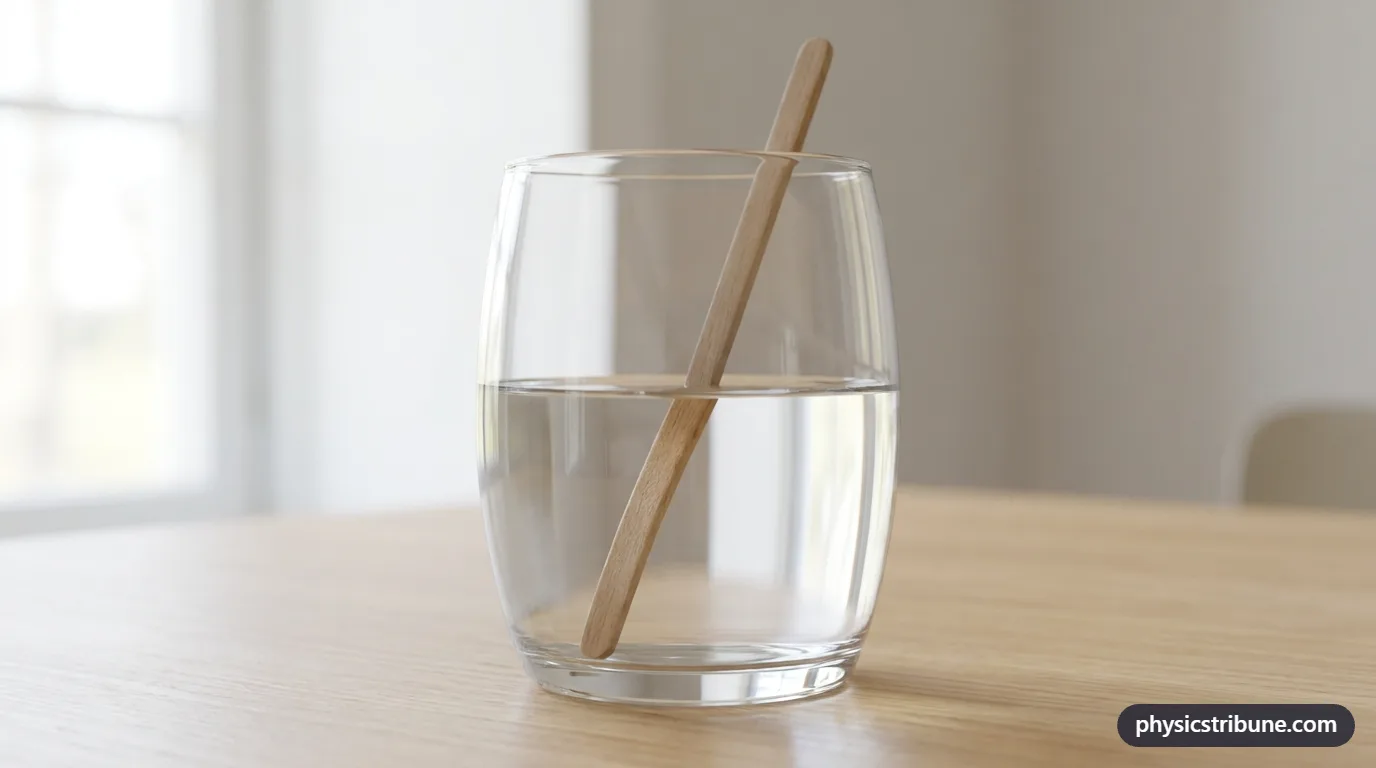
- A straw in a glass. The straw seems to snap at the water line because light from the underwater part bends as it leaves the water.
- Shallow-looking pools. Rays from the bottom bend away from the normal on the way out, so your brain places the bottom higher than it really is. This is called apparent depth.
- Eyeglasses and contact lenses. Curved surfaces refract light by just the right amount to focus it on the retina.
- Your own eyes. The cornea does most of the bending in the human eye, and the lens fine-tunes the focus.
- Rainbows. Raindrops refract sunlight, and each color bends by a slightly different amount.
- Twinkling stars. Moving pockets of warm and cool air refract starlight in shifting directions.
- Spearfishing. A fish is not where it appears to be, so people who fish with spears learn to aim below the image.
For many more cases, sorted by setting, see our list of examples of refraction.

How Do Lenses Use Refraction?
A lens is a piece of glass or plastic with curved faces. Because the surface is tilted differently at each point, rays hitting different parts of the lens bend by different amounts. A convex lens, thicker in the middle, bends parallel rays inward so they meet at a focal point. A concave lens, thinner in the middle, spreads them apart.
Every camera, microscope, telescope, projector and pair of glasses depends on this controlled bending. Lens designers stack several lenses made of different glasses so that their errors cancel and the final image is sharp from edge to edge.
What Phenomena Are Related to Refraction?
Dispersion. The index of a material depends slightly on color, with violet usually bending more than red. A prism uses this to fan white light into a spectrum, as explained on our dispersion of light page.
Total internal reflection. When light inside water or glass hits the surface at too steep an angle, it cannot escape and reflects back completely. This is total internal reflection, and it begins at the critical angle.
Mirages. Air near a hot road is less dense than the air above it, so light curves gradually rather than bending at one sharp boundary. The result is the shimmering false puddle known as a mirage.
Refraction is easy to confuse with reflection and diffraction. Compare them side by side in reflection vs refraction and diffraction vs refraction.

How Can You See Refraction at Home?
Put a coin at the bottom of an empty mug and step back until the rim just hides it. Without moving your head, have a friend slowly pour water into the mug. The coin rises into view, because light from it now bends at the water surface and clears the rim.
For a measurable version with a ray box and a rectangular block, follow our refraction through a glass block experiment, then check your angles with the Snell's law calculator. Printable practice is in our reflection and refraction worksheets.
Common Misconceptions
Myth: Light bends because it bounces off the surface of the water.
Physics: Bouncing is reflection. Refraction is the light that passes into the water and changes direction because it changes speed.
Myth: Refraction changes the color of light.
Physics: Color depends on frequency, which stays the same. Only the speed and wavelength change inside the new material.
Myth: Light always bends when it enters a new material.
Physics: Light that strikes the boundary straight on, along the normal, keeps its direction even though it changes speed.
Key Facts
- Refraction is the bending of light as it passes at an angle from one material into another.
- It happens because light travels at different speeds in different materials.
- Light bends toward the normal when it slows down and away from the normal when it speeds up.
- A ray that meets a boundary head-on changes speed but does not bend.
- The amount of bending is given by Snell's law, n1 sin θ1 = n2 sin θ2.
- During refraction the frequency of light stays the same while its wavelength changes.
- Lenses, eyes, prisms and rainbows all depend on refraction.
Quick Quiz: How Well Do You Know Refraction of Light?
5 questions. Tap an answer to check it.
What is the main cause of refraction?
Refraction happens because light changes speed when it moves into a different material.
Light passes from air into glass at an angle. Which way does it bend?
Glass is slower for light than air, so the ray bends toward the normal.
Which property of light stays the same during refraction?
The frequency is set by the source and does not change; speed and wavelength do.
Why does a swimming pool look shallower than it really is?
Rays from the bottom bend away from the normal at the surface, so the bottom appears higher.
In which material does light travel slowest?
Diamond has the highest index of these, about 2.42, so light is slowest there.
Frequently Asked Questions
What is refraction of light in simple words?
Refraction is the bending of light when it moves from one see-through material into another, such as from air into water. It happens because light travels at a different speed in each material. When a ray enters at a slant, one side slows down or speeds up first, and the ray turns onto a new path.
What causes refraction?
Refraction is caused by a change in the speed of light at a boundary between materials. Light is slower in water and glass than in air because it interacts with the electrons in those materials. If the light meets the boundary at an angle, the change in speed happens on one side of the beam first, which turns the beam.
Does light bend toward or away from the normal?
It depends on which way the light is going. When light enters a slower material with a higher index of refraction, such as going from air into glass, it bends toward the normal. When it enters a faster material with a lower index, such as going from water into air, it bends away from the normal.
What are three examples of refraction?
A pencil or straw that looks broken where it enters a glass of water is one example. A swimming pool that looks shallower than it really is is another. A third is a magnifying glass, which uses curved surfaces to bend light and make small objects look larger. Rainbows and eyeglasses also rely on refraction.
What is the law of refraction?
The law of refraction, also called Snell's law, states that n1 sin θ1 = n2 sin θ2. The n values are the indices of refraction of the two materials, and the θ values are the angles of the ray measured from the normal. It also states that the incoming and refracted rays lie in the same plane as the normal.
What is the difference between reflection and refraction?
In reflection, light bounces back from a surface into the material it came from, leaving at the same angle it arrived. In refraction, light passes through the surface into a new material and changes direction because its speed changes. At most boundaries, both happen at once: some light reflects and the rest refracts.
Why does a straw look bent in water?
Light from the underwater part of the straw speeds up as it leaves the water and bends away from the normal at the surface. Your eyes assume light travels in straight lines, so they trace the rays back to a point higher than the real straw. The underwater part seems lifted and shifted, making the straw look broken.
Does refraction happen with sound and water waves too?
Yes. Any wave that changes speed can refract. Ocean waves slow down in shallow water, so they bend toward the beach as they approach. Sound bends when it passes between layers of warm and cool air, which is why sounds can sometimes carry unusually far across a lake on a calm evening.
Keep Exploring
 lightSnell's Law
 lightIndex of Refraction
 lightTotal Internal Reflection
 lightDispersion of Light (Prisms)
 examplesExamples of Refraction
 compareReflection vs Refraction
 experimentsRefraction through a glass block
 questionsWhy does light travel slower in water?
 calculatorsSnell's Law & Critical Angle Calculator
Sources
Constants come from NIST CODATA 2022 (public domain) and unit definitions from the BIPM SI Brochure (CC BY 4.0). Text, diagrams and illustrations are original work by Physics Tribune.