
At a Glance
Every material responds to a magnetic field in one of three main ways. Ferromagnets (iron, nickel, cobalt) are strongly attracted and can become permanent magnets; paramagnets (aluminum, oxygen) are weakly attracted; diamagnets (water, copper, bismuth) are weakly repelled. Inside a long coil the field is B = μ0 n I, and a ferromagnetic core multiplies it by its relative permeability μr.
- Ferromagnetic
- Strongly attracted, can stay magnetized (iron, nickel, cobalt)
- Paramagnetic
- Weakly attracted, no lasting magnetism (aluminum, oxygen, platinum)
- Diamagnetic
- Weakly repelled, present in all matter (water, copper, bismuth)
- Measured by
- Magnetic susceptibility χ (dimensionless) or relative permeability μr = 1 + χ
- Key temperature
- Curie temperature, above which a ferromagnet becomes paramagnetic
- Origin
- Electron spin and orbital motion inside atoms
On this page
- What Is Ferromagnetism?
- Ferromagnetism Explained Simply
- How Do Magnetic Domains Work?
- What Is the Difference Between Soft and Hard Ferromagnets?
- What Is Paramagnetism?
- What Is Diamagnetism?
- How Is Magnetic Strength of a Material Measured?
- What Happens to a Ferromagnet When It Is Heated?
- Where Are Magnetic Materials Used?
- Going Deeper: Are There Other Kinds of Magnetic Order?
- Practice Magnetism Problems
- Common Misconceptions
- Key Facts
- Quiz
- FAQ
What Is Ferromagnetism?
Ferromagnetism is the kind of magnetism you meet every day: a fridge magnet clinging to a door, a paper clip jumping to a magnet, a steel screwdriver that picks up screws after it has touched a magnet. Only a handful of elements show it at room temperature, mainly iron, nickel and cobalt, along with many of their alloys and some compounds.
What makes these materials special is teamwork. Each atom carries a tiny magnetic moment, a built-in north and south pole that comes from the spin of its electrons. In a ferromagnet, a quantum effect called the exchange interaction makes neighboring moments line up parallel to one another, so billions of atoms act together as one strong magnet.
Ferromagnetism is the strongest of three main magnetic responses. The other two, paramagnetism and diamagnetism, are thousands to millions of times weaker, so you normally need a laboratory magnet to notice them at all.
Ferromagnetism Explained Simply
Imagine a stadium full of people each holding a small arrow. In most materials everyone points a random way, so the crowd as a whole points nowhere. In a paramagnet, people turn a little toward a loudspeaker announcement (the magnetic field) but drift back as soon as it stops. In a ferromagnet, people copy their neighbors, so whole sections of the stadium already point the same way.
Those sections are called magnetic domains. In an ordinary iron nail, different domains point different ways and cancel, so the nail is not a magnet. Bring a magnet close and the domains that point along its field grow while the others shrink. Suddenly the nail is a magnet too, and it grabs a paper clip.
Diamagnets are the stubborn ones. Every atom pushes back very slightly against any field, a little like a spring resisting a push, so a diamagnetic object is gently repelled.

How Do Magnetic Domains Work?
A domain is a region, often a fraction of a millimeter across, in which all the atomic moments point the same way. Splitting a crystal into many domains with different directions lowers the energy stored in the field outside it, which is why an unmagnetized lump of iron settles into a patchwork that cancels overall.
When an outside field is applied, the walls between domains move. Domains aligned with the field grow at the expense of their neighbors, and at stronger fields whole domains rotate into line. Once nearly every moment points the same way, the material is saturated and cannot be magnetized further; for iron this happens at roughly 2 tesla.
Remove the field and the domain walls do not always slide back. Some get stuck on impurities and crystal defects, leaving the material partly magnetized. This lagging behavior is called hysteresis, and it is the reason permanent and induced magnets behave so differently. The diagram below shows the field of a fully magnetized bar.

What Is the Difference Between Soft and Hard Ferromagnets?
Engineers sort ferromagnets by how easily their domains move. A soft magnetic material, such as pure iron or silicon steel, magnetizes strongly in a weak field and loses almost all of it when the field is switched off. That is exactly what you want inside an electromagnet or a transformer core, where the field must follow the current.
A hard magnetic material, such as an alnico alloy, a ceramic ferrite or a neodymium-iron-boron compound, resists changes. It takes a strong field to magnetize it and an equally strong one to undo the job, so once magnetized it stays that way for decades. Fridge magnets, motor magnets and speaker magnets are all hard.
Our electromagnet vs permanent magnet comparison follows this idea into everyday devices.

What Is Paramagnetism?
Paramagnetic materials contain atoms or molecules with unpaired electrons, so each one has its own small magnetic moment. Unlike a ferromagnet, the moments do not influence each other much. Without a field, heat jostles them into random directions and the material shows no magnetism.
In a field, the moments tilt slightly toward alignment, and the material is weakly pulled toward the stronger part of the field. Aluminum, platinum, magnesium and oxygen gas are common examples. Liquid oxygen shows the effect dramatically: poured between the poles of a strong magnet, it hangs there in a pale blue bridge.
Because heat fights the alignment, paramagnetism grows weaker as temperature rises. Pierre Curie measured this in 1895 and found that the susceptibility is inversely proportional to the absolute temperature,
What Is Diamagnetism?
Diamagnetism is present in every substance. When a field is applied, the motion of the electrons around each atom adjusts so as to create a tiny moment pointing against the field, a response that resembles Lenz's law on the scale of a single atom. The result is a weak push away from strong fields.
In most materials this effect is hidden underneath paramagnetism or ferromagnetism. It shows up clearly only in substances whose electrons are all paired, such as water, copper, gold, carbon, bismuth and most organic matter. Bismuth and pyrolytic graphite are the strongest common diamagnets; a thin slice of pyrolytic graphite will float above a grid of strong neodymium magnets.
Water is diamagnetic too, and because living things are mostly water, a strong enough field can levitate them. In 1997 researchers in the Netherlands floated a live frog inside a magnet of about 16 tesla, and the frog was unharmed. Superconductors push the idea to the limit by expelling the field completely, which our magnetic levitation page explains.
How Is Magnetic Strength of a Material Measured?
Physicists describe a material's response with its magnetic susceptibility χ, a pure number. It is positive for paramagnets and ferromagnets and negative for diamagnets. An equivalent number is the relative permeability
For paramagnets and diamagnets, μr is extremely close to 1, differing only in the third to sixth decimal place. For soft ferromagnets it can be hundreds or many thousands, although the value depends on the field strength and drops toward 1 as the material saturates. The table below compares typical values.
This is why a ferromagnetic core is so useful. The field inside a long coil is
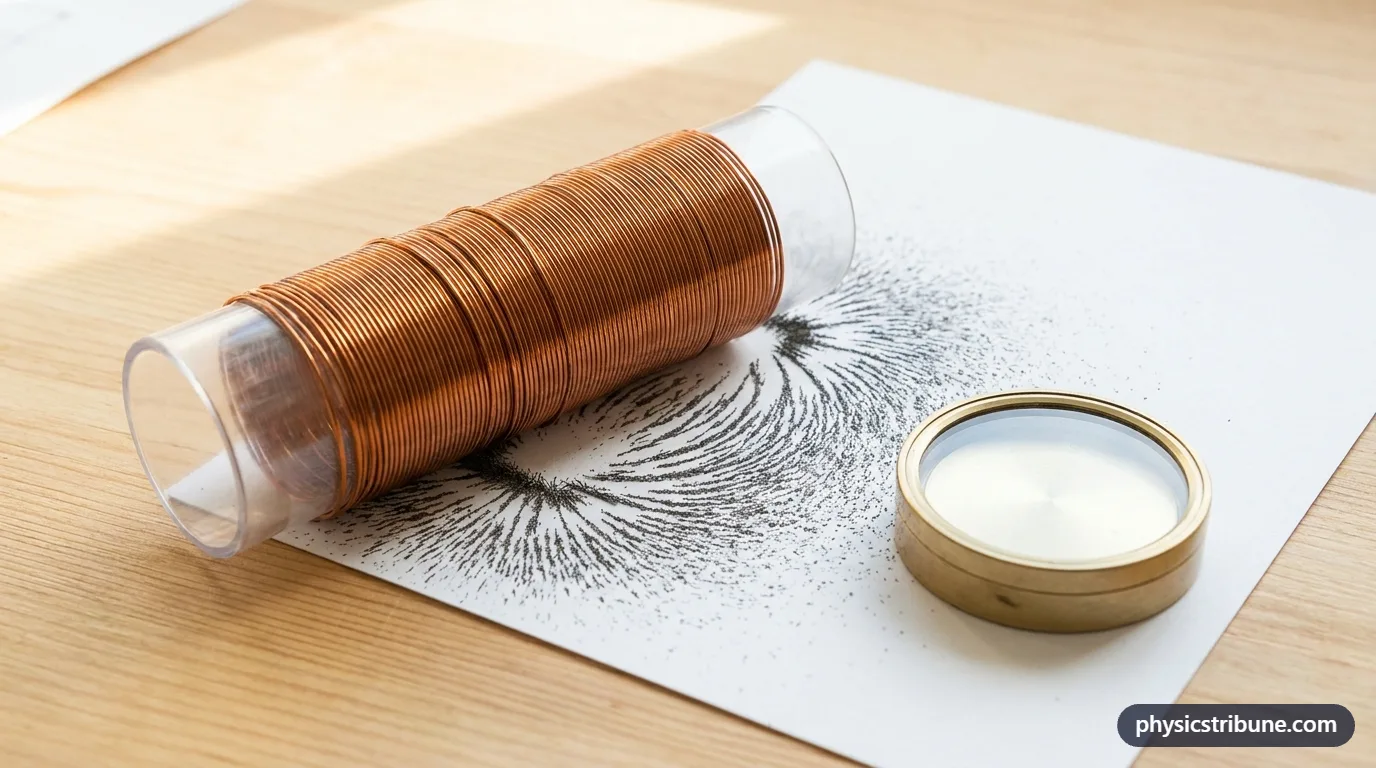
The field inside a long air-core coil is set by the turns per meter and the current. Filling the coil with a ferromagnetic core multiplies this field by the core's relative permeability.
| Symbol | Quantity | SI unit |
|---|---|---|
| magnetic field inside | tesla (T) | |
| permeability of free space (4π × 10⁻⁷ T·m/A (approximately; 1.2566 × 10⁻⁶ T·m/A)) | tesla meter per ampere (T·m/A) | |
| turns per unit length (N/ℓ) | per meter (1/m) | |
| current | ampere (A) | |
| total number of turns | dimensionless (1) | |
| length of the solenoid | meter (m) |
Rearranged to find another variable:
Valid for: long ideal solenoid, far from the ends; air core.
Example 1 An empty coil
A coil is wound with 1,500 turns per meter and carries 0.8 A. Using μ0 = 1.25663706127 × 10⁻⁶ T·m/A, what is the magnetic field inside it with only air in the middle?
- Given:
- turns per unit length (N/ℓ):
- current:
- turns per unit length (N/ℓ):
- Formula:
- Substitute:
- Answer:
About a millitesla and a half: noticeable, but too weak to lift much.
Example 2 The same coil with an iron core
The same coil (1,500 turns per meter, 0.8 A) is slid over a soft iron rod with an effective relative permeability μr of 600. Using μ0 = 1.25663706127 × 10⁻⁶ T·m/A, what is the field inside the iron?
- Given:
- turns per unit length (N/ℓ):
- current:
- μr:
- turns per unit length (N/ℓ):
- Formula:
- Substitute:
- Answer:
This simple estimate only holds below saturation. Iron saturates near 2 T, so real cores never multiply the field without limit.
| Material | Type | Susceptibility χ (SI, approx.) | Response to a magnet |
|---|---|---|---|
| Bismuth | Diamagnetic | about −1.7 × 10⁻⁴ | Weakly repelled |
| Copper | Diamagnetic | about −1 × 10⁻⁵ | Very weakly repelled |
| Water | Diamagnetic | about −9 × 10⁻⁶ | Very weakly repelled |
| Aluminum | Paramagnetic | about +2 × 10⁻⁵ | Very weakly attracted |
| Platinum | Paramagnetic | about +3 × 10⁻⁴ | Weakly attracted |
| Liquid oxygen | Paramagnetic | about +3.5 × 10⁻³ | Clearly attracted |
| Nickel | Ferromagnetic | roughly 100 to 600 | Strongly attracted |
| Soft iron | Ferromagnetic | hundreds to several thousand | Strongly attracted |
| Source: Typical published values; ferromagnetic values depend strongly on purity, processing and field strength · Retrieved October 2026 | |||
What Happens to a Ferromagnet When It Is Heated?
Heat makes atoms vibrate, and the vibration works against the exchange interaction that keeps neighboring moments aligned. As a ferromagnet warms up, its magnetization drops slowly at first and then steeply. At a sharp temperature called the Curie temperature, the order disappears completely and the material becomes paramagnetic.
Cool it back down and the ferromagnetism returns, but the domains form in random directions, so a heated permanent magnet comes back unmagnetized. Iron loses its ferromagnetism at about 770 °C, while gadolinium loses it just below room temperature, which makes a gadolinium sample switch from magnetic to nonmagnetic in a warm hand.
Rocks use this effect to record history. Lava contains magnetite grains that cool through their Curie temperature in Earth's field and lock in its direction, preserving a record of how the planet's magnetic field has flipped over millions of years.
| Material | Curie temperature (°C) | Curie temperature (K) | Magnetic at room temperature? |
|---|---|---|---|
| Cobalt | about 1,115 | about 1,388 | Yes |
| Iron | about 770 | about 1,043 | Yes |
| Magnetite (iron oxide) | about 580 | about 853 | Yes |
| Nickel | about 355 | about 628 | Yes |
| Gadolinium | about 20 | about 293 | Only when cool |
| Source: Typical published values, rounded; kelvin column computed as °C + 273.15 and rounded · Retrieved October 2026 | |||
Where Are Magnetic Materials Used?
- Motors and generators use hard magnets for the steady field and soft iron to guide it.
- Transformers and inductors wrap their coils around soft iron or ferrite cores to multiply and channel the field.
- Data storage on hard drives and magnetic stripes writes bits as tiny regions magnetized one way or the other.
- Recycling plants pull steel cans out of mixed waste with magnets, while spinning magnetic rotors push aluminum cans away using induced currents.
- Medical imaging in an MRI scanner relies on the weak magnetism of atomic nuclei, and contrast agents use strongly paramagnetic gadolinium compounds.
- Compasses use a magnetized steel needle that a weak field can turn, as our compass page describes.
Example 3 Current for a target field in a cored coil
A relay coil has 2,000 turns per meter around a ferrite core with an effective relative permeability μr of 250. Using μ0 = 1.25663706127 × 10⁻⁶ T·m/A, what current produces a field of 0.1 T in the core?
- Given:
- magnetic field inside:
- turns per unit length (N/ℓ):
- μr:
- magnetic field inside:
- Formula:
- Substitute:
- Answer:
Without the core the same field would need 250 times the current, which is why almost every relay and transformer is built around a ferromagnetic core.
Going Deeper: Are There Other Kinds of Magnetic Order?
Yes. In an antiferromagnet, such as manganese oxide, neighboring moments line up in opposite directions and cancel, so the material looks almost nonmagnetic from outside. In a ferrimagnet, opposite moments have different sizes and only partly cancel, leaving a net magnetism. Magnetite, the mineral in lodestone, and the ceramic ferrites in fridge magnets are ferrimagnets.
All of this ordering is quantum mechanical at heart. Classical physics cannot explain why electron spins in iron prefer to line up, and the exchange interaction only made sense after quantum theory arrived in the 1920s.
Practice Magnetism Problems
Our magnetism worksheets include questions on sorting materials, domains and coil fields with printable answer keys. For the basics of poles and fields, start with the magnets page, then test yourself with the quiz below.
Common Misconceptions
Myth: Only iron is magnetic, and everything else ignores magnets.
Physics: Every material responds to a magnetic field. Most responses are too weak to feel, but strong lab magnets attract paramagnets and repel diamagnets such as water and copper.
Myth: An iron nail is not a magnet because its atoms are not magnetic.
Physics: Its atoms are strongly magnetic and aligned within domains. The domains simply point in different directions and cancel until a field lines them up.
Myth: Heating a magnet makes it stronger because the atoms move faster.
Physics: Heat disrupts alignment. A ferromagnet weakens as it warms and loses its magnetism entirely at the Curie temperature.
Myth: Diamagnetism is just a weak form of paramagnetism.
Physics: They have opposite signs and different causes. Paramagnetism comes from permanent atomic moments turning toward the field; diamagnetism comes from induced moments opposing it.
Key Facts
- Ferromagnetic materials such as iron, nickel and cobalt are strongly attracted to magnets and can become permanent magnets.
- Paramagnetic materials such as aluminum and oxygen are weakly attracted and lose their magnetism when the field is removed.
- Diamagnetic materials such as water, copper and bismuth are weakly repelled by magnetic fields, and every material has some diamagnetism.
- Ferromagnets are divided into domains, regions where all atomic moments point the same way.
- Above its Curie temperature, about 770 °C for iron, a ferromagnet becomes paramagnetic.
- Relative permeability μr = 1 + χ tells how many times a material multiplies a magnetic field.
- Pierre Curie found in 1895 that paramagnetic susceptibility falls as 1/T.
Quick Quiz: How Well Do You Know Ferromagnetism, Paramagnetism and Diamagnetism?
6 questions. Tap an answer to check it.
Which material is strongly attracted to a magnet?
Nickel is one of the three ferromagnetic elements at room temperature.
What is a magnetic domain?
Domains are aligned regions inside a ferromagnet.
A diamagnetic material placed near a strong magnet is
Diamagnets develop moments that oppose the applied field, so they are pushed away.
What happens to iron above its Curie temperature?
Thermal motion destroys the long-range alignment, leaving only weak paramagnetism.
A coil's field is 1.5 mT with air inside. With a core of relative permeability 400 (below saturation) the field is about
The core multiplies the field by μr: 1.5 mT × 400 = 600 mT.
Which law says paramagnetic susceptibility is proportional to 1/T?
Pierre Curie found the inverse-temperature rule in 1895.
Frequently Asked Questions
What is the difference between ferromagnetic, paramagnetic and diamagnetic?
Ferromagnetic materials are strongly attracted to magnets and can stay magnetized, because their atomic moments line up together in domains. Paramagnetic materials have atomic moments that only tilt slightly in a field, so they are weakly attracted and lose the effect when the field goes. Diamagnetic materials develop moments that oppose the field, so they are weakly repelled.
Which metals are ferromagnetic?
At room temperature the ferromagnetic elements are iron, nickel and cobalt, and gadolinium when it is slightly cooled. Many alloys and compounds are ferromagnetic too, including most steels, alnico and neodymium-iron-boron. Some stainless steels are not, because their crystal structure stops the moments from aligning, which is why a magnet may not stick to a stainless fridge.
Is aluminum magnetic?
Aluminum is paramagnetic, so it is attracted to a magnet, but so weakly that you cannot feel it. A fridge magnet will not stick to an aluminum can. A strong magnet moving past aluminum does produce a noticeable drag, but that comes from induced eddy currents, not from the metal's own magnetism.
Is water diamagnetic?
Yes. Water is weakly diamagnetic, with a susceptibility of about minus nine millionths. A strong neodymium magnet held over a still dish of water makes a tiny dimple in the surface as the water is pushed away. In fields of around 16 tesla, the effect is strong enough to levitate small living things.
What is the Curie temperature?
The Curie temperature is the point at which a ferromagnet loses its spontaneous magnetization and becomes paramagnetic. Thermal vibration overwhelms the interaction that keeps neighboring moments aligned. For iron it is about 770 degrees Celsius, for nickel about 355 degrees and for gadolinium about 20 degrees. Cooling below it brings ferromagnetism back, but unmagnetized.
Why are some materials ferromagnetic and others not?
It depends on the electrons. An atom needs unpaired electrons to have a magnetic moment at all, and the spacing between neighboring atoms must let the exchange interaction favor parallel alignment. Iron, cobalt and nickel meet both conditions. In copper metal the outer electrons pair up and leave no lasting atomic moments, and manganese has them but its neighbors prefer to point in opposite directions.
Can a diamagnetic material become a magnet?
Not in the permanent sense. A diamagnet only develops an opposing moment while a field is applied, and the moment vanishes the instant the field is removed. It never keeps any magnetism of its own. Superconductors are the extreme case, expelling the field entirely while they are cold enough.
How do you demagnetize a ferromagnet?
You can heat it above its Curie temperature, place it in a coil carrying alternating current that is slowly turned down, or strike it repeatedly to jostle the domains. Each method scrambles the domain directions so they cancel. Tool shops use the alternating-current method to demagnetize screwdrivers and tweezers.
Is gold magnetic?
Pure gold is diamagnetic, so it is very weakly repelled by a magnet and will never stick to one. That makes a magnet a quick first check for fake jewelry: if a gold-colored piece is strongly attracted, it contains iron, nickel or cobalt. A piece that is not attracted could still be fake, though.
Keep Exploring
 magnetismHow Magnets Work
 glossaryMagnetic Domain
 magnetismPermanent and Temporary (Induced) Magnets
 compareDifference Between Electromagnet and Permanent Magnet
 magnetismElectromagnets
 calculatorsMagnetic Field Calculator (wire, solenoid)
 formulasMagnetism and Electromagnetism Formulas
 worksheetsMagnetism Worksheets
 physicistsPierre Curie
Sources
Constants come from NIST CODATA 2022 (public domain) and unit definitions from the BIPM SI Brochure (CC BY 4.0). Text, diagrams and illustrations are original work by Physics Tribune.