
At a Glance
Spacetime is the single four-dimensional framework of space and time used in relativity. Different observers disagree on separate distances and durations, but they all agree on the spacetime interval, s² = (cΔt)² − Δx² − Δy² − Δz². In general relativity, mass and energy curve spacetime, and that curvature is what we feel as gravity.
- Dimensions
- 4: three of space, one of time
- Basic element
- An event (a place at a moment)
- Invariant
- Interval s² = (cΔt)² − Δx² − Δy² − Δz²
- Conversion factor
- c = 299,792,458 m/s links meters and seconds
- Introduced
- Hermann Minkowski, 1908, building on Einstein's 1905 theory
On this page
- What Is Spacetime?
- Spacetime Explained Simply
- Why Do Space and Time Mix in Relativity?
- What Is the Spacetime Interval?
- How Do You Read a Spacetime Diagram?
- What Is a Light Cone?
- How Does Mass Curve Spacetime?
- Is Spacetime Like a Stretched Rubber Sheet?
- Is Spacetime Real or Just a Model?
- Who Came Up With the Idea of Spacetime?
- Common Misconceptions
- Key Facts
- Quiz
- FAQ
What Is Spacetime?
Spacetime is the stage on which all of physics happens, described as one four-dimensional whole rather than as space plus a separate clock. A point in spacetime is called an event: a particular place at a particular moment, such as a camera flash on a desk at 3:00 p.m. To locate an event you need four numbers, three for position and one for time.
Before 1905, physicists treated space and time as independent. Everyone was assumed to agree on how far apart two things were and how much time passed between two moments. Special relativity showed that this is not true for observers in relative motion. Their rulers and clocks disagree, but in a precise, linked way.
The link is so tight that it makes more sense to treat space and time as two aspects of one structure. That structure is spacetime, and the rules for how it looks to different observers are among the most tested results in physics.
Spacetime Explained Simply
Imagine planning to meet a friend. Saying "the corner of Oak and Main" is not enough; you also need "at noon." Every meeting is a place plus a time. Spacetime is the full collection of all such place-and-time combinations.
Now picture a stack of flip-book pages, each page a snapshot of space at one instant. Your life is a line threaded through the stack, called your worldline. If you sit still, the line goes straight up through the pages. If you walk, it tilts.
Relativity adds one surprise: someone moving past you would slice the stack at a slight angle. Their "pages" mix a bit of your space with a bit of your time. Neither slicing is the true one; both are valid views of the same block of events.
Why Do Space and Time Mix in Relativity?
The mixing comes from a single experimental fact: light in a vacuum moves at the same speed,
The amount of mixing is controlled by the Lorentz factor
The equations that convert one observer's coordinates into another's are the Lorentz transformation. You can think of them as a kind of rotation in spacetime that swaps some time into space and some space into time.
How strongly space and time mix between two observers is set by the Lorentz factor. Here it is with each variable and its SI unit.
| Symbol | Quantity | SI unit |
|---|---|---|
| Lorentz factor (≥ 1) | dimensionless (1) | |
| relative speed | meter per second (m/s) | |
| speed of light in vacuum (2.998 × 10⁸ m/s (exact: 299 792 458 m/s)) | meter per second (m/s) |
Rearranged to find another variable:
Valid for: v < c.
Example 1 The Lorentz factor of a fast probe
A probe moves past Earth at 0.6c (179,875,474.8 m/s). What is the Lorentz factor that relates Earth's measurements of space and time to the probe's?
- Given:
- relative speed:
- speed of light in vacuum:
- relative speed:
- Formula:
- Substitute:
- Answer:
A factor this size means each observer sees the other's clocks running 20 percent slow.
What Is the Spacetime Interval?
If observers disagree about distances and durations, what do they agree on? The answer is the spacetime interval. For two events separated by time
Notice the minus signs. In ordinary geometry, the Pythagorean theorem adds squares. In spacetime, the time part and the space part have opposite signs. That one change is why moving through space reduces the time your own clock records between two events.
When the interval is positive, its square root divided by
Example 2 Proper time between two events
In Earth's frame, a ship leaves Earth and arrives at a station 3 light-years away 5 years later. Working in light-years and years, so that c = 1 ly per year, how much time passes on the ship's own clock between departure and arrival?
- Given:
- time interval measured by the observer who sees the clock moving:
- Δx:
- time interval measured by the observer who sees the clock moving:
- Formula:
- Substitute:
- Answer:
Every observer, however they move, computes this same proper time for the ship's trip.
How Do You Read a Spacetime Diagram?
A spacetime diagram shows position on one axis and time on the other, with units chosen so that light travels one unit of distance per unit of time. With light-years and years, a light pulse moves along a 45-degree line. Anything slower than light makes a steeper line in the usual layout with time running up the page.
The path of an object across the diagram is its worldline. A parked car has a worldline parallel to the time axis; a jogger's leans slightly; a beam of light leans at the maximum angle. Accelerating objects have curved worldlines.
The graph below uses the opposite layout, with time across and position up, as many physics graphs do. It shows a ship that waits at its dock for 2 years and then leaves at 0.6 light-years per year. Its worldline is flat while it waits and rises once it moves.

What Is a Light Cone?
Draw every path light could take away from one event, in all directions, and you get a cone opening into the future. Draw every path that could bring light to that event and you get a second cone opening into the past. Together they form the event's light cone.
The light cone sorts all other events into three kinds. Events inside the future cone have a timelike interval: you could reach them traveling slower than light, so you can influence them. Events on the cone itself are lightlike, reachable only by light. Events outside the cone are spacelike: no signal can link them, and different observers can even disagree about which one happened first.
This structure protects cause and effect. Because nothing can move faster than light, every observer agrees on the order of events that could influence one another. The table below shows examples of each type, and the relativity of simultaneity explores the disagreement over spacelike pairs.
Example 3 Two flashes that cannot be connected
Two flashes go off 900 m apart, the second one 2 µs (0.000002 s) after the first, in the lab frame. Light covers less than 600 m in that time, so the interval is spacelike. What is the proper distance between the two flashes?
- Given:
- Δx:
- Δt:
- speed of light in vacuum:
- Δx:
- Formula:
- Substitute:
- Answer:
Some observer sees the two flashes happen at the same moment, and that observer measures exactly this distance between them.
| Time apart | Distance apart | s² (light-years² or m²) | Type | Invariant result |
|---|---|---|---|---|
| 5 years | 3 ly | 16 | Timelike | Proper time 4 years |
| 10 years | 0 ly | 100 | Timelike | Proper time 10 years |
| 4 years | 4 ly | 0 | Lightlike | Only light connects them |
| 1 year | 3 ly | −8 | Spacelike | Proper distance 2.83 ly |
| 2 µs | 900 m | about −4.5 × 10⁵ | Spacelike | Proper distance about 671 m |
| Source: Computed with s² = (cΔt)² − Δx², using c = 1 ly/year for the first four rows and c = 299,792,458 m/s (CODATA 2022, exact) for the last · Retrieved October 2026 | ||||
How Does Mass Curve Spacetime?
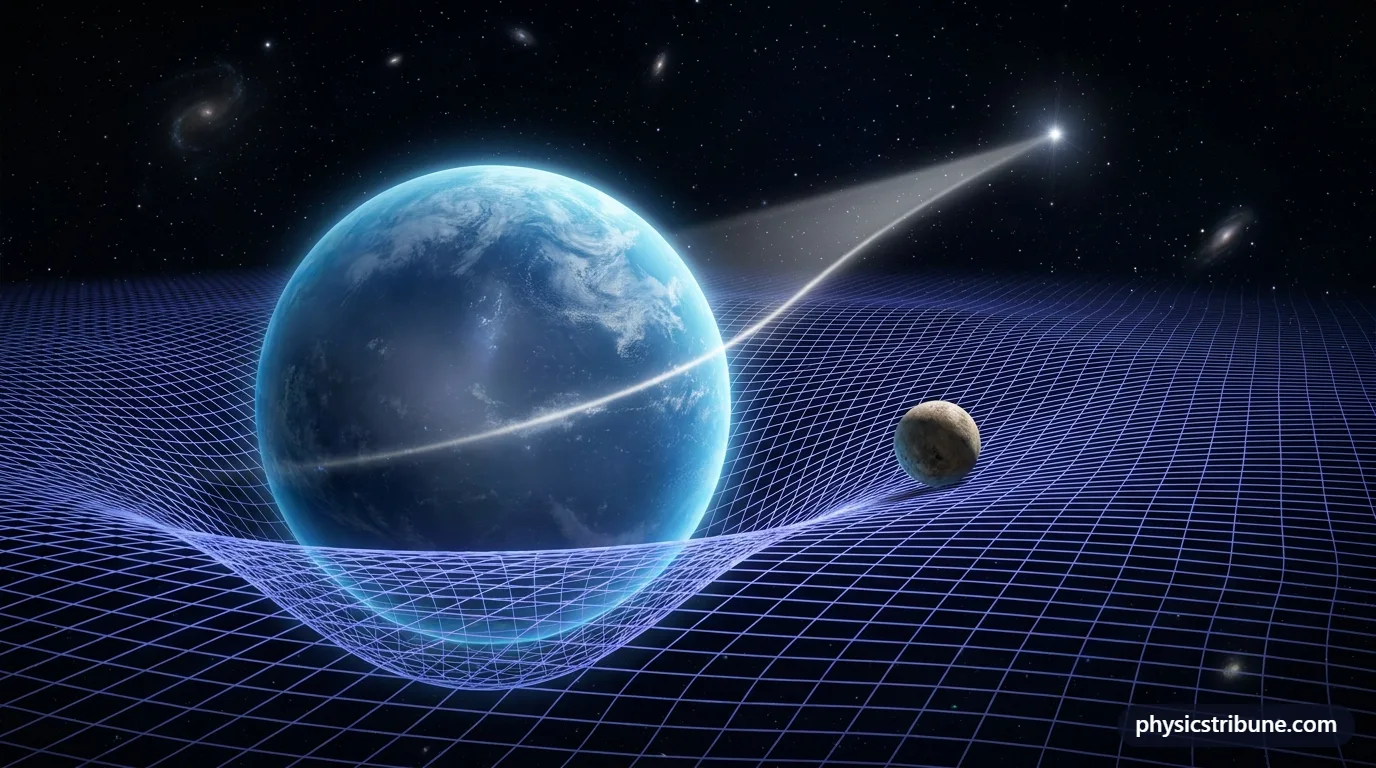
Special relativity describes flat spacetime, where free objects move in straight worldlines. General relativity, which Einstein completed in 1915, goes further: mass and energy bend spacetime, and free objects follow the straightest possible paths through that bent geometry. Those paths are what we experience as falling under gravity.
The Earth orbits the Sun not because a force tugs it sideways, in this view, but because it is coasting along the straightest path available in the curved spacetime around the Sun. Near Earth, most of the curvature is in the time direction: clocks lower down tick slightly slower than clocks higher up, an effect called gravitational time dilation.
Curvature is strongest near very dense objects. Around a black hole it becomes so extreme that light cones tip inward, and no path leads back out. Ripples in curvature, sent out by colliding black holes, travel at light speed as gravitational waves.

Is Spacetime Like a Stretched Rubber Sheet?
The rubber sheet with a heavy ball in the middle is a popular picture of curved spacetime, and it captures one idea well: nearby objects roll toward the dip. But the analogy has real limits. It uses gravity pulling the marbles down to explain gravity, which is circular, and it shows only curved space, not curved time.
For slow-moving objects near Earth, the curvature of time does almost all the work. A better mental picture is that clocks run at slightly different rates at different heights, and objects drift toward the region where clocks run slower. The rubber sheet is a helpful first image, but the full story is four-dimensional and cannot be drawn exactly.
Is Spacetime Real or Just a Model?
Spacetime is a model, but an extremely successful one. GPS satellites must account for both the slowing of their clocks by speed and the speeding up of their clocks by weaker gravity, or position errors would build up by kilometers per day. Gravitational waves have been detected directly, and the bending of starlight by the Sun was measured during a solar eclipse in 1919.
Whether spacetime is fundamental or emerges from something deeper is an open question. Attempts to join general relativity with quantum mechanics, such as quantum gravity, suggest that at extremely tiny scales spacetime may not be smooth at all.

Who Came Up With the Idea of Spacetime?
Albert Einstein published special relativity in 1905, showing that time and length depend on the observer's motion. His former mathematics teacher Hermann Minkowski then recast the theory in 1908 as the geometry of a single four-dimensional spacetime. In his view, separate space and separate time would lose their independent meaning, and only their union would survive as something all observers share.
Einstein was not keen on the geometric version at first, but he soon found it essential. It became the language of general relativity, where gravity is the curvature of Minkowski's spacetime. The mathematics of the transformations had also been worked out earlier by Hendrik Lorentz and others, though without the same physical meaning.
Common Misconceptions
Myth: Time is just another direction of space, exactly like the other three.
Physics: Time enters the spacetime interval with the opposite sign to space. That sign difference is why you cannot turn around in time the way you can in space.
Myth: Relativity says everything is relative, so nothing is the same for all observers.
Physics: The speed of light and the spacetime interval are identical for every observer. Relativity is really a theory of what stays the same.
Myth: Spacetime curvature is a rubber sheet bent downward by heavy objects.
Physics: The sheet is only an analogy. Real curvature is four-dimensional, and near Earth the curvature of time, not space, causes most of what we feel as gravity.
Myth: Spacetime effects only matter for spaceships near light speed.
Physics: GPS satellites must correct for both speed and gravity effects on their clocks every day, or navigation errors would grow quickly.
Key Facts
- Spacetime combines three dimensions of space and one of time into a single four-dimensional framework.
- A point in spacetime is called an event, and an object's path through spacetime is its worldline.
- Observers in relative motion disagree on distances and durations but agree on the spacetime interval.
- The interval is s² = (cΔt)² − Δx² − Δy² − Δz², with opposite signs for the time and space parts.
- Light cones divide events into timelike, lightlike and spacelike pairs, which protects cause and effect.
- In general relativity, mass and energy curve spacetime, and that curvature is gravity.
- Hermann Minkowski introduced the spacetime picture in 1908, three years after Einstein's special relativity.
Quick Quiz: How Well Do You Know Spacetime?
6 questions. Tap an answer to check it.
How many dimensions does spacetime have?
Spacetime has three space dimensions and one time dimension.
Which quantity do all inertial observers agree on?
Lengths and durations change between observers, but the interval s² stays the same.
Two events are 5 years and 3 light-years apart. What is the proper time between them?
√(5² − 3²) = √16 = 4 years.
What kind of interval separates events that no signal can connect?
Spacelike events lie outside each other's light cones, too far apart for light to link them.
In general relativity, what is gravity?
Mass and energy curve spacetime, and objects follow the straightest paths through it.
Who first described relativity as the geometry of four-dimensional spacetime?
Minkowski recast Einstein's special relativity in spacetime form in 1908.
Frequently Asked Questions
What is spacetime in simple terms?
Spacetime is the combination of space and time into one four-dimensional framework. Every event happens at a place and a time, so you need four numbers to describe it. Relativity shows that observers moving differently split this framework into space and time in different ways, so it is more accurate to treat the two as parts of a single whole.
Is time the fourth dimension?
In relativity, time is treated as the fourth dimension of spacetime, alongside the three dimensions of space. It is not identical to them, though. Time enters the spacetime interval with the opposite sign, which is why moving through space reduces the time your clock records and why you cannot travel backward in time the way you walk backward in a room.
What is a spacetime interval?
The spacetime interval is the separation between two events that every inertial observer agrees on. In one dimension it is s squared equals c times the time difference, squared, minus the distance squared. Positive values are timelike and give the proper time between events, zero means only light connects them, and negative values are spacelike.
How does gravity bend spacetime?
In general relativity, mass and energy determine the geometry of spacetime around them. Near a heavy object, clocks tick slower and distances change slightly, and free objects follow the straightest paths through that altered geometry. Those paths curve toward the mass, which we experience as falling. The more concentrated the mass, the stronger the curvature.
Who discovered spacetime?
The idea grew out of Albert Einstein's special relativity of 1905. Hermann Minkowski, who had taught Einstein mathematics, reformulated the theory in 1908 as the geometry of a four-dimensional spacetime. Einstein later used that geometric picture as the foundation of general relativity, published in 1915, where gravity becomes the curvature of spacetime.
Can spacetime be ripped or broken?
General relativity predicts places where curvature grows without limit, called singularities, at the centers of black holes and at the start of the Big Bang. Physicists generally take these as signs that the theory breaks down there, not as literal tears. A full description probably requires a quantum theory of gravity, which does not exist yet.
What is a worldline?
A worldline is the path an object traces through spacetime over its whole existence. An object at rest has a straight worldline along the time direction. A moving object's worldline is tilted, and an accelerating object's worldline is curved. Light follows worldlines tilted as far from the time direction as possible, at 45 degrees on a standard diagram, and no object with mass can tilt that far.
Is spacetime a real thing?
Spacetime is a model, but its predictions are confirmed with great precision. GPS clock corrections, the bending of starlight by the Sun and the direct detection of gravitational waves all match it. Whether spacetime is fundamental or emerges from deeper quantum ingredients is still an open research question.
Keep Exploring
 modern physicsSpecial Relativity
 modern physicsGeneral Relativity
 modern physicsTime Dilation
 modern physicsTwin Paradox
 modern physicsLorentz Transformation and Lorentz Factor
 calculatorsTime Dilation & Lorentz Factor Calculator
 compareSpecial vs General Relativity
 constantsSpeed of Light (c)
 physicistsAlbert Einstein