At a Glance
Gravitational waves are disturbances in spacetime produced by accelerating masses and moving at the speed of light. Their size is described by the strain h = ΔL / L, the fractional change in length they cause; waves from distant black hole mergers reach Earth with a strain of about 10^-21, so a 4 km detector arm changes length by only about 4 × 10^-18 m.
- What they are
- Ripples in spacetime that stretch and squeeze distances
- Speed
- The speed of light, c = 299,792,458 m/s
- Caused by
- Accelerating masses, strongest from merging black holes and neutron stars
- Size measure
- Strain h = ΔL/L, about 10⁻²¹ at Earth for typical detections
- Predicted
- Albert Einstein, 1916
- First direct detection
- GW150914, September 14, 2015, by LIGO
On this page
- What Are Gravitational Waves?
- What Causes Gravitational Waves?
- How Do Gravitational Waves Work, Explained Simply?
- How Are Gravitational Waves Detected?
- What Happens Step by Step When Black Holes Merge?
- When Were Gravitational Waves First Detected?
- Why Are Gravitational Waves Important?
- How Are Gravitational Waves Related to Other Phenomena?
- Common Misconceptions
- Key Facts
- Quiz
- FAQ
What Are Gravitational Waves?
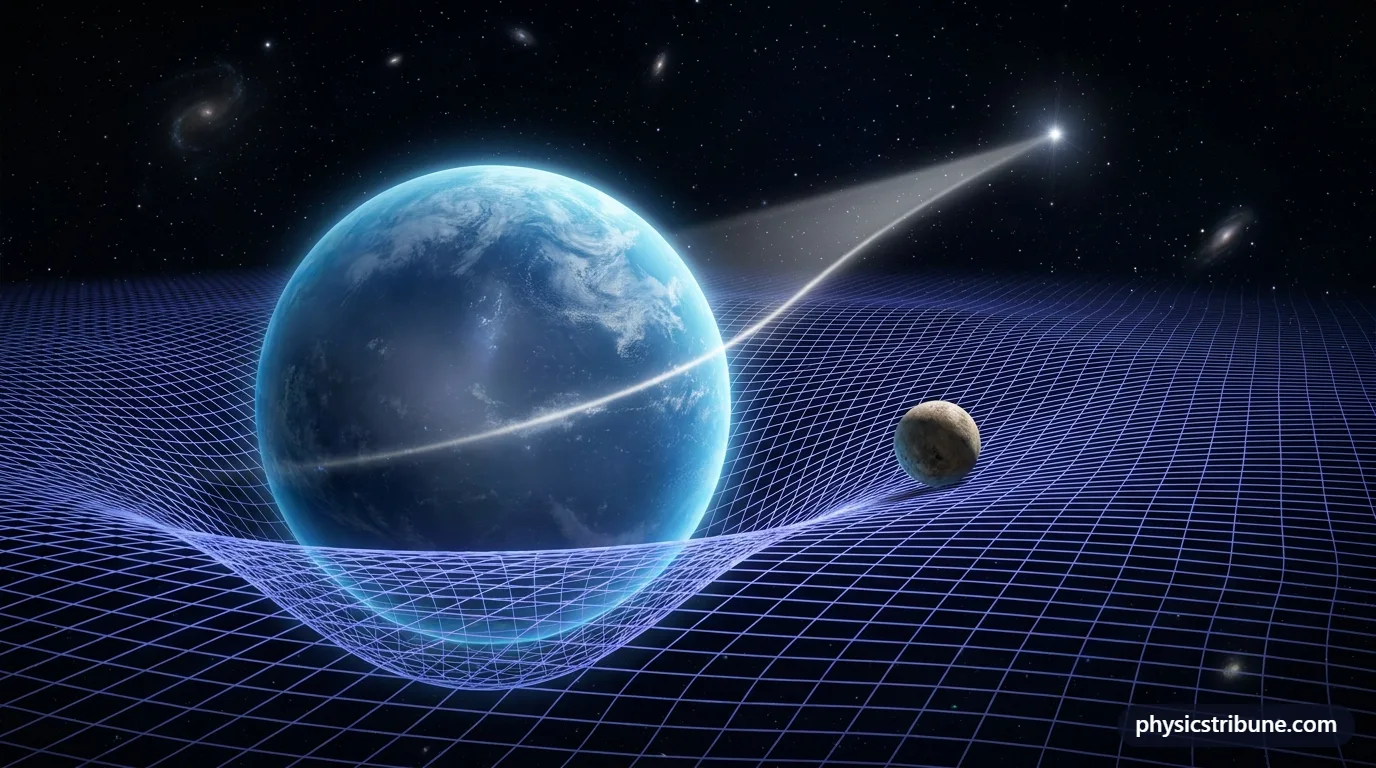
A gravitational wave is a traveling change in the shape of spacetime itself. In general relativity, mass and energy curve spacetime. When a mass moves in a lopsided, accelerating way, the curvature around it changes, and that change spreads outward like ripples spreading from a stone dropped into a pond.
The waves carry energy away from their source and travel at exactly the speed of light. They pass through planets, stars and dust almost untouched, which makes them a clean messenger from places that light cannot escape, such as the final moments before two black holes merge.
Like light, gravitational waves are transverse: the stretching happens across the direction of travel, not along it. Unlike light, they are not oscillations of electric and magnetic fields. They are oscillations of distance and time.
What Causes Gravitational Waves?
Any mass that accelerates without perfect symmetry gives off gravitational waves. A spinning perfect sphere or a ball moving at constant speed gives off none, but two stars orbiting each other do, because their mass distribution keeps swinging around.
In practice only enormous, compact masses moving at a large fraction of light speed make waves strong enough to detect. The main sources are:
- Merging black holes, which give the loudest signals that detectors have seen so far.
- Merging neutron stars, which also flash in light and forge heavy elements.
- Spinning neutron stars with small bumps, which should hum at a steady pitch.
- Collapsing stars in supernova explosions, if the collapse is uneven.
- The very early universe, which may have left a faint background of waves in every direction.
Everyday motion makes waves too, but they are absurdly weak. Earth orbiting the Sun radiates only about 200 watts of gravitational waves, roughly the power of a few light bulbs, which is why the orbit is not noticeably changing.
| Source | Typical frequency | Detected by | Status |
|---|---|---|---|
| Merging stellar-mass black holes | tens to a few hundred Hz | Ground laser interferometers | Detected many times since 2015 |
| Merging neutron stars | about 100 Hz up to above 1 kHz | Ground laser interferometers | Detected since 2017 |
| Spinning, slightly lumpy neutron stars | about 10 Hz to 1 kHz, steady | Ground laser interferometers | Searched for, not yet seen |
| Merging supermassive black holes | about 0.1 mHz to 0.1 Hz | Planned space interferometer | Mission planned for the 2030s |
| Supermassive black hole pairs long before merging | nanohertz (cycles of years) | Pulsar timing arrays | Evidence for a background reported in 2023 |
| Very early universe | wide range | Several methods | Not yet detected |
| Source: Typical published frequency ranges and mission status, rounded · Retrieved October 2026 | |||
How Do Gravitational Waves Work, Explained Simply?
Picture a ring of floating beads in space. When a gravitational wave passes straight through the ring, the beads first spread into an oval that is tall and narrow, then into an oval that is short and wide, and back again, over and over. Nothing pushes the beads. The space between them is what changes.
A ruler laid between two beads would stretch by the same fraction, so you cannot measure the effect with a ruler. You need light instead, because the speed of light stays fixed. That is the trick behind every gravitational wave detector: time how long light takes to travel along two arms and look for a tiny difference.

How Are Gravitational Waves Detected?
Ground-based detectors such as LIGO in the United States, Virgo in Italy and KAGRA in Japan are giant L-shaped laser interferometers. A laser beam is split in two, sent down two perpendicular arms several kilometers long, bounced off mirrors and recombined. Normally the two returning beams cancel, so almost no light reaches the light sensor.
When a gravitational wave passes, one arm gets slightly longer while the other gets slightly shorter. The beams then fall out of step and a flicker of light appears at the sensor. With a strain of 10⁻²¹, LIGO's 4 km arms change length by only about 4 × 10⁻¹⁸ m, roughly one four-hundredth of a proton's width (computed).
To trust such a small signal, the detectors use vacuum tubes, suspended mirrors isolated from ground shaking and, above all, more than one site. A real wave shows up in detectors thousands of kilometers apart within a few milliseconds, while local noise does not. Our LIGO GW150914 page walks through the first detection in detail.

What Happens Step by Step When Black Holes Merge?
- Inspiral. Two black holes orbit each other, losing energy to gravitational waves, so their orbit slowly shrinks. The wave frequency equals twice the orbital frequency.
- Chirp. As the orbit tightens, the black holes speed up, and the waves rise in both frequency and strength. Converted to sound, the signal sounds like a rising chirp.
- Merger. The two event horizons touch and join into one distorted black hole, and the wave reaches its peak.
- Ringdown. The new black hole shakes off its lumpy shape, sending out fading waves at a set pitch, then settles down.
- Travel. The waves cross space at light speed for millions or billions of years, weakening as they spread, before they briefly stretch our detectors.
When Were Gravitational Waves First Detected?
The first indirect evidence came from a pair of neutron stars, one of them a pulsar, found by Russell Hulse and Joseph Taylor in 1974. Over the following years their orbit shrank at exactly the rate general relativity predicts for energy lost to gravitational waves, work recognized with the 1993 Nobel Prize in Physics.
The first direct detection arrived on September 14, 2015, when both LIGO detectors recorded a signal now called GW150914. Two black holes of about 36 and 29 solar masses had merged roughly 1.3 billion light-years away, turning about three solar masses into wave energy in a fraction of a second. The signal swept from about 35 Hz to about 250 Hz in around 0.2 s.
The discovery earned the 2017 Nobel Prize in Physics for Rainer Weiss, Barry Barish and Kip Thorne. On August 17, 2017, detectors caught two neutron stars merging, and telescopes saw a burst of gamma rays from the same spot about 1.7 seconds later, showing that gravitational waves and light travel at the same speed.
| Quantity | Value |
|---|---|
| Masses before merging | about 36 and 29 solar masses |
| Mass radiated as waves | about 3 solar masses |
| Energy radiated (E = mc²) | about 5.4 × 10⁴⁷ J (computed) |
| Distance | about 1.3 billion light-years, or 1.2 × 10²⁵ m (computed) |
| Peak strain at Earth | about 1.0 × 10⁻²¹ |
| Change in a 4 km arm at that strain | about 4 × 10⁻¹⁸ m (computed) |
| Light travel time between the two LIGO sites (3,002 km) | about 10 ms maximum (computed) |
| Frequency sweep | about 35 Hz to 250 Hz in roughly 0.2 s |
| Source: Computed with E = mc² (solar mass 1.989 × 10³⁰ kg), ΔL = hL and t = d/c, c from NIST CODATA 2022 · public domain; masses, distance and strain are rounded published values · Retrieved October 2026 | |
Why Are Gravitational Waves Important?
Gravitational waves opened a new way of observing the universe. Telescopes collect light, but light cannot escape black holes and is blocked by dust and gas. Gravitational waves pass through almost everything, so they let scientists weigh black holes, count how often they collide and test Einstein's theory where gravity is extremely strong.
The 2017 neutron star merger showed that such collisions produce heavy elements like gold and platinum, and it gave an independent way to measure how fast the universe expands. Hundreds of mergers have now been recorded, and the catalog keeps growing with each observing run.
Future detectors will listen at other pitches. A planned space mission with arms millions of kilometers long will hear supermassive black holes merging, and pulsar timing arrays, which watch dozens of pulsars for tiny delays, have reported evidence for a very low-frequency background of waves.
Common Misconceptions
Myth: Gravitational waves are the same thing as gravity waves in the ocean or the air.
Physics: Ocean and atmospheric gravity waves are ordinary waves in water or air where gravity pulls the fluid back. Gravitational waves are ripples in spacetime itself and need no medium.
Myth: A gravitational wave passing Earth would push us around noticeably.
Physics: By the time they reach us, the waves change distances by about one part in 10²¹. That is billions of times smaller than an atom over the width of a person.
Myth: Gravitational waves travel faster than light because gravity acts instantly.
Physics: They travel at the speed of light. The 2017 neutron star merger showed that gamma rays and gravitational waves crossing 130 million light-years arrived within about two seconds of each other.
Key Facts
- Gravitational waves are ripples in spacetime that travel at the speed of light.
- They stretch space in one direction and squeeze it in the perpendicular direction as they pass.
- Einstein predicted them in 1916 from general relativity.
- The first direct detection, GW150914, came from two merging black holes on September 14, 2015.
- Typical waves reach Earth with a strain near 10⁻²¹, changing a 4 km arm by about 4 × 10⁻¹⁸ m.
- A 2017 neutron star merger proved that gravitational waves and light travel at the same speed.
- The 2017 Nobel Prize in Physics went to Rainer Weiss, Barry Barish and Kip Thorne for the detection.
Quick Quiz: How Well Do You Know Gravitational Waves?
6 questions. Tap an answer to check it.
What is a gravitational wave?
Gravitational waves are traveling distortions of spacetime moving at the speed of light.
Which event produced the first directly detected gravitational waves?
GW150914 came from black holes of about 36 and 29 solar masses merging.
About how large is the strain of a typical detected wave at Earth?
Detected strains are around 10⁻²¹.
Why do detectors use laser light rather than rulers?
Timing light along each arm reveals the change in length.
What did the 2017 neutron star merger show?
Gamma rays arrived about 1.7 s after the waves, after a journey of about 130 million years.
In a binary system, how does the wave frequency compare with the orbital frequency?
The mass pattern repeats every half orbit, so the waves have twice the orbital frequency.
Frequently Asked Questions
What are gravitational waves in simple terms?
They are ripples in space and time made by huge masses moving quickly, like two black holes circling each other. As a ripple passes, distances stretch one way and shrink the other way by a tiny amount. They travel at the speed of light and carry energy away from their source.
What causes gravitational waves?
Any mass that accelerates in a non-symmetric way, such as two stars orbiting each other. Only very compact and very massive objects, such as merging black holes and neutron stars, make waves strong enough to detect. Ordinary objects produce waves far too weak to measure.
How fast do gravitational waves travel?
At the speed of light, 299,792,458 m/s in a vacuum. The neutron star merger of August 2017 confirmed this: gamma rays from the same event arrived about 1.7 seconds after the gravitational waves, after a journey of roughly 130 million years.
Can gravitational waves hurt us?
No. By the time waves from distant mergers reach Earth, they stretch distances by about one part in 10²¹, which is far too small to feel or to affect anything in daily life. Only an observer extremely close to a merging pair of black holes would be in danger.
How does LIGO detect gravitational waves?
LIGO splits a laser beam into two perpendicular 4 km arms, reflects the beams off mirrors and recombines them. A passing wave makes one arm slightly longer and the other slightly shorter, so the beams no longer cancel perfectly. Two widely separated sites must see the same signal for it to count.
Who discovered gravitational waves?
Albert Einstein predicted them in 1916. Russell Hulse and Joseph Taylor found indirect evidence from a shrinking binary pulsar orbit starting in 1974. The LIGO collaboration made the first direct detection in 2015, and Rainer Weiss, Barry Barish and Kip Thorne shared the 2017 Nobel Prize for it.
Are gravitational waves the same as gravitons?
Not quite. Gravitational waves are the classical ripples described by general relativity and have been measured directly. A graviton is a proposed quantum particle of gravity, the way a photon is a particle of light. No experiment has detected a single graviton, and doing so may be far beyond current technology.
Do gravitational waves stretch the detector's ruler too?
Yes, a material ruler would stretch along with the space it sits in, which is why detectors measure the travel time of laser light instead. The speed of light is fixed, so a longer arm means the light takes longer to return, and that timing difference is what the instrument records.