
At a Glance
Kinetic energy is the energy of a moving object, calculated with KE = 1/2 m v^2, where m is mass in kilograms and v is speed in meters per second. The result is in joules, and because speed is squared, an object moving twice as fast carries four times as much kinetic energy.
- Symbol
- KE (also written K or Ek)
- SI unit
- joule (J), equal to 1 kg·m²/s²
- Formula
- KE = ½mv²
- Scalar or vector
- Scalar, never negative
- Depends on
- Mass and the square of speed
On this page
- What Is Kinetic Energy?
- Kinetic Energy Explained Simply
- What Is the Formula for Kinetic Energy?
- Why Does Speed Matter More Than Mass?
- What Are the Types of Kinetic Energy?
- Where Do You See Kinetic Energy in Everyday Life?
- How Do Kinetic and Potential Energy Trade Places?
- How Does Work Change Kinetic Energy?
- Is Kinetic Energy the Same as Momentum?
- Going Deeper: When Does ½mv² Stop Working?
- Practice Kinetic Energy Problems
- Common Misconceptions
- Key Facts
- Quiz
- FAQ
What Is Kinetic Energy?
Kinetic energy is the share of an object's energy that comes purely from its motion. A parked bicycle has none. Push it to a steady roll and it gains some; ride it fast down a hill and it gains a great deal more. The moment it stops, that energy has moved somewhere else, usually into heat in the brake pads and a little sound.
Physicists care about kinetic energy because it tells you what a moving object can do. A rolling ball can knock over a pin, a gust of wind can turn a turbine, and a falling hammer can drive a nail. In each case the moving thing does work on something else and gives up some of its kinetic energy in the process.
Kinetic energy is a scalar. It has a size but no direction, so a ball moving north at 10 m/s carries exactly the same kinetic energy as the same ball moving south at 10 m/s. Its SI unit is the joule (J), and one joule equals one kilogram times one meter squared per second squared.
Kinetic Energy Explained Simply
Think of kinetic energy as the "oomph" a moving thing carries with it. The heavier it is and the faster it goes, the more oomph it has, and the harder it is to stop.
Picture rolling a tennis ball and a bowling ball toward a stack of empty cans at the same speed. The bowling ball scatters the cans much more, because it has more mass. Now roll the tennis ball twice as fast as before. It hits the cans with four times the energy, not just twice. Speed is the stronger ingredient, and that one idea explains a lot about car crashes, sports and weather.
When something speeds up, energy has been added to it. When it slows down, energy has left it and gone into something else, such as heat, sound or a dent.
What Is the Formula for Kinetic Energy?
The kinetic energy of an object moving much slower than light is
Three features of the formula are worth noticing. Mass appears to the first power, so twice the mass means twice the energy. Speed appears squared, so twice the speed means four times the energy. And because a squared number can never be negative, kinetic energy is always zero or positive.
The formula sheet below is enough for most problems. If you want unit conversions from pounds, miles per hour or foot-pounds, or a step-by-step solution for speed or mass, use our kinetic energy calculator, which walks through each step.
Here is the formula with each variable and its SI unit, plus the two rearranged forms for finding speed or mass.
| Symbol | Quantity | SI unit |
|---|---|---|
| kinetic energy | joule (J) | |
| mass | kilogram (kg) | |
| speed | meter per second (m/s) |
Rearranged to find another variable:
Valid for: non-relativistic speeds (v << c).
Example 1 A skateboarder cruising down a path
A skateboarder and her board have a combined mass of 62 kg and roll along a flat path at 4.5 m/s. How much kinetic energy do they have?
- Given:
- mass:
- speed:
- mass:
- Formula:
- Substitute:
- Answer:
That is roughly the energy needed to lift a 64 kg sack one meter off the ground, which is why a fall at jogging pace still stings.
Why Does Speed Matter More Than Mass?
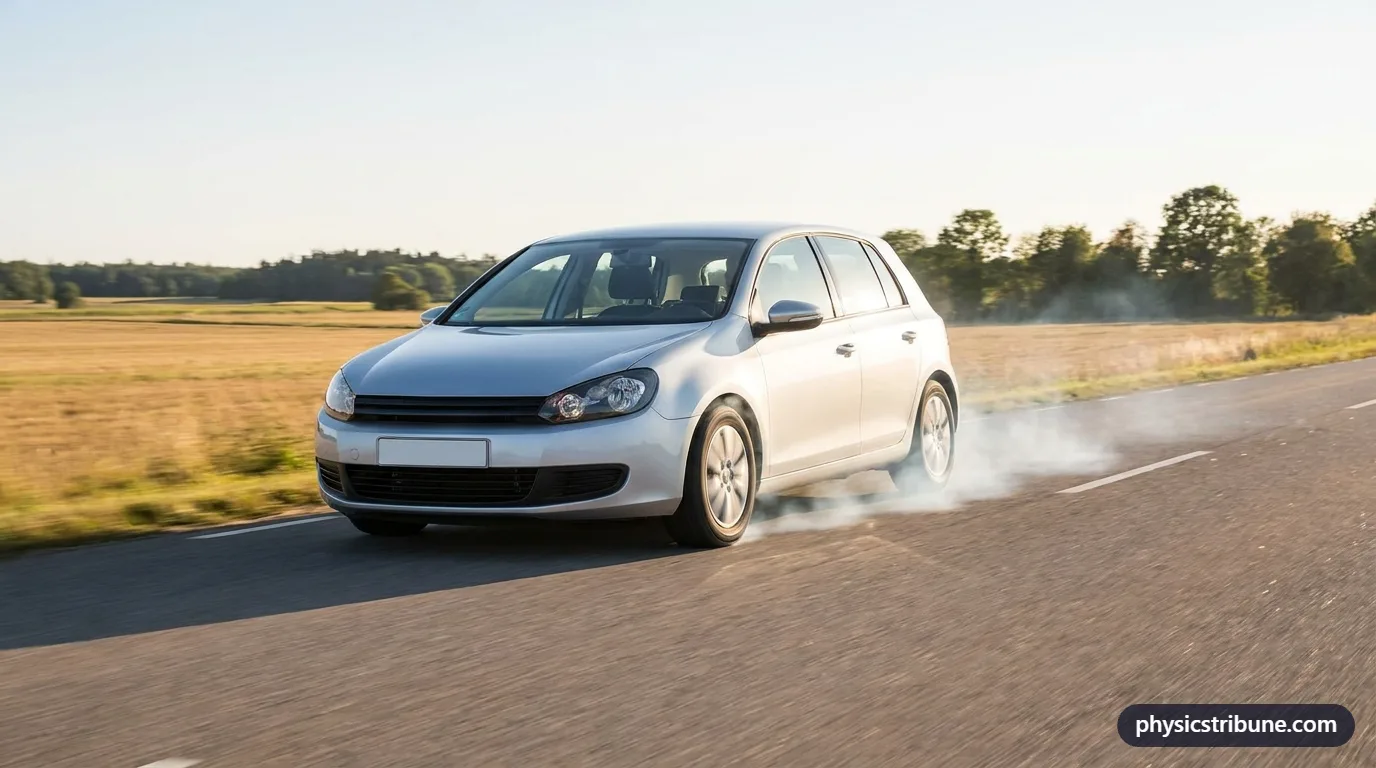
The squared speed term makes kinetic energy grow fast. Take a 1,200 kg car. Going from 30 km/h to 60 km/h doubles its speed but quadruples its kinetic energy, and pushing on to 120 km/h multiplies the original amount by sixteen. The table below shows the full pattern.
This is why highway crashes are so much more destructive than parking-lot bumps, and why braking distance grows so quickly with speed. The brakes must remove all of that energy as heat, and four times the energy takes roughly four times the distance at the same braking force.
Mass still matters, just in a straight line. A loaded truck with ten times the mass of a car, moving at the same speed, carries ten times the kinetic energy. The graph shows the curved, parabola-shaped link between speed and energy for a fixed mass.
Example 2 How fast is the delivery drone?
A 2.4 kg delivery drone flying level carries 270 J of kinetic energy. What is its speed?
- Given:
- kinetic energy:
- mass:
- kinetic energy:
- Formula:
- Substitute:
- Answer:
Working backward from energy to speed always involves a square root, because speed appears squared in the formula.
| Speed (km/h) | Speed (mph) | Kinetic energy (kJ) | Compared with 30 km/h |
|---|---|---|---|
| 30 | 18.6 | 41.7 | 1× |
| 50 | 31.1 | 115.7 | 2.78× |
| 60 | 37.3 | 166.7 | 4× |
| 90 | 55.9 | 375.0 | 9× |
| 100 | 62.1 | 463.0 | 11.1× |
| 120 | 74.6 | 666.7 | 16× |
| Source: Computed with KE = ½mv²; masses and speeds are typical values · Retrieved October 2026 | |||

What Are the Types of Kinetic Energy?
Every type of kinetic energy is motion of some kind. What changes is the kind of motion:
- Translational kinetic energy belongs to an object moving from one place to another, like a thrown frisbee crossing a field. This is the type that
- Rotational kinetic energy belongs to an object spinning in place, like a ceiling fan or a potter's wheel. It depends on how the mass is spread around the axis; see rotational kinetic energy.
- Vibrational kinetic energy comes from parts moving back and forth, like a plucked guitar string or atoms jiggling inside a solid.
- Thermal motion is the random kinetic energy of countless molecules. A warmer cup of tea has faster-moving molecules than a cold one.
A rolling wheel has two types at once: it moves forward and it spins. That is why a ball rolling down a ramp ends up slower than one sliding down a frictionless ramp; part of its energy is tied up in the spin.
Where Do You See Kinetic Energy in Everyday Life?
Once you look for it, kinetic energy is everywhere. A hammer swung toward a nail stores energy in its motion and dumps it into the nail and the wood in a fraction of a second. Wind is moving air, and turbines turn its kinetic energy into electricity. Rivers carry the kinetic energy of flowing water, which can roll boulders downstream during a flood.
Your own body is a good example too. An ordinary walking pace gives an adult about 70 J of kinetic energy, while a sprinter at top speed carries several thousand joules. Sound carries kinetic energy too, since it is air molecules being pushed back and forth. For a longer list sorted by setting, see our examples of kinetic energy.

How Do Kinetic and Potential Energy Trade Places?
Kinetic energy often swaps with stored energy. Potential energy is energy held because of position or shape, such as a book on a high shelf or a stretched rubber band. When the book falls, its height drops and its speed rises, so potential energy turns into kinetic energy.
The sum of the two is called mechanical energy. If air resistance and friction are small, that sum stays almost constant. A ball dropped from 10 m loses potential energy at exactly the rate it gains kinetic energy, as the energy bars below show. Halfway down, the two are equal.
A swing, a pendulum and a roller coaster all run on this back-and-forth exchange. For a side-by-side look at the two forms, read kinetic vs potential energy.

How Does Work Change Kinetic Energy?
The only way to change an object's kinetic energy is to do work on it. When a force pushes along the direction of motion, the object speeds up and gains energy. When a force pushes against the motion, like friction or a braking force, the object slows and loses energy.
This idea is captured by the work-energy theorem: the net work done on an object equals its change in kinetic energy. If a cyclist pedals hard and does 1,500 J of net work on herself and her bike, their kinetic energy rises by exactly 1,500 J. The theorem lets you skip forces and time entirely and jump straight from work to final speed.
Example 3 Finding the mass of a sled and rider
A sled with its rider slides across packed snow at 12 m/s and has 5,040 J of kinetic energy. What is the combined mass of the sled and rider?
- Given:
- kinetic energy:
- speed:
- kinetic energy:
- Formula:
- Substitute:
- Answer:
The answer is a believable adult plus a light sled, a handy sanity check whenever you solve for mass.
Is Kinetic Energy the Same as Momentum?
No, although both depend on mass and speed. Momentum,
The difference shows up in collisions. Momentum is conserved in every collision between objects that are free of outside forces, but kinetic energy is conserved only in perfectly elastic ones. In a crash where two cars crumple together, momentum before equals momentum after, yet much of the kinetic energy becomes heat, sound and bent metal. Our momentum vs kinetic energy comparison goes deeper.
Going Deeper: When Does ½mv² Stop Working?
The familiar formula is an approximation that works beautifully for everyday speeds. As an object approaches the speed of light, its true kinetic energy climbs faster than
Kinetic energy also depends on who is measuring. A passenger sitting in a moving train has zero kinetic energy relative to the train but plenty relative to the ground. Both answers are correct; you just need to stick with one frame of reference throughout a problem.
Practice Kinetic Energy Problems
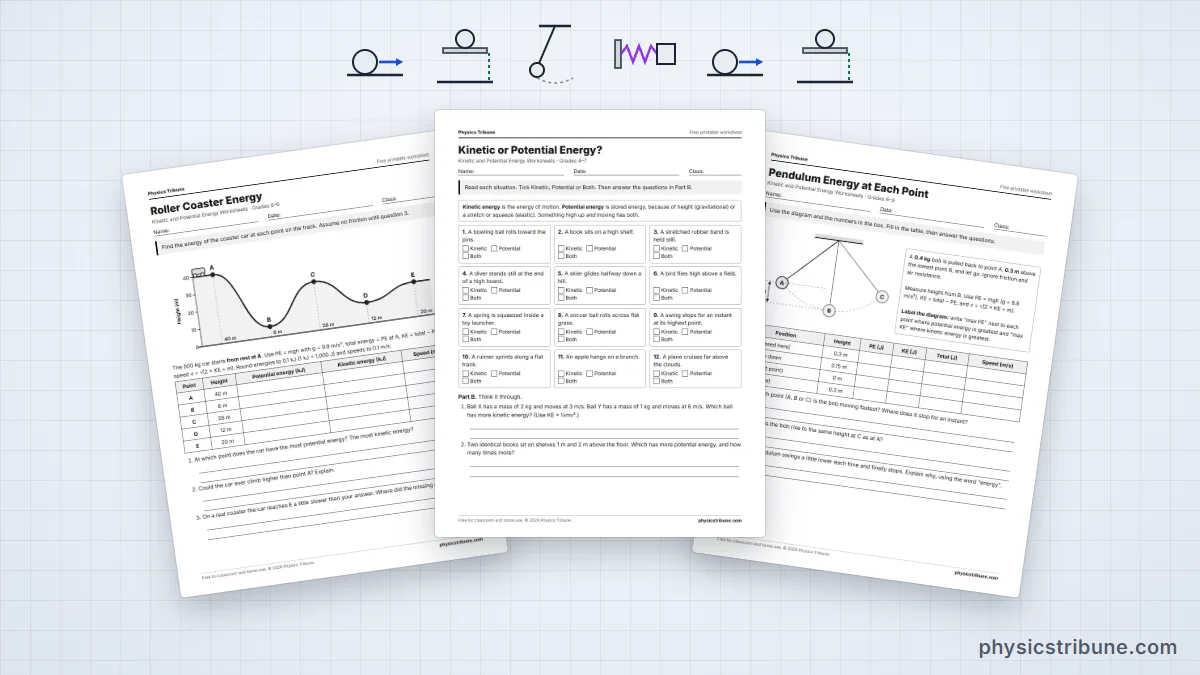
The fastest way to build confidence is to solve a handful of problems yourself. Our kinetic and potential energy worksheets include printable sets with answer keys for middle and high school. Check your answers with the kinetic energy calculator, which shows every step, then try the quiz below.
Common Misconceptions
Myth: If you double the speed, you double the kinetic energy.
Physics: Speed is squared in the formula, so doubling it multiplies kinetic energy by four. Tripling speed multiplies it by nine.
Myth: Kinetic energy has a direction, just like velocity.
Physics: Kinetic energy is a scalar. An object moving left and the same object moving right at equal speed have identical kinetic energy.
Myth: Heavier objects always have more kinetic energy.
Physics: Speed can outweigh mass. A 0.145 kg ball thrown at 40 m/s has more kinetic energy than a 70 kg adult walking at 1.4 m/s.
Myth: Kinetic energy is destroyed when a moving object stops.
Physics: Energy is never destroyed. It changes form, usually into heat, sound or the energy of deforming materials.
Key Facts
- Kinetic energy is the energy an object has because it is moving, found with KE = ½mv².
- The SI unit of kinetic energy is the joule, equal to one kilogram meter squared per second squared.
- Doubling an object's speed makes its kinetic energy four times larger, while doubling its mass only doubles it.
- Kinetic energy is a scalar quantity and can never be negative.
- The net work done on an object equals its change in kinetic energy.
- Kinetic and potential energy trade places in falling objects, swings and roller coasters, while their total stays nearly constant when friction is small.
- Kinetic energy depends on the frame of reference, so the same object can have different values for different observers.
Quick Quiz: How Well Do You Know Kinetic Energy?
6 questions. Tap an answer to check it.
A cart's speed doubles while its mass stays the same. What happens to its kinetic energy?
Speed is squared in KE = ½mv², so 2 × 2 gives four times the energy.
What is the SI unit of kinetic energy?
All forms of energy, including kinetic energy, are measured in joules.
Which of these has the most kinetic energy?
The 1 kg ball at 5 m/s has 12.5 J, more than 9 J, 8 J and 5 J for the others.
Why can kinetic energy never be negative?
A positive mass times a squared speed is always zero or positive.
A ball is dropped from a height with no air resistance. Halfway down, how do its kinetic and potential energy compare?
It has lost half its height, so half of the original potential energy has become kinetic energy.
According to the work-energy theorem, what changes an object's kinetic energy?
The net work done on an object equals its change in kinetic energy.
Frequently Asked Questions
What is kinetic energy in simple words?
Kinetic energy is the energy something has because it is moving. A rolling ball, a flying bird and a flowing river all have it. The faster an object moves and the more mass it has, the more kinetic energy it carries. When the object slows down, that energy does not vanish; it changes into other forms such as heat, sound or the motion of something it hits.
What is the unit of kinetic energy?
The SI unit of kinetic energy is the joule, written J. One joule equals one kilogram times one meter squared per second squared. Other units you may meet include kilojoules for cars, foot-pounds in American engineering and ballistics, and calories or kilowatt-hours when comparing motion with food energy or electricity. All of them measure the same quantity on different scales.
What does kinetic energy depend on?
Kinetic energy depends on two things only: the mass of the object and its speed. It is directly proportional to mass, so twice the mass gives twice the energy. It is proportional to the square of speed, so twice the speed gives four times the energy. The direction of travel, the shape of the object and what it is made of make no difference.
Can kinetic energy be negative?
No. Mass is always positive and speed is squared, so the product can never fall below zero. The lowest possible value is zero, for an object at rest in the chosen frame of reference. A change in kinetic energy can be negative, though. When a car brakes, its kinetic energy decreases, so the change is negative even though the energy itself stays positive.
Is kinetic energy a scalar or a vector?
Kinetic energy is a scalar. It has a size but no direction, because it depends on speed squared rather than on velocity. That means a puck sliding east at 8 m/s and the same puck sliding west at 8 m/s carry the same kinetic energy. Momentum, by contrast, is a vector and does point in the direction of motion.
What happens to kinetic energy when an object stops?
It turns into other forms of energy. A bike that brakes to a stop warms its brake pads and rims. A ball that lands in sand pushes the grains aside and heats them slightly. A car in a crash bends metal and makes a loud noise. The total amount of energy stays the same, it just becomes harder to see and use.
How is kinetic energy different from potential energy?
Kinetic energy comes from motion, while potential energy is stored because of an object's position or shape. A ball held above the ground has potential energy; once you let go, that stored energy turns into kinetic energy as it falls. Many systems, like pendulums and roller coasters, constantly convert one form into the other while their total stays nearly constant.
Does an object at rest have kinetic energy?
Not as a whole. An object at rest relative to you has zero kinetic energy in your frame of reference. Its atoms and molecules are still jiggling, though, and that random motion is thermal energy. Also, rest depends on the observer: a book on a train seat is at rest for the passenger but has kinetic energy for someone standing beside the tracks.
Keep Exploring






Sources
Constants come from NIST CODATA 2022 (public domain) and unit definitions from the BIPM SI Brochure (CC BY 4.0). Text, diagrams and illustrations are original work by Physics Tribune.