
At a Glance
Gravitational potential energy is energy stored by an object's position above a chosen reference level, calculated near Earth with PE = m g h, where m is mass in kilograms, g is about 9.81 m/s² and h is height in meters. The result is in joules, and doubling either the mass or the height doubles the stored energy.
- Symbol
- PEg (also U or GPE)
- SI unit
- joule (J), equal to 1 kg·m²/s²
- Formula (near Earth)
- PEg = mgh
- Scalar or vector
- Scalar; can be negative below the zero level
- Depends on
- Mass, local gravity and height above a reference level
On this page
- What Is Gravitational Potential Energy?
- Gravitational Potential Energy Explained Simply
- What Is the Formula for Gravitational Potential Energy?
- Where Does the mgh Formula Come From?
- Where Is Zero Gravitational Potential Energy?
- How Does Gravitational Potential Energy Turn Into Kinetic Energy?
- Why Does a Pendulum Keep Swinging?
- Where Is Gravitational Potential Energy Used in Real Life?
- Going Deeper: When Does mgh Stop Working?
- How Can You Practice Gravitational Potential Energy Problems?
- Common Misconceptions
- Key Facts
- Quiz
- FAQ
What Is Gravitational Potential Energy?
Gravitational potential energy is stored energy that comes from where an object sits, not from how it moves. Lift a bag of flour onto a counter and you have given it some. Leave it there and the energy stays stored. Knock the bag off and gravity converts that stored energy into motion on the way down.
The word potential means the energy is waiting to be used. Gravity pulls every object toward Earth, so any object above the ground has the ability to fall and do work, such as turning a water wheel or driving a stake into soil. The higher and heavier the object, the more work it can do on the way down.
Gravitational potential energy is a scalar, measured in joules like every other form of energy. It is one of several kinds of potential energy; others include the energy stored in a stretched spring and the energy stored between electric charges.
Gravitational Potential Energy Explained Simply
Think of lifting something as filling a piggy bank with energy. The work your muscles do as you raise a backpack does not vanish. It gets saved in the backpack's new position, ready to be spent when it falls.
Two things decide how much you save. A heavier backpack stores more, and lifting it higher stores more. Put a backpack twice as heavy on the same shelf and it holds twice the energy. Put the same backpack on a shelf twice as high and it also holds twice the energy.
When the backpack drops, the piggy bank empties. The saved energy becomes motion, then a thud, a bit of sound and a tiny bit of warmth in the floor.
What Is the Formula for Gravitational Potential Energy?
Near Earth's surface, gravitational potential energy is
The formula is a straight product, so each factor scales the answer in the same way. Twice the mass gives twice the energy, and twice the height also gives twice the energy. Notice that mg is just the object's weight in newtons, so you can also read the formula as weight times height.
For quick answers with unit conversions from pounds and feet, use our potential energy calculator. All the related energy equations are gathered on our energy formulas sheet.
This is the near-Earth formula with every symbol and its SI unit, followed by the rearranged forms for mass, height and gravity.
| Symbol | Quantity | SI unit |
|---|---|---|
| gravitational potential energy | joule (J) | |
| mass | kilogram (kg) | |
| acceleration due to gravity (9.80 m/s² (standard 9.80665 m/s²)) | meter per second squared (m/s²) | |
| height above the chosen reference level | meter (m) |
Rearranged to find another variable:
Valid for: near Earth's surface (uniform g); only changes in PE are physically meaningful.
Example 1 A suitcase lifted onto a luggage rack
A traveler lifts a 14 kg suitcase from the floor of a train onto a rack 1.9 m above the floor. How much gravitational potential energy does the suitcase gain, using the floor as the zero level?
- Given:
- mass:
- height above the chosen reference level:
- mass:
- Formula:
- Substitute:
- Answer:
The traveler's arms had to do at least this much work, which is why lifting heavy bags overhead feels so tiring.
Where Does the mgh Formula Come From?
The formula follows directly from the idea of work. To lift an object at a steady speed, you must push up with a force equal to its weight, mg. Work is force times distance, so raising it through a height h takes
That work does not disappear. It is stored as gravitational potential energy, and gravity hands back exactly the same amount if the object falls the same height. This is why gravity counts as a conservative force: the energy you put in by lifting comes back in full when the object returns, no matter which path it takes. You can read more in conservative and nonconservative forces.
Where Is Zero Gravitational Potential Energy?
Zero is wherever you decide. You might set it at the floor, the tabletop, the ground outside or sea level. The choice changes the number you get for potential energy, but it never changes the difference between two heights, and only differences matter for real physics.
Suppose a 2 kg vase sits on a table 0.8 m high in a room on the third floor. Measured from the tabletop, its potential energy is zero. Measured from the floor, it is about 15.7 J. Measured from the street, it is much more. Yet if the vase falls to the floor, it releases about 15.7 J of energy in every one of those descriptions.
An object below your chosen zero, like a ball at the bottom of a well when ground level is zero, has negative potential energy. That is not a problem; it simply means energy must be added to raise it back to the reference level.
Example 2 How high did the drone climb?
A 1.6 kg camera drone rises straight up from a launch pad and gains 2,500 J of gravitational potential energy. How high above the pad is it now?
- Given:
- gravitational potential energy:
- mass:
- gravitational potential energy:
- Formula:
- Substitute:
- Answer:
Height comes out by dividing the energy by the weight of the drone, which is mass times g.
How Does Gravitational Potential Energy Turn Into Kinetic Energy?
As an object falls, it loses height and gains speed. The potential energy it gives up becomes kinetic energy. If air resistance is small, the trade is exact: every joule of potential energy lost becomes one joule of kinetic energy gained.
The energy bars below follow a 2 kg melon dropped from 4 m. At the top it holds about 78.5 J of potential energy and no kinetic energy. Halfway down the two are equal, and just before it lands all of the energy is kinetic. The sum stays the same the whole way.
The same exchange runs in reverse when you throw a ball upward. It slows as it rises because kinetic energy is turning into potential energy, and it stops for an instant at the top when the conversion is complete. Our kinetic vs potential energy comparison lays the two forms side by side.

Why Does a Pendulum Keep Swinging?
A pendulum is a gravitational potential energy machine. At each end of its swing the bob is highest and momentarily still, so its energy is all potential. At the bottom it is lowest and fastest, so its energy is mostly kinetic.
The diagram tracks a 3 kg bob on a 2 m string released at 40 degrees. The only height that matters is how far the bob rises above its lowest point, not the length of the string. A real pendulum slowly loses energy to air drag and friction at the pivot, so each swing is a little lower than the last.

Where Is Gravitational Potential Energy Used in Real Life?
People put gravitational potential energy to work all the time. Hydroelectric power plants store water behind a dam and let it fall through turbines. Pumped-storage stations go one step further: they pump water uphill when electricity is cheap and release it when demand peaks, acting like giant batteries.
Old grandfather clocks run on slowly descending weights. Pile drivers lift a heavy hammer and let it fall onto a post. Water towers hold water high above town so that gravity, not pumps, pushes it through the pipes to your faucet. For more cases, see our list of potential energy examples.
The table shows how much energy some everyday and not-so-everyday objects store at typical heights.
Example 3 Mass of water in a rooftop tank
Water stored in a rooftop tank 22 m above the street holds 3,900,000 J of gravitational potential energy relative to the street. What mass of water is in the tank?
- Given:
- gravitational potential energy:
- height above the chosen reference level:
- gravitational potential energy:
- Formula:
- Substitute:
- Answer:
Since one liter of water has a mass of about 1 kg, the answer in kilograms is also roughly the tank's volume in liters.
| Object | Mass (kg) | Height (m) | Potential energy |
|---|---|---|---|
| Book on a high shelf | 1.2 | 2 | 23.5 J |
| Backpack carried up one floor | 8 | 3.5 | 274.7 J |
| Climber near the top of a gym wall | 70 | 12 | 8,240 J (8.24 kJ) |
| Elevator car with riders on the 10th floor | 1,500 | 30 | 441,450 J (441 kJ) |
| One cubic meter of water behind a dam | 1,000 | 50 | 490,500 J (491 kJ) |
| Skydiver at jump altitude | 85 | 4,000 | 3,335,400 J (3.34 MJ) |
| Source: Computed with PE = mgh and g = 9.81 m/s²; masses and heights are typical values · Retrieved October 2026 | |||

Going Deeper: When Does mgh Stop Working?
The formula
In that version zero is set infinitely far away, so every bound object has negative energy. The two formulas agree on the change in energy for small height differences close to the surface. The value of g also varies slightly with location on Earth and is very different on other worlds. A 5 kg rock raised 10 m stores about 491 J on Earth but only about 81 J on the Moon, where gravity is roughly a sixth as strong. More on that value is on our acceleration due to gravity page.
How Can You Practice Gravitational Potential Energy Problems?
Problems on this topic usually ask for one of the four quantities in
Common Misconceptions
Myth: Gravitational potential energy depends on the path taken to lift the object.
Physics: Only the vertical height change matters. Carrying a box up a ramp or straight up a ladder to the same height gives it the same potential energy.
Myth: An object on the ground always has zero potential energy.
Physics: Zero is a choice. An object on the ground has zero only if you pick the ground as the reference level; measured from a basement, it has positive energy.
Myth: Potential energy cannot be negative.
Physics: Below the chosen zero level the value is negative. That simply means energy must be added to raise the object back to the reference height.
Myth: Heavier objects fall faster because they have more potential energy.
Physics: Without air resistance all objects fall with the same acceleration. A heavier object stores more energy, but it also has more mass to speed up, so the speeds match.
Key Facts
- Gravitational potential energy is energy stored by an object's height in a gravitational field.
- Near Earth it is calculated with PE = mgh, using g of about 9.81 m/s².
- Its SI unit is the joule, the same as every other form of energy.
- Doubling the mass or the height doubles the gravitational potential energy.
- The zero level can be chosen freely, but differences in potential energy do not depend on that choice.
- As an object falls without air resistance, the potential energy it loses equals the kinetic energy it gains.
- Far from Earth's surface, the formula U = -GMm/r replaces mgh.
Quick Quiz: How Well Do You Know Gravitational Potential Energy?
6 questions. Tap an answer to check it.
A box is lifted to twice its original height. What happens to its gravitational potential energy?
PE = mgh is directly proportional to height, so twice the height means twice the energy.
Which quantity is NOT needed to calculate PE = mgh?
Speed affects kinetic energy, not gravitational potential energy.
Which object stores the most gravitational potential energy?
Mass times height is 12 for the 4 kg ball, more than 10, 5 and 8 for the others.
A ball falls with no air resistance. What happens to its total mechanical energy?
The lost potential energy becomes kinetic energy, so the sum stays constant.
Two people carry identical boxes to the same shelf, one by stairs and one by a ramp. Which box gains more potential energy?
Only the change in height matters, not the path taken.
What does a negative gravitational potential energy mean?
Values below the reference level are negative by definition.
Frequently Asked Questions
What is gravitational potential energy in simple words?
Gravitational potential energy is the energy something has because it is raised up. When you lift an object, you store energy in it, and that energy comes back out if the object falls. A rock on a cliff edge, a child at the top of a slide and water in a tall tank all have it. The higher and heavier the object, the more it stores.
What is the formula for gravitational potential energy?
Near Earth's surface the formula is PE = m g h. The mass m is in kilograms, g is the acceleration due to gravity, about 9.81 meters per second squared, and h is the height in meters above a chosen zero level. Multiplying them gives the energy in joules. For objects far above Earth, such as satellites, the formula U = -GMm/r is used instead.
What is the unit of gravitational potential energy?
The SI unit is the joule, written J. One joule equals one kilogram times one meter squared per second squared, which is what you get when you multiply kilograms, meters per second squared and meters. Larger amounts are often written in kilojoules or megajoules. In American engineering you may also see foot-pounds, which equal about 1.36 joules each.
What does gravitational potential energy depend on?
It depends on three things: the mass of the object, the strength of gravity where it is, and its height above the reference level. Increasing any of them increases the energy in direct proportion. It does not depend on the object's speed, its shape, what it is made of, or the path it took to reach that height. Only the vertical position counts.
Can gravitational potential energy be negative?
Yes. Because you choose the zero level yourself, an object below that level has negative potential energy. For example, if ground level is zero, a bucket at the bottom of a well has a negative value. In the universal formula U = -GMm/r, zero is placed infinitely far away, so every object near a planet has negative gravitational potential energy.
How is gravitational potential energy different from kinetic energy?
Gravitational potential energy is stored because of position, while kinetic energy comes from motion. A ball held still above the floor has potential energy but no kinetic energy. When you let it go, the potential energy turns into kinetic energy as it speeds up. The two forms often trade places in falling objects, swings, pendulums and roller coasters.
Does gravitational potential energy depend on the path?
No. Gravity is a conservative force, so the change in potential energy depends only on the starting and ending heights. Walking up a winding trail to a summit gives you the same increase as riding a cable car straight up to the same summit. The trail may take longer and more effort because of friction and inefficient muscles, but the stored energy is identical.
Is gravitational potential energy the same on the Moon?
No. The formula is the same, but g is much smaller on the Moon, about 1.62 meters per second squared instead of about 9.81 on Earth. That means an object raised to the same height stores roughly one sixth as much energy there. On a planet with stronger gravity, the same lift would store more energy.
Keep Exploring
 calculatorsPotential Energy Calculator
 energyPotential Energy
 energyKinetic Energy
 compareKinetic vs Potential Energy
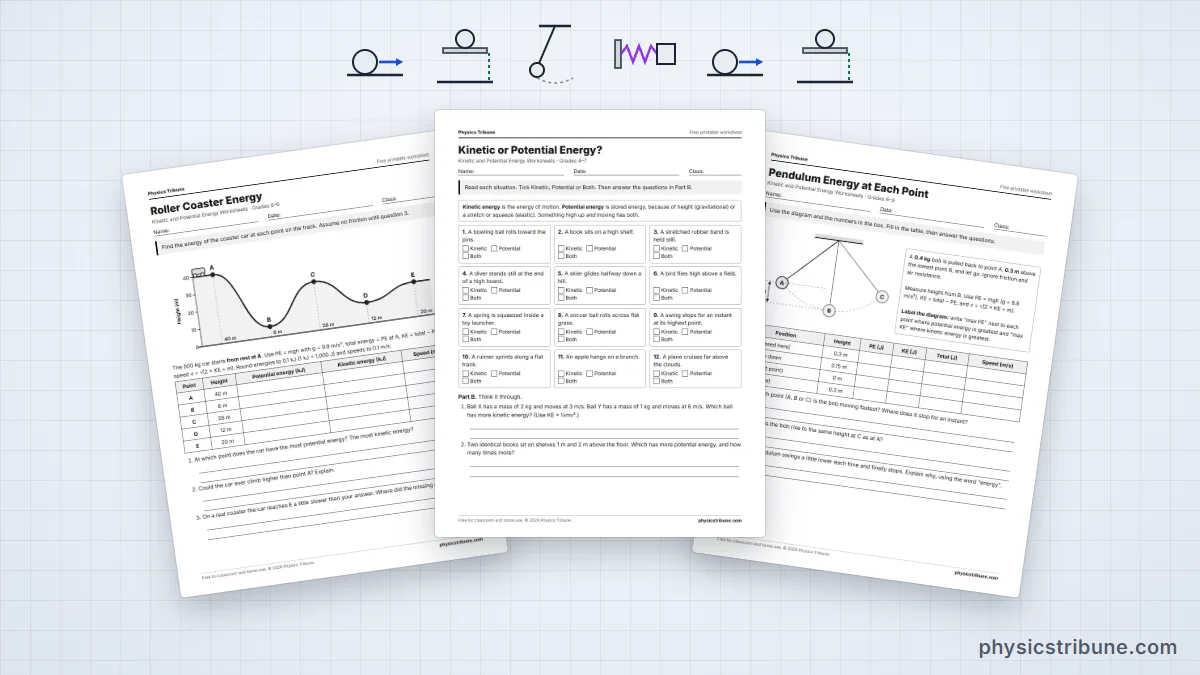 worksheetsKinetic and Potential Energy Worksheets
 formulasWork, Energy and Power Formulas
 gravityGravitational Potential Energy (Universal Form)
 examplesExamples of Potential Energy
 energyElastic Potential Energy
Sources
Constants come from NIST CODATA 2022 (public domain) and unit definitions from the BIPM SI Brochure (CC BY 4.0). Text, diagrams and illustrations are original work by Physics Tribune.