Potential Energy Calculator
- Convert to SI: m = 60 kg, g = 9.80665 m/s², h = 10 m
- PE = m × g × h = 60 × 9.80665 × 10
- PE = 588.399 × 10 = 5,883.99 J

At a Glance
Gravitational potential energy is calculated with PE = m g h, using mass in kilograms, g = 9.81 m/s² on Earth and height in meters to get joules. Elastic potential energy in a spring is PE = 1/2 k x^2, where k is the spring constant in N/m and x is the stretch or compression in meters.
- Formulas
- PE = mgh · PE = ½kx²
- Solves for
- Energy, mass, height, g, spring constant, stretch
- Mass units
- kg, g, lb, metric ton
- Length units
- m, cm, mm, km, in, ft
- Energy units
- J, kJ, MJ, cal, kcal, kWh, ft·lbf
- Spring units
- N/m, N/cm, N/mm, lbf/in, lbf/ft
On this page
- Potential energy calculator: gravitational (mgh) or elastic (½kx²)
- How to Use the Potential Energy Calculator
- What Is the Potential Energy Formula?
- How Do You Calculate Gravitational Potential Energy?
- How Do You Find Height or Mass From Potential Energy?
- How Do You Calculate the Potential Energy of a Spring?
- How Much Potential Energy Do Everyday Objects Store?
- Related Calculators and Practice
- Key Facts
- FAQ
How to Use the Potential Energy Calculator
First choose the type: Gravitational PE = mgh for an object raised above a reference level, or Elastic PE = ½kx² for a stretched or squeezed spring. Then press the quantity you want to find. Type the other values and set each unit from its dropdown; the answer updates as you type.
Gravity starts at the standard value of 9.80665 m/s², but you can change it to 9.81, to the Moon's 1.62 or to any other planet. Height may be negative if the object sits below your chosen zero level. The steps under the answer show the SI conversion, the formula, the substitution and the result, ready to copy into homework.
What Is the Potential Energy Formula?
The gravitational potential energy formula is
This page covers the calculation. For what potential energy is and the forms it takes, read our guides to potential energy and gravitational potential energy. The energy formulas sheet puts both formulas next to those for work, power and kinetic energy.
The gravitational mode of the calculator uses this formula and its rearranged forms, after converting every input to SI units.
| Symbol | Quantity | SI unit |
|---|---|---|
| gravitational potential energy | joule (J) | |
| mass | kilogram (kg) | |
| acceleration due to gravity (9.80 m/s² (standard 9.80665 m/s²)) | meter per second squared (m/s²) | |
| height above the chosen reference level | meter (m) |
Rearranged to find another variable:
Valid for: near Earth's surface (uniform g); only changes in PE are physically meaningful.
How Do You Calculate Gravitational Potential Energy?
Calculating PE = mgh by hand takes four steps:
- Choose the zero level. Usually the floor, the ground or the lowest point the object will reach.
- Convert to SI units. Mass in kilograms (multiply pounds by 0.45359237) and height in meters (multiply feet by 0.3048).
- Multiply mass by g. On Earth, use 9.81 m/s², or 9.80665 m/s² for the standard value.
- Multiply by the height. The result is the potential energy in joules.
For a 2 kg flowerpot on a 1.5 m shelf, 2 times 9.81 is 19.62, and 19.62 times 1.5 gives about 29.4 J. Only differences in potential energy matter physically, so a different zero level shifts every value by the same amount without changing any result.
Example 1 A crate lifted onto a loading dock
A worker lifts a 25 kg crate onto a loading dock 1.2 m above the ground. Using g = 9.81 m/s², how much gravitational potential energy does the crate gain?
- Given:
- mass:
- acceleration due to gravity:
- height above the chosen reference level:
- mass:
- Formula:
- Substitute:
- Answer:
That is about the same energy a 60 W bulb uses in five seconds.
How Do You Find Height or Mass From Potential Energy?
To find height, divide the potential energy by mass times g. To find mass, divide the energy by g times the height. In the calculator, press Height or Mass and enter the other values. You can even solve for g itself, which shows how an experiment on another planet could reveal its gravity.
A quick sense check catches most mistakes. If a classroom object comes out hundreds of meters high, the energy was probably entered in kilojoules while the unit was set to joules. The worked example below finds the height of a water tank from its stored energy.
Example 2 How high is the water tank?
A 1,000 kg block of water stored in a hilltop tank has 343,350 J of potential energy relative to the town below. Using g = 9.81 m/s², how high is the tank above the town?
- Given:
- gravitational potential energy:
- mass:
- acceleration due to gravity:
- gravitational potential energy:
- Formula:
- Substitute:
- Answer:
This height sets the water pressure that town faucets feel without any pump.
How Do You Calculate the Potential Energy of a Spring?
A spring stores elastic potential energy when it is stretched or compressed. The formula is
The spring constant comes from Hooke's law, F = kx, and our Hooke's law calculator finds k from a force and a stretch. Switch the calculator above to Elastic to solve for the energy, the spring constant or the stretch. The elastic potential energy page explains where this energy goes when the spring is released.
Example 3 Energy in a compressed launcher spring
A toy launcher spring with a spring constant of 250 N/m is pushed in by 0.06 m (6 cm). How much elastic potential energy does it store?
- Given:
- spring constant:
- stretch or compression from equilibrium:
- spring constant:
- Formula:
- Substitute:
- Answer:
When released, this energy becomes the kinetic energy of the foam dart, minus some losses to friction.
How Much Potential Energy Do Everyday Objects Store?
The table gives typical potential energies, computed with the calculator's formulas. Gravity dominates at large scales: a roller coaster car at the top of its first hill stores millions of joules, and that energy alone carries it through the rest of the ride. Springs store much less, but they release it in a split second.
The bar chart follows a ball as it falls. Potential energy turns into kinetic energy on the way down, while the total stays the same when air resistance is small. That trade is the heart of conservation of energy, and kinetic vs potential energy compares the two forms directly.
| Situation | Values used | Formula | Potential energy (J) |
|---|---|---|---|
| Ballpoint pen spring, clicked | k = 300 N/m, x = 4 mm | ½kx² | 0.0024 |
| Toy dart launcher spring | k = 200 N/m, x = 5 cm | ½kx² | 0.25 |
| Phone lifted onto a desk | m = 0.2 kg, h = 0.75 m | mgh | 1.47 |
| Book on a high shelf | m = 1 kg, h = 2 m | mgh | 19.6 |
| Car suspension spring, loaded | k = 30,000 N/m, x = 5 cm | ½kx² | 37.5 |
| Backpack lifted to the shoulder | m = 8 kg, h = 1.2 m | mgh | 94.1 |
| Garage door spring, door closed | k = 6,000 N/m, x = 0.3 m | ½kx² | 270 |
| Trampoline at its lowest point | k = 5,000 N/m, x = 0.5 m | ½kx² | 625 |
| Adult climbing one floor | m = 70 kg, h = 3 m | mgh | 2,060 |
| Diver on a 10 m platform | m = 65 kg, h = 10 m | mgh | 6,370 |
| Car on a 30 m high parking deck | m = 1,500 kg, h = 30 m | mgh | 441,000 |
| 1 m³ of water behind a 50 m dam | m = 1,000 kg, h = 50 m | mgh | 490,000 |
| Loaded roller coaster car on a 60 m hill | m = 4,000 kg, h = 60 m | mgh | 2,350,000 |
| Source: Computed with PE = mgh (g = 9.80665 m/s²) and PE = ½kx²; masses, heights and spring constants are typical values · Retrieved October 2026 | |||

Key Facts
- Gravitational potential energy is calculated with PE = mgh, using kilograms, m/s² and meters to get joules.
- Elastic potential energy in a spring is PE = ½kx², with k in N/m and x in meters.
- Doubling the height doubles gravitational PE, but doubling a spring's stretch quadruples its PE.
- Height is measured from a zero level you choose; only changes in potential energy matter.
- Standard gravity is 9.80665 m/s², while the Moon's surface gravity is about 1.62 m/s².
- The formula mgh assumes g is constant, which holds for heights small compared with Earth's radius.
Frequently Asked Questions
How do you calculate potential energy?
For an object raised above the ground, multiply its mass in kilograms by 9.81 m/s² and by its height in meters. The answer is gravitational potential energy in joules. A 3 kg box on a 2 m shelf stores about 3 times 9.81 times 2, or 58.9 J. For a spring, use one half times the spring constant times the stretch squared.
What is the formula for gravitational potential energy?
The formula is PE = mgh, where m is mass, g is the gravitational acceleration and h is height above a chosen zero level. On Earth g is about 9.81 m/s². Rearranged, height is h = PE/(mg) and mass is m = PE/(gh). The formula works near a planet's surface; far out in space, a different formula with the gravitational constant is used.
What is the potential energy formula for a spring?
A spring's elastic potential energy is PE = ½kx², where k is the spring constant in N/m and x is the stretch or compression in meters. A spring with k = 400 N/m pulled 0.1 m stores ½ times 400 times 0.01, or 2 J. The formula assumes the spring obeys Hooke's law and is not stretched past its elastic limit.
What value of g should I use?
Most textbooks use 9.8 or 9.81 m/s², and the internationally agreed standard value is exactly 9.80665 m/s². Real gravity varies slightly with latitude and altitude, by about half a percent across Earth's surface. For the Moon use about 1.62 m/s², and for Mars about 3.71 m/s². The calculator lets you type any value or choose ft/s².
Can potential energy be negative?
Yes. Gravitational potential energy is measured from a zero level that you choose, so anything below that level has negative potential energy. A ball at the bottom of a 2 m pit, with the ground as zero, has negative PE. The sign does not change the physics, because only differences in potential energy affect motion.
How do you find height from potential energy?
Divide the potential energy by the mass times g: h = PE/(mg). If a 4 kg object has 196.2 J of potential energy on Earth, its height is 196.2 divided by 39.24, or 5 m. In the calculator, choose Gravitational, press Height and enter the energy, mass and g to see each step of the division.
How is potential energy different from kinetic energy?
Potential energy is stored because of position or shape, like a raised weight or a squeezed spring. Kinetic energy belongs to motion and is calculated with ½mv². As an object falls, potential energy turns into kinetic energy, and without friction the total stays the same. Our kinetic energy calculator handles the moving side of that exchange.
Keep Exploring
 energyPotential Energy
 energyGravitational Potential Energy
 energyElastic Potential Energy
 calculatorsKinetic Energy Calculator
 calculatorsHooke's Law & Spring Constant Calculator
 calculatorsFree Fall Calculator
 compareKinetic vs Potential Energy
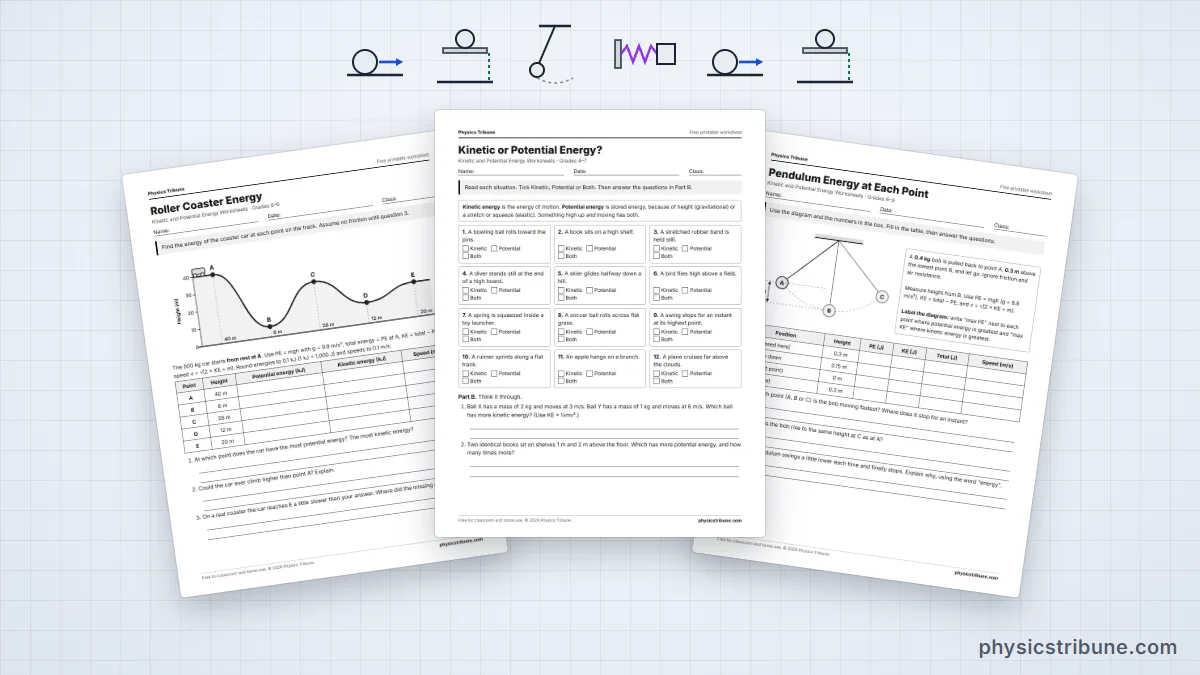 worksheetsKinetic and Potential Energy Worksheets
 formulasWork, Energy and Power Formulas