At a Glance
A mirage forms when light travels through air whose temperature, and therefore refractive index, changes with height. Hot air is less dense and has a slightly lower index (about n = 1.00025 versus about 1.00027 for cooler air), so light curves toward the cooler, denser air and the brain traces it back along a straight line to a false position.
- What causes it
- Refraction of light in air layers with different temperatures
- Key idea
- Light curves toward cooler, denser air with a higher refractive index
- Inferior mirage
- Image below the object; hot ground, cooler air above (roads, deserts)
- Superior mirage
- Image above the object; cold surface, warmer air above (polar seas, lakes)
- Is it real?
- Yes, the light is real and can be photographed; only its apparent source is false
- Best viewing angle
- Very low, less than about half a degree above the surface
On this page
- What Is a Mirage?
- Why Does Hot Air Bend Light?
- How Does a Road Mirage Form, Step by Step?
- Why Does the Puddle Move Away as You Drive Toward It?
- What Are the Types of Mirages?
- Where and When Can You See a Mirage?
- How Can You Explain a Mirage Simply?
- Which Light Phenomena Are Related to Mirages?
- Common Misconceptions
- Key Facts
- Quiz
- FAQ
What Is a Mirage?
A mirage is a real image made by bent light, not a trick of a tired mind. Light from the sky or from a distant object travels toward you along a curved path because the air it crosses is not uniform. Your eye and brain assume light always moves in straight lines, so they place the source in the wrong spot.
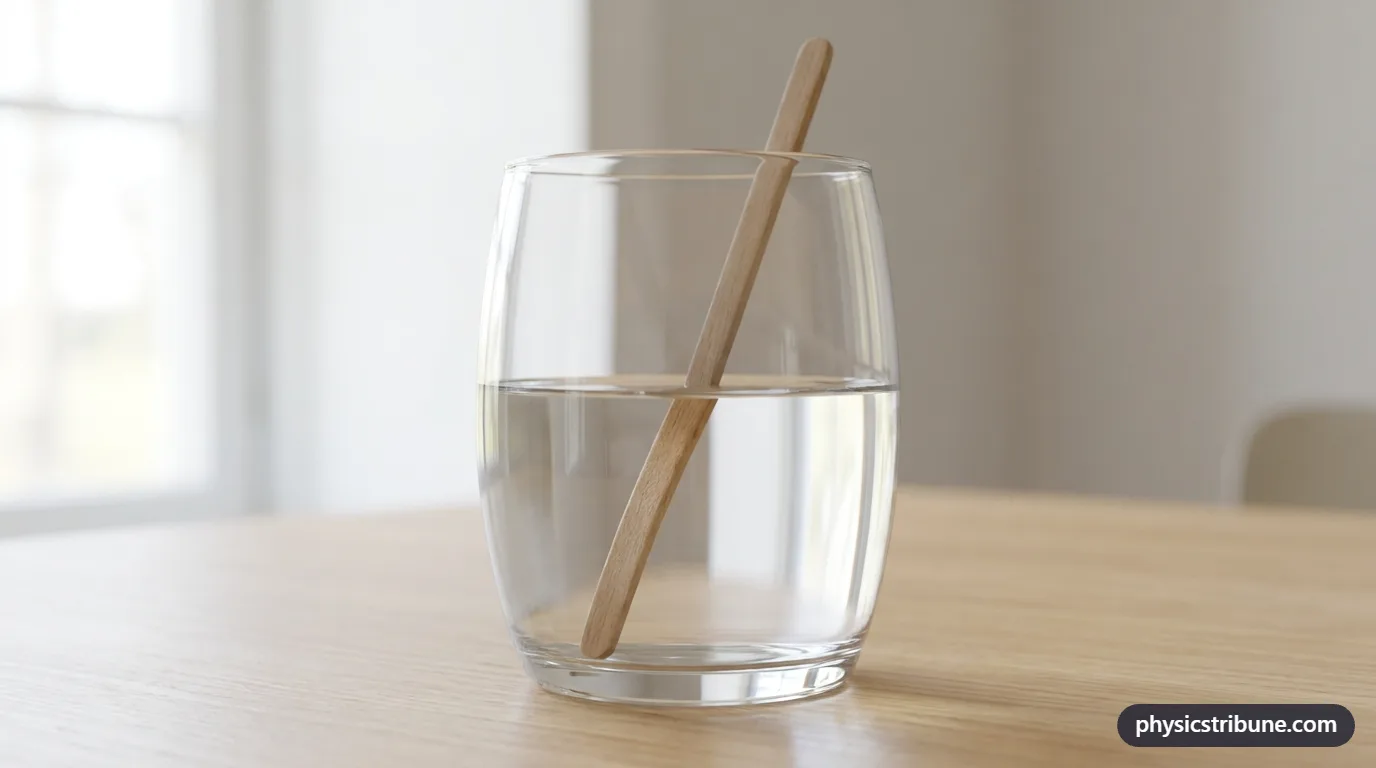
The bending is a form of refraction, the same effect that makes a straw look broken in a glass of water. In a glass the change of material is sudden. In a mirage the change is gradual, spread over a layer of air a few centimeters to many meters thick, so the light follows a gentle curve instead of a sharp kink.
Because a mirage is made of real light, it can be photographed and filmed. What is false is only the location, and sometimes the shape, of the thing you think you see.
Why Does Hot Air Bend Light?
The index of refraction of air depends on its density. Warm air expands, so it holds fewer molecules per cubic meter, and light moves through it a tiny bit faster. Cooler air is denser and slows light slightly more. At sea level the index of air is only about 1.0003, but small differences in that last decimal place are enough to steer light over long distances.
Light always bends toward the region where it travels more slowly. Picture a wide beam whose lower edge runs through hot, fast air while its upper edge runs through cooler, slower air. The lower edge pulls ahead, so the whole beam swings upward, curving away from the hot layer and toward the cool one.
When light skims almost parallel to the ground, the curve can bend it all the way back up. This is a smooth version of total internal reflection: instead of one sharp boundary, many thin layers each bend the ray a little until it turns around.
How Does a Road Mirage Form, Step by Step?
- The sun heats the road. Dark asphalt absorbs sunlight and can become 20 °C or more warmer than the air a couple of meters up.
- A hot layer forms. The air touching the road warms by conduction, so a thin, hot, low-density layer sits right on the surface with cooler air above it.
- Skylight heads down at a shallow angle. Light from the bright sky near the horizon travels downward toward the road, almost parallel to it.
- The ray curves upward. As it enters warmer and warmer air, the ray bends away from the road and turns upward before touching the surface.
- Your eye receives it from below. The light now reaches you traveling slightly upward, so your brain traces it back to a spot on the road.
- You see sky on the road. A patch of blue or bright gray appears on the asphalt, and the only everyday thing that shows the sky on the ground is water, so it looks like a puddle.
The puddle seems to shimmer because the hot air rises in restless bubbles and swirls, a small-scale form of convection. Each swirl changes the bending for a moment, so the image wobbles.
Why Does the Puddle Move Away as You Drive Toward It?
The mirage only exists for light that arrives at a very low angle, usually well under half a degree above the road. That angle sets a fixed distance at which the effect begins, a few hundred meters for a driver's eye height. As you move forward, that zone moves forward with you.
The table below uses a simple model in which a sharp hot layer sits on the road. It shows that the hotter the layer, the steeper the light can be and still turn back, so the mirage appears closer. Real air changes smoothly with height, so treat the distances as rough guides rather than exact predictions.
| Hot layer warmer by | Index of hot air (approx.) | Largest grazing angle that turns back | Rough distance where the mirage starts |
|---|---|---|---|
| 5 °C | 1.000263 | 0.17° | about 500 m |
| 10 °C | 1.000259 | 0.24° | about 360 m |
| 20 °C | 1.000251 | 0.33° | about 260 m |
| 30 °C | 1.000243 | 0.40° | about 210 m |
| 40 °C | 1.000236 | 0.46° | about 190 m |
| Source: Computed with a sharp two-layer model: (n − 1) ∝ 1/T at constant pressure, n − 1 ≈ 0.000277 at 15 °C (typical value), grazing angle = 90° − arcsin(n_hot / n_cool), distance = 1.5 m / tan(angle) · Retrieved October 2026 | |||
What Are the Types of Mirages?
Inferior mirage. The false image appears below the real object. It needs warm air near the ground and cooler air above, which is why it shows up over sunny roads, desert sand, runways and even the hood of a hot car. The image is upside down, which you can see when a distant car seems to sit on its own reflection.
Superior mirage. The false image appears above the real object. It needs the opposite layering, called a temperature inversion: cold air near a cold surface, with warmer air on top. Light then curves downward, following Earth's curve, and ships or coastlines that are below the horizon can rise into view. Superior mirages are common over icy seas and cold lakes.
Fata Morgana. This is a complex superior mirage produced by several stacked layers. It stretches and squeezes distant objects into towers, walls or floating cliffs that change shape within minutes. Sailors have long told stories of castles above the water and ghost ships that were really ordinary coastlines seen through a layered atmosphere.

Where and When Can You See a Mirage?
- Highways on sunny afternoons. The road has had hours to heat up, as the graph below shows, so the hot layer is strongest after midday.
- Deserts. Wide, flat sand under strong sun produces large inferior mirages that look like lakes on the horizon.
- Airport runways and parking lots. Long, flat, dark surfaces give a clear view at a low angle.
- Cold lakes and polar seas. Calm air over cold water creates superior mirages that lift distant shores.
- A hot wall or barbecue. Sight along a long sunlit wall or across a grill and objects behind it ripple and shift.
To see one on purpose, keep your eye low and look along a long, flat, sunny surface toward bright sky. Lying near the edge of a warm parking lot is often enough.

How Can You Explain a Mirage Simply?
Think of a line of marchers walking side by side across a field. If the marchers on the left reach soft mud and slow down while those on the right keep their pace on dry grass, the whole line turns toward the mud. Light behaves the same way: the slower side of the beam is the cooler air, so the beam turns toward it.
Near a hot road, the slow side is up and the fast side is down. A ray coming in low swings upward like the marching line, and when it reaches your eye it looks as though it bounced off the road. A real puddle would bounce it too, which is exactly why the brain is fooled.
Common Misconceptions
Myth: A mirage is a hallucination that happens only in your mind.
Physics: A mirage is made of real light that a camera can record. Only the apparent position of the source is wrong, because the light traveled along a curved path.
Myth: The water on a hot road is heat or steam rising from the asphalt.
Physics: The bright patch is an image of the sky, bent upward by the hot air layer. The rising air only makes it shimmer.
Myth: Mirages need a hot desert.
Physics: Any long, flat surface with a strong temperature difference works, including roads in cool weather. Superior mirages even need cold surfaces such as icy seas.
Key Facts
- A mirage is a real optical image made by light bending in air layers of different temperatures.
- Hot air is less dense and has a slightly lower refractive index than cool air.
- Light curves toward the cooler, denser air, the region where it travels more slowly.
- An inferior mirage appears below the object and needs a hot surface, such as a road or desert.
- A superior mirage appears above the object and needs cold air near the surface with warmer air above.
- Road mirages only appear for light arriving less than about half a degree above the surface.
- Mirages can be photographed, which proves they are not hallucinations.
Quick Quiz: How Well Do You Know Mirages?
5 questions. Tap an answer to check it.
What physical effect produces a mirage?
Changing temperature changes the refractive index of air, so light bends gradually.
Light passing through layers of air bends toward which region?
Light bends toward the region where it travels more slowly, which is the cooler, denser air.
The "water" on a hot road is really an image of what?
Skylight curves upward in the hot layer, so you see the sky on the road.
Which condition creates a superior mirage?
A temperature inversion bends light downward, lifting distant objects into view.
Why does a road mirage seem to move away as you drive toward it?
The shallow-angle zone stays a roughly fixed distance ahead of the viewer.
Frequently Asked Questions
What causes a mirage?
A mirage is caused by refraction in air whose temperature changes with height. Hot air is less dense than cool air, so light moves through it slightly faster. A ray crossing these layers bends toward the cooler air. Your eye receives the light from a new direction and your brain places the source along a straight line, in the wrong position.
Why do roads look wet on hot days?
The sun heats the asphalt, which warms a thin layer of air on the road. Light from the sky near the horizon travels down toward the road, curves upward in the hot layer and reaches your eye from below. You see a patch of sky on the road, and the only common thing that shows the sky on the ground is water.
Is a mirage real or an illusion?
It is a real optical effect, not an imagined one. The light reaching your eye really comes from the sky or from a distant object, and a camera records it the same way. The illusion is only about position: the brain assumes light travels straight, so it puts the source somewhere it is not, such as on the road surface.
What is the difference between an inferior and a superior mirage?
An inferior mirage shows the false image below the real object. It forms over hot surfaces where the warm air is at the bottom. A superior mirage shows the image above the object. It forms over cold surfaces when warmer air lies on top of cold air, a pattern called a temperature inversion, so light curves downward toward the viewer.
Can you take a photo of a mirage?
Yes. Because a mirage is made of real light rays arriving at the lens from a particular direction, any camera captures it. Photos of road mirages, desert lakes and lifted coastlines are common. A telephoto lens held close to a hot surface often gives the most striking images, since it magnifies the narrow band where the effect happens.
What is a Fata Morgana?
A Fata Morgana is a complicated superior mirage produced by several layers of warm and cool air stacked above a cold surface such as the sea. The layers stretch, squash and repeat distant objects, so a flat coastline can look like a row of towers or cliffs floating above the water. Its shape changes quickly as the air layers shift.
Why does a mirage disappear when you get close?
A mirage needs light that arrives at a very shallow angle, usually less than half a degree above the surface. Close to the spot, you look down at the road at a steeper angle, and light from that direction is not bent enough to turn back. The mirage zone therefore stays a fixed distance ahead and seems to retreat as you approach.
Do mirages happen in cold weather?
Yes. Road mirages can appear on a sunny winter day because dark asphalt still warms well above the cold air. Cold conditions are also ideal for superior mirages, which need chilly air near a cold surface with milder air above. Many famous lifted mirages have been reported over frozen seas and cold lakes.