
At a Glance
Newton's law of universal gravitation is F = G m1 m2 / r², where F is the attractive force in newtons, m1 and m2 are the two masses in kilograms, r is the distance between their centers in meters and G = 6.674 × 10^-11 N·m²/kg². Doubling the distance cuts the force to one quarter.
- Discovered by
- Isaac Newton
- Published
- 1687, in the Principia
- Formula
- F = Gm1m2/r²
- Constant
- G = 6.674 30 × 10-11 N·m²/kg² (CODATA 2022)
- Scalar or vector
- Vector: each force points from one mass straight toward the other
- Applies to
- Point masses and spherical bodies, at speeds far below light and outside extreme gravity
On this page
- What Does Newton's Law of Universal Gravitation Say?
- Newton's Law of Gravity Explained Simply
- What Is the Formula for Newton's Law of Universal Gravitation?
- Why Is Gravity an Inverse-Square Law?
- If Every Mass Attracts, Why Don't Objects Pull Toward Each Other?
- How Did Newton Use the Moon to Test His Law?
- How Do You Add Gravitational Forces From Several Bodies?
- Who Discovered the Law of Universal Gravitation?
- Going Deeper: Where Does Newton's Law of Gravitation Break Down?
- Practice Universal Gravitation Problems
- Common Misconceptions
- Key Facts
- Quiz
- FAQ
What Does Newton's Law of Universal Gravitation Say?
The law says that gravity is a pull between any two objects that have mass. The pull grows when either mass grows, and it shrinks quickly as the objects move apart. Each object feels the same size of force, pointing straight toward the other one.
The word universal is the bold part. Before Newton, many thinkers treated the heavens and the Earth as running on different rules. Newton claimed that the force pulling a dropped stone to the ground is the very same force holding the Moon in its orbit and the planets around the Sun.
The law has two separate dependences worth remembering. The force is proportional to the product
Newton's Law of Gravity Explained Simply
Think of gravity as an invisible tug that every object gives every other object. Big things tug hard; small things tug so gently that you never notice. You and a friend standing side by side are pulling on each other right now, but with a force far smaller than the weight of a grain of sand.
Earth is a different story. Its mass is so huge that its tug on you is strong enough to keep you on the ground. That tug is what you call your weight.
Distance matters a lot. Move twice as far from the center of a planet and its pull drops to one fourth. Move ten times as far and it drops to one hundredth. That fast fading is called the inverse-square rule.
What Is the Formula for Newton's Law of Universal Gravitation?
The law is written
Rearranged, the law gives
Here is the law with every variable and its SI unit, plus the forms solved for one mass and for the distance.
| Symbol | Quantity | SI unit |
|---|---|---|
| gravitational force between the masses | newton (N) | |
| gravitational constant (6.674 × 10⁻¹¹ N·m²/kg²) | newton meter squared per kilogram squared (N·m²/kg²) | |
| mass 1 | kilogram (kg) | |
| mass 2 | kilogram (kg) | |
| distance between the centers of mass | meter (m) |
Rearranged to find another variable:
Valid for: point masses or spherically symmetric bodies.
Example 1 The pull between Earth and the Moon
Earth has a mass of about 5.972 × 10^24 kg and the Moon about 7.346 × 10^22 kg. Their centers are on average 3.844 × 10^8 m apart. What gravitational force does each exert on the other?
- Given:
- gravitational constant:
- mass 1:
- mass 2:
- distance between the centers of mass:
- gravitational constant:
- Formula:
- Substitute:
- Answer:
This enormous force is what keeps the Moon in orbit and raises the ocean tides, yet it acts across empty space with nothing touching.
Why Is Gravity an Inverse-Square Law?
Picture the pull of a planet spreading outward in every direction. At twice the distance, that pull is shared over a sphere with four times the surface area, so each square meter gets a quarter as much. At three times the distance it gets a ninth. This geometric picture is why gravity, light and sound intensity all follow an inverse-square law.
The table follows a 1,000 kg satellite outward from Earth. Its weight at the surface is close to 10,000 N, but at the Moon's distance the pull has fallen to under 3 N. The field-line diagram shows the same idea as lines that spread apart and thin out with distance.
Example 3 How far out does a probe's pull drop to 100 N?
A 1,000 kg space probe moves straight away from Earth (mass about 5.972 × 10^24 kg). At what distance from Earth's center does the gravitational force on it fall to 100 N?
- Given:
- gravitational constant:
- mass 1:
- mass 2:
- gravitational force between the masses:
- gravitational constant:
- Formula:
- Substitute:
- Answer:
That is roughly ten Earth radii out. The force never reaches zero; it just keeps shrinking with the square of the distance.
| Distance from Earth's center | Force (N) | Fraction of surface value |
|---|---|---|
| 1 Earth radius (surface) | 9,820 | 1 |
| 2 Earth radii | 2,455 | 1/4 |
| 3 Earth radii | 1,091 | 1/9 |
| 4 Earth radii | 613.8 | 1/16 |
| 10 Earth radii | 98.2 | 1/100 |
| 60.3 Earth radii (Moon's distance) | 2.70 | about 1/3,640 |
| Source: Computed with F = G m1 m2 / r², G from NIST CODATA 2022 · public domain; Earth mass 5.972 × 1024 kg and mean radius 6,371 km are typical values · Retrieved October 2026 | ||

If Every Mass Attracts, Why Don't Objects Pull Toward Each Other?
They do, just very weakly. Two 70 kg people standing 1 meter apart attract each other with roughly a third of a millionth of a newton (computed), far less than friction from the floor can resist. Gravity becomes important only when at least one of the masses is enormous, like a moon, a planet or a star.
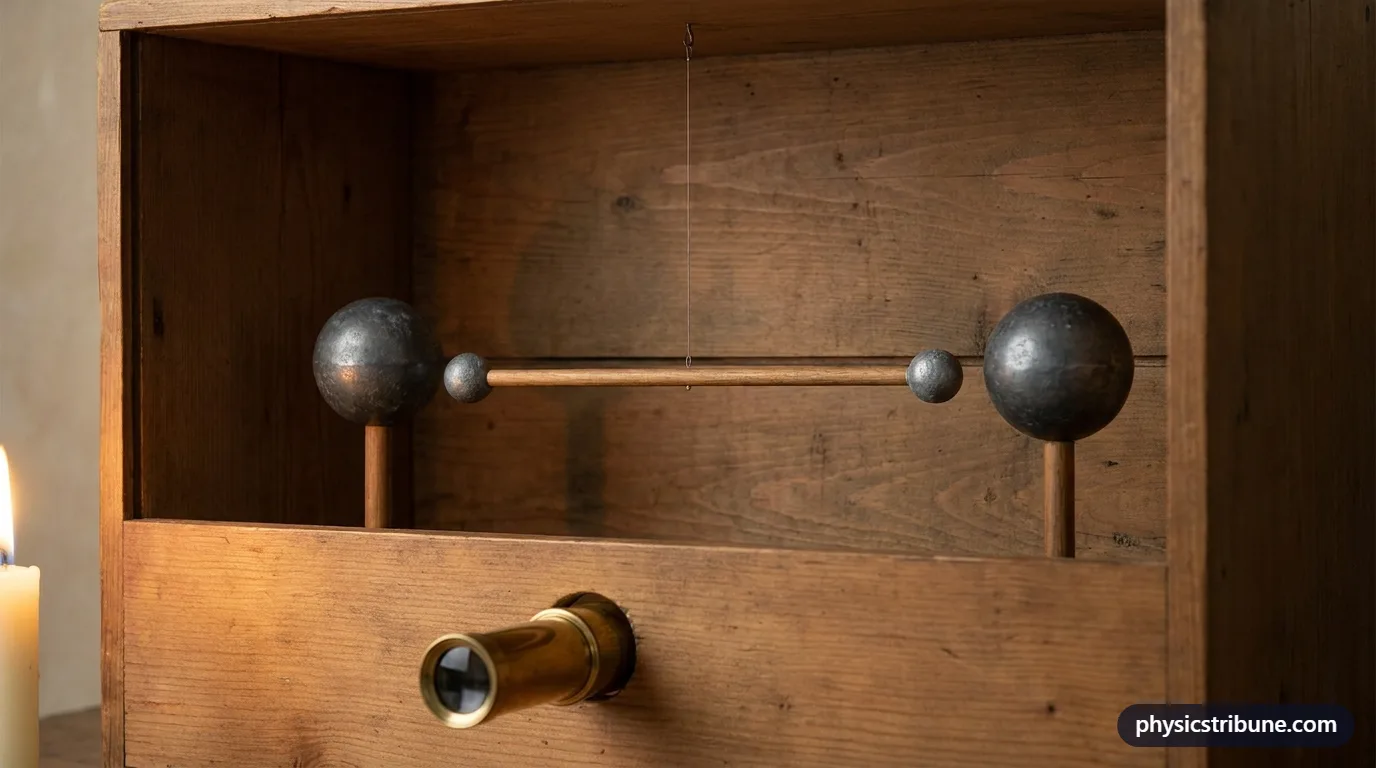
Measuring that faint pull in a lab was a triumph. In 1798, Henry Cavendish used a delicate twisting balance to detect the attraction between lead spheres, as described on our Cavendish experiment page. His result fixed the size of
The table compares the force for several pairs. Notice the range: from a few hundred-millionths of a newton for bowling balls to tens of billions of trillions of newtons between the Sun and Earth.
Example 2 Your own pull on the planet
A 65 kg student stands on the ground. Earth's mass is about 5.972 × 10^24 kg and the student is about 6.371 × 10^6 m from Earth's center. What is the gravitational force between the student and Earth?
- Given:
- gravitational constant:
- mass 1:
- mass 2:
- distance between the centers of mass:
- gravitational constant:
- Formula:
- Substitute:
- Answer:
This is simply the student's weight. By the third law, the student pulls up on Earth with exactly the same force, but Earth's huge mass means its resulting acceleration is far too small to notice.
| Pair | Masses | Distance between centers | Force (N) |
|---|---|---|---|
| Two bowling balls | 7 kg and 7 kg | 0.3 m | 3.6 × 10⁻⁸ |
| Two people | 70 kg and 70 kg | 1 m | 3.3 × 10⁻⁷ |
| Two parked cars | 1,500 kg and 1,500 kg | 5 m | 6.0 × 10⁻⁶ |
| Earth and an apple | 5.972 × 1024 kg and 0.1 kg | 6,371 km | 0.98 |
| Earth and the Moon | 5.972 × 1024 kg and 7.346 × 10²² kg | 384,400 km | 1.98 × 10²⁰ |
| Sun and Earth | 1.989 × 1030 kg and 5.972 × 1024 kg | 149.6 million km | 3.54 × 10²² |
| Sun and Jupiter | 1.989 × 1030 kg and 1.898 × 1027 kg | 778.5 million km | 4.16 × 10²³ |
| Source: Computed with F = G m1 m2 / r², G from NIST CODATA 2022 · public domain; masses and distances are typical values · Retrieved October 2026 | |||
How Did Newton Use the Moon to Test His Law?
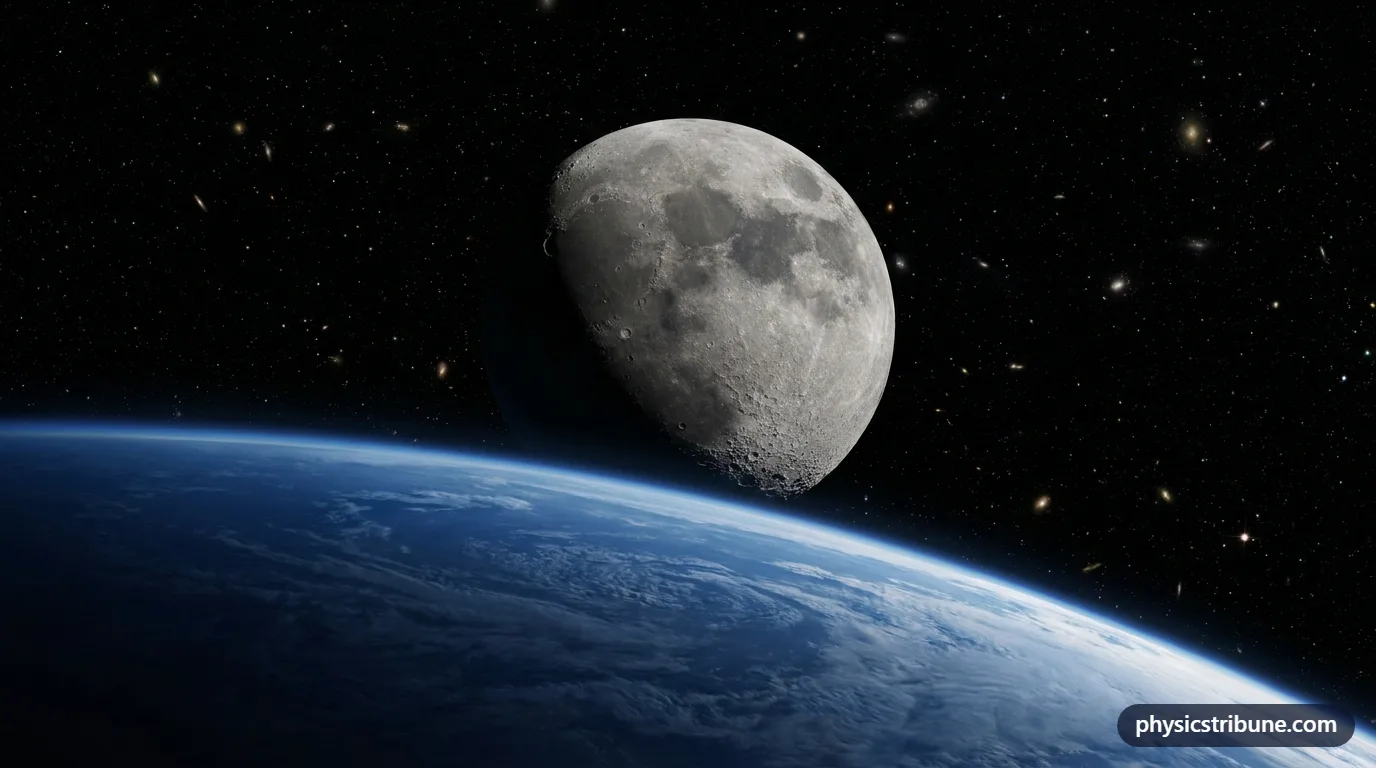
Isaac Newton compared two numbers. The Moon is about 60 Earth radii away, so if gravity follows an inverse square, the pull there should be about
Separately, he could calculate the acceleration the Moon needs just to stay on its circular path, from its distance and its 27.3-day orbit. That value also comes out near 0.0027 m/s² (computed). The match showed that the force dropping apples and the force steering the Moon are one and the same.
The story of a falling apple inspiring the idea comes from Newton's own later recollections. Whether or not an apple fell on cue, the Moon calculation was the real evidence. It also explains why the Moon does not crash into Earth: it is always falling toward us while moving sideways fast enough to keep missing.

How Do You Add Gravitational Forces From Several Bodies?
Gravitational forces add as vectors. To find the net pull on an object, work out the force from each body separately with Newton's law, then add them tip to tail. This is the same process used for any net force.
The diagram shows a 1,000 kg probe on the line between Earth and the Moon, 300,000 km from Earth's center. Earth pulls it with about 4.43 N and the Moon pulls the other way with about 0.69 N, leaving about 3.74 N toward Earth (computed). Farther out, around 346,000 km from Earth, the two pulls balance exactly.

Who Discovered the Law of Universal Gravitation?
Isaac Newton published the law in 1687 in his Philosophiæ Naturalis Principia Mathematica. He showed that an inverse-square force explains Kepler's laws of planetary motion, which until then had been rules without a cause. The same book contained his three laws of motion.
Newton was not the only person thinking about an inverse-square pull. Robert Hooke and others had suggested the idea, and Hooke later argued that he deserved credit. What Newton added was the full mathematical proof that the law reproduces the observed orbits, together with the bold claim that it applies to all matter everywhere. You can read more on who discovered gravity.
Newton himself never knew the value of
Going Deeper: Where Does Newton's Law of Gravitation Break Down?
Newton's law treats gravity as an instant pull across empty space. In 1915, Einstein replaced that picture with general relativity, in which mass curves spacetime and objects follow the curves. The two theories agree almost perfectly for weak gravity and slow speeds, which covers nearly all of the solar system.
The differences show up near very dense or massive objects. Newton's law cannot fully explain the slow turning of Mercury's orbit, the bending of starlight by the Sun or the slower ticking of clocks deep in a gravity well. GPS satellites must include relativity corrections to stay accurate.
The law also needs care with shape. The simple formula is exact for point masses and for perfect spheres, which act as if all their mass sat at the center. For irregular objects, you add up the pulls of many small pieces.
Practice Universal Gravitation Problems
Mix problems that ask for force, distance and mass to get comfortable with the inverse square. Our universal gravitation worksheets include printable answer keys, and you can check any result with the gravitational force calculator. To see how the same law sets the surface value of g on each planet, read acceleration due to gravity.
Common Misconceptions
Myth: Heavier objects pull on lighter objects harder than lighter objects pull back.
Physics: The forces are equal in size and opposite in direction. The lighter object simply accelerates more because it has less mass.
Myth: There is no gravity in space, which is why astronauts float.
Physics: At a space station's height Earth's gravity is still close to 90 percent of its surface value. Astronauts float because they are in free fall around Earth together with their station.
Myth: The distance r is measured from the surfaces of the two objects.
Physics: r is the distance between their centers. For a person on Earth, r is Earth's radius, about 6,371 km, not zero.
Myth: Gravity only acts between very large objects like planets.
Physics: Every pair of masses attracts. The pull between small objects is real but so tiny that friction and other forces hide it.
Key Facts
- Newton's law of universal gravitation states that every two masses attract with F = G m1 m2 / r².
- The force is proportional to the product of the masses and inversely proportional to the square of the distance between centers.
- G = 6.674 30 × 10^-11 N·m²/kg² (CODATA 2022), which makes gravity between everyday objects extremely weak.
- Both objects feel equal and opposite forces, as Newton's third law requires.
- Newton published the law in the Principia in 1687; Cavendish measured the attraction in the lab in 1798.
- Newton tested the law by showing the Moon's orbital acceleration is about 3,600 times smaller than g at Earth's surface.
- General relativity refines the law near very massive objects, but Newton's form is accurate across most of the solar system.
Quick Quiz: How Well Do You Know Newton's Law of Universal Gravitation?
6 questions. Tap an answer to check it.
What happens to the gravitational force between two objects if the distance between them is tripled?
Force depends on 1/r², so tripling r divides the force by 9.
If one of the two masses is doubled, the gravitational force:
The force is directly proportional to each mass.
In F = G m1 m2 / r², what does r measure?
r is always measured center to center.
Which scientist first measured the gravitational attraction between masses in a laboratory?
Cavendish used a torsion balance in 1797 and 1798 to detect the pull between lead spheres.
A small asteroid and Earth pull on each other. How do the two forces compare?
Gravitational forces come in equal and opposite pairs, as Newton's third law states.
What is the SI unit of the gravitational constant G?
G must turn kg² / m² into newtons, so its unit is N·m²/kg².
Frequently Asked Questions
What is Newton's law of universal gravitation in simple terms?
It says that every object with mass pulls on every other object with mass. The pull is stronger when the objects are heavier and weaker when they are farther apart, dropping to a quarter each time the distance doubles. The same rule explains why things fall on Earth and why the Moon and planets stay in their orbits.
What is the formula for universal gravitation?
The formula is F = G m1 m2 / r². F is the gravitational force in newtons, m1 and m2 are the two masses in kilograms, r is the distance between their centers in meters, and G is the gravitational constant, 6.674 × 10^-11 N·m²/kg². Rearranging gives the distance or either mass when the force is known.
Why is it called the universal law of gravitation?
Newton called it universal because it applies to all matter everywhere, not only to objects near Earth. The same equation describes an apple falling from a tree, the Moon circling Earth, planets orbiting the Sun and stars orbiting in galaxies. That was a major break from older ideas that treated the sky and the ground as separate realms.
What happens to gravitational force if the distance is doubled?
It drops to one quarter of its original value, because the force depends on 1/r². Tripling the distance cuts the force to one ninth, and ten times the distance cuts it to one hundredth. Doubling one of the masses, by contrast, doubles the force, since the force is directly proportional to each mass.
What is G in Newton's law of gravitation?
G is the universal gravitational constant, a fixed number that sets the strength of gravity everywhere. Its CODATA 2022 value is 6.674 30 × 10^-11 N·m²/kg². It is one of the hardest constants to measure precisely because gravity between laboratory masses is so weak. It should not be confused with lowercase g, the local acceleration due to gravity.
How is Newton's law of gravitation related to weight?
Your weight is the gravitational force between you and Earth. Putting Earth's mass and radius into F = G m1 m2 / r² gives about 9.8 newtons for every kilogram of your mass, which is why weight can be written as W = mg with g about 9.8 m/s². On another planet, the same law gives a different g and so a different weight.
Who discovered the law of universal gravitation?
Isaac Newton published the law in 1687 in the Principia, along with his laws of motion. Robert Hooke and others had suggested an inverse-square pull, but Newton proved mathematically that it explains planetary orbits and declared it valid for all matter. Henry Cavendish first measured the attraction between lab masses in 1798.
Is Newton's law of gravitation still used today?
Yes. It is accurate enough to plan spacecraft trajectories, predict tides and calculate satellite orbits. Einstein's general relativity is more accurate in strong gravity, such as near black holes, or where tiny timing errors matter, as in GPS. For most engineering and astronomy within the solar system, Newton's law gives answers good to many decimal places.
Does gravity depend on what objects are made of?
No. Gravity depends only on mass and distance, not on material, color, temperature or electric charge. A kilogram of feathers and a kilogram of lead attract Earth with the same force. Very precise experiments have tested this equality for many materials and found no difference, a result Einstein later built into general relativity.
Keep Exploring
 constantsGravitational Constant (G)
 calculatorsGravitational Force Calculator
 worksheetsUniversal Gravitation Worksheets
 gravityInverse Square Law
 gravityKepler's Laws of Planetary Motion
 gravityAcceleration Due to Gravity (g = 9.8 m/s²)
 experimentsCavendish experiment
 compareMass vs Weight
 physicistsIsaac Newton
Sources
Constants come from NIST CODATA 2022 (public domain) and unit definitions from the BIPM SI Brochure (CC BY 4.0). Text, diagrams and illustrations are original work by Physics Tribune.