At a Glance
A simple machine changes how a force is applied so a job feels easier. The six types are the lever, wheel and axle, pulley, inclined plane, wedge and screw, and their mechanical advantage is MA = F_o / F_i (output force divided by input force). Everyday examples include scissors, a doorknob, a flagpole rope, a wheelchair ramp, a knife and a jar lid.
- Number of types
- 6 (lever, wheel and axle, pulley, inclined plane, wedge, screw)
- Formula
- MA = F_o / F_i
- What they save
- Force, not work: you push less but farther
- Two families
- Lever family (lever, wheel and axle, pulley) and ramp family (inclined plane, wedge, screw)
- Quick test
- Does it trade a small force over a long distance for a big force over a short one?
On this page
- How Can You Tell Something Is a Simple Machine?
- What Are Examples of Levers, Wheels and Pulleys?
- What Are Examples of Inclined Planes, Wedges and Screws?
- What Are Examples of Simple Machines Used in Everyday Life at Home?
- What Happens When Simple Machines Are Combined?
- Do Simple Machines Reduce the Amount of Work?
- Simple Machines Examples for Kids
- Common Misconceptions
- Key Facts
- Quiz
- FAQ
How Can You Tell Something Is a Simple Machine?
A simple machine takes the push or pull you give it and hands it on in a more useful form. It may make the force bigger, send it in a new direction, or let a small hand movement become a fast, wide movement at the far end. What it never does is create energy. The work you put in, force times distance, is at least as large as the work you get out.
To classify a tool, look for one of six shapes. A rigid bar turning on a pivot is a lever. A big wheel locked to a thin rod is a wheel and axle. A rope over a grooved wheel is a pulley. A sloping surface is an inclined plane, a sharp moving slope is a wedge, and a slope wrapped around a cylinder is a screw.
The table lists the 18 examples on this page by type, and the sections that follow explain how each one helps.
Every example on this page can be scored with the same ratio: the force the machine delivers divided by the force you put in.
| Symbol | Quantity | SI unit |
|---|---|---|
| mechanical advantage | dimensionless (1) | |
| output force (exerted on the load) | newton (N) | |
| input force (effort) | newton (N) |
Valid for: for a lever in equilibrium MA = l_i / l_o (input arm / output arm).
| Example | Type | What it does |
|---|---|---|
| Bottle opener | Lever | Multiplies force to pry off a cap |
| Seesaw | Lever | Balances loads on either side of a pivot |
| Broom | Lever | Trades force for a wide, fast sweep |
| Doorknob | Wheel and axle | Turns a thin spindle with a light twist |
| Steering wheel | Wheel and axle | Turns the steering column with ease |
| Rolling pin | Wheel and axle | Spreads a push across the dough |
| Flagpole rope | Pulley | Changes a downward pull into upward lift |
| Window blinds | Pulley | Raises slats with a downward tug |
| Crane hook block | Pulley | Shares a heavy load among rope strands |
| Wheelchair ramp | Inclined plane | Lowers the force needed to rise |
| Playground slide | Inclined plane | Guides a smooth descent |
| Switchback road | Inclined plane | Stretches a steep climb into a gentle one |
| Kitchen knife | Wedge | Turns a downward push into sideways splitting force |
| Axe head | Wedge | Forces wood fibers apart |
| Doorstop | Wedge | Grips the floor to hold a door |
| Jar lid | Screw | Pulls the lid tight with a few twists |
| Wood screw | Screw | Drives into wood with a large pulling force |
| Car jack | Screw | Lifts a car with many small turns |
| Source: Classification by our editors · Retrieved October 2026 | ||
What Are Examples of Levers, Wheels and Pulleys?
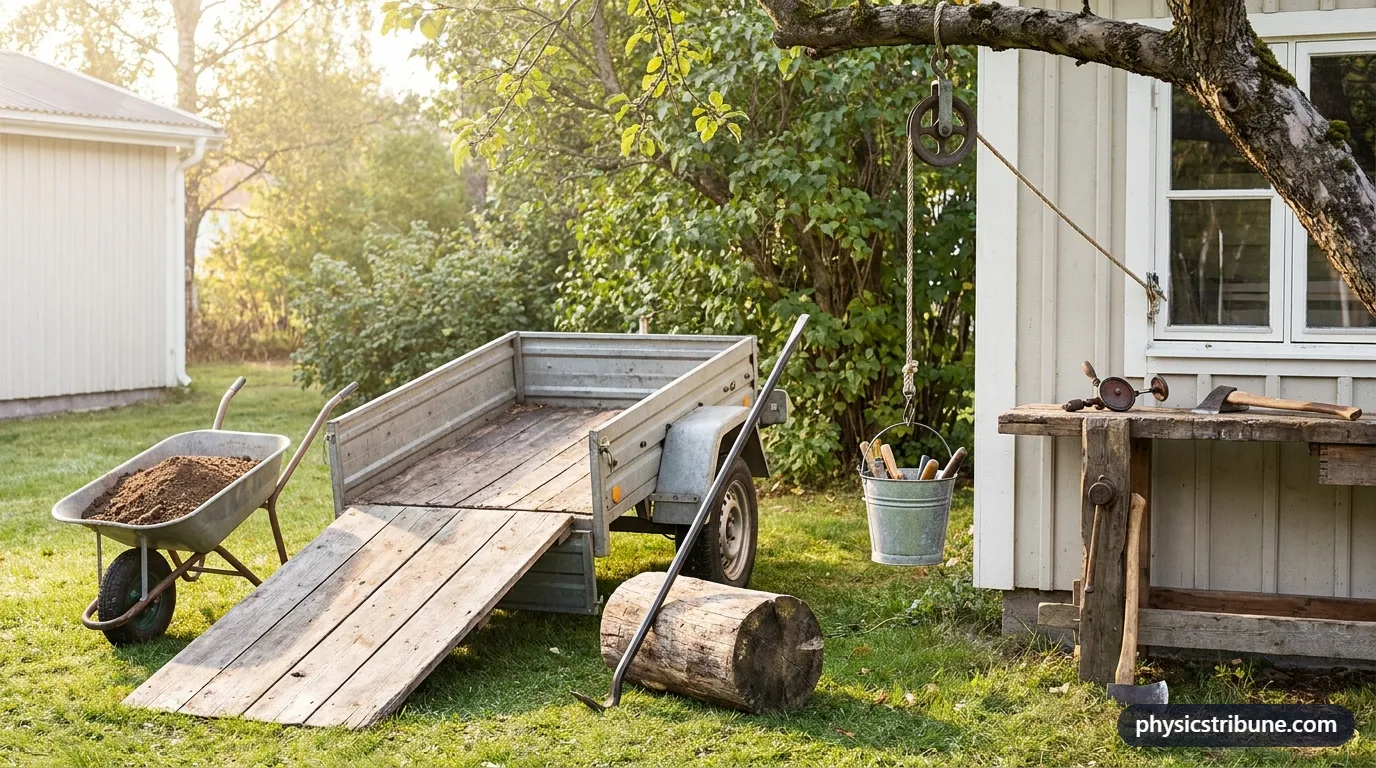
The first three machines all turn around a fixed point, so engineers group them as the lever family.
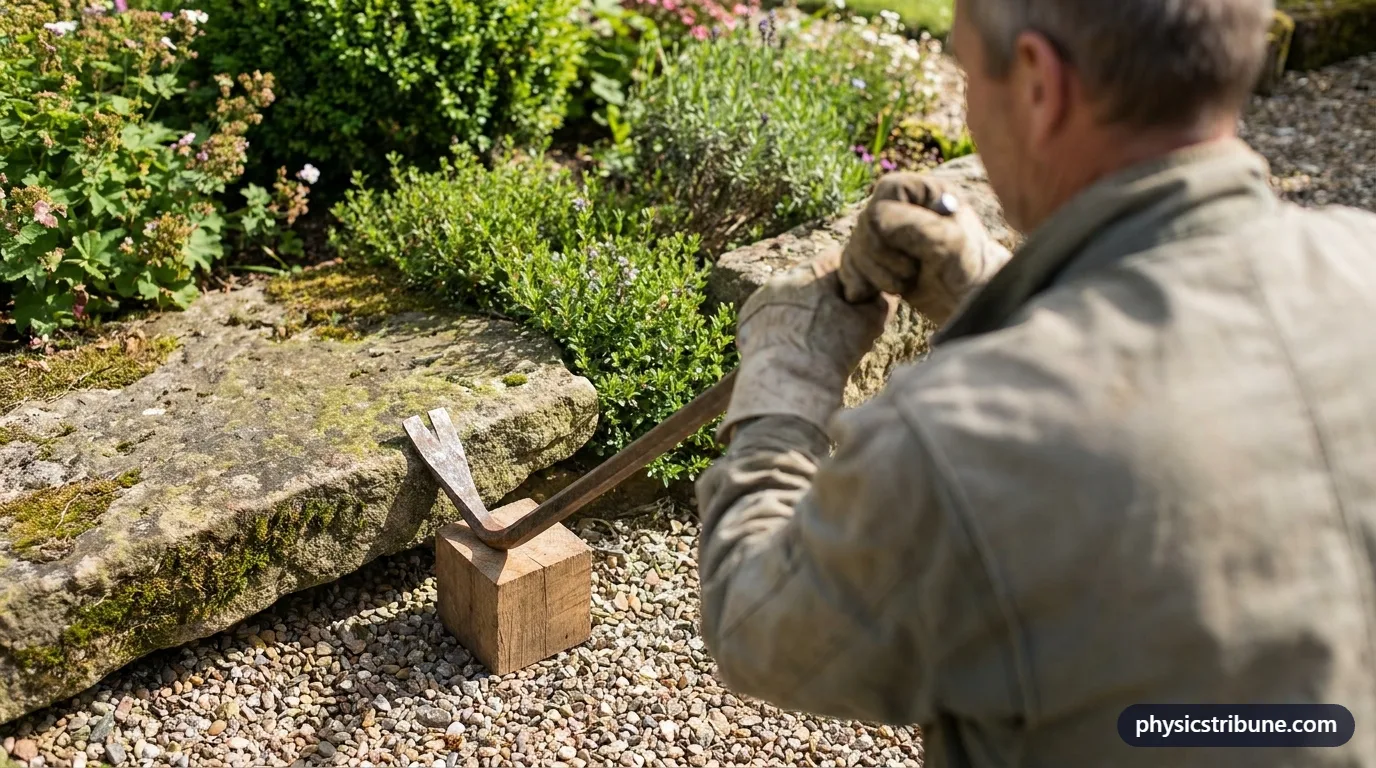
- Bottle opener (lever). The top of the cap is the pivot. Your hand lifts the long handle a few centimeters, and the lip hooked under the cap edge, between the pivot and your hand, pries it up with a much larger force.
- Seesaw (lever). A plank balanced on a central pivot lets a lighter child lift a heavier one by sitting farther from the middle.
- Broom (lever). Your top hand is the pivot and your lower hand supplies the push. The bristles sweep a wide arc, so you trade force for reach and speed.
- Doorknob (wheel and axle). The round knob is the wheel and the spindle inside the door is the axle. A gentle twist on the wide knob turns the thin spindle with enough force to pull back the latch.
- Steering wheel (wheel and axle). The large rim gives your hands a long path, which turns the narrow steering column with ease.
- Rolling pin (wheel and axle). The handles act as the axle and the wide roller acts as the wheel, spreading your push across the dough.
- Flagpole rope (pulley). A single fixed pulley at the top lets you pull down to send the flag up. It changes the direction of the force, not its size.
- Window blinds (pulley). The cord runs over small pulleys hidden in the top rail, so a downward tug raises the slats.
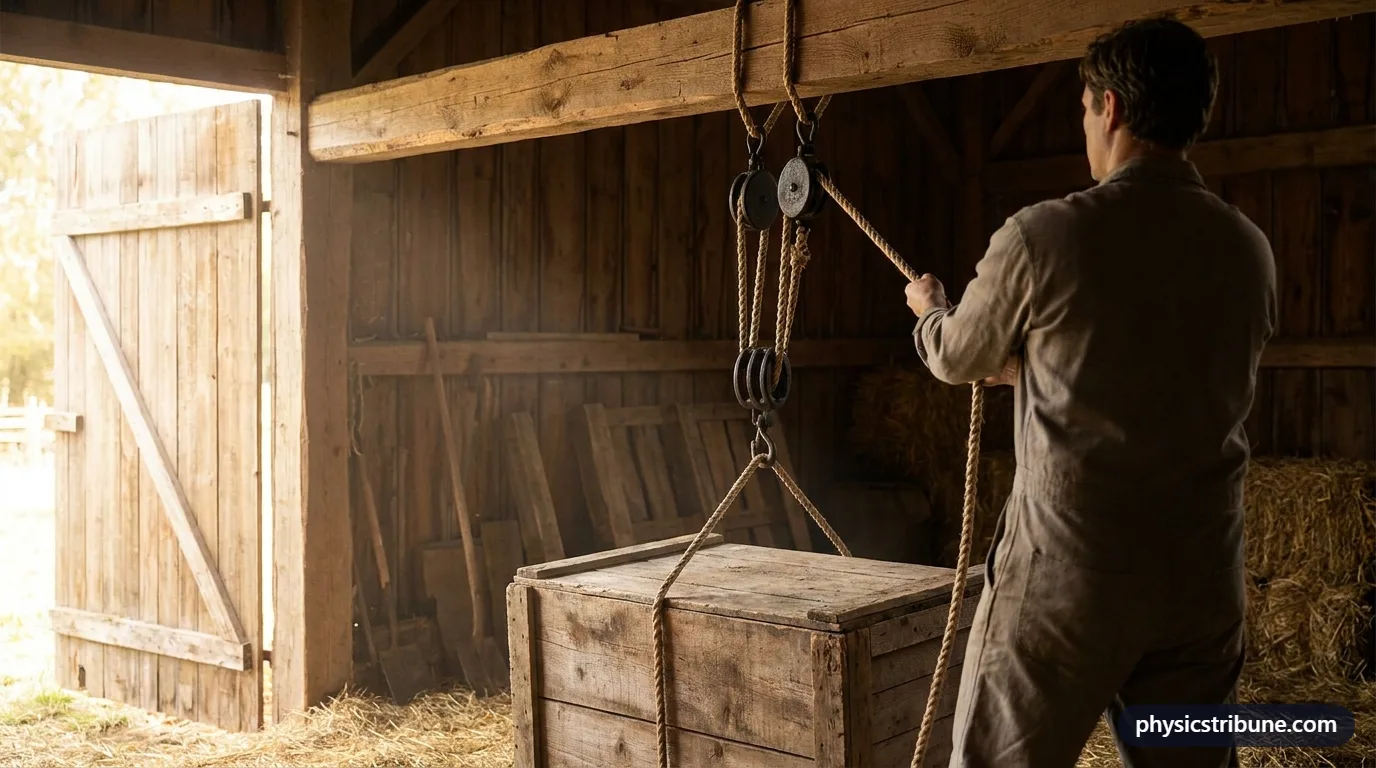
- Crane hook block (pulley). Many rope strands share the load in a block and tackle, so the motor needs only a fraction of the load's weight to lift it.
For more detail, see our lever examples, the wheel and axle page and our pulley examples.
Example 2 Raising a sail with a pulley system
A sailor uses a block and tackle with a mechanical advantage of 4 to hoist a heavy sail that needs 880 N of lifting force. Ignoring friction, how hard must the sailor pull on the rope?
- Given:
- output force (exerted on the load):
- mechanical advantage:
- output force (exerted on the load):
- Formula:
- Substitute:
- Answer:
The sailor pulls four meters of rope for every meter the sail rises, so the work done stays the same.

What Are Examples of Inclined Planes, Wedges and Screws?
The other three machines are all built from a slope, so they form the ramp family.
- Wheelchair ramp (inclined plane). Rolling up a gentle slope takes a much smaller force than lifting straight up, though you travel a longer path.
- Playground slide (inclined plane). Here the slope works in reverse, guiding your fall into a smooth, slower ride down.
- Mountain road with switchbacks (inclined plane). The zigzag stretches the climb over a long distance so cars and hikers face a gentle grade.
- Kitchen knife (wedge). The thin blade turns your downward push into strong sideways forces that split the food apart.
- Axe head (wedge). A swing drives the narrow edge into wood, and the widening sides force the fibers open.
- Doorstop (wedge). Pushed under a door, it converts the door's sideways push into a firm grip against the floor.
- Jar lid (screw). The thread is a ramp wrapped around the rim. Several twists of your wrist pull the lid down tight with a strong seal.
- Wood screw (screw). Each full turn drives the screw only a short way into the board, so a modest twist produces a large pulling force.
- Car jack (screw). Many turns of the handle raise one corner of a car a short distance, letting one person lift what they never could by hand.
Our pages on the inclined plane, the wedge and the screw explain the geometry behind each one.
Example 1 Rolling a piano up a loading ramp
Movers push a piano on a wheeled dolly up a long ramp into a truck. The piano and dolly weigh 2,400 N, and the movers measure that they need a steady push of 600 N along the ramp. What is the ramp's actual mechanical advantage?
- Given:
- output force (exerted on the load):
- input force (effort):
- output force (exerted on the load):
- Formula:
- Substitute:
- Answer:
In exchange, the movers push the piano along a ramp several times longer than the height it gains.
What Are Examples of Simple Machines Used in Everyday Life at Home?
Walk through a house and you can find all six types in a few minutes. The kitchen has knives (wedges), can openers (a lever plus a wheel and axle), jar lids (screws) and a rolling pin. The garage holds a hammer whose claw is a lever, a screwdriver whose handle is a wheel and axle, and a car jack built on a screw.
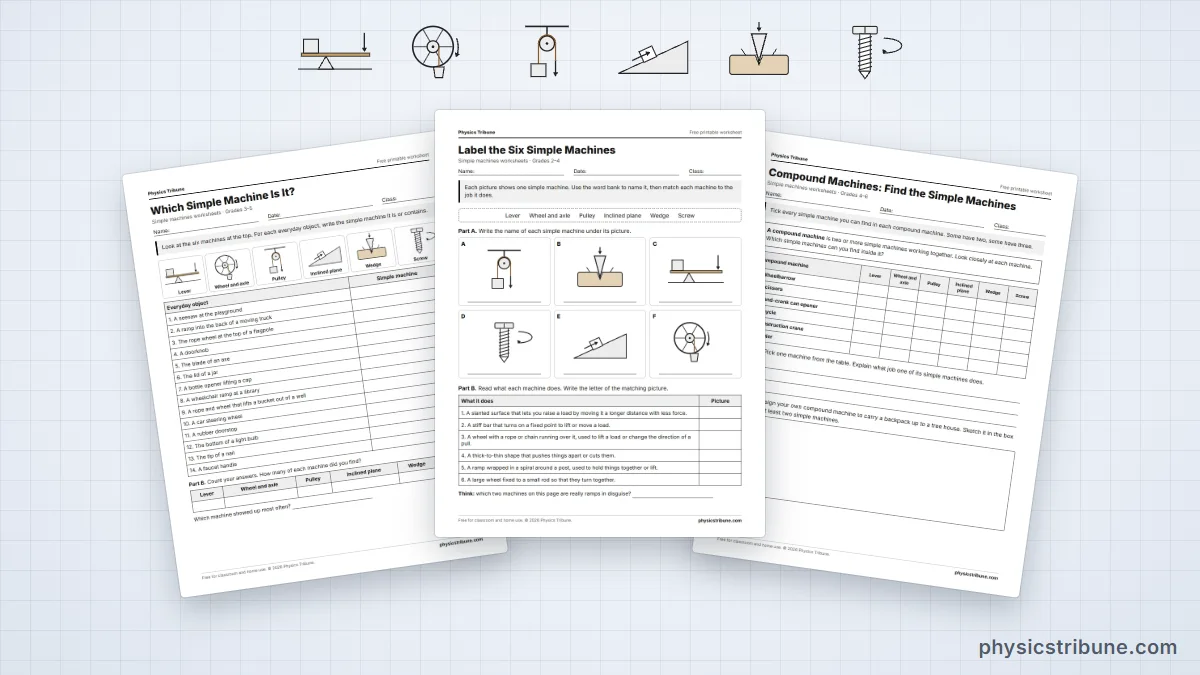
Even the door has three. The knob is a wheel and axle, the hinge lets the whole door swing like a lever around its edge, and the doorstop is a wedge. Spotting these is a good way to practice, and our simple machines worksheets include a sorting activity for exactly this.

What Happens When Simple Machines Are Combined?
A compound machine links two or more simple machines so the output of one becomes the input of the next. Scissors join two levers that pivot on one bolt, and each blade is a wedge. A bicycle uses wheels and axles, a chain over toothed sprockets and levers in the brakes and pedals.
The overall mechanical advantage of a compound machine is the product of the advantages of its parts. That is how a hand-cranked winch, with a long crank and a narrow drum, can lift a boat onto a trailer.
Do Simple Machines Reduce the Amount of Work?
No. They reduce the force, not the work. If a ramp lets you push with one quarter of the force, you must push along a path four times as long. Friction adds a little extra, so real machines always need slightly more work in than they deliver out. Our page on mechanical advantage separates the ideal value from the actual one, and the mechanical advantage calculator works out both.
The idea is very old. The Greek thinker Archimedes studied levers and pulleys more than two thousand years ago and showed that a long enough lever could balance a very heavy load with a light one.
Simple Machines Examples for Kids
A fun way to learn the six machines is a scavenger hunt. Give each one a card and find a real object for every card: a spoon prying a lid (lever), a toy car's wheels (wheel and axle), a bucket on a rope (pulley), a slide (inclined plane), a doorstop (wedge) and a bottle cap (screw).
Younger learners can try lifting a stack of books with a ruler over a pencil, then move the pencil and feel the difference. Our simple machines for kids page has more activities.
Common Misconceptions
Myth: Simple machines reduce the amount of work you do.
Physics: They reduce the force you need, but you apply it over a longer distance, so the work stays the same or slightly more because of friction.
Myth: A machine has to have a motor or many parts.
Physics: In physics, a simple machine can be a single plank, a ramp or a rope over a wheel. No engine is needed.
Myth: A single fixed pulley halves the force you need.
Physics: A single fixed pulley only changes the direction of the pull. You need a movable pulley or a block and tackle to reduce the force.
Key Facts
- There are six classic simple machines: lever, wheel and axle, pulley, inclined plane, wedge and screw.
- Simple machines make a task easier by changing the size or direction of a force.
- No simple machine reduces the work needed; a smaller force always means a longer distance.
- A wedge is an inclined plane that moves, and a screw is an inclined plane wrapped around a cylinder.
- A wheel and axle and a pulley both behave like levers that turn all the way around.
- Mechanical advantage is the output force divided by the input force.
- Compound machines such as scissors and bicycles combine two or more simple machines.
Quick Quiz: How Well Do You Know Examples of Simple Machines?
6 questions. Tap an answer to check it.
Which simple machine is a doorknob?
The round knob is the wheel and the spindle inside the door is the axle.
A jar lid is an example of which simple machine?
The lid's thread is a slope wrapped around a cylinder, which is a screw.
What does a single fixed pulley on a flagpole do?
You pull down and the flag goes up, but the force stays the same size.
Which tool is a wedge?
The narrow edge of the axe forces the wood apart.
A ramp lets you push with a quarter of the force. What else changes?
A smaller force must act over a longer distance to do the same work.
Why are scissors called a compound machine?
Two levers share one pivot, and each blade is a wedge.
Frequently Asked Questions
What are 6 examples of simple machines?
One example of each type is a seesaw (lever), a doorknob (wheel and axle), a flagpole rope (pulley), a wheelchair ramp (inclined plane), a kitchen knife (wedge) and a jar lid (screw). Each one changes the size or direction of a force so that a job takes less effort, even though you move farther.
What are examples of simple machines at home?
Homes are full of them. Scissors and bottle openers are levers, doorknobs and faucet handles are wheels and axles, window blinds use pulleys, the steps to a porch work like an inclined plane, a doorstop and a knife are wedges, and jar lids, light bulbs and spray bottle caps are screws.
What are examples of simple machines used in everyday life?
Outside the home you can see a crane lifting steel with pulleys, a delivery driver pushing a dolly up a ramp, a cyclist turning pedals on a wheel and axle, a woodcutter splitting logs with a wedge, a mechanic raising a car on a screw jack and children playing on a seesaw lever at the park.
Is a bicycle a simple machine?
No, a bicycle is a compound machine because it combines several simple ones. The pedals and cranks act as wheels and axles, the chain links two toothed wheels, the wheels themselves turn on axles and the brake handles are levers. Together they let your legs move you much faster than walking.
Is a knife a simple machine?
Yes, a knife blade is a wedge, one of the six simple machines. The thin edge concentrates your push onto a tiny area, and the sloping sides turn that downward push into sideways forces that push the food apart. A sharper, thinner blade gives a larger splitting force for the same push.
What simple machine is a ramp?
A ramp is an inclined plane. It lets you raise an object to a higher level by pushing it along a sloped path instead of lifting it straight up. The longer and gentler the ramp, the smaller the push you need, but the farther you have to travel to gain the same height.
What are good simple machines examples for kids?
Easy examples for kids are a seesaw at the playground, the wheels on a toy wagon, a bucket hoisted on a rope, a slide, a doorstop and the cap on a water bottle. Children can test each one and feel how it makes pushing, lifting or turning easier.