At a Glance
A compound machine combines two or more simple machines, such as a lever and a pulley, so they act in sequence. Its overall mechanical advantage is the product of the individual ones, MA = MA1 x MA2 x ..., and its overall efficiency is the product of the stage efficiencies, so it is always lower than the efficiency of any single stage.
- Definition
- Two or more simple machines acting in sequence
- Overall MA
- MA = MA1 × MA2 × …
- Measured MA
- MA = Fo / Fi (no unit)
- Overall efficiency
- η = η1 × η2 × …, always below 100%
- Everyday examples
- Scissors, bicycle, wheelbarrow, can opener, crane
On this page
- What Is a Compound Machine?
- Compound Machines Explained Simply
- How Do You Find the Mechanical Advantage of a Compound Machine?
- Why Are Compound Machines Less Efficient?
- What Are Examples of Compound Machines?
- How Do Gears Fit Into Compound Machines?
- Do Compound Machines Save Work?
- How Do You Analyze a Compound Machine Step by Step?
- Who Studied Compound Machines First?
- Common Misconceptions
- Key Facts
- Quiz
- FAQ
What Is a Compound Machine?
A compound machine is any device built from two or more simple machines that work in a chain. The first machine takes your push or pull, changes it, and passes it on. The second machine changes it again, and so on, until the final stage acts on the load.
The six classic simple machines are the lever, the pulley, the wheel and axle, the inclined plane, the wedge and the screw. Almost every hand tool and vehicle you use mixes several of them. A pair of scissors, for example, is two levers sharing a pivot, and each blade edge is a wedge.
Compound machines exist because one simple machine is rarely enough. A single lever long enough to lift a car would be awkward to carry, but a short lever turning a screw can do the same job in a jack that fits in a trunk.
Compound Machines Explained Simply
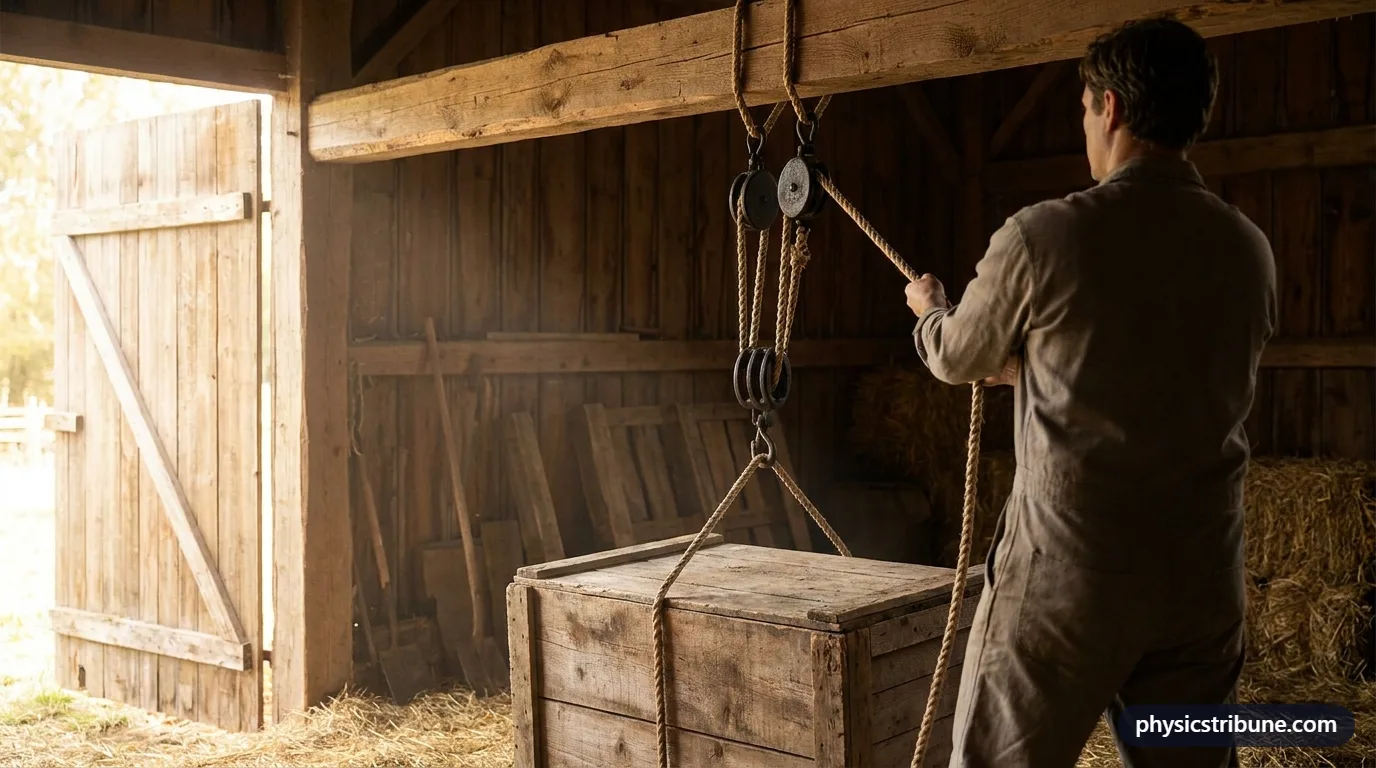
Think of a compound machine as a relay team for force. The first runner gets a small push from you and hands on a bigger push. The next runner makes it bigger again. By the end, a gentle effort has turned into a strong force on the load.
There is a catch. Every helper in the team makes you move your hand farther. If the force gets twelve times bigger, your hand has to travel about twelve times as far as the load moves. You never get more energy out than you put in. You only trade distance for force, or force for distance.
How Do You Find the Mechanical Advantage of a Compound Machine?
Mechanical advantage tells you how many times a machine multiplies force. For a compound machine, you multiply the mechanical advantages of the stages:
Multiplying makes sense once you follow the force. If the lever turns your 50 N pull into 150 N, that 150 N becomes the input of the pulley, which turns it into 600 N. Each stage works on what the previous stage hands it.
When you can measure the forces directly, the actual mechanical advantage is simply the output force divided by the input force, as in the formula below. To try numbers for any single stage, use the mechanical advantage calculator, then multiply the stage results.
Whatever the inside of a compound machine looks like, its actual mechanical advantage is still the output force divided by the input force.
| Symbol | Quantity | SI unit |
|---|---|---|
| mechanical advantage | dimensionless (1) | |
| output force (exerted on the load) | newton (N) | |
| input force (effort) | newton (N) |
Rearranged to find another variable:
Valid for: for a lever in equilibrium MA = l_i / l_o (input arm / output arm).
Example 1 A hand winch with a pulley
A boat-trailer winch has a crank handle that turns on a circle of radius 0.30 m, driving a drum of radius 0.05 m. The winch cable runs to a pulley block with 2 supporting rope segments. Ignoring friction, what is the overall ideal mechanical advantage?
- Given:
- R:
- r:
- n:
- R:
- Formula:
- Substitute:
- Answer:
The wheel and axle alone gives a factor of 6, and the pulley block doubles it again.

Why Are Compound Machines Less Efficient?
Every real stage loses some energy to friction, so its efficiency is below 100%. In a compound machine those losses stack, and the overall efficiency is the product of the stage efficiencies:
That is why engineers keep the number of stages as low as the job allows and use bearings, lubrication and well-cut gear teeth. Screws are a special case. A car jack screw may waste most of its input to friction, but that friction is useful: it stops the load from sliding back down when you let go.
The actual mechanical advantage equals the ideal one times the overall efficiency. The table below shows how this works for several combinations. For more on measuring losses, see energy efficiency.
Example 2 Effort for a lever and pulley rig with friction
A workshop rig lifts a 1,800 N engine part. A lever with an ideal mechanical advantage of 2.5 pulls on a rope that runs through a pulley system with 3 supporting segments, and the whole rig is 75% efficient. What input force must a person apply?
- Given:
- output force (exerted on the load):
- MA_1:
- n:
- eff:
- output force (exerted on the load):
- Formula:
- Substitute:
- Answer:
Without friction the effort would be smaller by a quarter, which shows how losses in each stage add up.
| Combination | Stage MAs | Stage efficiencies | Ideal overall MA | Overall efficiency | Actual MA | Effort for a 1,000 N load |
|---|---|---|---|---|---|---|
| Lever + 2-segment pulley | 3 × 2 | 95% × 90% | 6 | 85.5% | 5.13 | 194.9 N |
| Two gear pairs | 3 × 4 | 97% × 97% | 12 | 94.1% | 11.29 | 88.6 N |
| Wheel and axle + 4-segment pulley | 5 × 4 | 90% × 85% | 20 | 76.5% | 15.30 | 65.4 N |
| Three gear pairs | 3 × 3 × 3 | 97% each | 27 | 91.3% | 24.64 | 40.6 N |
| Lever handle + screw jack | 4 × 20 | 90% × 30% | 80 | 27.0% | 21.60 | 46.3 N |
| Source: Computed with MA = MA₁ × MA₂ × … and η = η₁ × η₂ × …; stage values are typical, chosen for illustration · Retrieved October 2026 | ||||||

What Are Examples of Compound Machines?
Compound machines are so common that it is harder to find a tool that is not one. Here are some you can check at home:
- Scissors: two first-class levers joined at a pivot, with wedge-shaped blades that split the material.
- Wheelbarrow: a second-class lever (the handles and tray, with the wheel's axle as the fulcrum) plus a wheel and axle that lets it roll.
- Bicycle: pedal cranks act as a wheel and axle, the chain and sprockets act like gears, the brake handles are levers, and the rear wheel is another wheel and axle.
- Manual can opener: lever handles squeeze a sharp wedge-shaped wheel into the lid, and a turning key works as a wheel and axle.
- Corkscrew with arms: a screw bites into the cork, and two levers lift it out.
- Construction crane: a winch drum (wheel and axle) feeds cable through a multi-segment pulley block on a long boom.
- Pencil sharpener: a crank works as a wheel and axle, and the spiral blades act as wedges.
For a longer, sorted list of single and combined machines around the house, browse our simple machines examples.

How Do Gears Fit Into Compound Machines?
Gears are toothed wheels, so physicists usually treat them as a form of wheel and axle. When a small gear drives a larger one, the larger one turns more slowly but with more turning force. Chaining several gear pairs is the purest form of a compound machine, because each pair multiplies the effect of the one before.
Three gear pairs that each reduce speed by a factor of 3 give an overall factor of 27. Mechanical clocks, kitchen mixers and car gearboxes rely on such gear trains. A bicycle with several sprockets lets the rider choose a high advantage for climbing hills or a low one for speed on flat roads.
Do Compound Machines Save Work?
No machine, simple or compound, reduces the work needed to do a task. Work is force times distance. A compound machine with an ideal advantage of 20 lets you push with one twentieth of the force, but your hand must move twenty times as far as the load. In the ideal case the work in equals the work out.
In real machines the work you put in is always a little larger than the useful work that comes out, because friction turns some of it into heat. What a compound machine saves is effort, not energy. It lets a person with a limited force do a job that would otherwise be impossible.
How Do You Analyze a Compound Machine Step by Step?
- Find the stages. Trace the path of force from your hand to the load and name each simple machine on the way.
- Find each ideal advantage. Use arm lengths for levers, radius ratios for a wheel and axle, the number of supporting rope segments for pulleys, and length over height for a ramp.
- Multiply. The overall ideal mechanical advantage is the product of the stage values.
- Include losses. Multiply the stage efficiencies, then multiply that by the ideal advantage to estimate the actual advantage.
- Check with a measurement. If you can measure the input and output forces, divide them and compare with your estimate.
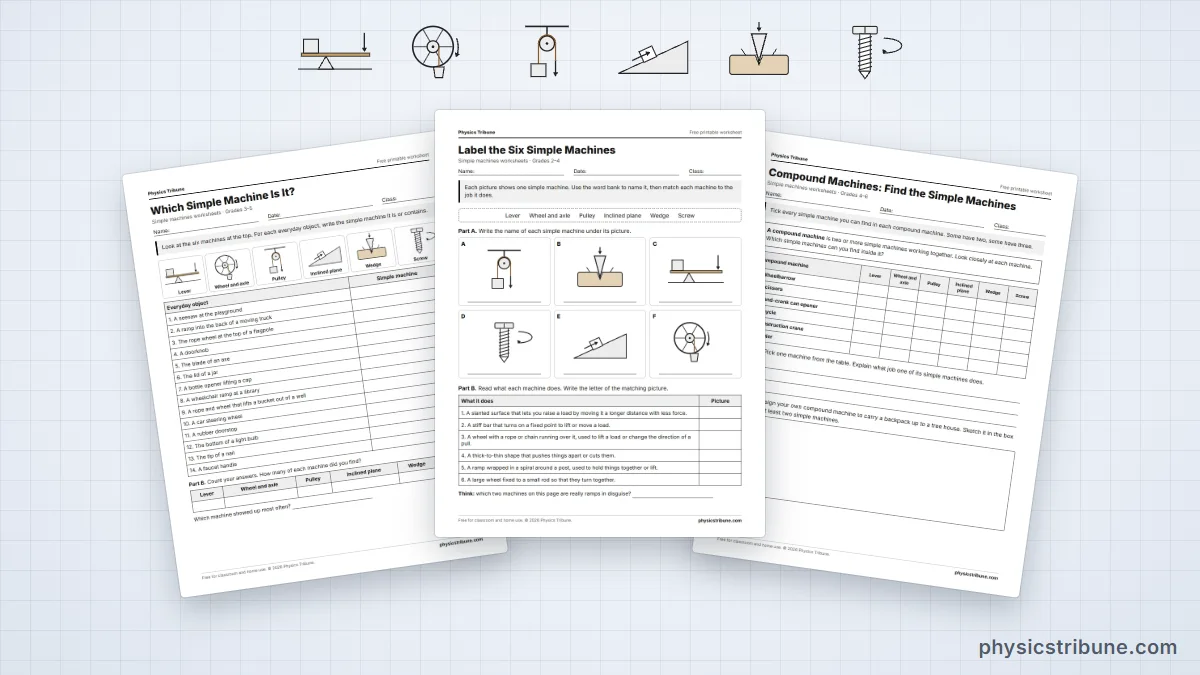
Practice this method with the printable simple machines worksheets, which include answer keys.
Example 3 Measuring a real car jack
A student tests a scissor car jack. Turning the handle with a steady force of 45 N raises a corner of a car that presses down with 3,600 N. What is the actual mechanical advantage of the jack?
- Given:
- output force (exerted on the load):
- input force (effort):
- output force (exerted on the load):
- Formula:
- Substitute:
- Answer:
Compare this with the ideal value from the screw pitch and handle length to find how much the threads lose to friction.
Who Studied Compound Machines First?
People built compound machines long before anyone wrote down the rules. Ancient builders combined ramps, levers and rollers to move huge stones. The Greek mathematician Archimedes, in the third century BCE, is credited with explaining the lever mathematically and with designing systems of pulleys that let a person move very heavy loads.
Later engineers in the Roman world, medieval Europe and elsewhere built cranes driven by treadwheels, which paired a large wheel and axle with ropes and pulleys. The modern idea that energy is conserved through every stage came much later, in the nineteenth century.
Common Misconceptions
Myth: You add the mechanical advantages of the stages to get the total.
Physics: You multiply them. The output of one stage is the input of the next, so a factor of 3 followed by a factor of 4 gives 12.
Myth: A compound machine with a big mechanical advantage gives you free energy.
Physics: Force goes up but distance goes down by the same factor in the ideal case. Real machines give back less work than you put in because of friction.
Myth: More stages always make a machine better.
Physics: Every extra stage adds friction losses and moving parts. Designers use the fewest stages that give the advantage they need.
Myth: Compound machines are only large industrial devices.
Physics: Most hand tools are compound machines, including scissors, pliers with wedge jaws, nail clippers and can openers.
Key Facts
- A compound machine is two or more simple machines connected so that one drives the next.
- The overall ideal mechanical advantage is the product of the stage advantages, not their sum.
- The overall efficiency is the product of the stage efficiencies, so it is lower than any single stage.
- Actual mechanical advantage equals the output force divided by the input force.
- Compound machines reduce the effort needed but never reduce the total work.
- Scissors, bicycles, wheelbarrows, can openers and cranes are all compound machines.
- A gear train is a compound machine made of several wheel-and-axle stages.
Quick Quiz: How Well Do You Know Compound Machines?
6 questions. Tap an answer to check it.
A lever with a mechanical advantage of 4 drives a pulley with a mechanical advantage of 3. What is the overall ideal mechanical advantage?
The stage advantages multiply: 4 × 3 = 12.
Two stages of a machine are each 80% efficient. What is the overall efficiency?
Efficiencies multiply: 0.8 × 0.8 = 0.64, or 64%.
Which of these is a compound machine?
Scissors combine two levers with wedge-shaped blades.
A compound machine has an ideal mechanical advantage of 10. How far must your hand move to lift the load 0.2 m?
In the ideal case the effort distance is 10 times the load distance, so 10 × 0.2 m = 2 m.
What does a compound machine reduce?
It lowers the effort force by making it act over a longer distance; total work is not reduced.
Which simple machines are found in a wheelbarrow?
The handles and tray form a second-class lever, and the wheel turns on an axle.
Frequently Asked Questions
What is a compound machine in simple terms?
A compound machine is a tool or device that uses two or more simple machines together. The simple machines are linked so that one passes its force to the next. Scissors combine levers and wedges, and a wheelbarrow combines a lever with a wheel and axle. Together they make a job easier than any single simple machine could on its own.
What are 5 examples of compound machines?
Five common examples are scissors, a bicycle, a wheelbarrow, a manual can opener and a construction crane. Others include corkscrews with arms, pencil sharpeners, car jacks, nail clippers and hand drills. In each one you can point to at least two simple machines, such as a lever, a wheel and axle, a screw, a wedge or a pulley, working in sequence.
How do you calculate the mechanical advantage of a compound machine?
Multiply the mechanical advantages of all the stages. If a lever has an advantage of 2 and it drives a pulley system with an advantage of 5, the overall ideal value is 10. To find the actual advantage of a real machine, divide the measured output force by the measured input force, which automatically includes friction losses.
What is the difference between a simple machine and a compound machine?
A simple machine has only one basic mechanism, such as a single lever or a single ramp, and few or no moving parts. A compound machine joins two or more of these mechanisms so they work together. Compound machines can reach much larger mechanical advantages, but they also lose more energy to friction because every extra stage adds its own losses.
Is a bicycle a compound machine?
Yes. The pedals and crank work as a wheel and axle, the chain and sprockets transfer motion like a pair of gears, the brake handles are levers, and the wheels turn on axles. Changing gears changes the overall mechanical advantage, giving more force for hills or more speed on flat ground. Several simple machines act in sequence, which is the definition of a compound machine.
Why is the efficiency of a compound machine low?
Each stage loses a share of its input energy, mostly to friction that becomes heat. Because the losses happen one after another, the overall efficiency is the product of the stage efficiencies. Three stages that are each 90 percent efficient give only about 73 percent overall. Machines with many stages or screw threads can end up well below half.
Can a compound machine have a mechanical advantage less than 1?
Yes. Some compound machines are designed to increase speed or distance instead of force. A bicycle in a high gear and the gear train in a fishing reel are examples. Their mechanical advantage is below 1, so you push harder than the output force, but the output moves farther and faster than your hand or foot does.
Is a pair of scissors a compound machine?
Yes. Scissors are two first-class levers joined at a single pivot, which acts as the fulcrum. Your fingers apply the effort at the handles and the material is the load near the blades. The sharp edges of the blades are wedges that concentrate the force into a thin line and split the paper or cloth apart.