At a Glance
Common examples of pulleys include a flagpole, a window blind, a well bucket, a clothesline, a construction crane, an elevator, a gym cable machine and the rope systems on a sailboat. A fixed pulley only changes the direction of the pull, while a movable or compound pulley lowers the effort: ideal mechanical advantage MA = F_out / F_in equals the number of rope segments holding up the load.
- Machine type
- Simple machine (a relative of the wheel and axle)
- Main types
- Fixed, movable, compound (block and tackle)
- Formula
- MA = F_out / F_in
- Ideal MA
- Number of rope segments supporting the load
- Trade-off
- Less force, but more rope pulled
- Quick test
- Does a rope or belt run over a turning grooved wheel?
On this page
- What Counts as an Example of a Pulley?
- What Are Examples of Fixed Pulleys at Home?
- What Are Examples of Movable Pulleys?
- What Are Examples of Compound Pulleys?
- How Much Force Does Each Pulley Save?
- Do Belt Pulleys in Machines Count as Examples?
- How Can You Tell Which Type of Pulley You Are Looking At?
- Common Misconceptions
- Key Facts
- Quiz
- FAQ
What Counts as an Example of a Pulley?
A pulley is a wheel with a groove around its rim that guides a rope, cable, chain or belt. It is one of the six classic simple machines. Something is a good pulley example when you can point to the wheel, the line running over it, the load being moved and the place where the pull is applied.
Pulleys do one or both of two jobs. They change the direction of a force, so you can pull down to lift something up. They can also share the load among several rope segments, so a smaller pull lifts a heavier object. The second job is measured by mechanical advantage.
The examples below are grouped by how the wheels are mounted. Fixed pulleys stay in place, movable pulleys ride up with the load, and compound systems combine both.
Every pulley on this page can be rated by the same ratio of the force it delivers to the force you put in.
| Symbol | Quantity | SI unit |
|---|---|---|
| mechanical advantage | dimensionless (1) | |
| output force (exerted on the load) | newton (N) | |
| input force (effort) | newton (N) |
Rearranged to find another variable:
Valid for: for a lever in equilibrium MA = l_i / l_o (input arm / output arm).
| Example | Type | What the pulley does |
|---|---|---|
| Flagpole | Fixed | Turns a downward pull into an upward lift |
| Window blinds | Fixed | Lifts the slats from a cord at the side |
| Well bucket | Fixed | Lets you pull down to raise water |
| Clothesline | Fixed | Moves clothes along a loop of line |
| Stage curtains | Fixed | Opens heavy drapes from one side |
| Garage bike lift | Fixed or movable | Hoists a bike to the ceiling |
| Zip line trolley | Moving wheel on a cable | Rolls the rider along with little friction |
| Construction hoist | Movable | Halves the pull on the winch line |
| Rope rescue haul | Movable or compound | Raises a person with a third or half the force |
| Theater fly system | Fixed with counterweight | Balances heavy scenery |
| Construction crane | Compound | Lets a winch lift tons of steel |
| Engine hoist | Compound | One person lifts an engine |
| Sailboat mainsheet | Compound | Holds the sail against the wind by hand |
| Elevator | Fixed drive wheel with counterweight | Moves the car with a smaller motor |
| Gym cable machine | Fixed and movable | Redirects and sometimes halves the weight |
| Tow truck winch with snatch block | Movable | Roughly doubles the pulling force |
| Source: Classification by our editors · Retrieved October 2026 | ||
What Are Examples of Fixed Pulleys at Home?
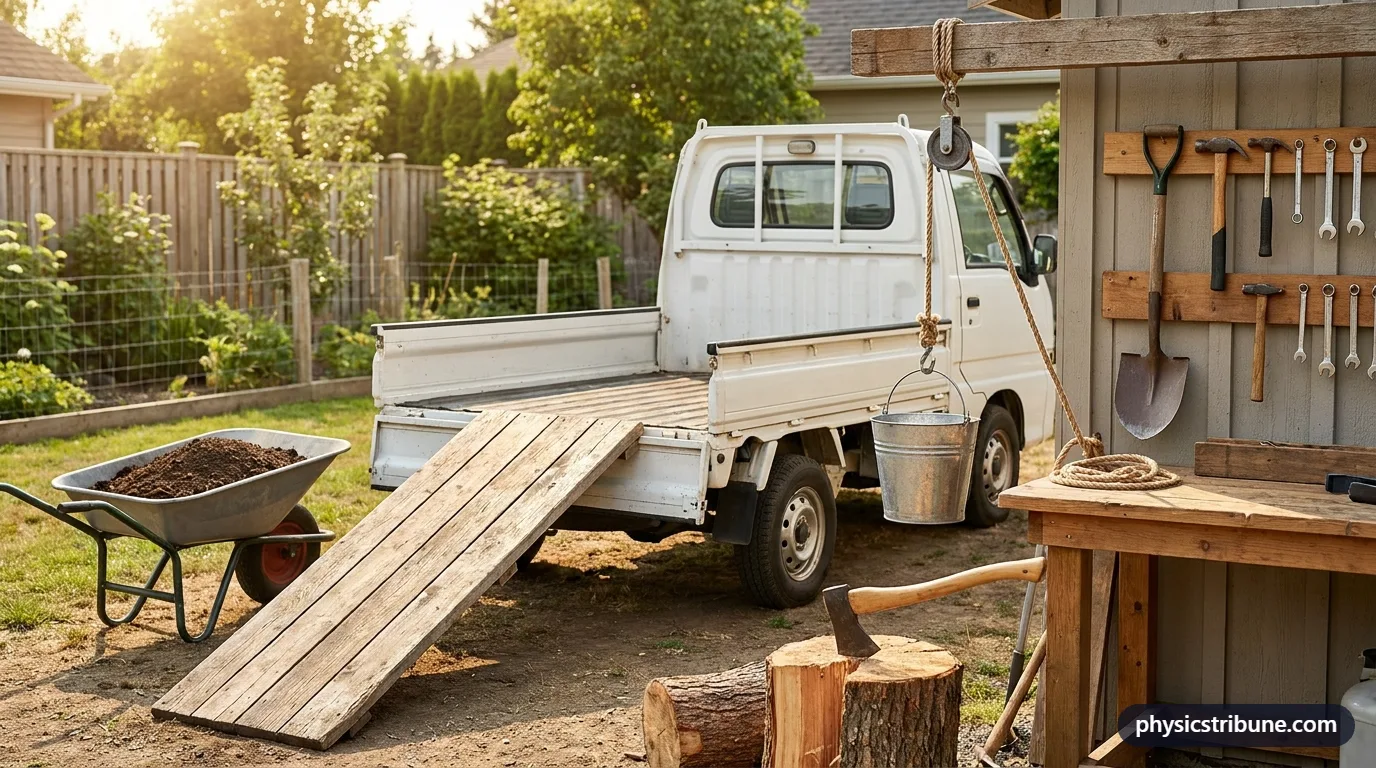
A fixed pulley is bolted to something that does not move. It gives no force advantage, but it lets you stand on the ground and pull down, which is easier and safer than climbing up and pulling up.
- Flagpole. A small wheel at the top of the pole lets you raise the flag by pulling the rope downward at the base.
- Window blinds. Cords pass over small wheels in the head rail. Pulling the cord down lifts the slats up.
- Well bucket. Older wells hang a wheel over the shaft. Pulling down on the rope brings the full bucket up.
- Clothesline. A loop of line runs between two wheels on posts or walls, so you can send clothes out across the yard while standing in one spot.
- Curtain and stage drapes. A cord over wheels at the ends of the track opens or closes heavy curtains from the side.
- Garage bike or kayak lift. Ceiling-mounted wheels let you hoist a bike out of the way. Many kits add a second wheel on the load hook to halve the pull.
What Are Examples of Movable Pulleys?
A movable pulley hangs on the load and rises with it. One end of the rope is tied to a fixed point, so two rope segments support the wheel and each carries half the weight. Ideally the effort is cut in half, but you pull twice as much rope.
- Zip line trolley. The wheels roll along the cable and travel with the rider. The cable guides the motion rather than lifting a load.
- Construction hoist with a single hook block. A wheel on the hook rides up with a bucket of mortar, so the winch carries only half the weight on its line.
- Rope rescue haul systems. Climbers and rescue teams build 2-to-1 and 3-to-1 systems from a few wheels and clamps to raise an injured person with far less force.
- Theater fly systems. Heavy scenery hangs from lines that run over wheels in the ceiling, with a counterweight on the other side so the crew moves it with a light pull.
You can test a movable pulley with a spool, a string and a small bag of coins. Lifting the bag directly and then through the spool shows how the pull changes. Our pulley for kids page has the full activity.
Example 2 Hauling a climber with a 3-to-1 system
A rescue team raises an 80 kg climber with a rope system in which 3 rope segments share the load. Using g = 9.81 m/s² and ignoring friction, what pull does the team need?
- Given:
- mass of the climber:
- acceleration due to gravity:
- mechanical advantage (supporting rope segments):
- mass of the climber:
- Formula:
- Substitute:
- Answer:
That is about a third of the climber's weight, which two rescuers can manage while a third handles the safety rope.
What Are Examples of Compound Pulleys?
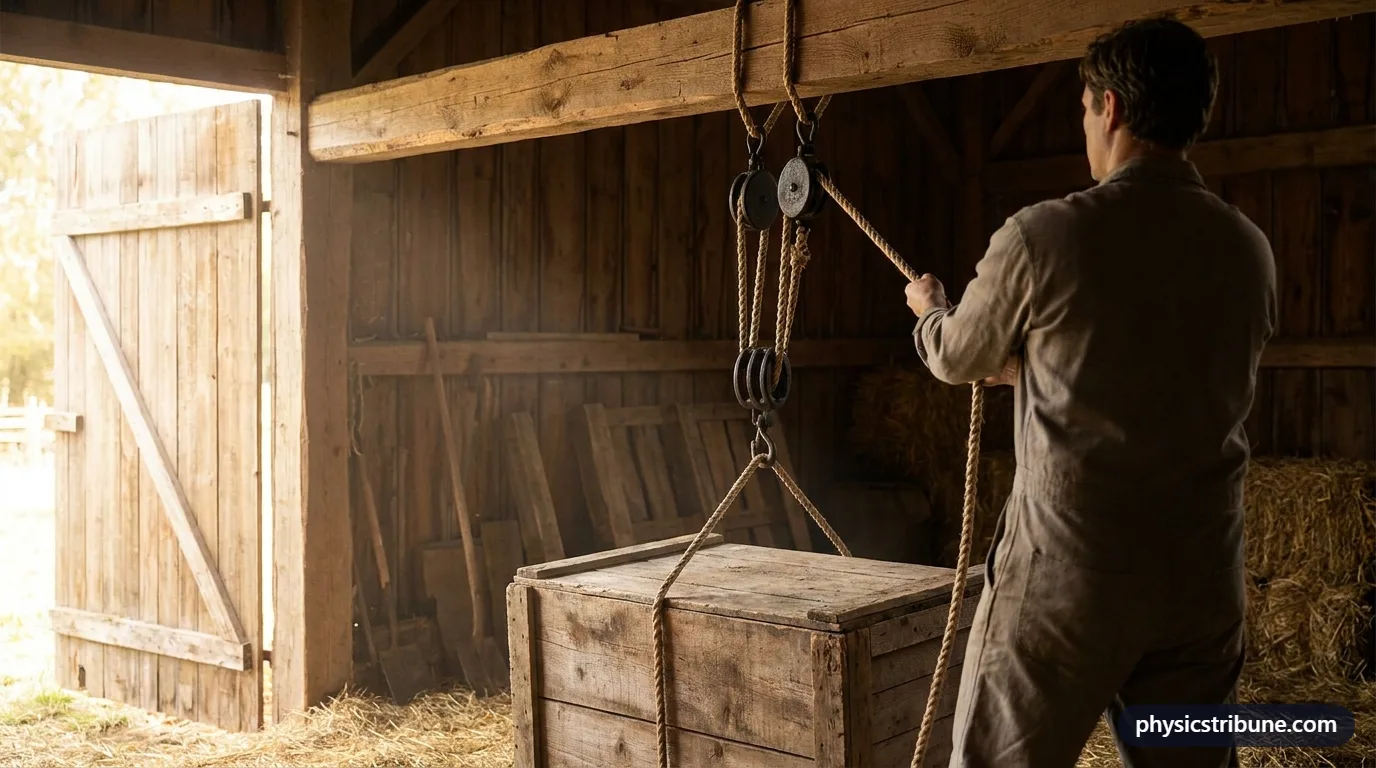
A compound pulley, also called a block and tackle, joins fixed and movable wheels. Each extra supporting rope segment adds one to the ideal mechanical advantage, which is how a single person can lift an engine or a crane can lift a steel beam.
- Construction crane. The hook block holds several wheels, and the cable loops between it and the top of the boom many times. The winch motor then needs only a fraction of the load's weight.
- Engine hoist in a garage. A chain or rope block lets one mechanic lift an engine out of a car.
- Sailboat mainsheet. The rope that controls the main sail runs through a set of blocks, so a sailor can hold the sail against strong wind by hand.
- Elevator. Steel cables run over a powered wheel at the top of the shaft. A counterweight on the other side balances most of the car's weight, so the motor works much less.
- Gym cable machine. Cables run over several wheels between the handle and the weight stack. Some machines use a movable wheel so the stack moves half as far as your hand.
- Tow truck and winch. Recovery crews often run the winch cable through a snatch block hooked to the stuck vehicle and anchor the cable end back at the truck, which roughly doubles the pulling force on the stuck vehicle.
Compound pulleys are old technology. Ancient writers told a story of Archimedes moving a loaded ship on dry land by pulling on a system of ropes and wheels, and whether or not it happened exactly that way, the physics behind it is sound.
Example 1 Lifting a car engine with a block and tackle
A mechanic lifts an engine that weighs 1,470 N using a block and tackle with 4 rope segments holding up the lower block. Ignoring friction, what pull must the mechanic apply to the free end of the rope?
- Given:
- output force (exerted on the load):
- mechanical advantage:
- output force (exerted on the load):
- Formula:
- Substitute:
- Answer:
In a real hoist, friction in the wheels adds a little to this, and the mechanic must pull 4 m of rope for every 1 m the engine rises.

How Much Force Does Each Pulley Save?
For an ideal pulley system with no friction and a weightless rope, the effort equals the load's weight divided by the number of supporting rope segments. The table below shows typical loads. Real systems lose some force to friction in the axles, so actual efforts run a little higher.
The saving is never free. Lifting a load 1 m with a 4-segment system means pulling 4 m of rope, so the work you do stays the same. To try your own loads, use our mechanical advantage calculator.
| Example | Load mass | Load weight | Supporting segments (ideal MA) | Ideal effort | Rope pulled per 1 m of lift |
|---|---|---|---|---|---|
| Window blind | 1.5 kg | 14.7 N | 1 | 14.7 N | 1 m |
| Flag on a flagpole | 2 kg | 19.6 N | 1 | 19.6 N | 1 m |
| Well bucket of water | 12 kg | 117.7 N | 1 | 117.7 N | 1 m |
| Sailboat mainsheet load | 60 kg equivalent | 588.6 N | 4 | 147.2 N | 4 m |
| Climber in a rescue haul | 80 kg | 784.8 N | 3 | 261.6 N | 3 m |
| Engine on a hoist | 150 kg | 1,471.5 N | 4 | 367.9 N | 4 m |
| Piano raised to a balcony | 220 kg | 2,158.2 N | 6 | 359.7 N | 6 m |
| Steel beam on a crane hook | 2,000 kg | 19,620 N | 8 | 2,452.5 N | 8 m |
| Source: Computed with W = mg (g = 9.81 m/s²) and effort = W / MA; loads are typical values · Retrieved October 2026 | |||||
Do Belt Pulleys in Machines Count as Examples?
Yes, but they do a different job. In a car engine, a long belt runs over grooved wheels that turn the alternator, the water pump and other parts. Older washing machines, sewing machines, treadmills and bench drills use belts in the same way.
These belt drives do not lift a load. They pass rotation from one shaft to another. A small wheel driving a large one turns the large wheel more slowly but with more turning force, the same trade-off you see in a wheel and axle.
When a list asks for examples of pulleys in everyday life, both kinds are correct. In class, check whether your teacher means lifting pulleys or belt drives.
How Can You Tell Which Type of Pulley You Are Looking At?
Follow the rope. If the wheel stays put and the rope simply turns a corner, it is fixed. If the wheel moves along with the load, it is movable. If you see a block with two or more wheels and several strands running between two blocks, it is compound.
Then count the rope segments that hold up the moving block. That number is the ideal mechanical advantage. The free end you pull on does not count if it comes down from a fixed wheel. For printable practice on counting segments, see our pulley worksheets and the broader simple machines worksheets.

Common Misconceptions
Myth: Every pulley makes lifting easier by reducing the force.
Physics: A single fixed pulley gives no force advantage. It only lets you pull in a more convenient direction.
Myth: A pulley system with a mechanical advantage of 4 saves three quarters of the work.
Physics: It cuts the force to a quarter but you pull four times as much rope, so the work is the same or a bit more because of friction.
Myth: You can find the mechanical advantage by counting the wheels.
Physics: Count the rope segments that hold up the moving block. Two systems with the same number of wheels can have different mechanical advantages.
Key Facts
- A pulley is a grooved wheel that guides a rope, cable, chain or belt.
- A single fixed pulley changes the direction of a force but not its size.
- A single movable pulley ideally halves the effort needed to lift a load.
- The ideal mechanical advantage of a pulley system equals the number of rope segments supporting the load.
- Less effort always means more rope to pull, so the work done stays the same in an ideal system.
- Friction in real pulleys means the actual effort is a little larger than the ideal value.
- Cranes, elevators, sailboats and gym machines all rely on pulleys.
Quick Quiz: How Well Do You Know Examples of Pulleys?
6 questions. Tap an answer to check it.
A flagpole uses which type of pulley?
The wheel at the top is attached to the pole and only changes the direction of your pull.
Four rope segments support a 400 N load in a frictionless block and tackle. What is the ideal effort?
The effort equals the load divided by the number of supporting segments, 400 N / 4.
Which example is a belt drive rather than a lifting pulley?
The engine belt passes rotation between shafts instead of lifting a load.
A movable pulley halves the effort. To lift the load 2 m, how much rope must you pull?
Half the force means twice the rope distance, so 2 m of lift needs 4 m of rope.
What balances most of an elevator car's weight?
A counterweight on the other side of the cables offsets most of the car's weight.
Which statement about an ideal pulley system is true?
Force goes down while rope distance goes up, so the work stays the same.
Frequently Asked Questions
What are 5 examples of pulleys?
Five common examples are a flagpole, window blinds, a well bucket, a construction crane and an elevator. The first three use a single fixed pulley to change the direction of the pull. Cranes use compound pulleys to cut the force needed, and elevators combine a powered wheel with a counterweight to move the car with a smaller motor.
What are examples of pulleys at home?
At home you can find pulleys in window blinds, clothesline wheels, curtain tracks, ceiling bike or kayak lifts and the cords of some ceiling fans and attic ladders. A home gym machine is full of them. Look in the garage too: many garage door openers and car engines use belts running over grooved wheels.
What are examples of pulleys in everyday life outside the home?
Outside the home, pulleys run elevators, construction cranes, ski lifts, flagpoles at schools, theater stage rigging, sailboat ropes and tow truck winches. Rock climbers and rescue teams build small pulley systems from a few wheels to raise people safely. Many factory conveyor belts also run over pulleys.
Is an elevator a pulley?
An elevator uses a pulley system. Steel cables attached to the car run over a large grooved wheel at the top of the shaft, which an electric motor turns. A counterweight hangs on the other side of the cables and balances most of the car's weight, so the motor only has to supply the difference.
Is a flagpole a fixed or movable pulley?
A flagpole uses a fixed pulley. The small wheel at the top is attached to the pole and never moves. It does not reduce the force you need, but it lets you stand on the ground and pull downward to send the flag up, which is far easier than climbing the pole.
How do you find the mechanical advantage of a pulley system?
Count the rope segments that directly hold up the moving block or the load. That number is the ideal mechanical advantage. A system with four supporting segments needs about a quarter of the load's weight as effort. Real systems need a little more because of friction in the wheels and the weight of the rope.
Why do cranes use many pulleys?
Each extra supporting rope segment shares the load, so a crane with many segments can lift a very heavy beam while its winch cable carries only a small fraction of that weight. The cost is that the winch must reel in much more cable for each meter of lift, which is why heavy loads rise slowly.