
At a Glance
Everyday examples of inclined planes include wheelchair ramps, moving truck ramps, playground slides, sloped roads and driveways, boat launch ramps, escalators and stairs. A ramp lowers the force needed to raise a load: ignoring friction, the push along the slope is F = m g sin θ and the ideal mechanical advantage is the ramp length divided by its height.
- Machine type
- Simple machine with no moving parts
- Force along the slope
- F = m g sin θ (no friction)
- Ideal MA
- Length of slope ÷ height gained
- Trade-off
- Less force, longer distance
- Relatives
- Wedge and screw
- Quick test
- Is a load moved up or down along a flat slope?
On this page
- What Counts as an Example of an Inclined Plane?
- What Are 5 Examples of Inclined Planes at Home and School?
- How Are Inclined Planes Used to Move Heavy Loads?
- What Are Examples of Inclined Planes in Transport?
- How Much Force Does a Ramp Save?
- How Does Friction Change These Examples?
- How Can You Spot an Inclined Plane?
- Common Misconceptions
- Key Facts
- Quiz
- FAQ
What Counts as an Example of an Inclined Plane?
An inclined plane is a flat surface set at an angle to the ground. It is one of the six simple machines and the only one with no moving parts. A situation is a good example when a load travels along a slope to change height, instead of being lifted or dropped vertically.
The slope works by spreading the job of gaining height over a longer path. Only part of the load's weight points down the slope, so the push you need is smaller. The price is distance: you travel farther to reach the same height.
Two other simple machines are inclined planes in disguise. A wedge is two slopes back to back that move, and a screw is a slope wrapped around a cylinder.
On a frictionless ramp, the push you need to hold or slide a load up equals the part of its weight that points down the slope.
| Symbol | Quantity | SI unit |
|---|---|---|
| component of weight parallel to the incline (down the slope) | newton (N) | |
| mass of object | kilogram (kg) | |
| acceleration due to gravity (9.80 m/s² (standard 9.80665 m/s²)) | meter per second squared (m/s²) | |
| incline angle above horizontal | radian (rad) |
Rearranged to find another variable:
Valid for: frictionless: acceleration down the slope is a = g sin θ.
| Example | Where you see it | What the slope does |
|---|---|---|
| Wheelchair ramp | Building entrances | Lets a chair roll up with a small push |
| Playground slide | Parks and schools | Lets gravity carry a child down gently |
| Sloped driveway | Homes | Connects street and garage levels |
| Stairs | Everywhere | Breaks a climb into small lifts |
| Skateboard ramp | Skate parks | Trades speed for height and back |
| Moving truck ramp | Moving day | Rolls furniture into the truck |
| Loading dock ramp | Warehouses | Bridges the dock and trailer floor |
| Boat launch ramp | Lakes and harbors | Lowers a boat into the water |
| Dump truck bed | Building sites | Slides the load out |
| Inclined conveyor belt | Factories, airports | Raises boxes and bags between levels |
| Ancient construction ramp | Historic building sites | Raised heavy stone blocks |
| Mountain road | Hills and passes | Keeps the slope gentle for vehicles |
| Escalator | Malls, stations | Carries people up a steady slope |
| Funicular railway | Steep hillsides | Pulls cars up a sloped track |
| Parking garage ramp | Multi-level garages | Moves cars between floors |
| Boarding ramp | Airports | Lets passengers walk up to the door |
| Source: Classification by our editors · Retrieved October 2026 | ||
What Are 5 Examples of Inclined Planes at Home and School?
- Wheelchair ramp. US accessibility guidelines limit most ramps to a rise of 1 unit for every 12 units of run, about 4.8 degrees. The gentle slope keeps the push manageable.
- Playground slide. Here the slope works in reverse. Gravity's pull along the surface carries a child down while friction keeps the speed safe.
- Sloped driveway or garage floor. A short slope lets a car or a bike roll from street level to a raised or sunken garage.
- Stairs. A staircase is a stepped inclined plane. Each step is small, so your legs lift your body a little at a time.
- Skateboard ramp. Riders roll down one slope to gain speed and up another to trade that speed for height.
Each of these trades a longer path for a smaller force or a slower, controlled change in height.
Example 2 Mechanical advantage of a wheelchair ramp
A wheelchair ramp rises 0.5 m to a front door and is 6.02 m long along its sloped surface. What is its ideal mechanical advantage?
- Given:
- length of the ramp along its slope:
- height the ramp rises:
- length of the ramp along its slope:
- Formula:
- Substitute:
- Answer:
With an ideal mechanical advantage near 12, someone pushing a wheelchair up this ramp needs only about a twelfth of the chair's weight as force, if rolling friction is ignored.
How Are Inclined Planes Used to Move Heavy Loads?
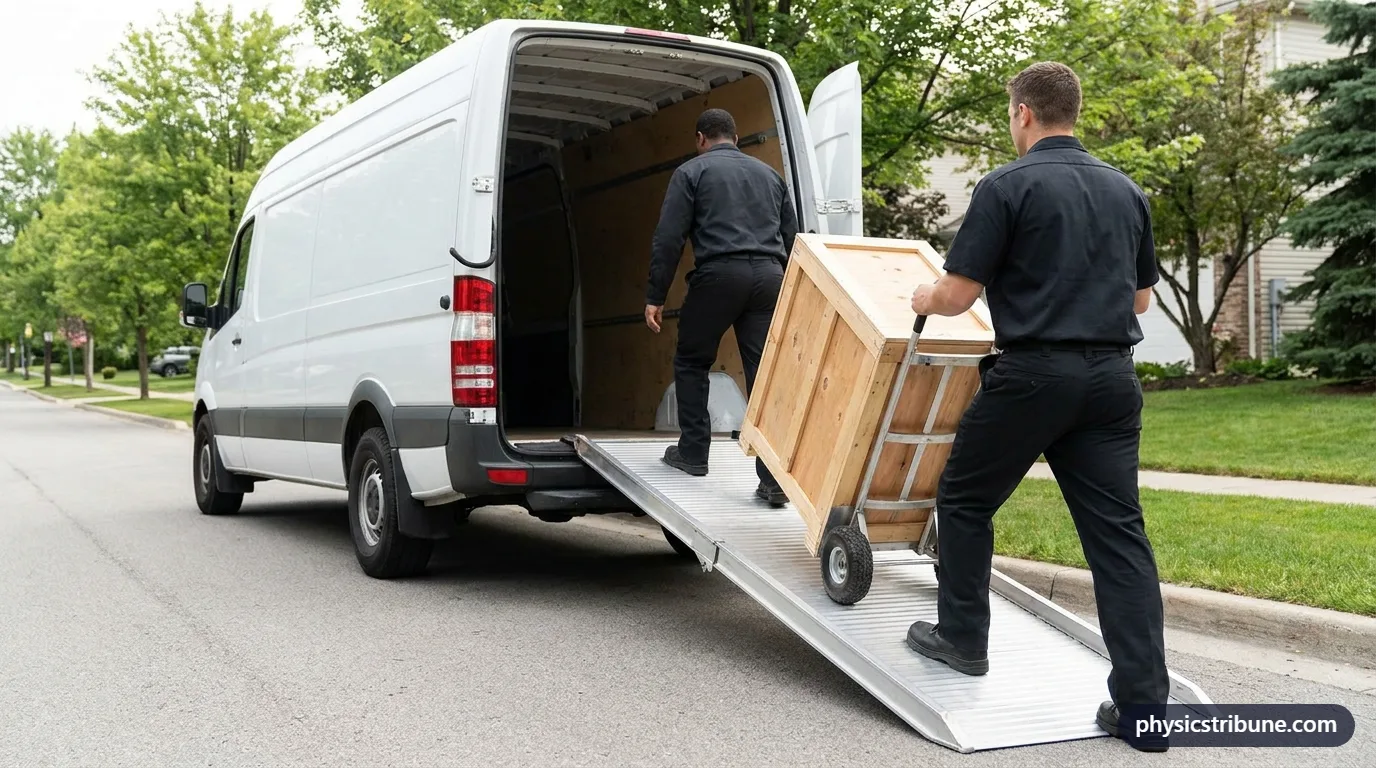
- Moving truck ramp. A metal ramp lets movers roll furniture on a dolly into the truck instead of lifting it chest high.
- Loading dock ramp. Warehouses use short sloped plates and longer ramps so forklifts and hand trucks can reach the trailer floor.
- Boat launch ramp. A concrete slope runs into the water so a trailer can back the boat in until it floats.
- Dump truck bed. The bed tilts up into a steep slope, and gravity slides the gravel or sand out the back.
- Conveyor belt up a slope. Factories and airports run belts at an angle to raise boxes and luggage between floors.
- Ancient construction ramps. Many historians think builders in ancient Egypt dragged huge stone blocks up long earth and brick ramps, although exactly how those ramps were laid out is still debated.
To try your own numbers for a ramp, use our inclined plane calculator. It also handles friction, which matters a lot for sliding loads.
Example 1 Pushing a loaded dolly up a truck ramp
Movers roll a 120 kg dresser on a dolly up a ramp tilted at 15° to the ground. Ignoring friction and using g = 9.81 m/s², what force along the ramp is needed to push it up at a steady speed?
- Given:
- mass of object:
- acceleration due to gravity:
- incline angle above horizontal:
- mass of object:
- Formula:
- Substitute:
- Answer:
Lifting the dresser straight up would take its full weight of about 1,177 N (computed), roughly four times as much.
What Are Examples of Inclined Planes in Transport?
- Mountain roads. Engineers zigzag roads up steep hills. Each switchback adds length but keeps the slope low enough for trucks to climb.
- Escalators. The moving steps follow a slope of about 30 degrees, and a motor does the lifting.
- Funicular railways. Cable cars on rails climb steep hillsides, often with two cars balancing each other on one cable.
- Highway on-ramps and parking garage ramps. Gentle slopes lift cars from one level to another without asking engines to strain.
- Airplane boarding ramps and stairs. Passengers walk up a slope to reach a cabin door well above the ground.
Road slopes are often given as a grade, the rise per 100 units of horizontal distance. An 8 percent grade climbs 8 m for every 100 m traveled horizontally, an angle of only about 4.6 degrees, yet loaded trucks still slow down on long stretches of it.

How Much Force Does a Ramp Save?
On a frictionless slope, the force needed to push a load up at a steady speed is its weight times the sine of the slope angle. The table below compares that push for a 100 kg load on several everyday slopes, along with the ideal mechanical advantage.
Gentle slopes save the most force. A wheelchair ramp needs only about a twelfth of the weight, while a playground slide is so steep that holding a load on it takes more than half the weight. The total work done is the same either way, because a gentle ramp is longer. You can see why in our page on forces on an inclined plane.
| Example | Typical angle | Ideal MA (length ÷ height) | Push along the slope for 100 kg |
|---|---|---|---|
| Road at an 8% grade | 4.6° | 12.5 | 78 N |
| Wheelchair ramp, 1:12 | 4.8° | 12.0 | 81 N |
| Loading dock ramp, 1:10 | 5.7° | 10.0 | 98 N |
| Boat launch ramp, 14% grade | 8.0° | 7.2 | 136 N |
| Moving truck ramp | 15° | 3.9 | 254 N |
| Escalator | 30° | 2.0 | 490 N |
| Playground slide | 35° | 1.7 | 563 N |
| Straight vertical lift (no ramp) | 90° | 1.0 | 981 N |
| Source: Computed with F = m g sin θ and MA = 1 / sin θ (g = 9.81 m/s²); angles are typical values · Retrieved October 2026 | |||

How Does Friction Change These Examples?
Real ramps are not frictionless. For wheeled loads like dollies, wheelchairs and cars, rolling friction is small and the frictionless numbers are close. For a crate dragged up a wooden plank, sliding friction can add a large extra force.
Friction also helps. It holds a parked car on a steep driveway, lets your shoes grip a ramp and keeps a child from going too fast on a slide. You can measure it yourself with our friction ramp experiment, or repeat a famous study of rolling balls in the Galileo inclined plane experiment.
How Can You Spot an Inclined Plane?
Ask three questions. Is there a flat surface that slopes? Does a load move along it to change height? Does the slope stay still while the load moves? If all three answers are yes, it is an inclined plane.
If the slope itself moves into the load, it is a wedge, and if it wraps around a shaft, it is a screw.
Younger learners can start with our inclined plane for kids page. For classroom practice with ramps, angles and mechanical advantage, see our inclined plane worksheets.
Common Misconceptions
Myth: A ramp reduces the work needed to lift something.
Physics: A ramp reduces the force, not the work. You push with less force over a longer distance, and friction adds a little extra work.
Myth: Steeper ramps are always better because they are shorter.
Physics: Steeper ramps need a larger push. They save distance, not effort, which is why ramps for wheelchairs and trucks are kept gentle.
Myth: Stairs and slides are not machines.
Physics: Both are inclined planes. Any fixed slope that changes the height of a load counts as this simple machine.
Key Facts
- An inclined plane is a flat surface set at an angle that helps raise or lower a load.
- It is the only one of the six simple machines with no moving parts.
- On a frictionless slope the push needed is m g sin θ, which shrinks as the slope gets gentler.
- The ideal mechanical advantage of a ramp is its length divided by its height.
- A gentler ramp needs less force but a longer path, so the work done stays the same.
- Wedges and screws are both forms of the inclined plane.
- Most US wheelchair ramps rise no more than 1 unit for every 12 units of horizontal run.
Quick Quiz: How Well Do You Know Examples of Inclined Plane?
6 questions. Tap an answer to check it.
Which of these is an inclined plane?
A ramp is a fixed slope used to change the height of a load.
What happens to the push needed when a ramp is made less steep?
The push along the slope is m g sin θ, which shrinks as θ gets smaller.
A ramp is 8 m long and rises 2 m. What is its ideal mechanical advantage?
Ideal MA is length divided by height, 8 m / 2 m.
Which simple machine is an inclined plane wrapped around a rod?
A screw thread is a long slope wound around a cylinder.
Compared with lifting a box straight up, pushing it up a frictionless ramp to the same height takes:
The ramp lowers the force but lengthens the distance, so the work is unchanged.
Which example uses an inclined plane to lower a load rather than raise it?
The tilted bed lets gravity slide the load down and out.
Frequently Asked Questions
What are 5 examples of inclined planes?
Five clear examples are a wheelchair ramp, a playground slide, a moving truck ramp, a sloped road up a hill and a staircase. In each one a load or a person travels along a slope to change height. The slope spreads the climb over a longer path, so the force needed at any moment is smaller than a straight lift.
What are examples of inclined planes in everyday life?
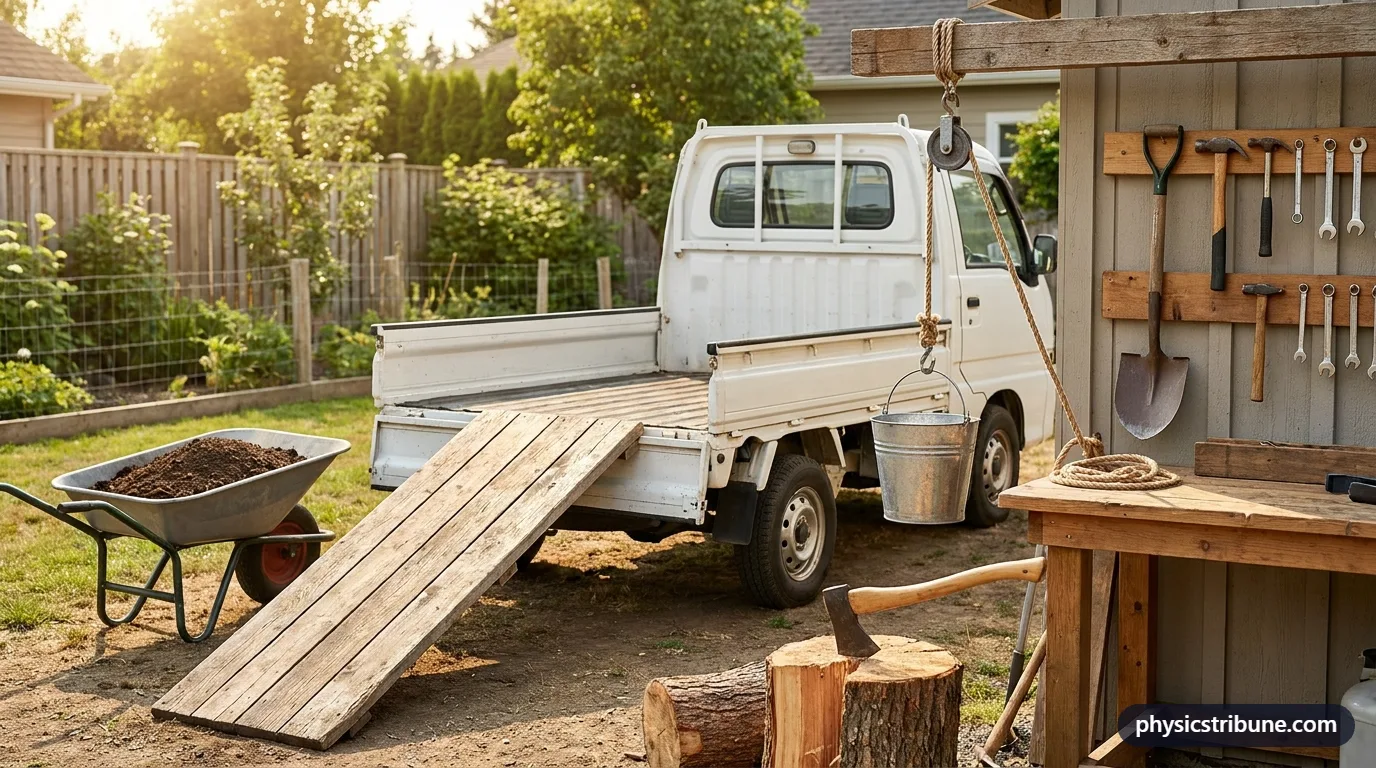
You meet inclined planes in driveways, ramps at building entrances, escalators, stairs, slides, parking garage ramps, boat launches and mountain roads. Tools contain them too: knives and axes are wedges, and screws and bolts carry a spiral slope. Even a plank leaned against a truck to roll a barrel aboard is one.
Is a slide an inclined plane?
Yes. A slide is an inclined plane used to lower a person instead of raising one. Gravity pulls you down along the slope, while friction between your clothes and the surface controls your speed. Steeper slides give a faster ride because a larger part of your weight points down the surface.
Are stairs an inclined plane?
Stairs act like an inclined plane broken into steps. Instead of lifting your body to the next floor in one go, you raise it a little with each step along a sloped path. A ramp beside the stairs reaches the same height with a smooth surface, which is easier for wheels.
Why are roads built in zigzags up mountains?
A road straight up a steep mountain would be too steep for trucks and cars to climb safely. Zigzagging adds length, which lowers the slope at every point. Each vehicle then needs a smaller force along the road, the same trade of distance for force you get on any inclined plane.
How do you calculate the mechanical advantage of an inclined plane?
Divide the length of the sloped surface by the height it rises. A ramp 6 m long that rises 1 m has an ideal mechanical advantage of 6, so pushing a load up it takes about a sixth of the load's weight if friction is ignored. Real ramps need a bit more force because of friction.
Is a wedge an example of an inclined plane?
A wedge is closely related. It is made of two inclined planes back to back, but unlike a ramp it moves into the material to split or lift it. An axe head, a doorstop and a chisel are wedges. Most textbooks list it as its own simple machine that grows out of the inclined plane.
Keep Exploring
 energyInclined Plane (Simple Machine)
 calculatorsInclined Plane Calculator
 worksheetsInclined Plane Worksheets
 forcesForces on an Inclined Plane
 kidsInclined Plane for Kids
 examplesExamples of Pulleys
 examplesExamples of Simple Machines
 experimentsGalileo's inclined plane experiment
 physicistsGalileo Galilei