At a Glance
In an inelastic collision, total momentum stays the same, m1 v1 + m2 v2 = m1 v1' + m2 v2', but total kinetic energy after the impact is smaller than before. The missing kinetic energy becomes heat, sound and deformation, and when the objects stick together the collision is called perfectly inelastic.
- Momentum
- Conserved (no outside net force)
- Kinetic energy
- Not conserved; some becomes heat, sound and deformation
- Key equation
- m₁v₁ + m₂v₂ = m₁v₁′ + m₂v₂′
- Coefficient of restitution
- Between 0 and 1 (0 when the objects stick)
- Extreme case
- Perfectly inelastic: objects move off together
- Opposite case
- Elastic collision: kinetic energy also conserved
On this page
- What Is an Inelastic Collision?
- Inelastic Collisions Explained Simply
- Why Is Momentum Conserved in an Inelastic Collision?
- Where Does the Kinetic Energy Go?
- What Is the Difference Between Partially and Perfectly Inelastic Collisions?
- What Are Some Examples of Inelastic Collisions?
- How Large Are the Forces in an Inelastic Collision?
- How Is an Inelastic Collision Different From an Elastic One?
- Who First Worked Out the Rules of Collisions?
- Practice Inelastic Collision Problems
- Common Misconceptions
- Key Facts
- Quiz
- FAQ
What Is an Inelastic Collision?
A collision is a short, strong interaction between two objects that changes how each of them moves. In an inelastic collision, the objects push on each other hard enough to dent, squash, heat up or make noise. Those effects all cost energy, and that energy comes out of the kinetic energy the objects carried into the impact.
The one thing that does not change is the total momentum. During the brief contact, the forces the two objects exert on each other are equal and opposite, so whatever momentum one loses the other gains. As long as no strong outside force acts during the impact, the momentum bookkeeping balances exactly.
So an inelastic collision is defined by a pair of facts: momentum is conserved, kinetic energy is not. This makes it different from an elastic collision, where both quantities are conserved.
Inelastic Collisions Explained Simply
Drop a rubber ball and a lump of modeling clay onto a hard floor from the same height. The ball springs back almost as high as you dropped it. The clay lands with a dull thud, flattens a little and stays put. The clay has had an inelastic collision with the floor, and its energy of motion went into reshaping it and warming it very slightly.
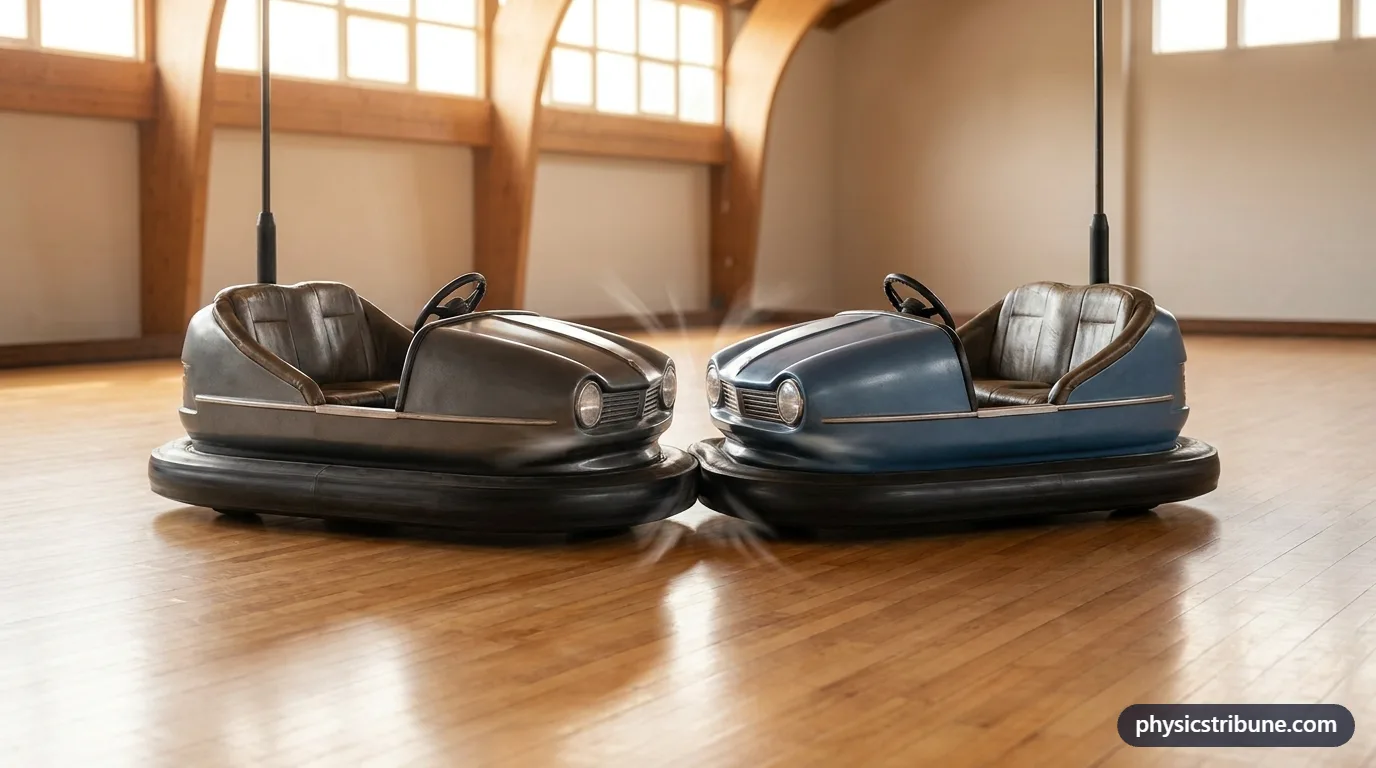
Now think of a pair of bumper cars. When one rams the other, both jolt and there is a bang, but the push the first car gives is not lost. The struck car speeds up by exactly the momentum the first car gives away. Motion is shared, while some of the energy of motion is spent on noise and squashed rubber.
Why Is Momentum Conserved in an Inelastic Collision?
During contact, object 1 pushes on object 2 and object 2 pushes back on object 1 with a force of the same size in the opposite direction, as Newton's third law requires. The two pushes also last for exactly the same time. Since a force acting for a time changes momentum, the two objects receive equal and opposite changes in momentum, and the total does not move.
That gives the equation
Friction from the ground and air drag do act during a crash, but the impact itself lasts only a fraction of a second while the collision forces are enormous. Over such a short time the outside forces barely change the total, so treating momentum as conserved "just before" and "just after" works very well.
Every inelastic collision obeys the momentum balance below; it holds whether the objects bounce apart or stick together.
| Symbol | Quantity | SI unit |
|---|---|---|
| mass of object 1 | kilogram (kg) | |
| initial velocity of object 1 | meter per second (m/s) | |
| mass of object 2 | kilogram (kg) | |
| initial velocity of object 2 | meter per second (m/s) | |
| final velocity of object 1 | meter per second (m/s) | |
| final velocity of object 2 | meter per second (m/s) |
Rearranged to find another variable:
Valid for: isolated system (net external force = 0); velocities are signed in 1D.
Example 1 Two lab carts that bounce apart slowly
On a level track, a 0.40 kg cart rolling at 3.0 m/s runs into a 0.60 kg cart sitting at rest. Their bumpers are soft, so the carts separate gently, and just after the impact the first cart is still moving forward at 0.6 m/s. What is the velocity of the second cart right after the collision?
- Given:
- mass of object 1:
- initial velocity of object 1:
- mass of object 2:
- initial velocity of object 2:
- final velocity of object 1:
- mass of object 1:
- Formula:
- Substitute:
- Answer:
Total momentum is the same before and after, so whatever the first cart gives up, the second cart gains.
Where Does the Kinetic Energy Go?
Energy is never destroyed, so the kinetic energy missing after an inelastic collision has to show up somewhere. Most of it goes into three places:
- Deformation. Metal bends, foam crushes and clay flattens. Bending a material permanently takes work, and that work stays in the material.
- Heat. Atoms in the squashed region jiggle faster, so the contact area warms. You can sometimes feel this after hammering a nail.
- Sound and vibration. The bang of a collision is energy carried away by pressure waves in the air, plus ringing in the objects themselves.
The energy bars below show a car crash in which the sedan from the third example locks onto the stopped hatchback. Before the impact all the energy is kinetic. Afterward the cars still move, so some kinetic energy remains, but a large share has become heat, noise and crumpled metal. The total is unchanged, which is exactly what conservation of energy demands.
Example 2 How much kinetic energy did the carts lose?
Use the same two carts: 0.40 kg moving at 3.0 m/s hits 0.60 kg at rest, and afterward the 0.40 kg cart moves at 0.6 m/s while the 0.60 kg cart moves at 1.6 m/s, both forward. How much kinetic energy disappears from the motion during the collision?
- Given:
- m1:
- v1:
- m2:
- v1p:
- v2p:
- m1:
- Formula:
- Substitute:
- Answer:
This is the kinetic energy before minus the kinetic energy after; it went into warming and squashing the bumpers and into the click you hear.

What Is the Difference Between Partially and Perfectly Inelastic Collisions?
Inelastic collisions come in a range. In a partially inelastic collision the objects bounce apart, but with less relative speed than they had coming together. A tennis ball hitting a racket or two billiard balls with slightly soft surfaces behave this way. Most of everyday life sits here.
In a perfectly inelastic collision the objects stick and move off with one shared velocity,
Physicists measure where a collision sits on this scale with the coefficient of restitution, written e. It compares the speed of separation with the speed of approach. A value of 1 means elastic, 0 means perfectly inelastic, and anything in between is partially inelastic.
The table shows how much kinetic energy survives when a moving object hits an equally free object at rest and sticks to it. The fraction kept depends only on the mass ratio: a light object hitting a heavy one loses nearly everything.
Example 3 Two cars that lock together
A 1,400 kg sedan traveling at 15 m/s rear-ends a 1,100 kg hatchback stopped at a light. The bumpers hook together and the two cars slide forward as one. How fast are they moving just after the impact?
- Given:
- mass of object 1:
- initial velocity of object 1:
- mass of object 2:
- initial velocity of object 2:
- mass of object 1:
- Formula:
- Substitute:
- Answer:
The pair moves off slower than the sedan arrived, because the same momentum is now shared by a larger total mass.
| Target mass ÷ moving mass | Final speed ÷ initial speed | Kinetic energy kept | Kinetic energy lost |
|---|---|---|---|
| 0.25 | 0.800 | 80.0% | 20.0% |
| 0.5 | 0.667 | 66.7% | 33.3% |
| 1 | 0.500 | 50.0% | 50.0% |
| 2 | 0.333 | 33.3% | 66.7% |
| 4 | 0.200 | 20.0% | 80.0% |
| 10 | 0.091 | 9.1% | 90.9% |
| Source: Computed with v' = m1 v1 / (m1 + m2) and KE = ½mv²; fraction kept = m1 / (m1 + m2) · Retrieved October 2026 | |||
What Are Some Examples of Inelastic Collisions?
Because some energy always leaks into heat or sound, nearly every collision you see is inelastic to some degree. A few clear examples:
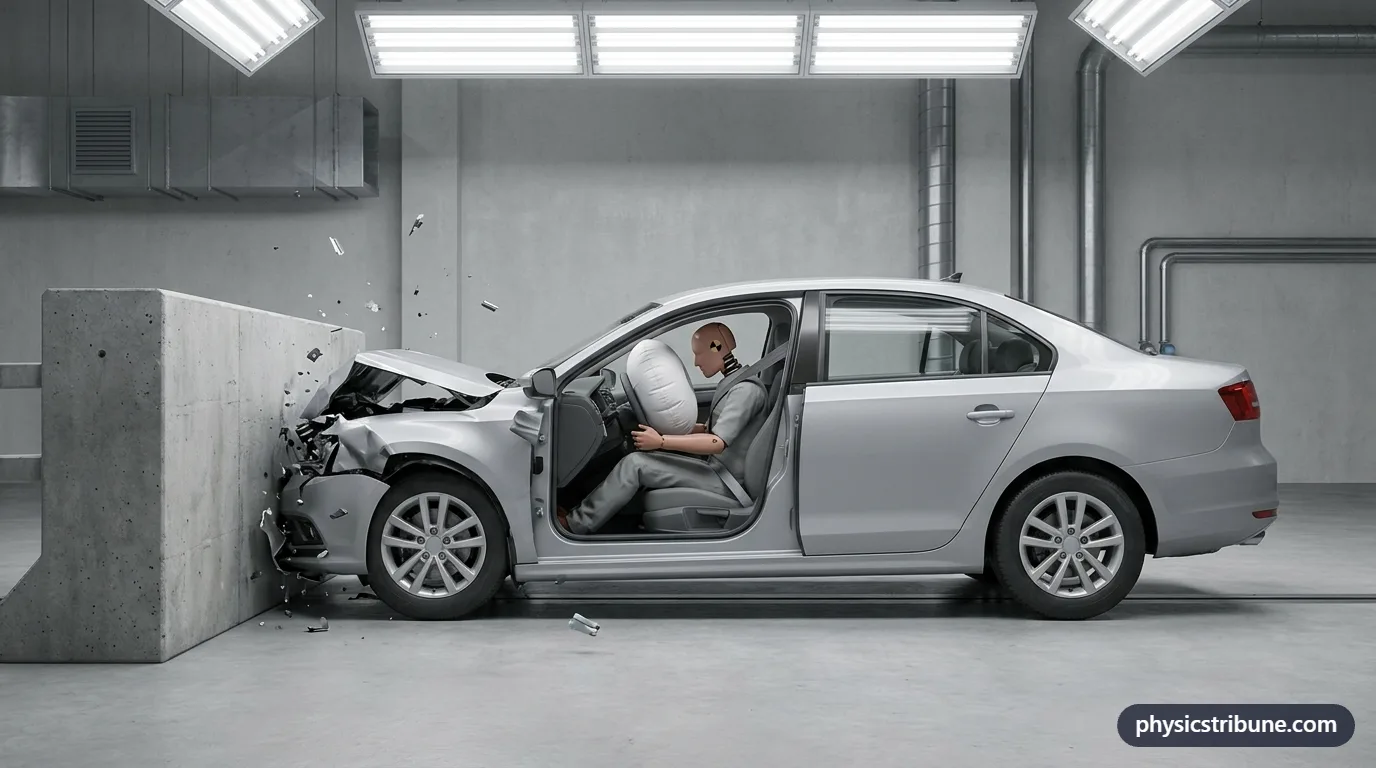
- Car crashes. Modern cars are designed to crumple, turning kinetic energy into bent metal rather than passing it to the people inside. Our page on car safety physics explains crumple zones and airbags.
- A football tackle. Two players collide and often move together for a moment, close to a perfectly inelastic collision.
- A ball of dough slapped onto a counter. It flattens and stops without bouncing.
- A dart hitting a dartboard. The dart embeds itself, and the fibers of the board absorb its energy.
- A railroad coupling. A moving freight car rolls into a parked one, the couplers latch and both roll away together.
- A meteorite strike. A space rock slamming into the ground spends its energy digging a crater and heating rock.
Even a bouncing basketball is slightly inelastic, since each bounce is a little lower than the last. For more cases sorted by setting, see our momentum examples.

How Large Are the Forces in an Inelastic Collision?
The collision force depends on how quickly the momentum changes. The sedan in the third example loses a lot of speed during the impact. If the crunch lasts about a tenth of a second, the average force from the hatchback on the sedan is roughly 92,400 N (computed from the change in momentum divided by 0.1 s), several times the car's own weight.
The free-body diagram shows that force next to the car's weight and the normal force from the road. Vertically the forces balance, while horizontally the impact force dominates everything else. Stretching the impact over a longer time, which is what crumple zones do, lowers that average force for the same change in momentum. The link between force, time and momentum change is the subject of our impulse page.

How Is an Inelastic Collision Different From an Elastic One?
Both types conserve momentum. The difference is kinetic energy. In an elastic collision the objects spring apart with the same total kinetic energy they started with, which only truly happens for things like gas molecules or the idealized steel balls of a desk toy. In an inelastic collision some of that energy is converted to other forms.
A quick test: if the objects stick, dent, get warm or make a loud noise, the collision is inelastic. If you have the velocities, calculate total kinetic energy before and after; any drop means the collision was inelastic. Our elastic vs inelastic collision comparison lays the two side by side, and momentum vs kinetic energy explains why one is conserved while the other is not.
Who First Worked Out the Rules of Collisions?
In 1668 the Royal Society in London asked scholars to explain how bodies behave when they strike each other. Christopher Wren and Christiaan Huygens sent rules for hard bodies that rebound, and John Wallis treated soft bodies that stick. Together their results showed that the product of mass and velocity, counted with direction, is the quantity that survives every impact.
Isaac Newton later built that idea into his laws of motion and tested it with swinging pendulum bobs. He noticed the bobs never quite rebounded with their full speed, an early measurement of what we now call the coefficient of restitution.
Practice Inelastic Collision Problems
To get comfortable with these problems, always follow the same order: choose a positive direction, write total momentum before, set it equal to total momentum after, then solve. Only after that compare kinetic energies to see how much was lost.
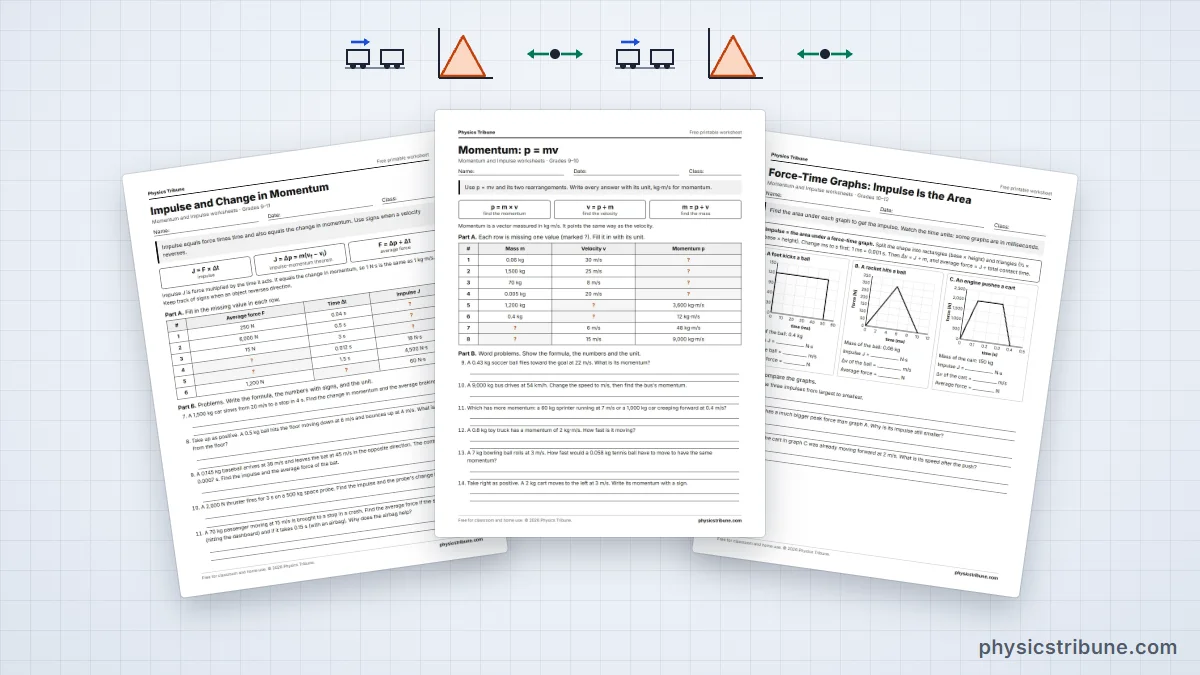
Our momentum and impulse worksheets include printable collision sets with answer keys. Check your work with the collision calculator, and keep the momentum formulas sheet nearby. You can also see momentum sharing for yourself with the momentum conservation carts experiment.
Common Misconceptions
Myth: In an inelastic collision, momentum is lost along with kinetic energy.
Physics: Momentum is conserved in every collision where outside forces are negligible. Only kinetic energy decreases.
Myth: Perfectly inelastic means all the kinetic energy disappears.
Physics: It means the objects stick together. They usually keep moving, so some kinetic energy remains; only the maximum amount allowed by momentum conservation is lost.
Myth: The lost kinetic energy is destroyed.
Physics: It changes into heat, sound and the work of deforming the objects. Total energy is the same before and after.
Myth: If objects bounce apart, the collision must be elastic.
Physics: Bouncing objects can still lose kinetic energy. Unless the total kinetic energy is exactly the same afterward, the collision is partially inelastic.
Key Facts
- An inelastic collision conserves total momentum but not total kinetic energy.
- The kinetic energy that disappears becomes heat, sound and permanent deformation, so total energy is still conserved.
- A perfectly inelastic collision is one where the objects stick together and share a single final velocity.
- The coefficient of restitution is between 0 and 1 for inelastic collisions and equals 0 when the objects stick.
- When a light object sticks to a much heavier one at rest, almost all of its kinetic energy is lost.
- Nearly every real collision is at least slightly inelastic.
- Crumple zones make car crashes more inelastic on purpose, spreading the impact over a longer time to lower the force on passengers.
Quick Quiz: How Well Do You Know Inelastic Collisions?
6 questions. Tap an answer to check it.
Which quantity is always conserved in an inelastic collision with no outside net force?
Momentum is conserved in every collision without outside forces; kinetic energy is not.
Two objects collide and stick together. What kind of collision is this?
Objects that move off together after an impact have had a perfectly inelastic collision.
Where does the lost kinetic energy go in an inelastic collision?
Energy is conserved overall, so the missing kinetic energy turns into other forms like heat and sound.
A 2 kg cart moving at 4 m/s sticks to a 2 kg cart at rest. What is their speed afterward?
Momentum of 8 kg·m/s is now shared by 4 kg, giving 2 m/s.
What is the coefficient of restitution for a perfectly inelastic collision?
The objects have no speed of separation, so e equals zero.
Why do crumple zones make cars safer?
The same momentum change spread over a longer time requires a smaller average force.
Frequently Asked Questions
What is an inelastic collision in simple terms?
It is a collision where the objects keep their total momentum but lose some of their energy of motion. That energy is spent squashing, heating or making noise. A ball of clay landing on the floor, two cars crumpling together and a dart sticking into a board are all inelastic collisions. Most collisions in everyday life are of this kind.
Is momentum conserved in an inelastic collision?
Yes. The forces the two objects exert on each other are equal, opposite and last the same time, so their momentum changes cancel. As long as outside forces such as friction are small during the brief impact, the total momentum just after equals the total just before. This is true for elastic, inelastic and perfectly inelastic collisions alike.
Is kinetic energy conserved in an inelastic collision?
No. That is what makes it inelastic. Some kinetic energy is converted into heat, sound and permanent deformation, so the total kinetic energy after the impact is less than before. The total energy of everything involved is still conserved, though; it has just moved into forms that no longer count as energy of motion.
What is the formula for an inelastic collision?
Use conservation of momentum: m1 v1 + m2 v2 = m1 v1' + m2 v2', with the primes meaning after the impact. If the objects stick together, both final velocities are the same, so the shared velocity is v' = (m1 v1 + m2 v2) / (m1 + m2). To find the energy lost, subtract the total kinetic energy after from the total before.
What is the difference between inelastic and perfectly inelastic collisions?
In a general inelastic collision the objects may bounce apart, but they lose some kinetic energy. In a perfectly inelastic collision they stick together and move with one velocity afterward. Sticking together loses the largest possible amount of kinetic energy for the given momentum, so perfectly inelastic is the most extreme kind of inelastic collision.
How do you know if a collision is elastic or inelastic?
Compare the total kinetic energy before and after. If it is the same, the collision is elastic; if it drops, it is inelastic. Physical clues help too: sticking, denting, warming or a loud bang all point to an inelastic collision. You can also find the coefficient of restitution, which is 1 for elastic collisions and less than 1 for inelastic ones.
Why are car crashes inelastic collisions?
Cars are built to crumple. Bending the front of a car absorbs a large share of the kinetic energy and also stretches the impact over a longer time, which lowers the force on the people inside. The cars often stick together or move off slowly, so a big fraction of the original kinetic energy ends up as bent metal, heat and noise.
Can an inelastic collision ever gain kinetic energy?
Not on its own. Ordinary collisions can only keep or lose kinetic energy. If an event releases stored energy, such as a spring snapping open or a small explosion between two objects, kinetic energy can increase, but physicists call that a superelastic event or an explosion rather than an inelastic collision. Momentum is still conserved in every case.
Keep Exploring
 momentumPerfectly Inelastic Collisions
 momentumElastic Collisions
 momentumLaw of Conservation of Momentum
 compareElastic vs Inelastic Collision
 calculatorsElastic & Inelastic Collision Calculator
 momentumCoefficient of Restitution
 momentumCar Safety Physics: Crumple Zones, Airbags and Seat Belts
 worksheetsMomentum and Impulse Worksheets
 formulasMomentum and Impulse Formulas
Sources
Constants come from NIST CODATA 2022 (public domain) and unit definitions from the BIPM SI Brochure (CC BY 4.0). Text, diagrams and illustrations are original work by Physics Tribune.