
At a Glance
In an elastic collision, momentum and kinetic energy are both conserved. For a head-on collision, the final velocities are v1' = ((m1 − m2) v1 + 2 m2 v2) / (m1 + m2) and v2' = (2 m1 v1 + (m2 − m1) v2) / (m1 + m2). When equal masses collide head-on, they simply swap velocities.
- Conserved
- Total momentum and total kinetic energy
- Final velocity of object 1
- v1' = [(m1 − m2)v1 + 2m2v2] / (m1 + m2)
- Units
- Momentum kg·m/s, energy joules (J), velocity m/s
- Coefficient of restitution
- e = 1 (relative speed is the same after as before)
- Real examples
- Steel balls, billiard balls, air-track gliders with magnets, gas molecules
On this page
- What Is an Elastic Collision?
- Elastic Collisions Explained Simply
- What Is the Formula for an Elastic Collision?
- What Happens When Masses Are Equal or Very Different?
- Why Do Objects Separate at the Same Speed They Approached?
- Where Does the Kinetic Energy Go During the Impact?
- What Are Real-Life Examples of Elastic Collisions?
- How Is an Elastic Collision Different From an Inelastic One?
- Who First Worked Out the Rules of Elastic Collisions?
- Practice Elastic Collision Problems
- Common Misconceptions
- Key Facts
- Quiz
- FAQ
What Is an Elastic Collision?
When two objects collide, two things are worth tracking: momentum and kinetic energy. Momentum is conserved in every collision of an isolated system. Kinetic energy is the picky one. In an elastic collision it comes through untouched, so the objects leave with exactly as much energy of motion as they brought in.
During the brief contact, the objects squash slightly and store energy like springs. In a perfectly elastic collision, every bit of that stored energy is handed back as they spring apart. Nothing is left behind as warmth, noise or a permanent dent.
Real collisions between large objects are never perfectly elastic, because some energy always leaks into sound and heat. Still, hardened steel, glass marbles, billiard balls and magnet-bumper carts come close enough that the elastic model predicts their motion very well.
Elastic Collisions Explained Simply
Think of the best bounce you have ever seen: a super ball dropped on concrete that leaps nearly back to your hand. That is close to an elastic collision with the ground. Now think of a ball of wet clay dropped on the same floor. It lands with a thud and stays put. That is the opposite extreme.
In an elastic collision, objects act like perfect springs. They push off each other and part ways at the same relative speed they came together with. In everyday life a little energy always escapes, which is why even a great bounce is never quite as high as the drop.
What Is the Formula for an Elastic Collision?
An elastic collision obeys two conservation laws at once. Momentum gives
Velocities carry signs. Pick one direction as positive and give anything moving the other way a negative value. A negative result for a final velocity means that object is moving backward after the impact.
The algebra is easy to slip on, so our elastic and inelastic collision calculator does it in one step and shows the energy before and after. For the full list of related equations, see the momentum formulas sheet.
These are the final velocities for a head-on elastic collision between two objects, with each variable and its SI unit.
| Symbol | Quantity | SI unit |
|---|---|---|
| mass of object 1 | kilogram (kg) | |
| mass of object 2 | kilogram (kg) | |
| initial velocity of object 1 | meter per second (m/s) | |
| initial velocity of object 2 | meter per second (m/s) | |
| final velocity of object 1 | meter per second (m/s) | |
| final velocity of object 2 | meter per second (m/s) |
Valid for: head-on (1D) perfectly elastic collision: both momentum and kinetic energy conserved; signed velocities.
Example 1 Two equal steel balls
A 0.10 kg steel ball moving at 0.8 m/s hits an identical 0.10 kg ball that is at rest, head-on and elastically. What is the velocity of the second ball after the collision?
- Given:
- mass of object 1:
- mass of object 2:
- initial velocity of object 1:
- initial velocity of object 2:
- mass of object 1:
- Formula:
- Substitute:
- Answer:
The first ball stops dead and the second takes over its full velocity, exactly what you see in a desk toy with hanging steel balls.
What Happens When Masses Are Equal or Very Different?
Three special cases cover most of what you will meet, all for a moving object 1 hitting object 2 at rest:
- Equal masses. The objects swap velocities. The moving one stops and the target leaves with its full speed, which is the classic pool-table stop shot.
- Light object hits heavy object. The light one bounces back, almost at its original speed when the target is very heavy. A tennis ball hitting a wall is the everyday example.
- Heavy object hits light object. The heavy one barely slows, and the light one shoots forward at up to twice the heavy one's speed.
The table shows how much of the energy is handed to a target at rest for different mass ratios. Transfer is complete only when the masses are equal, which is why nuclear reactors use moderators with light nuclei to slow fast neutrons.
Example 2 A light cart bouncing off a heavy one
On a low-friction track, a 0.25 kg cart moving at 1.2 m/s bumps elastically into a 0.75 kg cart at rest, using magnetic bumpers. What is the velocity of the light cart afterward? (Take its starting direction as positive.)
- Given:
- mass of object 1:
- mass of object 2:
- initial velocity of object 1:
- initial velocity of object 2:
- mass of object 1:
- Formula:
- Substitute:
- Answer:
The negative sign shows the light cart rebounds. The heavy cart moves forward at the same speed, 0.6 m/s, and the kinetic energy totals still match.
| Mass ratio m1 : m2 | v1' as a fraction of v1 | v2' as a fraction of v1 | Share of kinetic energy passed to the target |
|---|---|---|---|
| 1 : 100 | −0.980 | 0.020 | 3.9% |
| 1 : 10 | −0.818 | 0.182 | 33.1% |
| 1 : 2 | −0.333 | 0.667 | 88.9% |
| 1 : 1 | 0 | 1 | 100% |
| 2 : 1 | 0.333 | 1.333 | 88.9% |
| 10 : 1 | 0.818 | 1.818 | 33.1% |
| 100 : 1 | 0.980 | 1.980 | 3.9% |
| Source: Computed with the elastic collision equations, v2 = 0; a negative fraction means object 1 bounces back · Retrieved October 2026 | |||

Why Do Objects Separate at the Same Speed They Approached?
A neat shortcut falls out of the two conservation laws. In any head-on elastic collision, the speed at which the objects move apart equals the speed at which they came together:
This gives a much faster way to solve problems. Use the momentum equation plus this relative-speed rule, and you avoid squaring any velocities. It also links to the coefficient of restitution, the ratio of separation speed to approach speed, which equals exactly 1 for an elastic collision and less than 1 for every real bounce.
Example 3 Two gliders moving toward each other
A 0.30 kg air-track glider moving at 0.5 m/s meets a 0.20 kg glider moving at 0.4 m/s in the opposite direction, and they collide elastically. What is the velocity of the 0.20 kg glider afterward? (Take the 0.30 kg glider's starting direction as positive.)
- Given:
- mass of object 1:
- mass of object 2:
- initial velocity of object 1:
- initial velocity of object 2:
- mass of object 1:
- Formula:
- Substitute:
- Answer:
The lighter glider reverses and leaves faster than it arrived. The heavier one also reverses, moving back at 0.22 m/s, so the gliders separate at 0.9 m/s, the same speed at which they approached.
Where Does the Kinetic Energy Go During the Impact?
Kinetic energy is conserved from before to after, but not at every instant in between. As the light cart in the second worked example presses into the heavy one, both move together for an instant at 0.3 m/s. At that moment most of the original kinetic energy is stored as elastic potential energy in the compressed bumpers.
The bumpers then spring back and return that energy as motion. The energy bars show the three moments: before, at maximum compression and after. The total never changes, and in a truly elastic collision the thermal energy bar stays at zero throughout.

What Are Real-Life Examples of Elastic Collisions?
Perfectly elastic collisions are rare at everyday sizes, but many come close:
- Billiard and pool balls. Hard, smooth resin balls lose only a small fraction of their energy in each hit.
- Hanging steel balls. In a desk toy with a row of steel balls, the swing passes through the row almost unchanged.
- Gas molecules. Collisions between molecules in a gas are elastic on average, which is a basic assumption of the kinetic theory of gases.
- Spacecraft slingshots. A probe swinging past a planet behaves like an elastic collision with no contact, gaining speed from the planet's motion.
- Subatomic particles. Electrons and protons scattering at moderate energies often bounce elastically.
For collisions that lose energy, see inelastic collisions, and for glancing hits at an angle, see collisions in two dimensions.

How Is an Elastic Collision Different From an Inelastic One?
Both kinds conserve momentum. The difference is kinetic energy. In an elastic collision it is fully kept; in an inelastic collision some becomes heat, sound or deformation; and in a perfectly inelastic collision the objects stick together and lose the most energy the momentum rule allows.
A quick test is to compute the kinetic energy before and after. If the totals match, the collision was elastic. Our elastic vs inelastic collision comparison lays out every difference in a side-by-side table.
Who First Worked Out the Rules of Elastic Collisions?
The Dutch scientist Christiaan Huygens studied colliding hard bodies in the 1650s and found the correct rules, published in 1669. He realized that the relative speed of two hard bodies is the same before and after a direct impact, and that the sum of each mass times its speed squared is unchanged. That second quantity is twice what we now call kinetic energy.
Isaac Newton later tested real collisions with pendulum balls and noticed that most materials bounce back with a little less relative speed than they arrive with. That observation is the root of the coefficient of restitution used today.
Practice Elastic Collision Problems
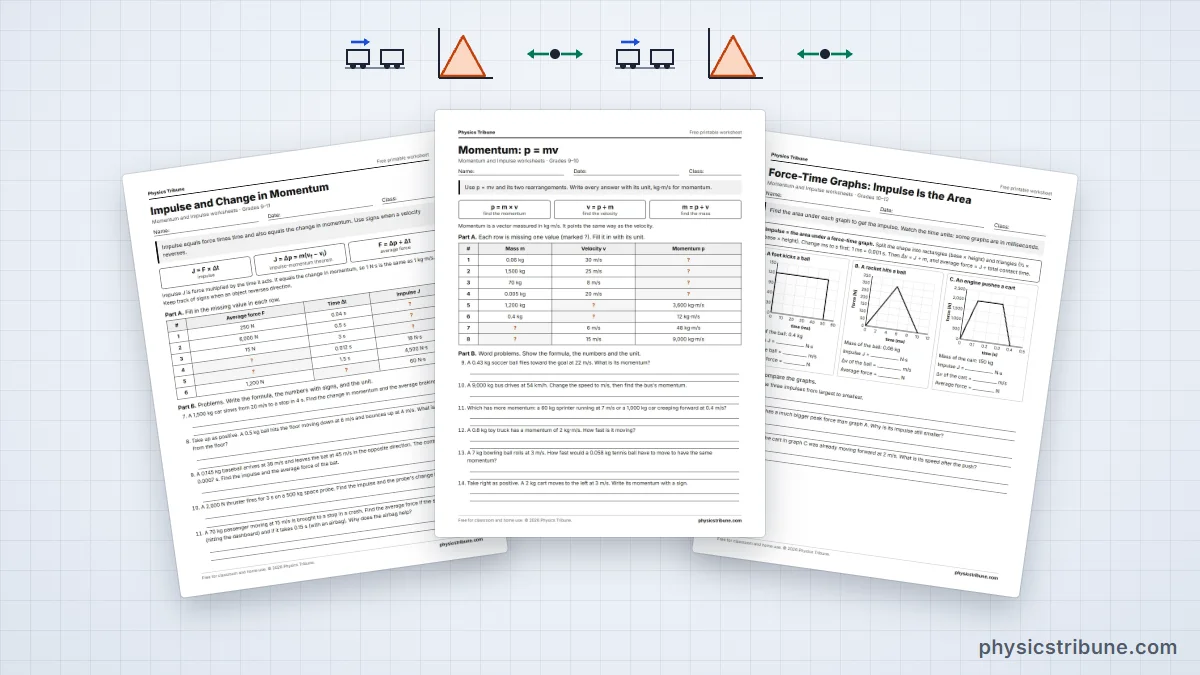
Collision problems reward careful sign work. Our momentum and impulse worksheets include elastic and inelastic collisions with printable answer keys. Check your answers with the collision calculator, and see the effect live in our colliding carts experiment.
Common Misconceptions
Myth: In an elastic collision, each object keeps its own kinetic energy.
Physics: Only the total kinetic energy is conserved. Energy can move from one object to the other, and with equal masses it transfers completely.
Myth: Kinetic energy stays constant at every moment during an elastic collision.
Physics: During contact some kinetic energy is stored as elastic potential energy in the squashed objects. It returns as motion when they spring apart.
Myth: Objects that bounce apart always had an elastic collision.
Physics: Most bouncing collisions lose some kinetic energy and are partly inelastic. A collision is elastic only if the kinetic energy totals match.
Myth: Elastic collisions break the rule that momentum is conserved because objects reverse direction.
Physics: Reversals are allowed because momentum is a vector. Signed momenta still add to the same total before and after.
Key Facts
- An elastic collision conserves both total momentum and total kinetic energy.
- Equal masses in a head-on elastic collision swap velocities.
- A light object hitting a much heavier one at rest bounces back with almost its original speed.
- In a head-on elastic collision, the separation speed equals the approach speed.
- The coefficient of restitution of a perfectly elastic collision is exactly 1.
- A moving object hands all of its kinetic energy to a target at rest only when the masses are equal.
- Collisions between gas molecules are elastic on average, which underlies the kinetic theory of gases.
Quick Quiz: How Well Do You Know Elastic Collisions?
6 questions. Tap an answer to check it.
Which quantities are conserved in an elastic collision?
An elastic collision is defined by keeping both total momentum and total kinetic energy.
A ball moving at 2 m/s hits an identical ball at rest, head-on and elastically. What happens?
Equal masses in a head-on elastic collision swap velocities.
A small ball hits a very heavy wall elastically. What is its speed afterward?
A light object hitting a very massive one at rest bounces back with almost its original speed.
What is the coefficient of restitution of a perfectly elastic collision?
Separation speed equals approach speed, so the ratio is exactly 1.
During the instant of greatest compression in an elastic collision, where is most of the missing kinetic energy?
The squashed objects store it like springs and give it back as they separate.
Which of these comes closest to a perfectly elastic collision?
Hard, smooth billiard balls lose only a small share of their kinetic energy in each hit.
Frequently Asked Questions
What is an elastic collision in simple terms?
An elastic collision is a perfect bounce. The objects hit and spring apart without losing any kinetic energy to heat, sound or permanent damage. Their total momentum and total kinetic energy are both the same afterward as before. Billiard balls and hard steel balls come close to this, while a lump of clay hitting the floor is the opposite.
What is conserved in an elastic collision?
Two quantities are conserved: total momentum and total kinetic energy. Momentum is conserved in every collision of an isolated system, so the special feature of an elastic collision is that kinetic energy also survives. Total energy is conserved in all collisions too, but in inelastic ones part of it changes into forms other than motion.
What is the formula for an elastic collision?
For a head-on elastic collision, v1' = ((m1 − m2) v1 + 2 m2 v2) / (m1 + m2) and v2' = (2 m1 v1 + (m2 − m1) v2) / (m1 + m2). These come from solving momentum conservation and kinetic energy conservation together. Velocities must carry signs for direction, and masses can be in any consistent unit.
What happens when two equal masses collide elastically?
In a head-on elastic collision between equal masses, the objects simply exchange velocities. If one is at rest, the moving one stops completely and the other moves off at the original speed. If both are moving toward each other, each bounces back with the other's original velocity. This is why a cue ball can stop dead after a straight hit.
Are any collisions perfectly elastic?
At the scale of everyday objects, no collision is perfectly elastic, because some energy always becomes sound, heat or tiny vibrations. Hard steel and resin balls lose only a small share. At the atomic scale, collisions between gas molecules or between particles below certain energies can be truly elastic, since there is no internal way for the energy to escape.
How can you tell if a collision is elastic or inelastic?
Calculate the total kinetic energy, the sum of one half m v squared for every object, before and after the collision. If the totals are equal, the collision is elastic. If the total after is smaller, it is inelastic. You can also compare relative speeds: in an elastic collision, the objects separate at the same speed they approached.
Is a ball bouncing on the floor an elastic collision?
Only approximately. A ball that bounced perfectly elastically would rise back to its original drop height every time. Real balls rise a little less, because some energy turns into heat and sound in the ball and the floor. The ratio of rebound speed to impact speed is the coefficient of restitution, which is below 1 for every real ball.
Why is kinetic energy not conserved in all collisions?
When objects collide, they deform. If they spring back completely, the stored energy returns as motion. If the material bends permanently, rubs internally or vibrates, part of the energy is turned into heat and sound instead. Momentum cannot leak away like this because the forces between the objects are always equal and opposite.
Keep Exploring
 momentumCollisions
 momentumInelastic Collisions
 momentumLaw of Conservation of Momentum
 momentumCoefficient of Restitution
 compareElastic vs Inelastic Collision
 calculatorsElastic & Inelastic Collision Calculator
 worksheetsMomentum and Impulse Worksheets
 formulasMomentum and Impulse Formulas
 physicistsChristiaan Huygens
Sources
Constants come from NIST CODATA 2022 (public domain) and unit definitions from the BIPM SI Brochure (CC BY 4.0). Text, diagrams and illustrations are original work by Physics Tribune.