
At a Glance
A liquid keeps its volume but not its shape: it flows and fills the bottom of any container. Its particles are packed closely but can slide past each other, which is why liquids are hard to compress yet easy to pour. The pressure inside a still liquid grows with depth as P = rho g h.
- Shape
- Takes the shape of its container
- Volume
- Fixed (nearly incompressible)
- Particle arrangement
- Close together, disordered, free to slide
- Key formula
- P = ρgh (pressure with depth)
- Typical density
- About 700 to 13,600 kg/m³ for common liquids
- Examples
- Water, oil, milk, ethanol, mercury
On this page
- What Is a Liquid?
- Liquids Explained Simply
- How Are Particles Arranged in a Liquid?
- What Are the Main Properties of Liquids?
- How Dense Are Liquids?
- Why Does Pressure Increase With Depth in a Liquid?
- Why Do Some Objects Float in Liquids?
- How Do Liquids Transmit Force?
- How Do Liquids Change State?
- What Are Some Examples of Liquids?
- Practice Problems on Liquids
- Common Misconceptions
- Key Facts
- Quiz
- FAQ
What Is a Liquid?
A liquid is matter that holds a fixed amount of space but lets that space change shape. Pour 200 mL of juice from a tall glass into a wide bowl and you still have 200 mL, only now it is shallow and spread out. That single behavior separates liquids from the other two common states of matter.
A solid keeps both its shape and its volume. A gas keeps neither and expands to fill any container. A liquid sits in between: it keeps its volume like a solid but flows like a gas. Liquids and gases together are called fluids, because both can flow.
On Earth, liquid water is so common that we rarely notice how unusual it is. Most substances on our planet are solids or gases at room temperature. Only a handful, such as water, mercury, bromine and many oils, are liquids under everyday conditions.
Liquids Explained Simply
Imagine a crowd of people packed into a hallway. Nobody has much room, yet everyone can shuffle and squeeze past their neighbors. That crowd behaves like the particles of a liquid. They are close together, but they are not locked in place.
Because the particles are already touching, you cannot push them much closer, so a liquid barely shrinks when you squeeze it. Because they can move around each other, the liquid slumps to the bottom of a cup and spreads into any shape. Tip the cup and the whole crowd flows out.
How Are Particles Arranged in a Liquid?
The particle model of matter pictures every substance as tiny particles in constant motion. In a liquid, those particles are about as close together as in a solid, but their arrangement is messy rather than a neat repeating pattern. Small clusters form and break apart billions of times every second.
What holds a liquid together are intermolecular forces, the attractions between neighboring molecules. In a solid these attractions win completely and pin each particle in place. In a gas the particles move so fast that the attractions barely matter. A liquid is the balanced middle case, where the particles have enough energy to slide but not enough to escape.
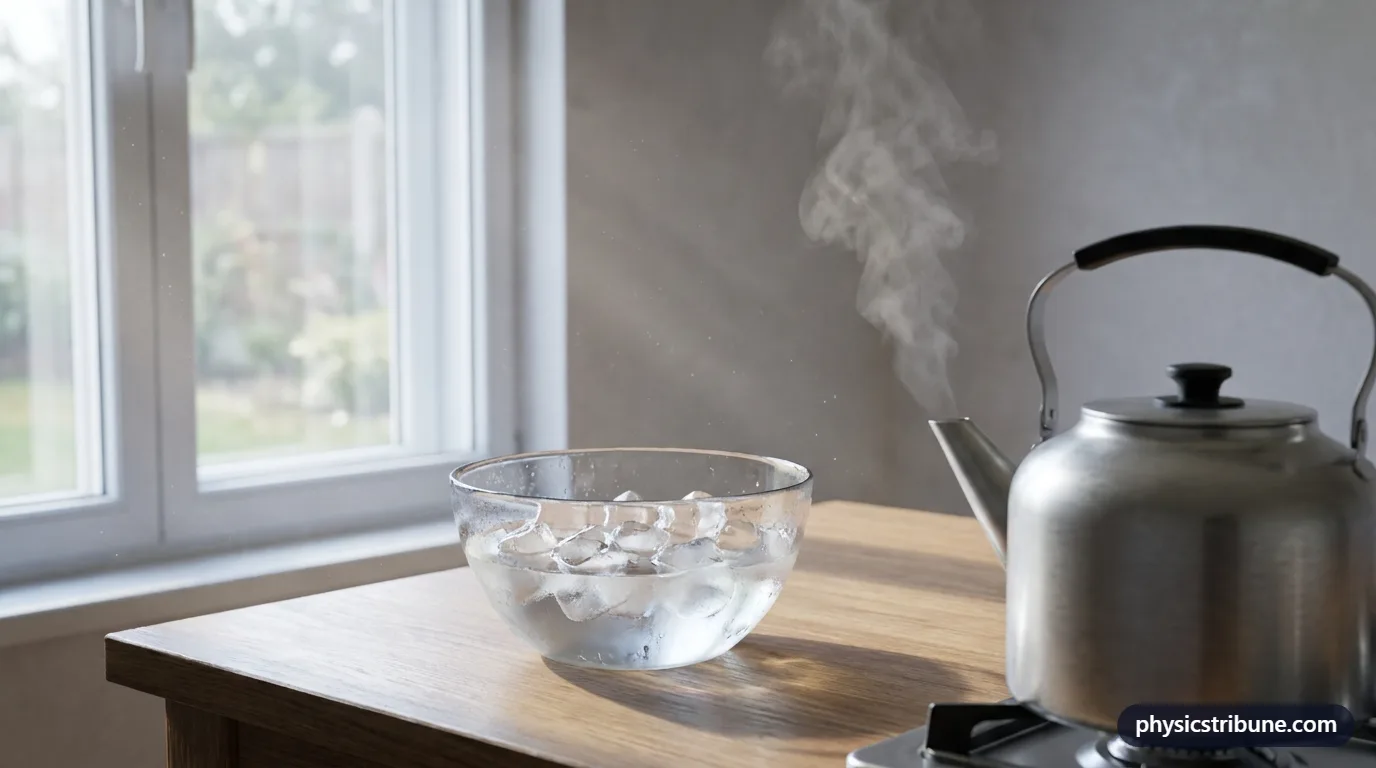
Heat a liquid and its particles speed up. Eventually some escape from the surface, which is evaporation. Cool it and the particles slow until they settle into a fixed pattern, which is freezing.
What Are the Main Properties of Liquids?
Every liquid shares a short list of properties that come straight from its particle arrangement:
- Definite volume. A liquid occupies the same space whatever its container.
- No fixed shape. It flows to fill the lowest part of a container and forms a flat top surface when still.
- Very low compressibility. Adding a full extra atmosphere of pressure squeezes water by only about 0.005 percent of its volume.
- Ability to flow. How easily a liquid flows is its viscosity. Water is runny, while honey and motor oil are thick.
- Surface tension. Molecules at the surface are pulled inward, so the surface acts like a stretched skin. This is surface tension, and it lets small insects stand on a pond.
- Diffusion. A drop of food coloring slowly spreads through a glass of still water because the particles keep wandering.

How Dense Are Liquids?
Density tells you how much mass is packed into each unit of volume,
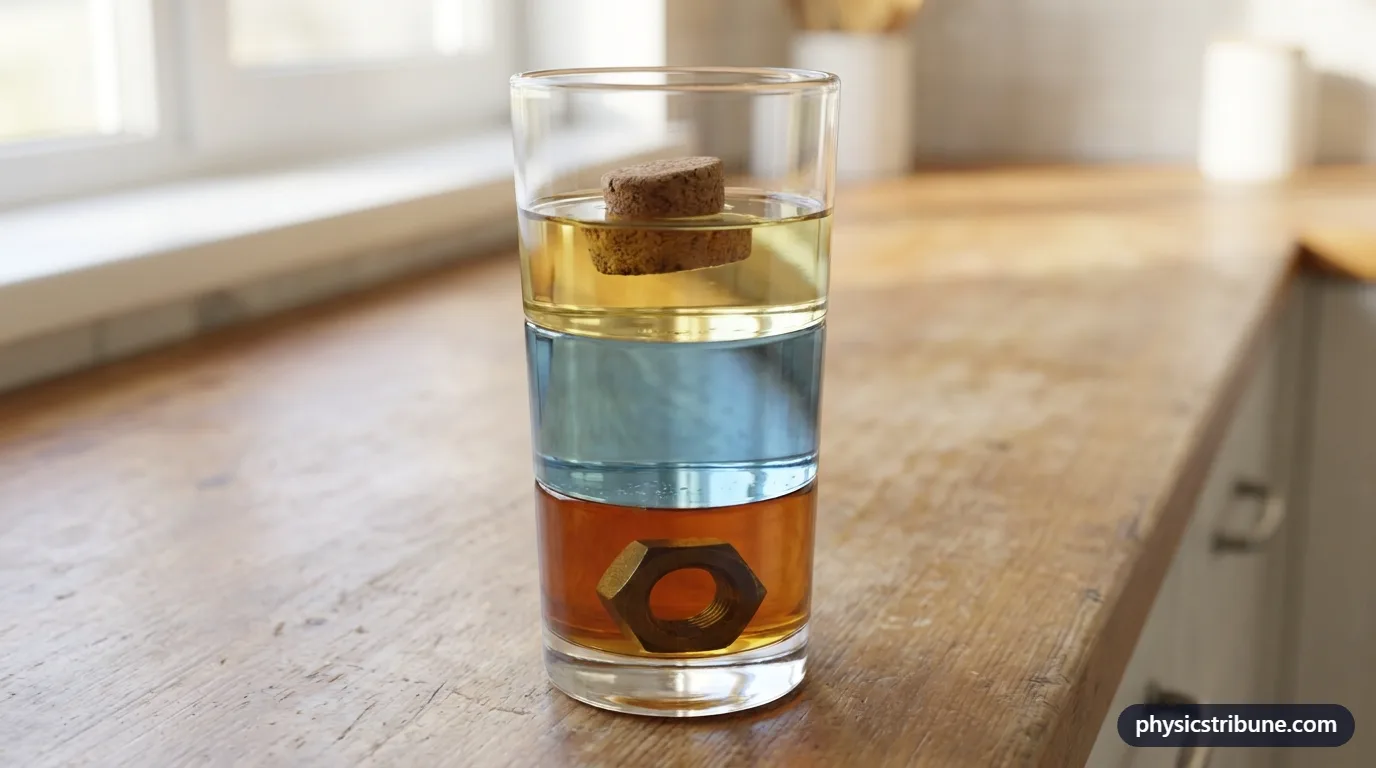
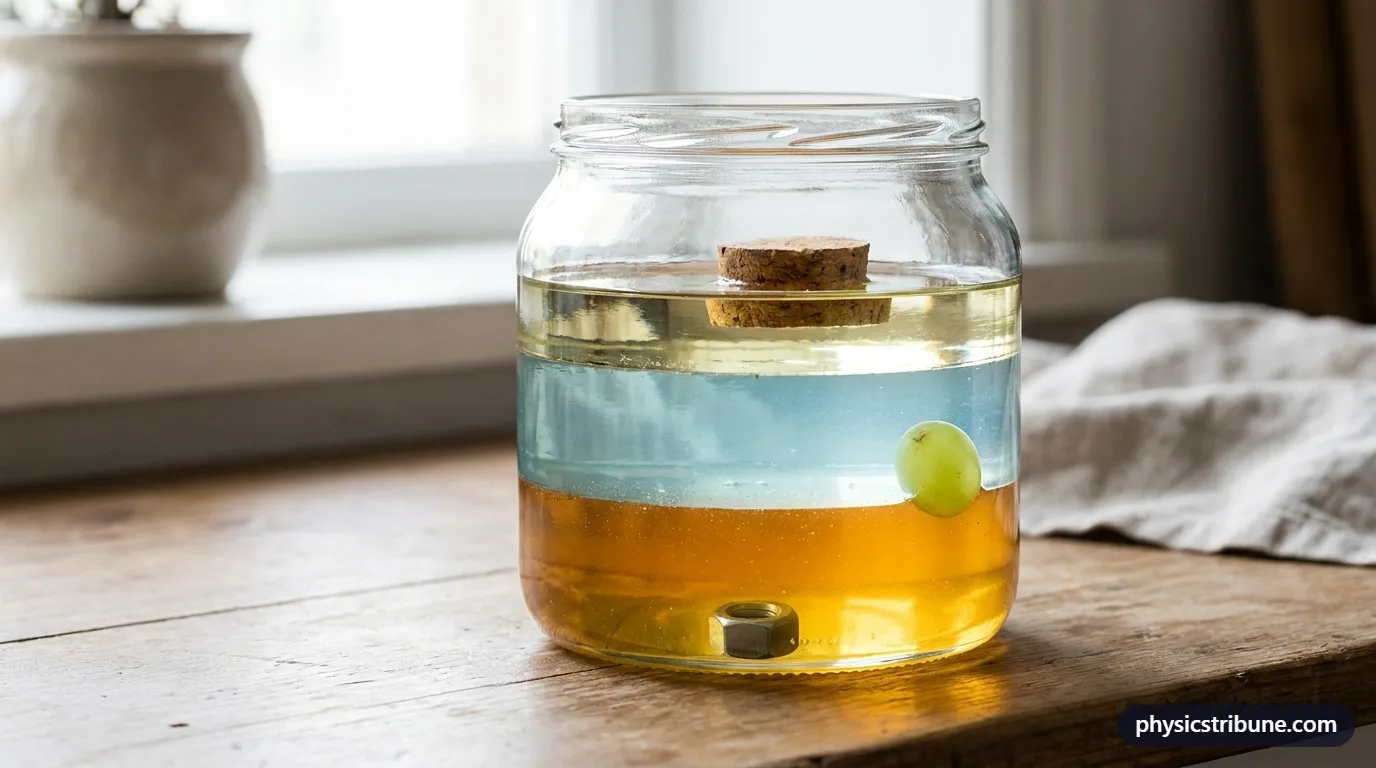
Liquids that do not mix stack themselves in order of density, with the densest at the bottom. That is why oil floats on vinegar and why a layered drink stays layered if you pour carefully. The table shows typical values for several common liquids. For the full method of measuring and calculating density, see our density formula page or try the density calculator.
Example 1 Identifying a cooking oil by its density
A measuring cup holds 250 mL (0.00025 m³) of a cooking oil, and the oil alone has a mass of 0.229 kg. What is the density of the oil?
- Given:
- mass:
- volume:
- mass:
- Formula:
- Substitute:
- Answer:
A value a little below 1,000 kg/m³ explains why the oil floats as a layer on top of water in a salad dressing.
| Liquid | Density near 20 °C (kg/m³) | Freezing point (°C) | Boiling point (°C) |
|---|---|---|---|
| Acetone | about 791 | about −95 | about 56 |
| Ethanol | about 789 | about −114 | about 78 |
| Fresh water | about 998 | 0 | 100 |
| Seawater | about 1,025 | about −2 | about 100.5 |
| Glycerol | about 1,261 | about 18 | about 290 |
| Mercury | about 13,534 | about −39 | about 357 |
| Source: Typical handbook values, rounded; seawater varies with saltiness · Retrieved October 2026 | |||
Why Does Pressure Increase With Depth in a Liquid?
A liquid has weight, and every layer must hold up the layers above it. The deeper you go, the more liquid sits on top of you, so the pressure grows steadily with depth. In a still liquid this extra pressure equals
Notice what is missing from the formula: the width or shape of the container. A narrow tube of water 3 m tall and a wide lake 3 m deep produce the same pressure at the bottom. Divers feel this as a squeeze in their ears after only a meter or two, and dams are built thicker at the base than at the top for the same reason.
Liquid pressure also pushes equally in all directions at a given depth. Our fluid pressure formula page works through the details, and the pressure calculator handles unit conversions.
This is the relation for the extra pressure a still liquid exerts at a depth h below its surface, with each variable and its SI unit.
| Symbol | Quantity | SI unit |
|---|---|---|
| pressure due to the fluid column (gauge pressure) | pascal (Pa) | |
| fluid density | kilogram per cubic meter (kg/m³) | |
| acceleration due to gravity (9.80 m/s² (standard 9.80665 m/s²)) | meter per second squared (m/s²) | |
| depth below the surface | meter (m) |
Rearranged to find another variable:
Valid for: incompressible fluid at rest; add atmospheric pressure for absolute pressure.
Example 2 Pressure at the bottom of a diving pool
Fresh water with a density of 998 kg/m³ fills a pool to a depth of 2.4 m. Using g = 9.80665 m/s², how much extra pressure does the water exert on the pool floor?
- Given:
- fluid density:
- acceleration due to gravity:
- depth below the surface:
- fluid density:
- Formula:
- Substitute:
- Answer:
This is gauge pressure; add about 101,325 Pa of air pressure on the surface to get the absolute pressure at the floor.
Example 3 How heavy is the water in a saltwater aquarium?
A home aquarium holds 0.12 m³ of seawater with a density of 1,025 kg/m³. What is the mass of the water?
- Given:
- density:
- volume:
- density:
- Formula:
- Substitute:
- Answer:
That is more than a typical adult, which is why large tanks need a stand rated for the full load.
| Depth (m) | Gauge pressure (kPa) | Gauge pressure (atm) | Absolute pressure (kPa) |
|---|---|---|---|
| 0.5 | 4.89 | 0.048 | 106.2 |
| 1 | 9.79 | 0.097 | 111.1 |
| 2 | 19.57 | 0.193 | 120.9 |
| 5 | 48.94 | 0.483 | 150.3 |
| 10 | 97.87 | 0.966 | 199.2 |
| 20 | 195.7 | 1.932 | 297.1 |
| Source: Computed with P = ρgh, g = 9.80665 m/s², 1 atm = 101.325 kPa (CODATA/BIPM standard values) · Retrieved October 2026 | |||
Why Do Some Objects Float in Liquids?
Because pressure rises with depth, the liquid pushes harder on the bottom of a submerged object than on its top. The difference is an upward force called buoyancy. An object floats when that upward push can match its weight before it is fully under the surface.
An ice cube is a neat example. Ice is slightly less dense than liquid water, so the cube floats with roughly nine tenths of its volume below the waterline. Steel is far denser than water, yet a steel ship floats because its hollow hull pushes aside a huge volume of water. The diagram shows the two balanced forces on a floating cube.

How Do Liquids Transmit Force?
Since a liquid hardly compresses, a push on one part of it spreads almost instantly through the whole volume. This idea, known as Pascal's principle after the French scientist Blaise Pascal, is the basis of car brakes, dentist chairs and the lifts in auto repair shops. A small force on a narrow piston creates a pressure that acts on a much wider piston and produces a much larger force.
The same near-incompressibility explains why water speeds up when you narrow a hose with your thumb. The volume flowing past each point per second must stay the same, so a smaller opening means faster flow. The diagram below shows this for a pipe that narrows, and our hydraulic systems page covers the machines built on it.

How Do Liquids Change State?
A liquid becomes a solid when it cools to its freezing point and becomes a gas when it reaches its boiling point or evaporates from the surface. For pure water at standard sea-level air pressure these happen at 0 °C and 100 °C. Other liquids have their own values, as the table shows, and our pages on melting and freezing points and the boiling point explain why.
Evaporation and boiling are not the same process. Evaporation happens at the surface at any temperature, while boiling forms vapor bubbles throughout the liquid at one particular temperature. Our evaporation vs boiling comparison lays the differences side by side.
What Are Some Examples of Liquids?
Liquids show up all around us, often in places we do not think about:
- In the kitchen: water, milk, vinegar, cooking oil, honey and soy sauce.
- In the body: blood plasma, saliva and the fluid that cushions the brain.
- In machines: gasoline, brake fluid, engine coolant and hydraulic oil.
- In nature: oceans, rivers and the molten rock called magma deep underground.
- Unusual ones: mercury, the only metal that is liquid at room temperature, and liquid nitrogen, which boils at about −196 °C.
Some materials are harder to classify. Glass, toothpaste and cornstarch mixed with water behave partly like solids and partly like liquids, which is why scientists treat them as special cases.
Practice Problems on Liquids
To test yourself on states of matter, try our printable states of matter worksheets, which come with answer keys. For calculation practice, the density worksheets pair well with the worked examples on this page. Then take the quick quiz below.
Common Misconceptions
Myth: A wider container of water creates more pressure at the bottom.
Physics: Pressure at the bottom depends only on the depth and the density of the liquid. A narrow tube and a wide tank filled to the same depth give the same pressure.
Myth: Liquids can be squeezed into a much smaller volume, like gases.
Physics: Liquid particles are already touching, so even very large forces change a liquid's volume by only a tiny fraction.
Myth: Thick liquids like honey are denser than thin ones.
Physics: Thickness is viscosity, which is a different property from density. Motor oil is thick but less dense than water, so it floats on it.
Myth: Liquids only evaporate when they boil.
Physics: Evaporation happens at the surface at any temperature. A puddle dries on a cool day without ever boiling.
Key Facts
- A liquid has a definite volume but takes the shape of its container.
- Liquid particles are close together but can slide past one another, held loosely by intermolecular forces.
- Liquids are nearly incompressible, which is why hydraulic machines can transmit force through them.
- Pressure in a still liquid increases with depth according to P = ρgh, whatever the shape of the container.
- Liquids that do not mix settle in layers, with the densest liquid at the bottom.
- Viscosity measures how thick a liquid is, and surface tension makes its surface act like a thin skin.
- Mercury is the only metal that is liquid at room temperature.
Quick Quiz: How Well Do You Know Liquids?
6 questions. Tap an answer to check it.
Which statement describes a liquid?
A liquid keeps its volume but flows to take the shape of its container.
Two tanks of water are 3 m deep. One is narrow, one is very wide. How do the pressures at their bottoms compare?
Liquid pressure depends on depth and density, not on the width of the container.
Why are liquids very hard to compress?
With particles already touching, there is almost no space left to squeeze out.
Oil floats on water because the oil is…
Liquids that do not mix stack by density, and oil is less dense than water.
What property describes how thick or runny a liquid is?
Viscosity measures a liquid's resistance to flowing.
Which principle explains how hydraulic car brakes multiply force?
Pressure applied to a confined liquid spreads through all of it, so a wide piston receives a larger force.
Frequently Asked Questions
What is a liquid in science?
In science, a liquid is one of the states of matter. It has a fixed volume but no fixed shape, so it flows and takes the form of its container. Its particles are packed closely together, like in a solid, but they can move past each other. That combination makes liquids pourable yet very hard to compress.
What are 5 properties of liquids?
Five key properties are a definite volume, no definite shape, very low compressibility, the ability to flow, and surface tension. Liquids also have a density that is usually much greater than that of gases, and each has its own viscosity, which describes how thick or runny it is. Most liquids also expand slightly when heated.
Why do liquids take the shape of their container?
The particles in a liquid are not fixed in place. Gravity pulls them down, and because they can slide over one another, they flow until they fill the lowest part of the container. The attractions between particles are strong enough to keep the volume constant but too weak to hold any particular shape, so the liquid simply follows the walls.
Can liquids be compressed?
Only very slightly. The particles in a liquid are already in contact, so there is almost no empty space to squeeze out. Water, for example, needs an enormous pressure to shrink by even one percent. For most everyday purposes, engineers treat liquids as incompressible, which is exactly what makes hydraulic brakes and lifts work so reliably.
What is the difference between a liquid and a fluid?
A fluid is anything that can flow, which includes both liquids and gases. Every liquid is a fluid, but not every fluid is a liquid. The difference is that a liquid keeps a fixed volume and forms a surface, while a gas spreads out to fill its whole container and has no surface of its own.
Is honey a liquid?
Yes. Honey flows, keeps a fixed volume and takes the shape of its jar, so it is a liquid. It simply has a very high viscosity, which means its particles resist sliding past each other far more than water molecules do. Warming honey lowers its viscosity, which is why it pours more easily after a few seconds in warm water.
Why is pressure higher at the bottom of a lake?
At any depth, the water must support the weight of all the water above it. The deeper you go, the taller that column of water becomes, so the pressure rises steadily. In fresh water the extra pressure grows by roughly one atmosphere for every ten meters of depth, which is why divers must equalize their ears as they descend.
Which is the densest common liquid?
Among liquids you might meet in a lab or a home, mercury is the densest, at roughly 13.5 times the density of water. A steel bolt, which sinks in water, actually floats in mercury. Because mercury vapor is toxic, it has largely been removed from household thermometers and is now handled only with care in labs.
Keep Exploring





Sources
Constants come from NIST CODATA 2022 (public domain) and unit definitions from the BIPM SI Brochure (CC BY 4.0). Text, diagrams and illustrations are original work by Physics Tribune.