
At a Glance
Intermolecular forces are weak electrical attractions between molecules: London dispersion forces, dipole-dipole forces, hydrogen bonds and ion-dipole forces. Stronger intermolecular forces mean higher melting and boiling points, larger latent heat (Q = m L), higher surface tension and higher viscosity.
- What they are
- Attractions between separate molecules
- Origin
- Electrical (Coulomb attraction between partial charges)
- Main types
- Dispersion, dipole-dipole, hydrogen bond, ion-dipole
- Typical strength
- About 1 to 10 percent of a covalent bond
- Key formula
- Q = m L (energy to change phase)
- Controls
- Boiling point, latent heat, surface tension, viscosity
On this page
- What Are Intermolecular Forces?
- Intermolecular Forces Explained Simply
- What Are the Four Types of Intermolecular Forces?
- Why Do Intermolecular Forces Act Only at Short Range?
- How Do Intermolecular Forces Shape Bulk Properties?
- How Can You Measure the Strength of Intermolecular Forces?
- Which Substances Have the Strongest Intermolecular Forces?
- Why Is Water So Unusual?
- Where Do You See Intermolecular Forces in Everyday Life?
- Practice and Next Steps
- Common Misconceptions
- Key Facts
- Quiz
- FAQ
What Are Intermolecular Forces?
Intermolecular forces are the pulls and pushes between whole molecules. Inside a water molecule, the oxygen and two hydrogen atoms are held together by strong covalent bonds. Between one water molecule and the next, a much weaker attraction keeps them close. That second, weaker attraction is an intermolecular force.
Every one of these forces comes from electric charge. Molecules are neutral overall, but their electrons are not always spread evenly. One end can be slightly negative and the other slightly positive, and opposite partial charges on neighbors attract each other just as Coulomb's law describes for ordinary charges.
The forces also have a repulsive side. Push two molecules too close and their electron clouds overlap and shove back. Real molecules settle at a comfortable spacing where attraction and repulsion balance, which is why liquids and solids are so hard to compress.
Intermolecular Forces Explained Simply
Imagine a crowd of people at a party. Each person is a molecule. Some guests barely notice each other and drift around the room freely, like the particles of a gas. Others hold hands loosely and shuffle around in a group, like a liquid. A few lock arms in tidy rows, like a solid.
How tightly the guests hold on depends on the intermolecular forces. Heat is like loud music that makes everyone move faster. With weak grips, a little music is enough to break the groups apart. With strong grips, you need the music very loud before anyone lets go. That is the whole story behind melting points and boiling points.
What Are the Four Types of Intermolecular Forces?
Chemists and physicists usually sort these attractions into four families, from the weakest per contact to the strongest:
- London dispersion forces. Electrons are always moving, so for an instant one side of any atom or molecule can carry a little more negative charge than the other. That brief imbalance nudges the electrons of a neighbor into a matching imbalance, and the two attract. Every substance has dispersion forces, and they grow with the number of electrons.
- Dipole-dipole forces. Polar molecules, such as hydrogen chloride or acetone, have a permanent positive end and negative end. They line up so that the positive end of one faces the negative end of the next. A polar molecule behaves much like an electric dipole.
- Hydrogen bonds. When hydrogen is attached to a small, strongly electron-hungry atom (oxygen, nitrogen or fluorine), it is left almost bare. That exposed hydrogen is attracted strongly to a lone pair of electrons on a nearby molecule. Water, ammonia and the paired strands of DNA all rely on hydrogen bonds.
- Ion-dipole forces. A charged ion surrounded by polar molecules pulls on their oppositely charged ends. This is how water molecules crowd around sodium and chloride ions when table salt dissolves.
The name "van der Waals forces" is often used as an umbrella term for dispersion and dipole-related attractions between neutral molecules.

Why Do Intermolecular Forces Act Only at Short Range?
A single charge feels another charge at a fairly long distance. Intermolecular forces fade much faster, because each molecule is neutral overall and its positive and negative regions nearly cancel when seen from far away. For dispersion attraction, the energy falls roughly as one over the sixth power of the separation, so doubling the distance cuts the attraction energy to about one sixty-fourth.
That steep drop explains why gases behave so simply. At room temperature and ordinary pressure, gas molecules sit about ten molecular diameters apart on average, so they hardly feel each other between collisions. Squeeze or cool the gas until the molecules crowd together, and the attractions suddenly matter enough to pull it into a liquid.
How Do Intermolecular Forces Shape Bulk Properties?
A bulk property is something you measure on a visible amount of material, such as a cup of liquid or a block of solid. Many of them trace straight back to how strongly the molecules attract each other:
- Melting and boiling points. Stronger attractions need more thermal motion to overcome, so the boiling point rises.
- Latent heat. The energy per kilogram needed to melt or boil a substance is a direct measure of the attraction being overcome. Our latent heat page covers the formula in full.
- Surface tension. Molecules at the surface have neighbors on one side only, so they are pulled inward. Strong attractions give a tight surface "skin", as described on our surface tension page.
- Viscosity. Molecules that cling to each other resist sliding past one another, so the liquid flows slowly. Honey and glycerol are classic examples; see viscosity.
- Volatility. Liquids with weak attractions evaporate quickly at room temperature, which is why nail polish remover vanishes from your skin much faster than water.
- Capillary rise. When a liquid is attracted more to a glass wall than to itself, it creeps upward, an effect explained on our capillary action page.
How Can You Measure the Strength of Intermolecular Forces?
You cannot weigh a single molecular attraction with a kitchen scale, but you can measure the energy needed to break billions of them at once. During melting or boiling, a substance absorbs heat while its temperature stays fixed. That hidden energy, called latent heat, goes entirely into pulling molecules away from their neighbors.
The relationship is
The heating curve below shows the same idea as a graph. The flat steps are where the energy goes into separating molecules instead of raising the temperature.
The latent heat formula turns the strength of intermolecular attraction into a number you can measure: the energy needed per kilogram to pull the molecules apart during a phase change.
| Symbol | Quantity | SI unit |
|---|---|---|
| heat absorbed or released | joule (J) | |
| mass changing phase | kilogram (kg) | |
| latent heat of fusion (L_f) or vaporization (L_v) | joule per kilogram (J/kg) |
Rearranged to find another variable:
Valid for: at constant temperature (melting/boiling point); water: L_f = 334 kJ/kg, L_v = 2256 kJ/kg.
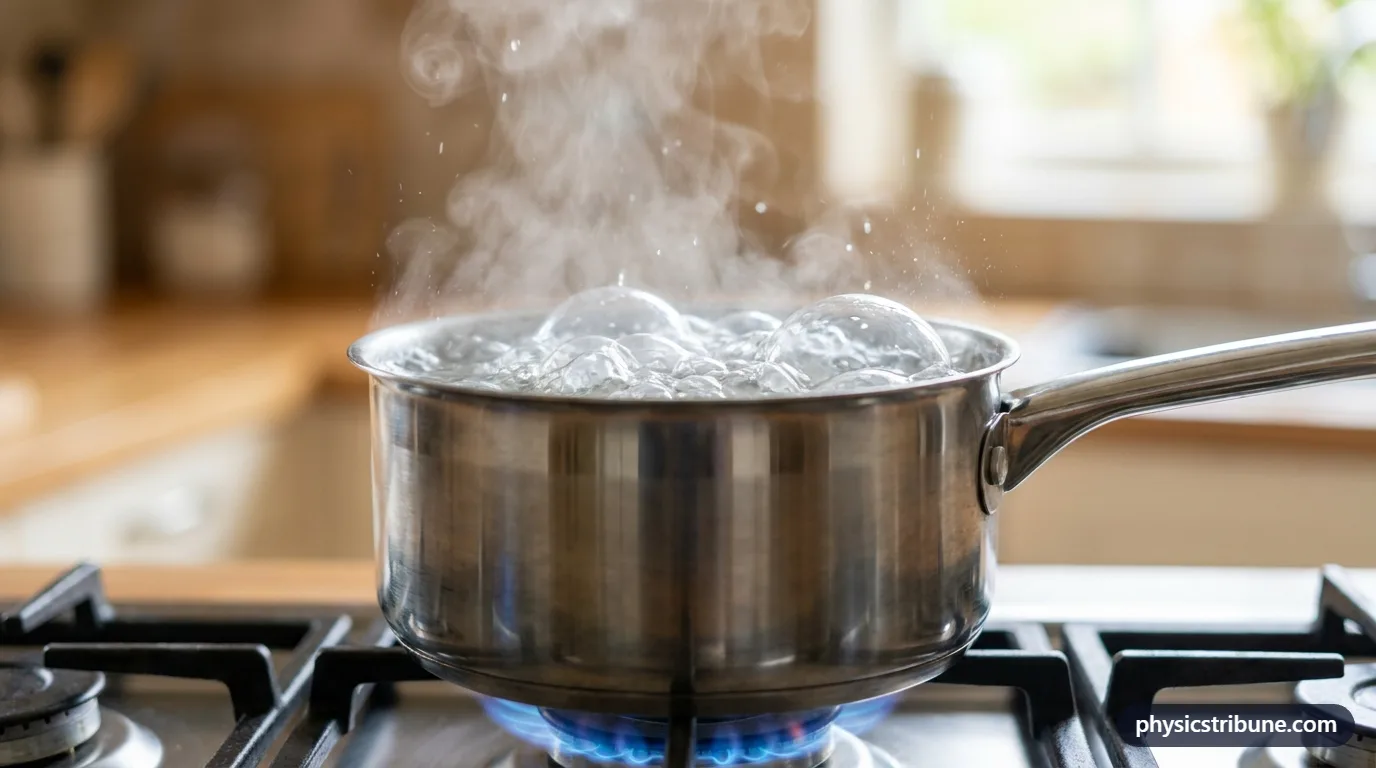
Example 1 Boiling away a pot of water
A pot holds 0.25 kg of water that is already at 100 °C. Water's latent heat of vaporization is about 2.26 × 10⁶ J/kg. How much energy must the stove supply to boil all of it away?
- Given:
- mass changing phase:
- latent heat of fusion (L_f) or vaporization (L_v):
- mass changing phase:
- Formula:
- Substitute:
- Answer:
None of this energy raises the temperature; all of it goes into separating hydrogen-bonded water molecules from each other.
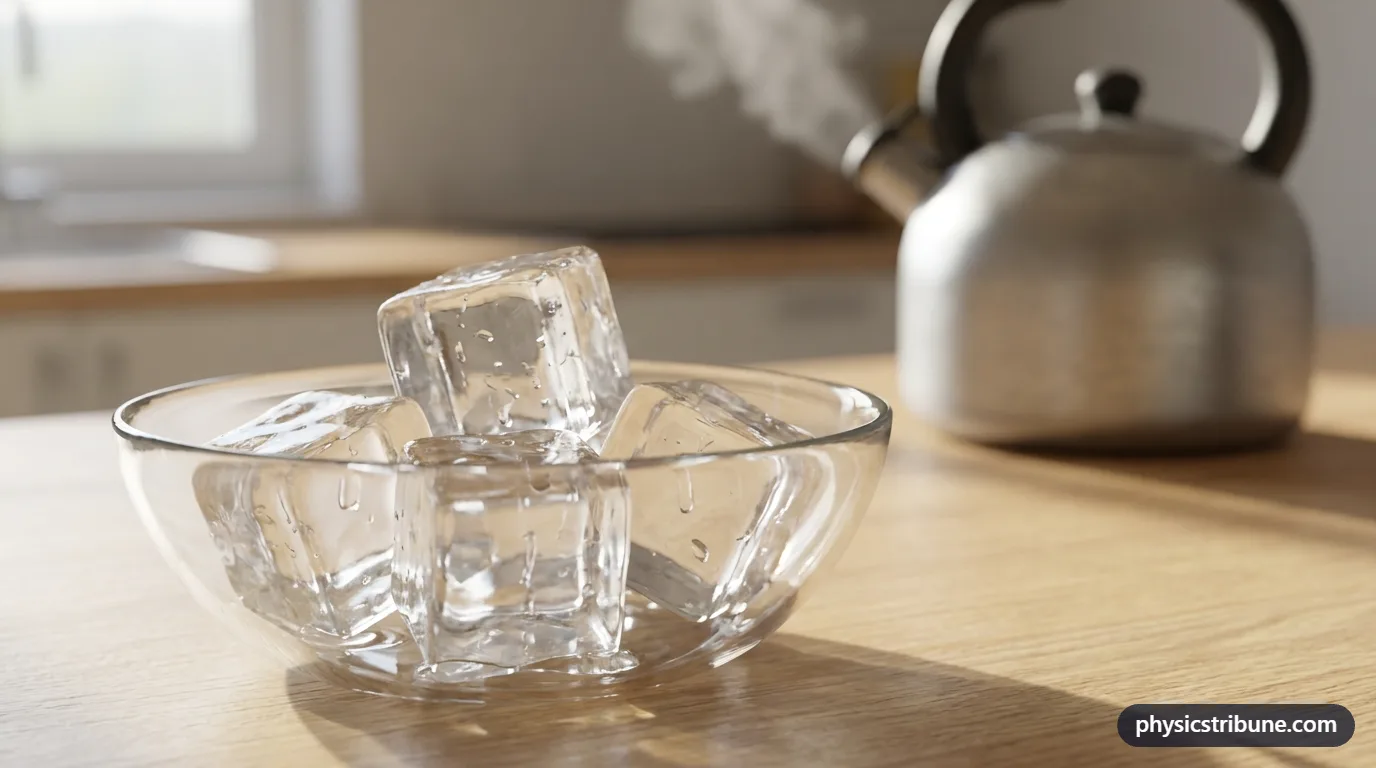
Example 2 Melting a tray of ice cubes
A tray holds 0.40 kg of ice at 0 °C. The latent heat of fusion of water is about 3.34 × 10⁵ J/kg. How much energy is needed to melt the ice without warming it?
- Given:
- mass changing phase:
- latent heat of fusion (L_f) or vaporization (L_v):
- mass changing phase:
- Formula:
- Substitute:
- Answer:
Compare this with the first example: melting only loosens the molecular network, while boiling must separate the molecules completely, so it costs far more energy per kilogram.

Which Substances Have the Strongest Intermolecular Forces?
Comparing substances side by side makes the pattern clear. Small, nonpolar molecules such as nitrogen and methane rely only on dispersion forces and boil far below freezing. Polar molecules without hydrogen bonds, such as acetone, boil near room temperature. Water, with its hydrogen bonds, boils far higher than any other molecule of its size.
Size matters too. Larger molecules and heavier atoms have more electrons, and those bigger electron clouds are easier to distort, so their dispersion forces are stronger. The noble gases show this neatly: helium, with only two electrons, stays a gas until just a few kelvins above absolute zero, while xenon liquefies at a far higher temperature. Shape plays a role as well, since long, straight molecules have more surface contact than compact, round ones.
Example 3 Finding the latent heat of a solvent
In a lab test, 0.10 kg of ethanol at its boiling point absorbs 84,100 J and fully evaporates. What is the latent heat of vaporization of ethanol from this measurement?
- Given:
- heat absorbed or released:
- mass changing phase:
- heat absorbed or released:
- Formula:
- Substitute:
- Answer:
The result is well below water's value, which fits the picture of ethanol forming fewer hydrogen bonds per kilogram than water.
| Substance | Boiling point at 1 atm (°C) | Latent heat of vaporization (kJ/kg) | Strongest intermolecular force |
|---|---|---|---|
| Helium | about −269 | about 21 | Dispersion (very weak) |
| Nitrogen | about −196 | about 199 | Dispersion |
| Methane | about −162 | about 510 | Dispersion |
| Acetone | about 56 | about 518 | Dipole-dipole |
| Ethanol | about 78 | about 841 | Hydrogen bonding |
| Water | 100 | about 2,260 | Hydrogen bonding (up to four per molecule) |
| Source: Typical handbook values, rounded; latent heat measured at the normal boiling point · Retrieved October 2026 | |||
| Noble gas | Electrons per atom | Boiling point at 1 atm (°C) |
|---|---|---|
| Helium | 2 | about −269 |
| Neon | 10 | about −246 |
| Argon | 18 | about −186 |
| Krypton | 36 | about −153 |
| Xenon | 54 | about −108 |
| Source: Electron counts = atomic numbers; boiling points are typical rounded values · Retrieved October 2026 | ||
Why Is Water So Unusual?
Each water molecule can form up to four hydrogen bonds: two through its hydrogen atoms and two through the lone pairs on its oxygen. That gives liquid water a constantly shifting web of connections, and it explains a long list of odd behaviors. Water has a high boiling point, a high latent heat, a large specific heat capacity and strong surface tension for its size.
Freezing locks the web into an open hexagonal pattern that takes up more room than the jumbled liquid. As a result, ice is less dense than liquid water and floats. Lakes freeze from the top down, and the ice layer insulates the water and life below. Few other substances share this trait.
Where Do You See Intermolecular Forces in Everyday Life?
Water beads into round droplets on a freshly waxed car because water molecules attract each other more than they attract the wax. Sweat cools you because evaporating water carries away the energy needed to break hydrogen bonds. Pressure cookers, refrigerators and air conditioners all depend on liquids that absorb a lot of energy as their molecules separate.
Living things use these forces constantly. Geckos climb glass walls using dispersion forces between millions of tiny hairs on their toes and the surface. Proteins fold into working shapes partly through hydrogen bonds, and the two strands of DNA unzip easily for copying because they are held by hydrogen bonds rather than full covalent bonds.

Practice and Next Steps
Intermolecular forces connect the tiny world of molecules with the properties you can see and feel. To build on this page, review the states of matter and how phase changes work, then try our states of matter worksheets. For the electric force behind it all, the Charles-Augustin de Coulomb biography tells how the inverse square law was first measured, and the comparison of evaporation vs boiling shows the forces at work in two kinds of vaporization.
Common Misconceptions
Myth: Boiling water breaks water molecules into hydrogen and oxygen.
Physics: Boiling only separates whole water molecules from each other by overcoming hydrogen bonds. The covalent bonds inside each molecule stay intact, so the steam is still H₂O.
Myth: A hydrogen bond is a type of chemical bond, as strong as a covalent bond.
Physics: Despite its name, a hydrogen bond is an intermolecular attraction. It is typically about a tenth as strong as a covalent bond or less, which is why it breaks and reforms easily.
Myth: Nonpolar substances have no intermolecular forces.
Physics: Every substance has London dispersion forces. They are weak in small molecules but can be strong in large ones, which is why heavy nonpolar waxes are solids at room temperature.
Myth: Heavier molecules always boil at higher temperatures.
Physics: Mass is only a rough guide. Water is lighter than many gases at room temperature yet boils at 100 °C, because hydrogen bonds outweigh the effect of size.
Key Facts
- Intermolecular forces act between separate molecules, while chemical bonds hold atoms together within a molecule.
- All intermolecular forces are electrical, arising from attraction between full or partial charges on neighboring molecules.
- The four main types are London dispersion forces, dipole-dipole forces, hydrogen bonds and ion-dipole forces.
- Stronger intermolecular forces raise melting point, boiling point, latent heat, surface tension and viscosity.
- The latent heat formula Q = m L measures the energy per kilogram needed to pull molecules apart during a phase change.
- Dispersion forces exist in every substance and grow stronger as molecules get larger and have more electrons.
- Hydrogen bonding gives water its high boiling point and makes ice less dense than liquid water.
Quick Quiz: How Well Do You Know Intermolecular Forces and Bulk Properties?
6 questions. Tap an answer to check it.
Which type of intermolecular force is present in every substance?
Every atom and molecule has moving electrons, so temporary dipoles and dispersion attractions always exist.
When water boils, what is being overcome?
Boiling separates whole molecules by breaking the hydrogen bonds between them; the molecules stay intact.
Which property increases when intermolecular forces get stronger?
Stronger attractions need more thermal energy to overcome, so the boiling point rises.
Why does xenon boil at a higher temperature than helium?
Larger electron clouds are easier to distort, which strengthens London dispersion attraction.
In the formula Q = m L, what does a large value of L tell you about a liquid?
A large latent heat means a lot of energy is needed per kilogram to pull the molecules apart.
Which feature lets water molecules form hydrogen bonds?
Hydrogen bonded to a highly electronegative atom attracts lone pairs on neighboring molecules.
Frequently Asked Questions
What is the difference between intermolecular and intramolecular forces?
Intramolecular forces are the chemical bonds that hold atoms together inside a single molecule, such as the covalent bonds between oxygen and hydrogen in water. Intermolecular forces are the much weaker attractions between separate molecules. Breaking intramolecular bonds is a chemical change, while overcoming intermolecular forces, as in melting or boiling, is a physical change that leaves the molecules themselves unchanged.
Which intermolecular force is the strongest?
Among forces between neutral molecules, hydrogen bonding is usually the strongest, followed by dipole-dipole forces and then London dispersion forces per contact. Ion-dipole forces, which act between an ion and a polar molecule, are stronger still. Keep in mind that dispersion forces add up over large molecules, so a big nonpolar molecule can have more total attraction than a small polar one.
How do intermolecular forces affect boiling point?
To boil, molecules must gain enough energy to escape completely from their neighbors in the liquid. The stronger the attraction holding them, the more thermal energy they need, so the boiling point rises. That is why water, with hydrogen bonds, boils at 100 °C while methane, a molecule of similar size held only by dispersion forces, boils at about −162 °C.
Are intermolecular forces stronger in solids, liquids or gases?
The forces themselves depend on the substance, but their effect is greatest in solids, where molecules sit closest together and are held in fixed positions. In liquids, the molecules are still close and the forces keep them together while letting them slide. In gases, the molecules are so far apart that the attractions barely matter except during collisions.
What are van der Waals forces?
Van der Waals forces is a general name for the weak attractions between neutral molecules that do not involve full ions or hydrogen bonds. It usually includes London dispersion forces and dipole-related attractions. The name honors the Dutch physicist Johannes van der Waals, who in the 1870s added molecular attraction and molecular size to the equation of state for real gases.
Why does water have such strong intermolecular forces?
Oxygen pulls electrons strongly toward itself, leaving each hydrogen in a water molecule with a sizable positive charge. The oxygen also carries two lone pairs of electrons. Together, these let each molecule form up to four hydrogen bonds with its neighbors. That dense network makes water's attractions unusually strong for such a small, light molecule.
How do intermolecular forces relate to surface tension?
A molecule deep inside a liquid is pulled equally in every direction by its neighbors. A molecule at the surface has neighbors only beside and below it, so it feels a net inward pull. The liquid acts as if it has a stretched skin. Stronger intermolecular forces make that skin tighter, which is why water has much higher surface tension than alcohol or oil.
Do intermolecular forces affect solubility?
Yes. A substance dissolves well when the attractions between solvent and solute molecules are similar in strength to those within each pure substance. Polar and hydrogen-bonding substances, such as sugar and alcohol, mix easily with water. Nonpolar substances, such as cooking oil, cannot break into water's hydrogen-bond network and stay separate, which is the idea behind the rule that like dissolves like.
Keep Exploring





Sources
Constants come from NIST CODATA 2022 (public domain) and unit definitions from the BIPM SI Brochure (CC BY 4.0). Text, diagrams and illustrations are original work by Physics Tribune.