At a Glance
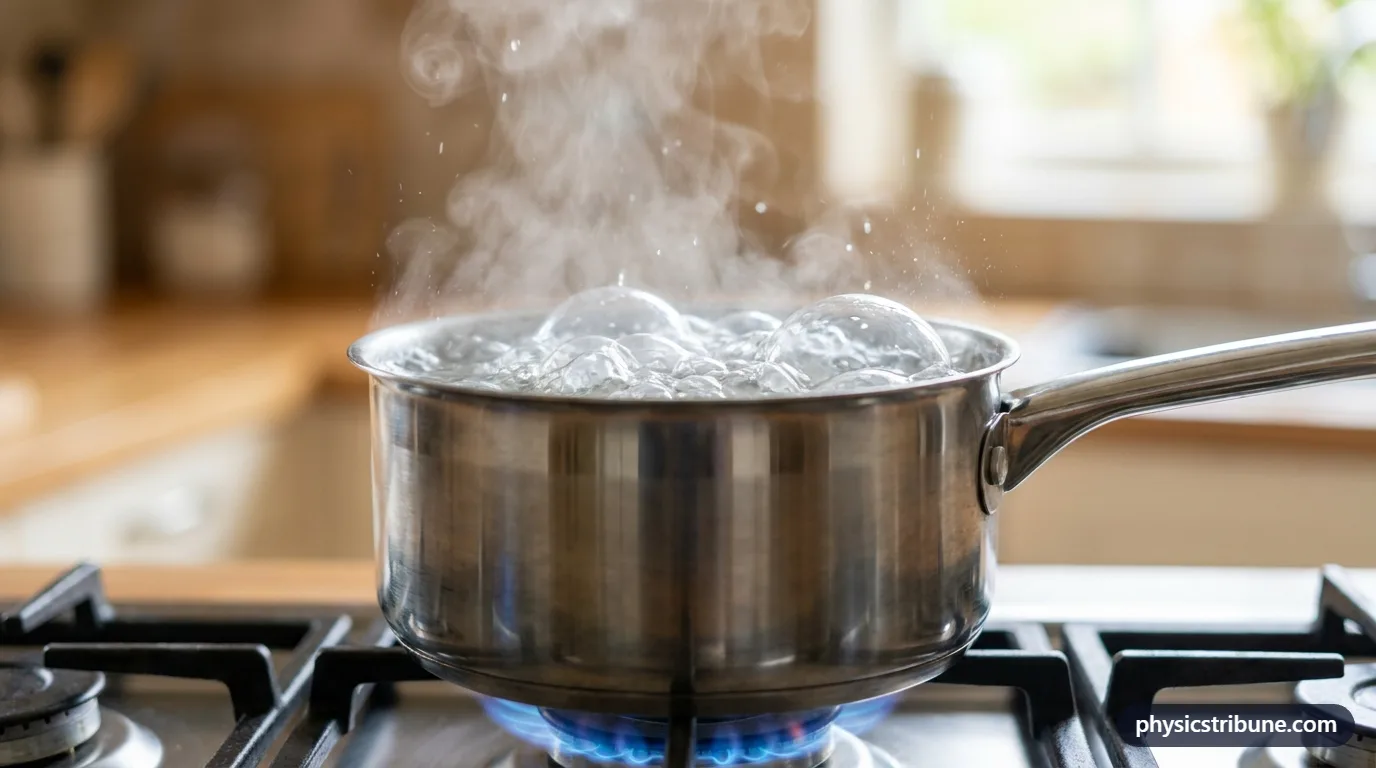
A liquid boils when its vapor pressure matches the surrounding pressure. Pure water boils at about 100 °C at 1 atm, but only near 94.5 °C in a mile-high city and about 120 °C inside a pressure cooker. While a liquid boils its temperature stays constant, because the added heat Q = m L goes into turning liquid into vapor instead of warming it.
- Symbol
- Tb (or bp)
- SI unit
- kelvin (K); usually quoted in °C or °F
- Water at 1 atm
- about 100 °C = 212 °F = 373 K
- Heat to boil off
- Q = m Lv (latent heat)
- Depends on
- Outside pressure, the substance, dissolved solutes
On this page
- What Is the Boiling Point?
- Boiling Point Explained Simply
- What Happens to Molecules When a Liquid Boils?
- How Does Pressure Change the Boiling Point?
- Why Does Water Boil at a Lower Temperature at High Altitude?
- Why Does the Temperature Stay Constant While Boiling?
- How Much Energy Does It Take to Bring Water to a Boil?
- What Are the Boiling Points of Common Substances?
- Is Boiling the Same as Evaporation?
- Does Salt Raise the Boiling Point of Water?
- Going Deeper: Phase Diagrams and the Critical Point
- Common Misconceptions
- Key Facts
- Quiz
- FAQ
What Is the Boiling Point?
Every liquid constantly releases some molecules from its surface as vapor, and that vapor pushes back with a pressure called the vapor pressure. As the liquid warms, more molecules escape and the vapor pressure rises. The boiling point is the temperature where this vapor pressure becomes equal to the pressure pressing down on the liquid, usually the air pressure above it.
At that point something new happens. Bubbles of vapor can form deep inside the liquid, not just at the surface, because the vapor inside a bubble is strong enough to hold the bubble open against the surrounding pressure. Those bubbles rise, burst and carry vapor away, which is the rolling motion we call boiling.
The normal boiling point is the boiling point measured at exactly one standard atmosphere, 101,325 Pa. When a book lists water's boiling point as 100 °C, that is the normal boiling point. The more precise modern value is 99.97 °C, a small shift that came from refining the international temperature scale.
Boiling Point Explained Simply
Imagine the molecules in a pot of water as a crowd of people trying to leave a packed room. The air above the water is like a doorman pushing back on the door. When the water is cool, only a few energetic molecules slip out at the surface. That slow escape is evaporation.
Heat the water and the molecules get more and more energetic. At the boiling point they are lively enough to push the door open from anywhere in the room, forming bubbles of steam all through the pot. Push harder on the door, with a higher outside pressure, and they need even more energy to get out, so the boiling point goes up. Push less, as on a mountain, and they escape at a lower temperature.
What Happens to Molecules When a Liquid Boils?
A pot on a stove is heated from below. Water near the bottom warms first, becomes slightly less dense and rises, while cooler water sinks at the sides to take its place. This circulating convection current spreads heat through the pot, as the diagram shows.
The first tiny bubbles you see are often dissolved air coming out of solution. Next, steam bubbles start forming on the hot bottom and collapse as they rise into cooler water, which causes the hissing sound just before a full boil. Once the whole pot reaches the boiling point, the bubbles survive all the way to the surface and the boil becomes steady.
Bubbles usually start on scratches, specks of dust or tiny pockets of trapped gas. In a very smooth, clean container a liquid can be heated slightly past its boiling point without bubbling, a risky state called superheating that can end in a sudden burst of steam. That is why microwaved water in a smooth mug deserves care.

How Does Pressure Change the Boiling Point?
Because boiling means matching the outside pressure, the boiling point is not a fixed number. It rises when the pressure above the liquid rises and falls when that pressure falls. At half an atmosphere, water boils near 81 °C; at two atmospheres it boils near 120 °C.
A pressure cooker uses this on purpose. Its sealed lid traps steam until the pressure inside is roughly one atmosphere above the outside air. A small weighted valve sits over a vent and lifts only when the steam pushes up on it harder than the valve's own weight pulls down. Inside, water stays liquid up to about 120 °C, and food cooks much faster at that higher temperature.
The reverse happens in a vacuum chamber. Pump the air out of a sealed jar and room-temperature water starts to boil, even though it is not hot at all. Our atmospheric pressure page explains where the pressure on an open pot comes from.

Why Does Water Boil at a Lower Temperature at High Altitude?
The higher you go, the less air sits above you, so the atmospheric pressure is lower and water reaches the matching vapor pressure sooner. In a city about 1,600 m above sea level, water boils near 94.5 °C. On the summit of the highest mountain on Earth it boils at only about 70 °C, too cool to cook pasta or brew good tea.
This is why high-altitude recipes call for longer cooking times. The water is boiling vigorously, but it is simply not as hot. The table shows how the boiling point falls with height, and our question page on why water boils at a lower temperature at altitude answers the cooking side in more detail.
| Altitude (m) | Air pressure (kPa) | Boiling point (°C) | Boiling point (°F) |
|---|---|---|---|
| 0 (sea level) | 101.3 | 100.0 | 212 |
| 500 | 95.5 | 98.3 | 209 |
| 1,000 | 89.9 | 96.6 | 206 |
| 1,609 (one mile) | 83.4 | 94.5 | 202 |
| 2,000 | 79.5 | 93.2 | 200 |
| 3,000 | 70.1 | 89.8 | 194 |
| 4,000 | 61.6 | 86.3 | 187 |
| 5,000 | 54.0 | 82.9 | 181 |
| 8,849 (highest summit) | 31.4 | 69.4 | 157 |
| Source: Computed with the standard-atmosphere pressure model and the Clausius-Clapeyron relation (L_v = 2.256 MJ/kg, R = 8.314 J/(mol·K)); real values shift by about 1 °C with the weather · Retrieved October 2026 | |||

Why Does the Temperature Stay Constant While Boiling?
Once water is boiling, turning the burner up does not make it any hotter. It only makes it boil faster. The extra heat goes into pulling molecules apart from their neighbors so they can escape as vapor, rather than into making them move faster. Heat absorbed during a change of state without a change in temperature is called latent heat.
For boiling, the relevant quantity is the latent heat of vaporization,
On a graph of temperature against time, this shows up as a flat plateau at the boiling point. Our heating and cooling curves page walks through every rise and plateau from ice to steam.
The heat needed to turn a liquid at its boiling point into vapor is given by the latent heat formula below, with each variable and its SI unit.
| Symbol | Quantity | SI unit |
|---|---|---|
| heat absorbed or released | joule (J) | |
| mass changing phase | kilogram (kg) | |
| latent heat of fusion (L_f) or vaporization (L_v) | joule per kilogram (J/kg) |
Rearranged to find another variable:
Valid for: at constant temperature (melting/boiling point); water: L_f = 334 kJ/kg, L_v = 2256 kJ/kg.
Example 1 Boiling away a cup of water
A pot holds 0.25 kg of water that is already at its boiling point. The latent heat of vaporization of water is 2,256,000 J/kg. How much heat must the stove deliver to boil all of it away?
- Given:
- mass changing phase:
- latent heat of fusion (L_f) or vaporization (L_v):
- mass changing phase:
- Formula:
- Substitute:
- Answer:
That is more than five times the heat needed to warm the same water from room temperature up to the boiling point, which is why a pot takes so long to boil dry.
Example 3 How much water boils off?
Once a pot of soup reaches a rolling boil, the burner feeds 451,200 J into it over several minutes. Treating the soup as water with a latent heat of vaporization of 2,256,000 J/kg, what mass of water turns to steam?
- Given:
- heat absorbed or released:
- latent heat of fusion (L_f) or vaporization (L_v):
- heat absorbed or released:
- Formula:
- Substitute:
- Answer:
This is why a simmering pot slowly loses volume and a lid, which returns condensed water, keeps soup from thickening too fast.
How Much Energy Does It Take to Bring Water to a Boil?
Getting water up to its boiling point is a separate step from boiling it away. Below the boiling point, heat raises the temperature, and the amount follows
Compare the two steps for the same kilogram of water. Warming it from 20 °C to 100 °C needs roughly 335 kJ. Turning it all into steam needs another 2,256 kJ, almost seven times as much. For more on the first step, see specific heat capacity or try the specific heat calculator.
Example 2 Heating a kettle up to the boiling point
A kettle holds 1.5 kg of tap water at 20 °C. Water has a specific heat of about 4,186 J/(kg·K). How much heat raises the water to 100 °C, a temperature change of 80 K?
- Given:
- mass:
- specific heat capacity (water ≈ 4186 J/(kg·K)):
- temperature change:
- mass:
- Formula:
- Substitute:
- Answer:
A typical 2,000 W kettle supplies this in a little over four minutes, ignoring heat lost to the room.
What Are the Boiling Points of Common Substances?
Boiling points range from a few degrees above absolute zero to thousands of degrees. The deciding factor is how strongly the molecules of a substance attract one another. Weak attractions, as in helium or nitrogen, let molecules escape easily, so these substances boil far below room temperature. Water molecules hold on to each other with unusually strong hydrogen bonds, which gives water a high boiling point for such a small molecule.
Metals sit at the top of the range because their atoms are bound together by a shared sea of electrons. Iron does not boil until it passes about 2,860 °C, hotter than the surface of some cool red dwarf stars. Our page on intermolecular forces explains how attraction strength links to boiling and melting points, and melting point covers the solid-to-liquid change.
| Substance | Boiling point (°C) | Boiling point (K) | Boiling point (°F) |
|---|---|---|---|
| Helium | −268.9 | 4.3 | −452.0 |
| Nitrogen | −195.8 | 77.3 | −320.4 |
| Oxygen | −183.0 | 90.1 | −297.4 |
| Propane | −42.1 | 231.0 | −43.8 |
| Ammonia | −33.3 | 239.8 | −27.9 |
| Acetone | 56.1 | 329.3 | 133.0 |
| Ethanol | 78.4 | 351.5 | 173.1 |
| Water | 100.0 | 373.1 | 212.0 |
| Mercury | 356.7 | 629.8 | 674.1 |
| Iron | about 2,862 | about 3,135 | about 5,184 |
| Source: Boiling points in °C are typical reference values; K and °F columns computed with K = °C + 273.15 and °F = 1.8 × °C + 32 · Retrieved October 2026 | |||
Is Boiling the Same as Evaporation?
No, though both turn liquid into gas. Evaporation happens only at the surface and at any temperature, which is why a puddle dries on a cool day. Boiling happens throughout the liquid and only at one temperature for a given pressure. Evaporation cools the liquid left behind, while a boiling liquid holds steady at its boiling point. The full side-by-side table is on our evaporation vs boiling page.
The reverse process, gas turning back into liquid, is condensation, and it releases exactly the latent heat that boiling absorbed.
Does Salt Raise the Boiling Point of Water?
Yes, but only slightly in the kitchen. Dissolved particles get in the way of water molecules escaping, which lowers the vapor pressure, so the solution has to be a bit hotter to boil. This effect is called boiling point elevation. A tablespoon of salt in a large pot of pasta water raises the boiling point by a small fraction of a degree, far too little to change cooking times.
The effect becomes large only in strong solutions, such as the syrups made in candy making, where sugar can push the boiling point well above 100 °C. Seawater, with its dissolved salts, boils roughly half a degree higher than fresh water.
Going Deeper: Phase Diagrams and the Critical Point
Plotting boiling points at every pressure traces a curve on a phase diagram, the line that separates the liquid region from the gas region. Physicists describe the slope of that line with the Clausius-Clapeyron relation, which links it to the latent heat and the change in volume as liquid becomes vapor.
The curve does not go on forever. It ends at the critical point, about 374 °C and 22 MPa for water, beyond which liquid and gas can no longer be told apart. At the other end it meets the melting curve at the triple point, where solid, liquid and gas coexist. The Anders Celsius temperature scale was originally built on the freezing and boiling points of water, and you can practice these ideas with our states of matter worksheets.
Common Misconceptions
Myth: Water always boils at 100 °C.
Physics: Only at a pressure of one standard atmosphere. At higher altitudes it boils at lower temperatures, and in a pressure cooker it boils at higher ones.
Myth: Turning up the heat makes boiling water hotter.
Physics: Extra heat only makes the water boil faster. The temperature stays at the boiling point until all the liquid has turned to vapor.
Myth: The bubbles in boiling water are air.
Physics: The first small bubbles are often dissolved air, but the big bubbles of a rolling boil are water vapor, which is steam.
Myth: Adding salt makes pasta water boil much faster or hotter.
Physics: A kitchen amount of salt changes the boiling point by only a tiny fraction of a degree. It adds flavor, not meaningful heat.
Key Facts
- The boiling point is the temperature at which a liquid's vapor pressure equals the surrounding pressure.
- Pure water boils at about 100 °C (212 °F) at a pressure of one standard atmosphere.
- Lower outside pressure lowers the boiling point, so water boils near 94.5 °C in a mile-high city.
- A pressure cooker raises the boiling point of water to about 120 °C, which speeds up cooking.
- While a liquid boils, its temperature stays constant because the heat goes into the change of state, Q = m L.
- Turning 1 kg of water at 100 °C into steam takes about 2,256 kJ, nearly seven times the heat needed to warm it from 20 °C.
- Stronger attractions between molecules give a substance a higher boiling point.
Quick Quiz: How Well Do You Know Boiling Point?
6 questions. Tap an answer to check it.
At the boiling point, the vapor pressure of a liquid is equal to what?
Boiling starts when vapor bubbles can push back against the outside pressure.
What happens to the boiling point of water on a high mountain?
Lower air pressure at altitude lets water boil at a lower temperature.
You turn the burner up under a pot that is already boiling. What happens?
Extra heat speeds up vaporization, but the temperature stays at the boiling point.
Which formula gives the heat needed to boil away a mass m of liquid at its boiling point?
During a change of state, the heat is the mass times the latent heat.
Why does a pressure cooker cook food faster?
Higher pressure lets the water stay liquid at around 120 °C, so food heats more.
Which of these has the lowest boiling point?
Nitrogen boils near −196 °C because its molecules attract each other only weakly.
Frequently Asked Questions
What is the boiling point of water?
At a pressure of one standard atmosphere, pure water boils at about 100 °C, which is 212 °F or roughly 373 K. The precise modern value is 99.97 °C. The figure changes with pressure, so at high altitude water boils at a lower temperature, and in a sealed pressure cooker it boils at a higher one, around 120 °C at typical settings.
What determines the boiling point of a liquid?
Two main things decide it: the pressure around the liquid and how strongly its molecules attract each other. Strong attractions mean molecules need more energy to escape, giving a high boiling point. Higher outside pressure also raises the boiling point, because the vapor must push back harder. Dissolved substances can raise it a little further by lowering the vapor pressure.
Why does the temperature stay the same when water boils?
At the boiling point, any added heat is used to separate water molecules from one another so they can leave as vapor. That energy, called the latent heat of vaporization, changes the state of the water instead of making its molecules move faster. As a result, the thermometer reading holds steady until all the liquid has turned to steam.
What is the difference between boiling point and melting point?
The melting point is the temperature at which a solid turns into a liquid, while the boiling point is where a liquid turns into a gas throughout its volume. For water at normal pressure they are about 0 °C and 100 °C. Pressure affects the boiling point strongly but the melting point only slightly, because liquids and solids change volume very little.
Does water boil faster with a lid on?
Yes. A lid traps hot vapor and stops warm air from carrying heat away, so more of the burner's energy goes into the water and it reaches a boil sooner. The lid does not noticeably change the boiling point, because an ordinary lid lets steam escape and keeps the pressure close to normal. Only a sealed pressure cooker raises the pressure enough to matter.
Can water boil at room temperature?
Yes, if the pressure is low enough. Room-temperature water has a vapor pressure of only a few kilopascals, so in a vacuum chamber where the air pressure drops to that level, the water starts to bubble and boil without any heating. It also cools as it boils, because the fastest molecules leave and carry energy away.
What is the normal boiling point?
The normal boiling point is the boiling point measured at exactly one standard atmosphere, 101,325 pascals. Reference tables list normal boiling points so that different substances can be compared fairly at the same pressure. A related value, the standard boiling point, uses a pressure of 100 kPa instead, which makes water boil about 0.4 °C lower.
Why do different liquids have different boiling points?
Each liquid is held together by different forces between its molecules. Small, nonpolar molecules such as nitrogen attract each other weakly and boil at very low temperatures. Molecules that form hydrogen bonds, like water, cling together more tightly and need much more energy to escape. Heavier molecules also tend to have higher boiling points because their attractions add up over more atoms.
Keep Exploring
 thermodynamicsLatent Heat (Specific Latent Heat)
 calculatorsLatent Heat Calculator (Q = mL)
 compareEvaporation vs Boiling
 questionsWhy Does Water Boil at a Lower Temperature at High Altitude?
 matterMelting Point and Freezing Point
 matterPhase Diagrams
 matterHeating and Cooling Curves
 worksheetsStates of Matter Worksheets
 physicistsAnders Celsius
Sources
Constants come from NIST CODATA 2022 (public domain) and unit definitions from the BIPM SI Brochure (CC BY 4.0). Text, diagrams and illustrations are original work by Physics Tribune.