
At a Glance
Condensation happens when water vapor in air cools to its dew point, so vapor molecules slow down and cling together as liquid droplets on surfaces or on tiny particles. The process releases heat Q = m L_v, about 2,256 kJ per kilogram of steam at 100 °C. Dew, fog, clouds and the droplets on a cold glass are all condensation.
- Change of state
- Gas (vapor) to liquid
- Trigger
- Cooling to the dew point, or compressing the vapor
- Energy
- Releases latent heat, Q = m Lv
- Steam at 100 °C
- Releases about 2,256 kJ/kg as it condenses
- Needs
- A surface or tiny particles for droplets to form on
- Opposite process
- Evaporation
On this page
- What Is Condensation?
- What Causes Condensation?
- What Is the Dew Point?
- How Does Condensation Happen, Step by Step?
- Why Does Condensation Release Heat?
- Where Do You See Condensation?
- How Do Clouds and Fog Form?
- How Can You Stop Condensation in a Home?
- How Is Condensation Related to Other Phase Changes?
- Common Misconceptions
- Key Facts
- Quiz
- FAQ
What Is Condensation?
Condensation is how a gas becomes a liquid. On Earth the most common example by far is water vapor, the invisible gas form of water that is always mixed into the air. When moist air cools enough, some of that vapor gathers into droplets you can see, on a window, on blades of grass or high in the sky as a cloud.
Other gases condense too. Steel tanks of propane hold the fuel as a liquid because it is squeezed under pressure, and in industry, air is cooled until its nitrogen and oxygen condense into liquids. The physics is the same in every case: the molecules end up close enough and slow enough for their attractions to hold them together.
What Causes Condensation?
Molecules in a gas fly around fast and far apart, so their weak attractions barely matter. When the gas cools, the molecules slow down. Slow molecules that bump into each other or into a surface are more likely to stick than to bounce away, and once enough of them cluster together they form a liquid.
Air can only hold a certain amount of water vapor at a given temperature, and that limit falls as the air cools. When air contains exactly as much vapor as it can hold, it is saturated, at 100% relative humidity. Cool saturated air any further and the extra vapor has to come out as liquid. Squeezing vapor into a smaller space works as well, because it pushes molecules closer together.
Droplets also need somewhere to start. In open air they form on tiny particles of dust, sea salt or smoke called condensation nuclei. On the ground they form on cool surfaces such as glass, metal and leaves.
What Is the Dew Point?
The dew point is the temperature to which air must be cooled, at constant pressure and moisture content, for its water vapor to start condensing. It is a direct measure of how much vapor the air holds. A high dew point means muggy air full of moisture, while a low dew point means dry air.
On a clear, calm evening the ground loses heat by radiating it to the sky, and the air near the ground cools with it. Once that air reaches its dew point, dew begins to form on grass and car roofs, as the graph shows. The table below gives dew points for some common combinations of temperature and humidity, which you can explore further on our humidity page.
If the dew point is below 0 °C, vapor can skip the liquid stage and turn straight into ice crystals as frost. That direct change is called deposition, the reverse of sublimation.
| Air temperature (°C) | Relative humidity (%) | Dew point (°C) | Dew point (°F) |
|---|---|---|---|
| 10 | 80 | 6.7 | 44 |
| 15 | 60 | 7.3 | 45 |
| 20 | 40 | 6.0 | 43 |
| 20 | 60 | 12.0 | 54 |
| 20 | 80 | 16.4 | 62 |
| 25 | 50 | 13.9 | 57 |
| 25 | 70 | 19.1 | 66 |
| 30 | 50 | 18.4 | 65 |
| 30 | 80 | 26.2 | 79 |
| 35 | 60 | 26.1 | 79 |
| Source: Computed with the Magnus approximation (a = 17.62, b = 243.12 °C) at sea-level pressure; accurate to a few tenths of a degree in this range · Retrieved October 2026 | |||

How Does Condensation Happen, Step by Step?
- Moist air cools. It might touch a cold surface, rise and expand in the atmosphere, or lose heat overnight.
- Vapor molecules slow down. Lower temperature means lower average molecular speed, so collisions become gentler.
- The air reaches its dew point. The air is now saturated and cannot hold any more vapor at that temperature.
- Molecules stick together. Vapor molecules gather on a surface or on tiny particles and begin forming liquid droplets.
- Latent heat is released. Every molecule that joins the liquid gives up energy, which warms the surface and the air around the droplets.
- Droplets grow. More vapor joins, droplets merge, and eventually they become large enough to run down a window or fall as rain.
Why Does Condensation Release Heat?
Evaporation takes energy to pull molecules away from a liquid. Condensation is the same process run backward, so it gives that energy back. When vapor molecules settle into a liquid, the energy that kept them flying free is handed to their surroundings as heat, the latent heat of vaporization,
For steam at 100 °C,
The same heat release matters on a giant scale. When vapor condenses into cloud droplets, the heat warms the surrounding air, which helps it keep rising. That is the engine that drives towering thunderclouds and hurricanes.
The heat released when a mass of vapor condenses follows the latent heat formula, using the latent heat of vaporization for L.
| Symbol | Quantity | SI unit |
|---|---|---|
| heat absorbed or released | joule (J) | |
| mass changing phase | kilogram (kg) | |
| latent heat of fusion (L_f) or vaporization (L_v) | joule per kilogram (J/kg) |
Rearranged to find another variable:
Valid for: at constant temperature (melting/boiling point); water: L_f = 334 kJ/kg, L_v = 2256 kJ/kg.
Example 1 Why a puff of steam burns
A puff of steam with a mass of 0.01 kg (10 g) condenses on a cook's hand. The latent heat of vaporization of water at 100 °C is 2,256,000 J/kg. How much heat does the steam release just by condensing, before the new water starts to cool?
- Given:
- mass changing phase:
- latent heat of fusion (L_f) or vaporization (L_v):
- mass changing phase:
- Formula:
- Substitute:
- Answer:
The same 10 g of boiling water cooling to body temperature would give up only about 2,637 J (computed), so the condensing steam delivers roughly nine times more.
Where Do You See Condensation?
Condensation shows up all around us once you know to look for it.
- A cold drink: air touching the chilled glass cools below its dew point, and droplets bead on the outside. The water comes from the air, not from inside the glass.
- A bathroom mirror: a hot shower fills the room with vapor that condenses on the cooler mirror.
- Your breath on a cold day: warm, moist breath cools quickly in winter air and forms a small cloud of droplets.
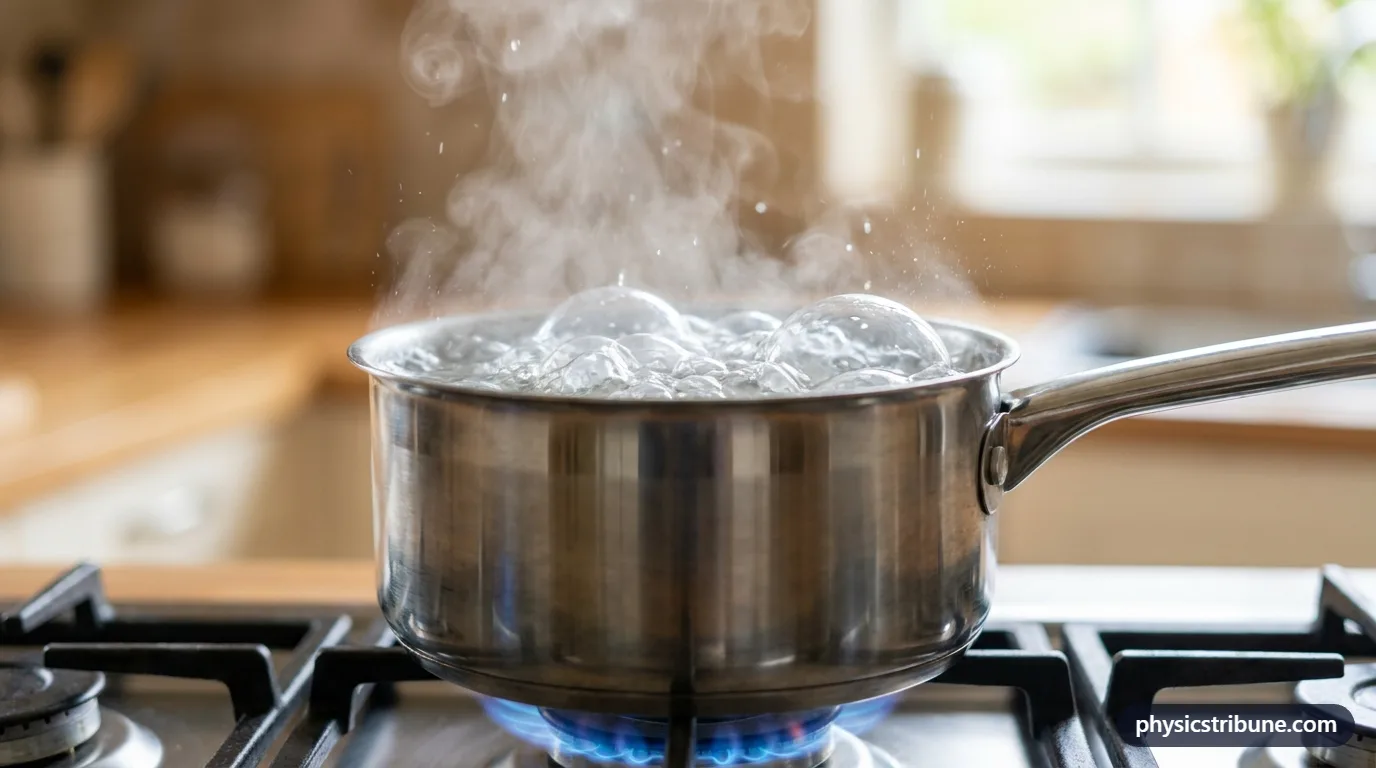
- The mist above a kettle: the vapor right at the spout is invisible; the white cloud a little higher up is condensed droplets.
- Morning dew: grass cools overnight, and droplets form on it as the air touching it reaches the dew point.
- Air conditioners: cold coils pull water out of room air, which drips out through a drain line.
How Do Clouds and Fog Form?
Clouds form when moist air rises. As it climbs, the air pressure around it drops, so the air expands and cools. When it cools to its dew point, vapor condenses onto countless tiny particles and forms droplets only a few thousandths of a millimeter across. Billions of these droplets together make a cloud that we see because they scatter sunlight.
Fog is simply a cloud that forms at ground level. On calm, clear nights the air near the ground can cool to its dew point and fill with droplets. Fog also forms when warm, moist air drifts over cold water or snow. As the morning sun warms the ground, the droplets evaporate again and the fog lifts. Our evaporation page covers that reverse step.

How Can You Stop Condensation in a Home?
Indoor condensation on windows and cold walls can lead to damp patches and mold. The fixes work by either removing water vapor from the air or keeping surfaces warmer than the dew point.
- Ventilate: run kitchen and bathroom fans to carry moist air outside.
- Dehumidify: a dehumidifier cools air over a cold coil so vapor condenses into a tank.
- Insulate: double-glazed windows and insulated walls keep the inside surface warmer, so it stays above the dew point.
- Keep air moving: furniture pushed tight against cold outside walls traps cool, still air where condensation forms easily.
Example 2 Heat released inside a dehumidifier
A home dehumidifier collects 12 kg of water from damp air in a day. At room temperature the latent heat of vaporization of water is about 2,450,000 J/kg. How much heat does the condensation release inside the machine over that day?
- Given:
- mass changing phase:
- latent heat of fusion (L_f) or vaporization (L_v):
- mass changing phase:
- Formula:
- Substitute:
- Answer:
That is about 8.2 kWh of heat (computed), which is one reason a dehumidifier slightly warms the room it dries.
Common Misconceptions
Myth: The water on the outside of a cold glass leaked through from inside.
Physics: The droplets come from water vapor in the surrounding air, which condenses when it touches the cold glass.
Myth: The white cloud above a kettle is steam, which is water vapor.
Physics: Water vapor is invisible. The white cloud is tiny liquid droplets that formed when the vapor condensed in cooler air.
Myth: Condensation makes things colder.
Physics: Condensation releases heat to its surroundings. The surface is cold because something else cooled it, not because of the condensing water.
Key Facts
- Condensation is the change of a gas into a liquid, the reverse of evaporation.
- Water vapor condenses when air cools to its dew point and becomes saturated.
- Droplets need a surface or tiny particles, called condensation nuclei, to form on.
- Condensing steam at 100 °C releases about 2,256 kJ of heat per kilogram, Q = m L_v.
- Steam burns are worse than boiling-water burns because condensing steam releases latent heat into the skin.
- Dew, fog, clouds and the droplets on a cold glass are all examples of condensation.
Quick Quiz: How Well Do You Know Condensation?
5 questions. Tap an answer to check it.
Condensation is the change from which state to which?
In condensation a gas, usually water vapor, becomes a liquid.
What is the dew point?
Cooling air to its dew point makes it saturated, so extra vapor condenses.
Where do the droplets on the outside of a cold glass come from?
Vapor in the air condenses when it touches the cold surface.
Why is a steam burn usually worse than a burn from boiling water?
Condensing steam releases about 2,256 kJ per kilogram before it even starts cooling.
What do cloud droplets usually form on?
Droplets need condensation nuclei, tiny particles in the air, to start forming.
Frequently Asked Questions
What is condensation in simple terms?
Condensation is when a gas turns into a liquid. Usually it means water vapor in the air cooling down and forming tiny drops of water. That is what happens when a cold can of soda gets wet on the outside, when a bathroom mirror fogs up after a shower, or when dew appears on grass early in the morning.
What causes condensation on windows?
Window glass is often the coldest surface in a heated room. Moist indoor air touching the glass cools below its dew point, and the extra water vapor condenses as droplets. It is most common in winter, in kitchens and bathrooms, and on single-pane windows. Better ventilation, a dehumidifier or warmer double-glazed glass all reduce it.
Does condensation release or absorb heat?
Condensation releases heat. Turning vapor into liquid gives back the latent heat of vaporization that was absorbed when the liquid evaporated, about 2,256 kJ per kilogram for steam at 100 °C. This heat warms whatever the vapor condenses on. It explains why steam causes severe burns and why condensing vapor helps power storms.
What is the dew point?
The dew point is the temperature at which air becomes saturated with water vapor, so cooling it any further makes the vapor condense. It depends only on how much moisture the air holds, not on the current air temperature. A dew point above about 20 °C feels sticky and humid, while a dew point near 0 °C means the air is quite dry.
What is the difference between condensation and evaporation?
They are opposite processes. Evaporation turns a liquid into a gas at its surface and absorbs heat, so it cools the liquid. Condensation turns a gas back into a liquid and releases that same heat. In a closed container both run at the same time, and when their rates match, the amount of liquid stays constant.
How do clouds form by condensation?
Warm, moist air rises, and as it rises it expands into lower pressure and cools. When it reaches its dew point, water vapor condenses onto microscopic particles of dust, salt or smoke, forming droplets far too small to fall. Huge numbers of these droplets scatter sunlight and appear as a white cloud. The heat they release helps the air keep rising.
Why does a cold drink sweat?
The drink cools the glass, and the glass cools the thin layer of air touching it. If that air drops below its dew point, its water vapor condenses into droplets on the outside of the glass. On a humid summer day the dew point is high, so even a mildly cool drink gathers plenty of droplets.
Keep Exploring






Sources
Constants come from NIST CODATA 2022 (public domain) and unit definitions from the BIPM SI Brochure (CC BY 4.0). Text, diagrams and illustrations are original work by Physics Tribune.