
At a Glance
A pure solid melts at one fixed temperature, its melting point, and its liquid freezes at that same temperature. Ice melts at 0 °C (32 °F, 273.15 K) at 1 atm. While melting, the temperature holds steady because the heat Q = m L_f goes into breaking the solid's structure, about 334 kJ for every kilogram of ice.
- Symbol
- Tm (or mp); freezing point Tf
- SI unit
- kelvin (K); usually quoted in °C or °F
- Ice at 1 atm
- 0 °C = 32 °F = 273.15 K
- Heat to melt
- Q = m Lf (latent heat of fusion)
- Depends on
- The substance, its purity, and (weakly) pressure
On this page
- What Is the Melting Point?
- Melting Point Explained Simply
- Is the Melting Point the Same as the Freezing Point?
- What Happens to Particles When a Solid Melts?
- Why Does Temperature Stay Constant While Ice Melts?
- How Much Heat Does It Take to Warm Ice to Its Melting Point?
- What Are the Melting Points of Common Substances?
- Does Pressure Change the Melting Point?
- Why Does Salt Lower the Freezing Point of Water?
- Where Do We Use Melting Points in Everyday Life?
- Going Deeper: The Melting Curve and the Triple Point
- Common Misconceptions
- Key Facts
- Quiz
- FAQ
What Is the Melting Point?
In a solid, atoms or molecules are locked into fixed positions, vibrating in place but held by attractions to their neighbors. Heating the solid makes those vibrations larger. At the melting point, the particles have enough energy to slip out of their fixed places and slide past one another, and the solid becomes a liquid.
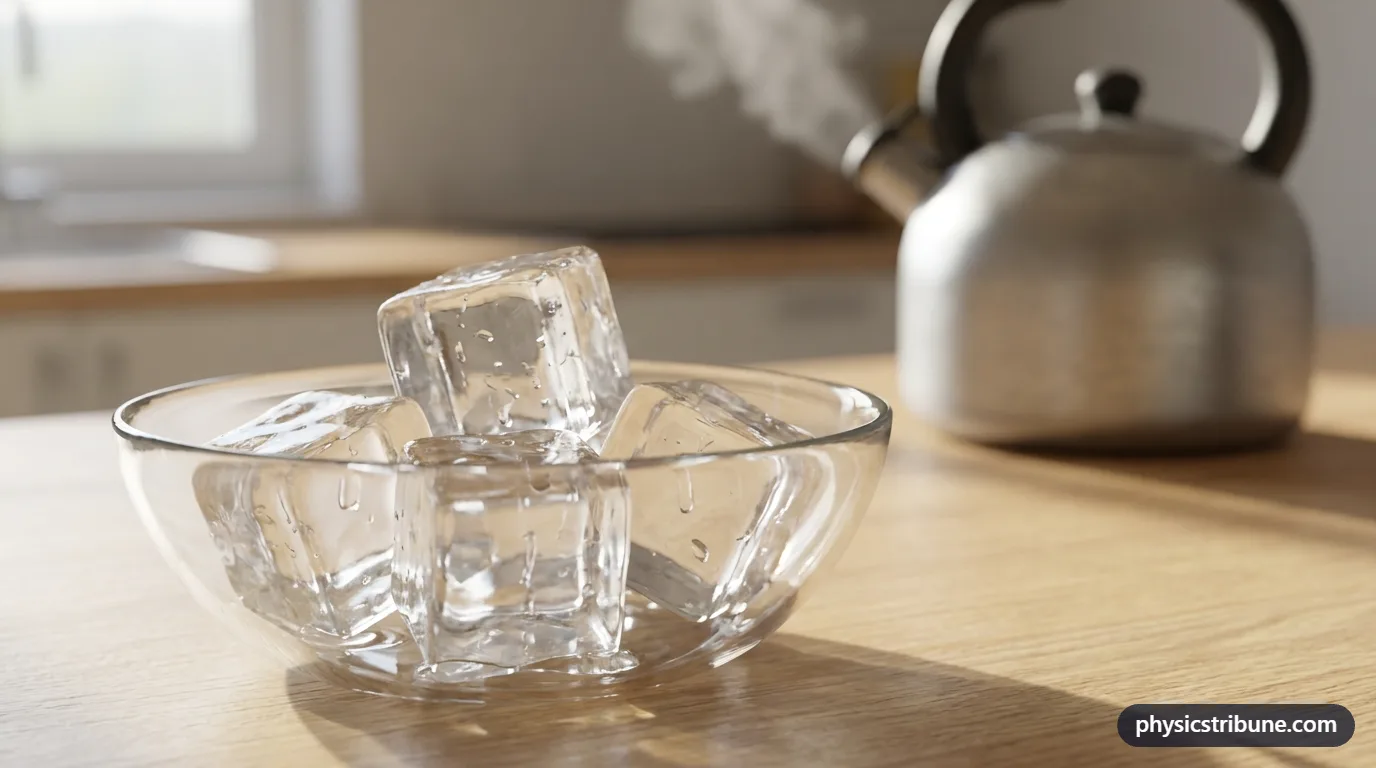
Strictly, the melting point is the temperature at which the solid and liquid forms of a substance can exist together in balance. Hold a mixture of ice and water at exactly 0 °C and neither one wins: some ice melts while some water freezes at the same rate. Add a little heat and melting gets ahead; take a little away and freezing does.
Reference books give the melting point at standard atmospheric pressure, 101,325 Pa. For water that value is 0 °C, which is 32 °F or 273.15 K. You can convert between the scales with our temperature converter.
Melting Point Explained Simply
Picture a stadium crowd where every person must stay in an assigned seat. They can fidget and bounce, but they cannot leave. That is a solid. Now play louder and louder music so the crowd gets more and more restless.
At some point the fans are so energetic that they climb out of their seats and start wandering the aisles. They still stay inside the stadium, packed close together, but they are no longer pinned to one spot. That moment is the melting point. Run the story backward, calming the crowd until everyone settles into a seat again, and you have freezing.
Is the Melting Point the Same as the Freezing Point?
For a pure substance, yes. Melting and freezing are the same balance seen from opposite sides, so water freezes at 0 °C and ice melts at 0 °C. The two names only tell you which direction the change is going.
There is one catch. A liquid can sometimes cool below its freezing point without turning solid, a state called supercooling. Very pure water in a smooth bottle can stay liquid several degrees below 0 °C because the first tiny crystal has nothing to grow on. Tap the bottle or drop in a speck of ice and crystals race through it within seconds, and the temperature jumps back up to 0 °C as the freezing releases heat.
Mixtures behave differently again. Chocolate, wax, butter and glass do not have one sharp melting point. They soften gradually over a range of temperatures because they contain many kinds of molecules or have no regular crystal pattern at all.
What Happens to Particles When a Solid Melts?
Below the melting point, heat simply makes particles vibrate harder, and the temperature of the solid rises. Most solids also expand a little as they warm, because larger vibrations push neighbors slightly farther apart. You can read more about this in our thermal expansion page.
At the melting point the ordered pattern, called the crystal lattice, starts to break down. Melting usually begins at the surface and at defects, places where particles are already less tightly held. As heat keeps flowing in, the boundary between solid and liquid moves inward until no solid is left.
Water is unusual here. Ice has an open, hexagonal structure that takes up more room than liquid water, so ice shrinks when it melts and expands when it freezes. That is why ice floats and why frozen pipes can burst, explained further in why water expands when it freezes.
Why Does Temperature Stay Constant While Ice Melts?
Drop a thermometer into a well-stirred glass of ice water and it reads 0 °C. Leave it in a warm room and the reading stays at 0 °C for as long as any ice remains, even though heat flows in the whole time. The graph shows this: a mixture of ice and water holds its temperature, while the same amount of cold water with no ice warms steadily toward room temperature.
The incoming heat is spent loosening the lattice rather than speeding particles up. Heat absorbed during a change of state without a change in temperature is called latent heat, and for melting it is the latent heat of fusion,
Freezing runs the process in reverse. When water freezes it releases the same 334 kJ per kilogram into its surroundings. Farmers have long used this by spraying orchards with water on frosty nights, since the freezing water gives off heat that keeps blossoms near 0 °C. Our latent heat page and latent heat calculator cover the formula in depth.
The heat needed to melt a solid that is already at its melting point is given by the latent heat formula, with each variable and its SI unit below.
| Symbol | Quantity | SI unit |
|---|---|---|
| heat absorbed or released | joule (J) | |
| mass changing phase | kilogram (kg) | |
| latent heat of fusion (L_f) or vaporization (L_v) | joule per kilogram (J/kg) |
Rearranged to find another variable:
Valid for: at constant temperature (melting/boiling point); water: L_f = 334 kJ/kg, L_v = 2256 kJ/kg.
Example 1 Melting a bag of party ice
A cooler holds a 2.5 kg bag of ice that has already warmed to 0 °C. The latent heat of fusion of ice is 334,000 J/kg. How much heat must the ice absorb to melt completely?
- Given:
- mass changing phase:
- latent heat of fusion (L_f) or vaporization (L_v):
- mass changing phase:
- Formula:
- Substitute:
- Answer:
All of that heat is drawn from the drinks and the air inside the cooler, which is exactly why ice keeps things cold.
Example 2 How much ice can a warm drink melt?
A glass of juice gives up 20,040 J of heat to the ice cubes floating in it. If all of that heat goes into melting ice that is at 0 °C, with a latent heat of fusion of 334,000 J/kg, what mass of ice melts?
- Given:
- heat absorbed or released:
- latent heat of fusion (L_f) or vaporization (L_v):
- heat absorbed or released:
- Formula:
- Substitute:
- Answer:
That is roughly two or three ordinary ice cubes, and the juice ends up noticeably colder while the ice slowly disappears.
| Amount of ice | Mass (kg) | Heat to melt, Q = mLf (kJ) |
|---|---|---|
| One ice cube | 0.025 | 8.35 |
| A full ice tray | 0.3 | 100.2 |
| A small bag of ice | 1 | 334 |
| A large block for a cooler | 10 | 3,340 |
| Source: Computed with Q = m L_f and L_f = 334 kJ/kg for ice; cube and tray masses are typical values · Retrieved October 2026 | ||

How Much Heat Does It Take to Warm Ice to Its Melting Point?
Ice from a freezer is usually well below 0 °C, often around −18 °C. Before it can melt, it first has to warm up to its melting point. That step follows
Put the two steps side by side and the melting step usually wins by a wide margin. The full sequence from cold ice to warm water, with every rise and plateau, appears on our heating and cooling curves page, and the specific heat calculator handles the warming step.
Example 3 Warming freezer ice up to its melting point
A 0.2 kg block of ice comes out of a freezer at −18 °C. Ice has a specific heat of about 2,100 J/(kg·K). How much heat warms it to 0 °C, a temperature change of 18 K, before any melting starts?
- Given:
- mass:
- specific heat capacity (water ≈ 4186 J/(kg·K)):
- temperature change:
- mass:
- Formula:
- Substitute:
- Answer:
Compare this with melting the same block, which needs 66,800 J (computed as 0.2 × 334,000): the melting step dominates.

What Are the Melting Points of Common Substances?
Melting points span an enormous range, from far below freezing for gases like oxygen to thousands of degrees for tungsten. The key is how strongly the particles of a solid hold one another. Weak attractions between small molecules give low melting points, while metals and network solids, where every atom is tied into a strong web of bonds, melt only when very hot.
Mercury is the only common metal that is liquid at room temperature, because it melts at about −39 °C. Tungsten, at about 3,422 °C, has the highest melting point of any metal, which is why it was chosen for the glowing filaments of old light bulbs. Our intermolecular forces page explains the link between attraction strength and melting and boiling points.
| Substance | Melting point (°C) | Melting point (K) | Melting point (°F) |
|---|---|---|---|
| Oxygen | about −218.8 | about 54.4 | about −361.8 |
| Nitrogen | about −210.0 | about 63.2 | about −346.0 |
| Mercury | about −38.8 | about 234.3 | about −37.9 |
| Water (ice) | 0 | 273.15 | 32 |
| Paraffin wax | about 60 (softens over a range) | about 333 | about 140 |
| Lead | about 327.5 | about 600.7 | about 621.5 |
| Aluminum | about 660.3 | about 933.5 | about 1,220.5 |
| Silver | about 961.8 | about 1,235.0 | about 1,763.2 |
| Gold | about 1,064.2 | about 1,337.4 | about 1,947.6 |
| Copper | about 1,084.6 | about 1,357.8 | about 1,984.3 |
| Iron | about 1,538 | about 1,811 | about 2,800 |
| Tungsten | about 3,422 | about 3,695 | about 6,192 |
| Source: Melting points in °C are typical reference values; K and °F columns computed with K = °C + 273.15 and °F = 1.8 × °C + 32 · Retrieved October 2026 | |||
Does Pressure Change the Melting Point?
Only slightly, because solids and liquids change volume very little when they melt. For most substances, squeezing raises the melting point a bit. Water is the exception: since ice takes up more room than water, pressure favors the liquid and lowers the melting point of ice, by roughly 0.007 °C for each extra atmosphere.
A popular story says ice skates glide because the blade's pressure melts the ice. The numbers do not support it. A 70 kg skater standing on one blade with a contact area of about 30 cm by 3 mm presses down with roughly 7.5 atmospheres, which lowers the melting point by only about 0.06 °C (computed). The real reason ice is slippery is a thin, loosely bound layer of water molecules on its surface, helped by heating from friction.
Why Does Salt Lower the Freezing Point of Water?
Dissolved particles get in the way when water molecules try to lock into ice crystals. The solution has to be cooled further before freezing can win, an effect called freezing point depression. Seawater, for example, freezes at about −2 °C instead of 0 °C.
That is why cities spread salt on icy roads. The salt dissolves into the thin film of water on the ice, and the salty solution stays liquid at temperatures where pure water would freeze. The trick stops working in very hard frosts, since even a strong salt brine freezes at about −21 °C.
The same idea makes old-fashioned ice cream makers work. Packing salt and ice around the cream canister produces a brine well below 0 °C, cold enough to freeze the cream mixture inside. Chemists also use melting points as a purity test, because a contaminated sample melts lower and over a wider range than a pure one.

Where Do We Use Melting Points in Everyday Life?
Melting points shape a surprising amount of technology. Solder is chosen to melt at a temperature low enough to join electronic parts without damaging them. Electrical fuses rely on a thin wire that melts when too much current heats it, and metal casting depends on pouring a metal above its melting point into a mold.
- Cooking: butter and chocolate soften over a range of temperatures, which is why chocolate is tempered carefully.
- Weather: whether rain, sleet or snow reaches the ground depends on layers of air above and below 0 °C.
- Temperature scales: the Celsius scale was originally built on the freezing and boiling points of water.
- Cooling: ice packs and cold drinks rely on the large latent heat absorbed as ice melts.
Going Deeper: The Melting Curve and the Triple Point
Plotting the melting point at every pressure draws a line on a phase diagram that separates the solid region from the liquid region. For water the line tilts slightly to the left, the signature of a substance that shrinks when it melts. For almost everything else it tilts to the right.
At very low pressure the melting line meets the boiling line at the triple point, where solid, liquid and gas coexist. Below that pressure a solid skips the liquid stage entirely and turns straight to gas, which is sublimation. The Swedish astronomer Anders Celsius used the freezing point of water as one fixed point of his temperature scale, and you can practice these ideas with our states of matter worksheets or compare heat vs temperature.
Common Misconceptions
Myth: Ice in a drink keeps getting colder than 0 °C as it cools the drink.
Physics: Melting ice stays at 0 °C. It cools the drink by absorbing latent heat, not by dropping below its melting point.
Myth: The melting point and the freezing point are two different temperatures.
Physics: For a pure substance they are the same temperature. The names only describe the direction of the change.
Myth: Ice skates work because the blade's pressure melts the ice.
Physics: The pressure lowers the melting point by only a few hundredths of a degree. A thin liquid-like surface layer and frictional heating make ice slippery.
Myth: Every solid has one sharp melting point.
Physics: Pure crystalline solids do, but mixtures and amorphous solids such as glass, wax and chocolate soften over a range of temperatures.
Key Facts
- The melting point is the temperature at which a solid and its liquid can coexist in balance.
- For a pure substance, the melting point and the freezing point are the same temperature.
- Pure ice melts at 0 °C (32 °F, 273.15 K) at standard atmospheric pressure.
- While a solid melts, its temperature stays constant because the heat goes into the change of state, Q = m L_f.
- Melting 1 kg of ice takes about 334 kJ, the same heat that warms 1 kg of water by about 80 °C.
- Dissolved salt lowers the freezing point of water, which is why roads are salted in winter.
- Pressure changes melting points only slightly; for ice it lowers the melting point by about 0.007 °C per atmosphere.
Quick Quiz: How Well Do You Know Melting Point and Freezing Point?
6 questions. Tap an answer to check it.
At its melting point, a pure substance can exist as what?
The melting point is the temperature where solid and liquid coexist in balance.
A glass of stirred ice water sits in a warm room. What does a thermometer in it read while ice remains?
The heat flowing in melts ice instead of raising the temperature.
What is the freezing point of pure water at normal pressure?
For a pure substance the freezing point equals the melting point, 0 °C for water.
Which formula gives the heat needed to melt a mass m of ice at 0 °C?
During a change of state the heat equals the mass times the latent heat of fusion.
Why is salt spread on icy roads?
Salty water stays liquid below 0 °C, so ice melts at lower temperatures.
Which of these has the highest melting point?
Tungsten melts at about 3,422 °C, the highest of any metal.
Frequently Asked Questions
What is the melting point of ice?
Pure ice melts at 0 °C, which is 32 °F or 273.15 K, at normal atmospheric pressure. Ice straight from a freezer is colder than this, so it first warms up to 0 °C and then stays at that temperature while it melts. Salt or other dissolved substances lower the temperature at which the resulting water would freeze again.
What is the difference between melting point and freezing point?
For a pure substance there is no difference in temperature. The melting point describes a solid becoming liquid as heat flows in, and the freezing point describes the liquid becoming solid as heat flows out. Both happen at the same temperature, where the two phases are in balance. Only supercooled liquids, which have not yet started to crystallize, can sit below it.
Why does the temperature stay the same while ice melts?
At the melting point, the heat flowing in is used to break the bonds that hold the ice crystal together. That energy, the latent heat of fusion, changes the state of the water rather than making its molecules move faster. A thermometer in stirred ice water therefore reads 0 °C until the last piece of ice has melted, and only then starts to rise.
What determines the melting point of a substance?
The main factor is how strongly the particles of the solid attract one another. Strong bonds, as in metals and minerals, need a lot of energy to loosen, so they melt at high temperatures. Weakly attracted molecules, such as oxygen, melt far below room temperature. Purity matters too, because impurities lower the melting point and spread it over a range.
Does salt make ice melt faster?
Salt lowers the freezing point of water, so the salty water on the surface of ice can stay liquid below 0 °C. That lets ice melt at air temperatures where it would otherwise stay frozen, which is why it works on winter roads. The melting still needs heat, which comes from the surroundings, so a salted ice and water mix becomes colder than 0 °C.
Which metal has the highest melting point?
Tungsten has the highest melting point of any metal, about 3,422 °C. Its atoms are held together by especially strong metallic bonds. That property made tungsten the standard material for incandescent light bulb filaments and it is still used in welding electrodes and high-temperature furnace parts. Among all elements, carbon in the form of graphite stays solid to even higher temperatures.
Can water freeze above 0 °C?
Pure water cannot freeze above 0 °C at normal pressure. It can, however, stay liquid below 0 °C for a while if it is very clean and still, a condition called supercooling. Pressure moves the freezing point only slightly. Dissolved substances push it lower, never higher, so salty or sugary water always needs to be colder than 0 °C to freeze.
Why do chocolate and butter not have a single melting point?
Chocolate and butter are mixtures of many different fats, each with its own melting temperature. As they warm, the fats with the lowest melting points soften first and the others follow, so the whole material softens gradually over a range of several degrees. Chocolate makers use careful heating and cooling, called tempering, to control which crystal forms set.
Keep Exploring






Sources
Constants come from NIST CODATA 2022 (public domain) and unit definitions from the BIPM SI Brochure (CC BY 4.0). Text, diagrams and illustrations are original work by Physics Tribune.