
At a Glance
A gas is matter whose particles move freely and far apart, so it fills any container and has neither a fixed shape nor a fixed volume. Gases are easily compressed and their pressure, volume and temperature are linked by the ideal gas law, PV = nRT. Air, carbon dioxide and water vapor are everyday gases.
- Shape
- None; fills its container
- Volume
- None of its own; easily compressed
- Particle arrangement
- Far apart, random, fast-moving
- Key formula
- PV = nRT (ideal gas law)
- Typical density
- About 0.09 to 2 kg/m³ at 0 °C and 1 atm
- Examples
- Air, oxygen, helium, steam, carbon dioxide
On this page
- What Is a Gas?
- Gases Explained Simply
- How Do Particles Behave in a Gas?
- What Are the Properties of Gases?
- What Causes Gas Pressure?
- What Are the Gas Laws?
- What Is the Ideal Gas Law?
- Why Are Some Gases Lighter Than Air?
- How Does Sound Travel Through a Gas?
- What Are Some Examples of Gases?
- Practice Problems on Gases
- Common Misconceptions
- Key Facts
- Quiz
- FAQ
What Is a Gas?
A gas is matter in which the particles are so spread out and so energetic that they hardly hold on to each other at all. Release a puff of perfume in one corner of a room and, given time, you can smell it everywhere. The gas does not stay in a neat blob; it spreads to fill all the space available.
That is the key difference from the other common states of matter. A solid keeps its shape and volume, and a liquid keeps its volume but changes shape. A gas keeps neither. Put the same amount of gas in a bigger box and it simply spreads thinner.
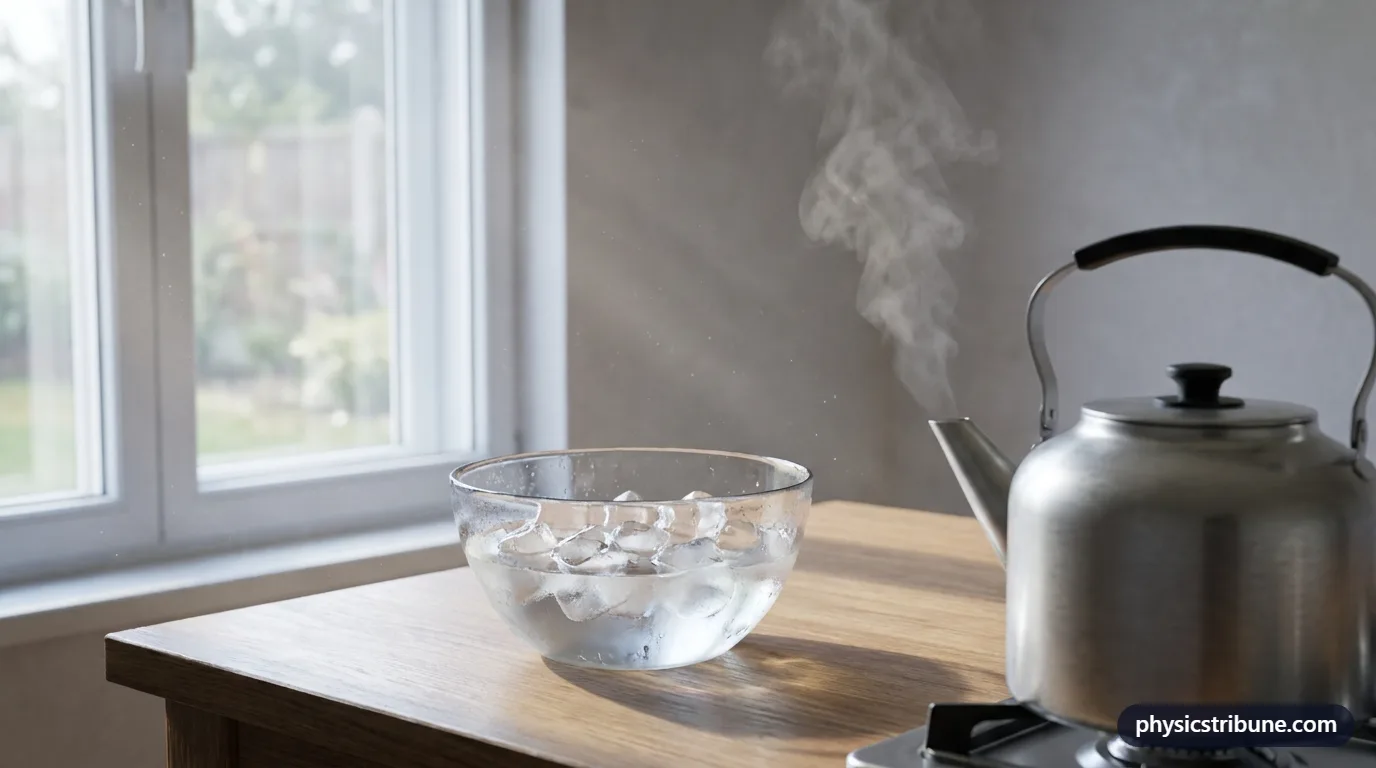
Gases are invisible more often than not. Air, the gas mixture we breathe, is colorless. Steam rising from a kettle is visible only because some of the water vapor has already cooled into tiny liquid droplets.
Gases Explained Simply
Picture a few bouncy balls zooming around an empty gym. They rarely touch each other and spend most of their time crossing open space. Every time one hits a wall, it gives the wall a small push. That is a good mental model of a gas.
Because there is so much empty space, you can squeeze a gas into a smaller box easily. Because the balls never stop moving, they always spread out to fill the whole gym. And all those tiny pushes on the walls add up to a steady force, which we call gas pressure.
How Do Particles Behave in a Gas?
According to the particle model of matter, gas particles move in straight lines until they hit another particle or a wall, then bounce off in a new direction. The distance between particles is typically about ten times their own size, so a gas is mostly empty space.
The particles move very quickly. At room temperature, typical oxygen and nitrogen molecules travel at hundreds of meters per second, as the worked example below shows. Their random zigzag paths are why gases mix by themselves, a process called diffusion.
Temperature measures how fast these particles move on average. The kinetic theory of gases makes this exact: the average kinetic energy of a gas particle is proportional to the absolute temperature in kelvins.
Example 3 How fast do nitrogen molecules move?
A nitrogen molecule has a mass of 4.6518 × 10⁻²⁶ kg. Using k_B = 1.380649 × 10⁻²³ J/K, what is the root-mean-square speed of nitrogen molecules in a room at 293 K?
- Given:
- Boltzmann constant:
- absolute temperature:
- mass of one molecule:
- Boltzmann constant:
- Formula:
- Substitute:
- Answer:
That is faster than the speed of sound in the same air, yet a smell still takes seconds to cross a room because each molecule collides billions of times per second.

What Are the Properties of Gases?
The main properties of gases all follow from fast, widely spaced particles:
- No fixed shape or volume. A gas expands to fill any container completely.
- High compressibility. Because gas is mostly empty space, you can squeeze it into a much smaller volume, as in a bicycle pump or a scuba tank.
- Low density. Air near sea level is roughly 800 times less dense than water.
- Pressure on every surface. Particle impacts push outward on all walls of a container equally.
- Easy mixing. Different gases mix completely and evenly on their own.
- Large thermal expansion. Heating a gas at constant pressure makes it expand far more than a solid or liquid would.
What Causes Gas Pressure?
Gas pressure is the combined push of countless particles striking a surface. Each collision is tiny, but there are so many every second that together they produce a steady force. Pressure is that force divided by the area it acts on, measured in pascals.
You can raise the pressure of a gas in three ways: add more particles, squeeze the same particles into less space, or heat them so they hit harder and more often. The air around us presses on every square meter with roughly 101 kN of force at sea level, which is the atmospheric pressure we never notice because it pushes equally from all sides.
The diagram shows a piston held in place by a balance of forces. Gas inside pushes up, while outside air and the piston's own weight push down. Our force vs pressure comparison explains why the same force can create very different pressures.

What Are the Gas Laws?
Four measurable quantities describe a gas: pressure, volume, temperature and amount. Change one and at least one other must change. Early experiments uncovered these links one pair at a time, and together they are called the gas laws.
- Boyle's law: at constant temperature, pressure and volume are inversely proportional. Halve the volume and the pressure doubles. It is named after Robert Boyle, who studied it in the 1660s.
- Charles's law: at constant pressure, volume is proportional to absolute temperature.
- Avogadro's law: at the same temperature and pressure, equal volumes of gases contain equal numbers of particles.
All three are special cases of a single equation, the ideal gas law.
What Is the Ideal Gas Law?
The ideal gas law states that
The temperature must be absolute. Using degrees Celsius gives nonsense, because 0 °C is not the point where particle motion stops; that point is absolute zero, 0 K. A useful result is that one mole of any ideal gas at 0 °C and one standard atmosphere fills about 22.4 liters, whatever the gas.
For quick answers with unit conversions, use our ideal gas law calculator. Real gases follow the law closely at ordinary conditions, and depart from it when they are very cold or squeezed to high pressure, where the size of the particles and their attractions start to matter.
The ideal gas law ties together the four quantities that describe a sample of gas. Here it is with each variable and its SI unit.
| Symbol | Quantity | SI unit |
|---|---|---|
| absolute pressure | pascal (Pa) | |
| volume | cubic meter (m³) | |
| amount of gas | mole (mol) | |
| ideal gas constant (8.314 J/(mol·K)) | joule per mole kelvin (J/(mol·K)) | |
| absolute temperature | kelvin (K) |
Rearranged to find another variable:
Valid for: ideal gas (low pressure, high temperature); T in kelvin, P absolute.
Example 1 Pressure inside a small gas cylinder
A sealed 0.012 m³ cylinder holds 4.8 mol of nitrogen at 293 K. Using R = 8.314462618 J/(mol·K), what is the pressure inside the cylinder?
- Given:
- amount of gas:
- ideal gas constant:
- absolute temperature:
- volume:
- amount of gas:
- Formula:
- Substitute:
- Answer:
Divide by 101,325 Pa and this is close to ten times normal air pressure, which is why such cylinders have thick steel walls.
Example 2 The volume of one mole of gas
One mole of any ideal gas is held at 273.15 K and 101,325 Pa. With R = 8.314462618 J/(mol·K), what volume does it occupy?
- Given:
- amount of gas:
- ideal gas constant:
- absolute temperature:
- absolute pressure:
- amount of gas:
- Formula:
- Substitute:
- Answer:
In liters this is about 22.4 L, roughly the size of a large backpack, and it is the same for helium, oxygen or carbon dioxide.
Why Are Some Gases Lighter Than Air?
At the same temperature and pressure, every gas packs the same number of particles into a given volume. So a gas made of light particles has a low density, and a gas made of heavy particles has a high one. The table compares several common gases under the same conditions.
Helium and hydrogen are much less dense than air, which is why a helium balloon rises: the surrounding air pushes it up with more force than its own weight. Carbon dioxide is denser than air, so it tends to pool in low places like cellars, which can be dangerous in poorly ventilated spaces.
| Gas | Molar mass (g/mol) | Density at 0 °C, 1 atm (kg/m³) | rms speed at 20 °C (m/s) |
|---|---|---|---|
| Hydrogen (H₂) | 2.016 | 0.0899 | 1,904 |
| Helium (He) | 4.003 | 0.1786 | 1,352 |
| Nitrogen (N₂) | 28.01 | 1.2497 | 511 |
| Dry air (mixture) | 28.97 | 1.2925 | 502 |
| Oxygen (O₂) | 32.00 | 1.4277 | 478 |
| Argon (Ar) | 39.95 | 1.7824 | 428 |
| Carbon dioxide (CO₂) | 44.01 | 1.9635 | 408 |
| Source: Computed with ρ = PM/(RT) and v_rms = √(3k_BT/m) using CODATA 2022 R and k_B; ideal-gas values, molar masses are standard values · Retrieved October 2026 | |||
How Does Sound Travel Through a Gas?
Sound is a pressure wave. A vibrating speaker cone pushes nearby air particles together, forming a compression, then pulls back and leaves a region of lower pressure, a rarefaction. Each layer of air passes the push to the next, so the pattern travels outward while the particles themselves only jiggle back and forth.
The diagram shows this pattern. In air at room temperature the speed of sound is roughly 343 m/s. It is faster in warmer air, where particles move faster, and much faster in helium, whose light particles pass the push along quickly. That is why your voice sounds squeaky after a breath of helium.

What Are Some Examples of Gases?
Gases are all around and inside us:
- Air, a mixture of mostly nitrogen and oxygen with smaller amounts of argon, carbon dioxide and water vapor.
- Oxygen, which we breathe in, and carbon dioxide, which we breathe out and plants take in.
- Water vapor, the gas form of water, which makes air humid.
- Helium in party balloons and natural gas, mostly methane, used for cooking and heating.
- Neon and argon in lighting, and nitrogen in tire inflation and food packaging.
If a gas is heated so strongly that its atoms lose electrons, it becomes a plasma, often called the fourth state of matter.
| Gas | Share by volume | Notes |
|---|---|---|
| Nitrogen (N₂) | about 78.1% | Unreactive, the bulk of every breath |
| Oxygen (O₂) | about 20.9% | Needed for breathing and burning |
| Argon (Ar) | about 0.93% | A noble gas |
| Carbon dioxide (CO₂) | about 0.04% | Slowly rising, used by plants |
| Neon, helium, methane and others | under 0.01% together | Trace gases |
| Source: Typical values for dry air; water vapor (not included) varies from near 0% to about 4% · Retrieved October 2026 | ||
Practice Problems on Gases
For more practice, our printable states of matter worksheets include questions on particle behavior with answer keys. Try solving the worked examples above with different numbers, check them in the ideal gas law calculator, then take the quiz.
Common Misconceptions
Myth: Gases have no mass because you cannot see or feel them.
Physics: Gases have mass. A cubic meter of air at sea level has a mass of over a kilogram, and a filled scuba tank is measurably heavier than an empty one.
Myth: Gas particles fill the space between them like a soft cushion.
Physics: The space between gas particles is empty. Particles are small compared with the distances between them, which is why gases compress so easily.
Myth: You can use degrees Celsius in the ideal gas law.
Physics: The law needs absolute temperature in kelvins. A gas at 20 °C is not twice as hot as one at 10 °C; in kelvins the ratio is only about 1.04.
Myth: Steam you can see is a gas.
Physics: Water vapor is invisible. The white cloud above a kettle is made of tiny liquid droplets that formed as the vapor cooled.
Key Facts
- A gas has no fixed shape and no fixed volume; it spreads out to fill any container.
- Gas particles are far apart and move fast in random straight-line paths between collisions.
- Gas pressure comes from countless particle collisions with the walls of a container.
- The ideal gas law, PV = nRT, links pressure, volume, amount and absolute temperature.
- One mole of an ideal gas at 0 °C and 1 atm occupies about 22.4 liters, whatever the gas.
- Gases are easily compressed and expand strongly when heated.
- Dry air is about 78% nitrogen and 21% oxygen by volume.
Quick Quiz: How Well Do You Know Gases?
6 questions. Tap an answer to check it.
Which statement describes a gas?
Gas particles spread out to fill any container, so neither shape nor volume is fixed.
What causes the pressure of a gas in a container?
Countless particle impacts on the walls add up to a steady outward force.
In the ideal gas law PV = nRT, temperature must be measured in…
The gas laws use absolute temperature, which starts at absolute zero.
At constant temperature, the volume of a gas is halved. What happens to its pressure?
Boyle's law says pressure and volume are inversely proportional at constant temperature.
Why are gases easy to compress?
A gas is mostly empty space, so its particles can be pushed closer together.
Which gas is denser than air at the same temperature and pressure?
Carbon dioxide molecules are heavier than the average air molecule, so the gas is denser.
Frequently Asked Questions
What is a gas in science?
In science, a gas is a state of matter whose particles move freely and are spread far apart. A gas has no fixed shape and no fixed volume, so it expands to fill any container. Its particles constantly collide with each other and with the walls, and those collisions create pressure. Air, oxygen, helium and water vapor are examples.
What are the 5 properties of gases?
Five key properties are: gases have no fixed shape, no fixed volume, they are highly compressible, they have low density compared with liquids and solids, and they mix evenly with other gases. Gases also exert pressure equally in all directions and expand a great deal when heated, which is why hot-air balloons rise.
Why can gases be compressed?
Gases can be compressed because their particles are far apart, with mostly empty space between them. Pushing on a gas simply moves the particles closer together. That is very different from a liquid or solid, where the particles already touch. Compressing a gas does raise its pressure, though, because the particles now hit the container walls more often.
Do gases have mass and weight?
Yes. Gases are made of atoms and molecules, which all have mass. A liter of air near sea level has a mass of a little over a gram. The air in a typical living room has a mass of tens of kilograms. We do not feel that weight because the air presses on us equally from every direction.
What happens to a gas when it is heated?
Heating a gas makes its particles move faster. If the container can expand, like a balloon, the gas takes up more space. If the container is rigid, like a sealed can, the pressure inside rises instead, because the faster particles strike the walls harder and more often. That is why aerosol cans warn against heating them.
What is the difference between a gas and a vapor?
Both are the gas state of matter. Vapor is the word usually used for the gas form of a substance that is normally a liquid or solid at room temperature, such as water vapor or iodine vapor. A vapor can be turned back into a liquid simply by squeezing it, while a true gas above its critical temperature cannot.
Why do helium balloons float?
Helium is much less dense than air, because helium atoms are far lighter than the nitrogen and oxygen molecules in air. The surrounding air pushes up on the balloon with a buoyant force equal to the weight of the air it displaces. That push is greater than the weight of the helium plus the balloon, so the balloon rises.
What is an ideal gas?
An ideal gas is a simplified model in which the particles have no size and do not attract each other, interacting only through brief, perfectly elastic collisions. Real gases behave almost ideally at room temperature and normal pressure, so the ideal gas law gives accurate answers. The model breaks down at very high pressures and very low temperatures.
Keep Exploring
 matterStates of Matter
 matterLiquids
 matterPlasma (Fourth State of Matter)
 thermodynamicsIdeal Gas Law (PV = nRT)
 thermodynamicsKinetic Theory of Gases
 calculatorsGas Law Calculator (ideal, Boyle, Charles, combined)
 worksheetsStates of Matter Worksheets
 compareDifference Between Force and Pressure
 physicistsRobert Boyle
Sources
Constants come from NIST CODATA 2022 (public domain) and unit definitions from the BIPM SI Brochure (CC BY 4.0). Text, diagrams and illustrations are original work by Physics Tribune.