
At a Glance
Physics grew in four broad stages: ancient and medieval natural philosophy, the scientific revolution of the 1500s and 1600s that ended with Newton's 1687 laws of motion and gravity, classical physics of the 1700s and 1800s that added thermodynamics and Maxwell's electromagnetism, and modern physics from 1900 onward built on relativity (E = mc²) and quantum mechanics.
- Earliest roots
- Ancient Greece and the Hellenistic world (Archimedes, 3rd century BC)
- Turning point
- Scientific revolution, ending with Newton's Principia in 1687
- Classical era
- 1700s to late 1800s: mechanics, heat, electricity and magnetism
- Modern era
- From 1900: quantum theory, relativity, nuclear and particle physics
- Key formula
- F = G m₁m₂ / r² (Newton, 1687)
On this page
- What Is the History of Physics?
- The History of Physics Explained Simply
- How Did Physics Begin in the Ancient World?
- What Happened During the Scientific Revolution?
- What Did Classical Physics Discover in the 1700s and 1800s?
- Why Did Classical Physics Run Into Trouble Around 1900?
- How Did Relativity and Quantum Theory Create Modern Physics?
- What Has Physics Discovered Since the 1930s?
- What Does the History of Physics Teach Us?
- Common Misconceptions
- Key Facts
- Quiz
- FAQ
What Is the History of Physics?
The history of physics traces how humans learned to describe matter, motion, energy and forces with ideas that can be tested. For most of recorded history, physics was part of natural philosophy, and arguments about why things move relied heavily on reasoning and everyday impressions. The decisive shift came when careful measurement and mathematics became the final judges of an idea.
It helps to think of the story as a series of widening circles. Each new era explained more of nature with fewer assumptions, and each kept the earlier laws as special cases that still work within their range. Newton's laws did not vanish when relativity arrived; they became the slow-speed version of a deeper theory.
For a quick year-by-year list, see our physics timeline. This page focuses on the big turning points and why they mattered.
The History of Physics Explained Simply
Long ago, people mostly thought about nature by talking and arguing. Some of their ideas were clever, and some were wrong, like the belief that heavier rocks fall faster. Then, about 400 years ago, scientists started testing ideas with careful experiments and writing the rules as math.
That change worked so well that physics grew fast. First came the rules of motion and gravity. Next came heat, electricity, magnetism and light. Around 1900, scientists found that very fast things and very tiny things follow surprising new rules, and that led to relativity and quantum physics. Today physicists study everything from particles smaller than atoms to the whole universe.
How Did Physics Begin in the Ancient World?
Early Greek thinkers asked what the world is made of and why things change. Some proposed that matter is built from tiny indivisible pieces, an idea that would return, much refined, more than two thousand years later. Aristotle's influential account of motion held that objects move toward their natural place and need a constant push to keep going, a view that shaped thinking for centuries.
The most modern-feeling ancient physicist was Archimedes, working in the 3rd century BC. He treated the lever and floating bodies with geometry and proof, giving principles that engineers still use. Astronomers of the era also built detailed geometric models of planetary motion, showing that mathematics could predict the sky even before anyone knew why planets move.
During the medieval period, scholars in the Islamic world and later in Europe preserved and extended this work, with notable advances in optics and in criticizing Aristotle's ideas about motion.
What Happened During the Scientific Revolution?
The scientific revolution reshaped physics between the mid-1500s and the late 1600s. In 1543 Nicolaus Copernicus published a model with the Sun, not Earth, at the center. Johannes Kepler then used precise observations to show that planets move on ellipses, publishing his first laws in 1609 and the third in 1619; see Kepler's laws.
Galileo Galilei turned a telescope to the sky, found moons circling Jupiter and, through experiments with balls on ramps published in 1638, showed that falling objects speed up steadily regardless of their weight. His insistence on measured, controlled experiments is why he is often called a father of modern physics, a title our page on who the father of physics is explores.
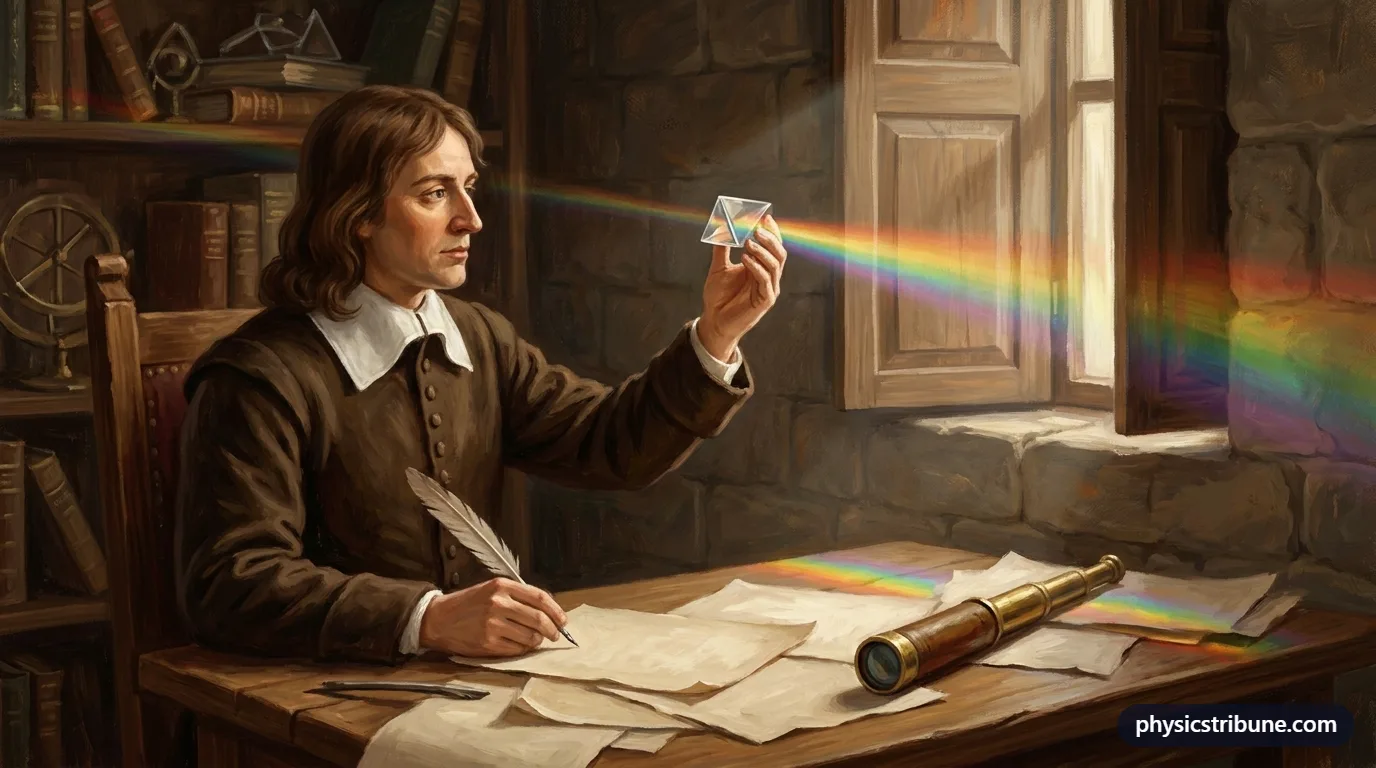
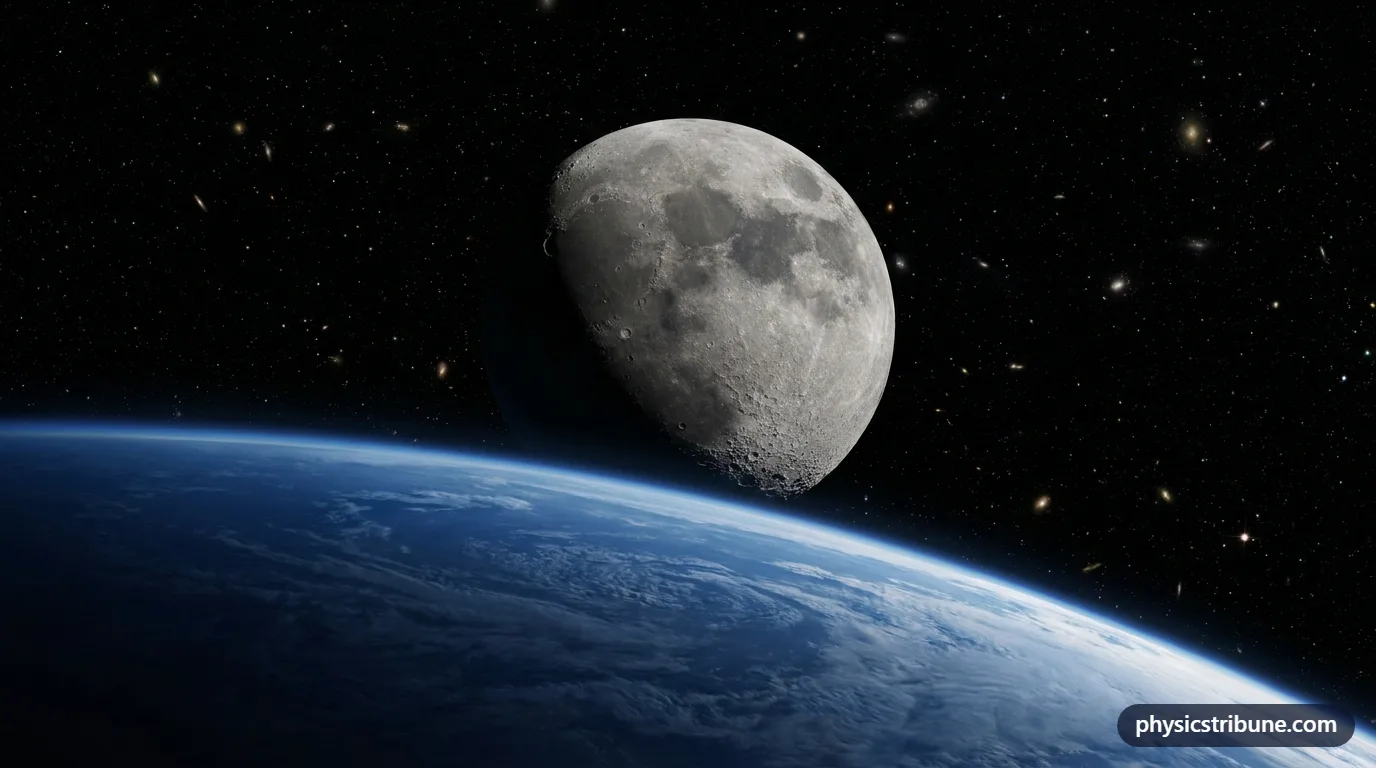
The revolution peaked in 1687 when Isaac Newton published his three laws of motion and the law of universal gravitation. For the first time, the same mathematics described a dropped apple, the tides and the orbit of the Moon.
Newton's law of universal gravitation was the first law to treat a falling apple and an orbiting Moon with one equation, and it set the template for physics as a mathematical science.
| Symbol | Quantity | SI unit |
|---|---|---|
| gravitational force between the masses | newton (N) | |
| gravitational constant (6.674 × 10⁻¹¹ N·m²/kg²) | newton meter squared per kilogram squared (N·m²/kg²) | |
| mass 1 | kilogram (kg) | |
| mass 2 | kilogram (kg) | |
| distance between the centers of mass | meter (m) |
Valid for: point masses or spherically symmetric bodies.
Example 1 Newton's law applied to a person on Earth
Earth has a mass of about 5.972 × 10²⁴ kg and a mean radius of about 6.371 × 10⁶ m. Using G = 6.6743 × 10⁻¹¹ N·m²/kg², what gravitational force does Earth exert on a 70 kg person standing on the surface?
- Given:
- gravitational constant:
- mass 1:
- mass 2:
- distance between the centers of mass:
- gravitational constant:
- Formula:
- Substitute:
- Answer:
The result matches the person's weight, mg, which is exactly the link Newton made between falling objects and the heavens.
| Year | Milestone | Who | Why it mattered |
|---|---|---|---|
| 3rd century BC | Principles of the lever and of floating bodies | Archimedes | Physics treated with geometry and proof |
| 1543 | Sun-centered model of the planets published | Nicolaus Copernicus | Challenged the Earth-centered view |
| 1609 to 1619 | Laws of planetary motion | Johannes Kepler | Orbits described by precise mathematical rules |
| 1638 | Inclined-plane studies of falling motion published | Galileo Galilei | Controlled experiment became central |
| 1687 | Laws of motion and universal gravitation | Isaac Newton | One set of laws for Earth and sky |
| 1785 | Law of electric force between charges | Charles-Augustin de Coulomb | Electricity became quantitative |
| 1831 | Electromagnetic induction | Michael Faraday | Basis of generators and transformers |
| 1865 | Equations of electromagnetism | James Clerk Maxwell | Light identified as an electromagnetic wave |
| 1887 | Michelson-Morley experiment | Albert A. Michelson, Edward W. Morley | No sign of a light-carrying medium |
| 1896 | Discovery of radioactivity | Henri Becquerel | Opened nuclear physics |
| 1900 | Quantum hypothesis | Max Planck | Energy comes in discrete packets |
| 1905 | Special relativity and E = mc² | Albert Einstein | New ideas of space, time and energy |
| 1913 | Quantum model of the atom | Niels Bohr | Explained atomic spectra |
| 1932 | Discovery of the neutron | James Chadwick | Completed the picture of the nucleus |
| 2012 | Higgs boson discovered | ATLAS and CMS collaborations | Final missing piece of the Standard Model |
| 2015 | First direct detection of gravitational waves | LIGO and Virgo collaborations | Confirmed a key prediction of general relativity |
| Source: Years from our data files (data/physicists.json, data/laws.json, data/experiments.json); summaries written for this page · Retrieved October 2026 | |||

What Did Classical Physics Discover in the 1700s and 1800s?
The next two centuries filled in the rest of everyday physics. Mathematicians extended Newton's mechanics to fluids, vibrations and rotating bodies. Coulomb measured the force between electric charges in 1785, and Cavendish weighed the gravitational pull between lead spheres in 1798. Thomas Young's double-slit experiment around 1803 showed that light behaves as a wave.
Electricity and magnetism turned out to be linked. Ørsted saw a current deflect a compass needle in 1820, and Michael Faraday discovered electromagnetic induction in 1831, the principle behind every generator. In the 1860s James Clerk Maxwell combined these results into the equations of electromagnetism and predicted waves that travel at the speed of light. Hertz produced such waves in 1887, and light took its place on the electromagnetic spectrum.
Meanwhile, studies of steam engines and of heat produced thermodynamics. Experiments such as Joule's in the 1840s showed that heat and mechanical work are interchangeable forms of energy, leading to the law of conservation of energy.
Example 2 Wavelength of a radio wave, Maxwell's prediction made real
An FM radio station broadcasts at a frequency of 100 MHz (1.0 × 10⁸ Hz). Radio waves travel at the speed of light, 299,792,458 m/s. What is the wavelength?
- Given:
- speed of light in vacuum:
- frequency:
- speed of light in vacuum:
- Formula:
- Substitute:
- Answer:
Waves a few meters long are exactly what Heinrich Hertz produced in his laboratory in the late 1880s, confirming that light and radio are the same kind of wave.


Why Did Classical Physics Run Into Trouble Around 1900?
By the 1890s some physicists felt the main laws were known. Yet a handful of stubborn results did not fit. The Michelson-Morley experiment of 1887 found no sign of Earth moving through the supposed medium that carried light. The glow of hot objects could not be explained by the known laws of heat and light. New discoveries arrived quickly: X-rays in 1895, radioactivity in 1896 and the electron in 1897.
These puzzles were not small corrections. They pointed to two entirely new frameworks, one for very high speeds and strong gravity, the other for the very small. Our famous physics experiments collection covers many of the tests that forced the change.
How Did Relativity and Quantum Theory Create Modern Physics?
In 1900 Max Planck proposed that energy is emitted in discrete packets, the first step into quantum theory. In 1905 Albert Einstein published special relativity, including the equivalence of mass and energy, and a decade later his general theory described gravity as the curvature of spacetime. The 1919 eclipse measurements of bending starlight made him world famous.
Quantum theory developed through the 1910s and 1920s. Rutherford's scattering experiments revealed a tiny, dense nucleus, Bohr built a quantum model of the atom in 1913, and by the late 1920s Heisenberg, Schrödinger and others had a full quantum mechanics. It explained chemistry, light and the stability of matter, and it underpins lasers, transistors and every computer chip.
Example 3 The energy locked in one gram of matter
Einstein's 1905 work says mass and energy are equivalent. How much rest energy corresponds to a mass of 1 gram (0.001 kg), with c = 299,792,458 m/s?
- Given:
- rest mass:
- speed of light in vacuum:
- rest mass:
- Formula:
- Substitute:
- Answer:
That is roughly the energy a large power station delivers in a day, which hints at why nuclear reactions release so much energy from so little fuel.
What Has Physics Discovered Since the 1930s?
The neutron was found in 1932, and nuclear fission was recognized at the end of 1938, with Lise Meitner among those who explained it. The first controlled chain reaction ran in Chicago in 1942. After the war, particle accelerators revealed a zoo of new particles that the quark model and the Standard Model eventually organized.
Two recent milestones confirmed long-standing predictions. In 2012 experiments at CERN announced the discovery of the Higgs boson, and in 2015 the LIGO detectors recorded gravitational waves from two merging black holes, a century after Einstein predicted such waves. Open questions remain, including the nature of dark matter and how to unite gravity with quantum theory. Our Nobel Prize in Physics winners list traces the modern era name by name.
What Does the History of Physics Teach Us?
Three lessons stand out. First, measurement beats authority: Aristotle's views on motion lasted for centuries but fell quickly once Galileo timed balls on ramps. Second, old theories rarely become useless; they become limits of new ones, which is why engineers still design bridges with Newton's laws. Third, progress often comes from small anomalies that refuse to go away, like the null result of Michelson and Morley.
Physics also became a collaborative enterprise. Early discoveries were often the work of one person; today experiments such as those at CERN or LIGO involve thousands of scientists. If you want to try Newton's law yourself, the gravitational force calculator and our universal gravitation worksheets are good places to start, and the classical vs quantum physics comparison sums up the great divide of 1900. To see how the subject is organized now, read about the branches of physics or start from what physics is.
Common Misconceptions
Myth: Newton's laws were proven wrong by Einstein.
Physics: Newton's laws remain extremely accurate at everyday speeds and gravity. Relativity shows where they stop working and reduces to them in that limit.
Myth: Galileo proved that heavy objects fall faster.
Physics: Galileo argued the opposite. His experiments showed that, without air resistance, objects fall with the same acceleration whatever their weight.
Myth: Physics was basically complete by 1900.
Physics: Around 1900 several results did not fit classical physics, and resolving them produced relativity and quantum theory, the foundations of modern physics.
Myth: Great discoveries are always the work of one lone genius.
Physics: Most advances built on many earlier results, and modern discoveries such as the Higgs boson involved thousands of scientists working together.
Key Facts
- Physics grew out of ancient natural philosophy, with Archimedes giving some of the earliest mathematical laws of statics and floating bodies.
- The scientific revolution replaced arguments from authority with measurement and mathematics, ending with Newton's laws in 1687.
- Classical physics of the 1700s and 1800s added thermodynamics and unified electricity, magnetism and light through Maxwell's equations.
- Unexplained results around 1900, such as the Michelson-Morley null result and the glow of hot objects, led to relativity and quantum theory.
- Einstein's special relativity of 1905 showed that mass and energy are equivalent, E = mc².
- Quantum mechanics, completed in the late 1920s, explains atoms, chemistry and the electronics in every modern device.
- Recent landmarks include the Higgs boson discovery in 2012 and the first detection of gravitational waves in 2015.
Quick Quiz: How Well Do You Know History of Physics?
6 questions. Tap an answer to check it.
In which year did Newton publish his laws of motion and universal gravitation?
Newton's laws appeared in 1687 and marked the peak of the scientific revolution.
Who combined electricity, magnetism and light into one set of equations?
Maxwell's equations of the 1860s unified electric and magnetic phenomena and predicted electromagnetic waves.
Which experiment found no evidence of a medium carrying light?
Its 1887 null result was one of the puzzles that relativity later explained.
What did Max Planck propose in 1900?
Planck's quantum hypothesis was the first step toward quantum theory.
Which discovery was announced in 2012?
Experiments at CERN announced the Higgs boson in 2012.
What happened to Newton's laws after relativity was developed?
Relativity reduces to Newton's mechanics when speeds are small compared with light.
Frequently Asked Questions
Who is considered the father of physics?
Several people receive the title depending on what you emphasize. Galileo is often called the father of modern physics because he made controlled, measured experiments central. Isaac Newton is called the father of classical physics for his laws of motion and gravity. Archimedes is sometimes named for the ancient world, and Einstein for modern physics.
When did physics start?
Questions about matter and motion go back at least to ancient Greece, more than 2,500 years ago, and Archimedes was solving physics problems with geometry in the 3rd century BC. Physics as an experimental, mathematical science is usually dated to the scientific revolution of the 1500s and 1600s, culminating in Newton's work published in 1687.
What are the main eras in the history of physics?
A common division has four eras: ancient and medieval natural philosophy, the scientific revolution of roughly 1543 to 1687, classical physics from about 1700 to 1900 covering mechanics, heat, electricity, magnetism and light, and modern physics from 1900 onward, built on relativity and quantum mechanics and extended into nuclear and particle physics.
What is the difference between classical and modern physics?
Classical physics covers the laws worked out before about 1900: Newton's mechanics, thermodynamics and Maxwell's electromagnetism. It works extremely well for everyday sizes and speeds. Modern physics adds relativity, needed near light speed or in strong gravity, and quantum mechanics, needed for atoms and smaller. Classical results reappear as limits of the modern theories.
What was the scientific revolution in physics?
The scientific revolution was the period, roughly from the mid-1500s to the late 1600s, when Copernicus, Kepler, Galileo and Newton replaced the older Aristotelian picture with a Sun-centered solar system and mathematical laws of motion tested by observation and experiment. It ended with Newton's 1687 laws of motion and universal gravitation.
Who discovered quantum physics?
No single person. Max Planck introduced the idea of energy packets in 1900, Einstein used it to explain the photoelectric effect in 1905, and Niels Bohr applied it to the atom in 1913. The complete theory of quantum mechanics was developed in the mid to late 1920s by Werner Heisenberg, Erwin Schrödinger, Paul Dirac, Max Born and others.
What are the most important discoveries in physics history?
Lists vary, but most include Newton's laws of motion and gravity, the conservation of energy, Maxwell's unification of electricity, magnetism and light, the discovery of the electron and the atomic nucleus, Einstein's relativity, quantum mechanics, nuclear fission and the Standard Model of particles, confirmed by the Higgs boson discovery in 2012.
How has physics changed everyday life?
Almost every modern technology rests on a physics discovery. Electromagnetic induction gave us generators and the power grid. Maxwell's waves led to radio, television, Wi-Fi and phones. Quantum mechanics made transistors, lasers and computer chips possible, and relativity is built into the timing corrections that keep satellite navigation accurate.
Keep Exploring
 physicistsTimeline of Physics Discoveries
 physicistsIsaac Newton
 physicistsAlbert Einstein
 physicistsGalileo Galilei
 experimentsFamous Physics Experiments
 gravityNewton's Law of Universal Gravitation
 calculatorsGravitational Force Calculator
 worksheetsUniversal Gravitation Worksheets
 unitsBranches of Physics