
At a Glance
Nuclear fission is the splitting of a heavy nucleus, usually uranium-235 or plutonium-239, into two lighter nuclei plus two or three free neutrons. The products weigh slightly less than the starting particles, and that missing mass becomes energy given by Q = (m_initial - m_final) c^2, about 200 MeV per split. The released neutrons can split more nuclei in a chain reaction.
- Type of process
- Nuclear reaction: one heavy nucleus splits into two lighter ones
- Energy per split
- About 200 MeV (roughly 3.2 × 10⁻¹¹ J)
- Formula
- Q = (minitial − mfinal)c²
- Common fuels
- Uranium-235, plutonium-239, uranium-233
- Usual trigger
- Absorption of a slow (thermal) neutron
- Discovered
- 1938, Otto Hahn and Fritz Strassmann; explained by Lise Meitner and Otto Frisch
On this page
- What Is Nuclear Fission?
- Nuclear Fission Explained Simply
- How Does Nuclear Fission Happen Step by Step?
- Where Does the Energy in Fission Come From?
- What Is a Nuclear Chain Reaction?
- Which Elements Can Undergo Fission?
- How Is Nuclear Fission Used?
- What Happens to the Fission Products?
- Who Discovered Nuclear Fission?
- How Is Fission Different From Fusion?
- Practice Nuclear Physics Problems
- Common Misconceptions
- Key Facts
- Quiz
- FAQ
What Is Nuclear Fission?
Nuclear fission is the breaking apart of a large atomic nucleus into two medium-sized nuclei. The nuclei that do this most readily are very heavy ones, such as uranium-235 and plutonium-239, which hold more than two hundred protons and neutrons packed tightly together. When one of them splits, the two fragments fly apart at high speed, two or three neutrons shoot off, and bursts of gamma radiation follow.
Fission is a change inside the atomic nucleus, not in the electron cloud around it. That is why it is so different from burning or any other chemical reaction. Chemistry rearranges electrons and frees a few electronvolts per atom; fission rearranges protons and neutrons and frees around 200 million electronvolts per nucleus.
The two fragments are new elements. A uranium nucleus might become barium and krypton, or cesium and rubidium, or one of many other pairs. Which pair forms is a matter of chance, so a piece of used reactor fuel contains a mix of dozens of different elements.
Nuclear Fission Explained Simply
Picture a large, wobbly drop of water hanging from a faucet. Tap it gently and it stretches, narrows in the middle, and finally pinches into two smaller drops. A heavy nucleus behaves a lot like that drop. When it swallows an extra neutron, it starts to wobble and stretch, and if it stretches far enough it snaps in two.
Inside the nucleus, two forces are fighting. The strong nuclear force holds the protons and neutrons together, but it only reaches to the nearest neighbors. The electric push between protons reaches across the whole nucleus. In a huge nucleus the electric push is almost winning already, so a small nudge is enough to tip it over.
Once the two pieces separate, both are positively charged, and they shove each other away hard. That violent shove is where most of the energy shows up: as the speed of the flying fragments, which quickly turns into heat.
How Does Nuclear Fission Happen Step by Step?
The most common fission in power reactors is a slow neutron splitting uranium-235. It happens in a fixed order:
- Capture. A slow-moving neutron drifts close to a uranium-235 nucleus and is absorbed, creating uranium-236 in an excited, energetic state.
- Stretching. The extra energy makes the nucleus vibrate and deform into an elongated, peanut-like shape.
- Splitting. The electric repulsion between the two lobes wins over the short-range strong force, and the nucleus breaks into two fragments.
- Neutron release. Two or three free neutrons, about 2.4 on average, escape at the moment of the split, along with prompt gamma rays.
- Fragments fly apart. The positively charged fragments push each other away and carry most of the released energy as motion.
- Decay of the products. The fragments are packed with too many neutrons, so they undergo a string of beta decays over seconds to years.
A typical example reaction is
Example 2 One split, one tiny mass loss
In a typical fission of uranium-235, the products together weigh about 0.2 u less than the neutron and nucleus that started the reaction. Using 1 u = 1.66053906892 × 10^-27 kg, that missing mass is 3.32107813784 × 10^-28 kg. How much energy does one split release?
- Given:
- rest mass:
- speed of light in vacuum:
- rest mass:
- Formula:
- Substitute:
- Answer:
Using 1 MeV = 1.602 × 10^-13 J, this is about 186 MeV (computed), in line with the typical figure of roughly 200 MeV per fission.
Where Does the Energy in Fission Come From?
The energy comes from mass. If you add up the masses of everything after a fission, the total is slightly smaller than the mass of the uranium nucleus plus the neutron that hit it. That small difference, called the mass defect of the reaction, has been converted into energy according to mass-energy equivalence,
Why do the products weigh less? The answer lies in nuclear binding energy. Medium-sized nuclei, such as barium and krypton, have their protons and neutrons bound more tightly than uranium does: about 8.5 MeV per particle instead of about 7.6 MeV. Moving roughly 236 particles into tighter, lower-energy arrangements frees close to 1 MeV per particle, which adds up to around 200 MeV.
Only about a tenth of a percent of the starting mass turns into energy. That sounds small, yet it is millions of times more than chemistry can manage, as the examples below show.
The energy freed by any nuclear reaction, fission included, is the Q value: the drop in total rest mass multiplied by the speed of light squared.
| Symbol | Quantity | SI unit |
|---|---|---|
| energy released (Q > 0 exothermic) | joule (J) | |
| total rest mass before the reaction | kilogram (kg) | |
| total rest mass after the reaction | kilogram (kg) | |
| speed of light in vacuum (2.998 × 10⁸ m/s (exact: 299 792 458 m/s)) | meter per second (m/s) |
Valid for: Q > 0: energy released (fission, fusion, decay); Q < 0: energy must be supplied.
Example 1 Energy from a kilogram of fissioned uranium
Imagine 1.0 kg of uranium-235 and the neutrons that hit it, all fully fissioned. Afterward, the fragments and free neutrons have a combined mass of 0.99909 kg. How much energy was released?
- Given:
- total rest mass before the reaction:
- total rest mass after the reaction:
- speed of light in vacuum:
- total rest mass before the reaction:
- Formula:
- Substitute:
- Answer:
That is close to the blast energy of 20 kilotons of TNT (computed), and it comes from less than one gram of mass disappearing.
| Carrier of the energy | Typical share (MeV) | When it appears | Captured as heat in a reactor? |
|---|---|---|---|
| Kinetic energy of the two fragments | about 168 | Instantly | Yes |
| Kinetic energy of prompt neutrons | about 5 | Instantly | Yes |
| Prompt gamma rays | about 7 | Instantly | Yes |
| Beta particles from product decay | about 7 | Seconds to years later | Yes |
| Gamma rays from product decay | about 6 | Seconds to years later | Yes |
| Antineutrinos from product decay | about 10 | Seconds to years later | No, they escape |
| Total | about 200 | About 190 MeV usable | |
| Source: Typical rounded values for thermal-neutron fission of uranium-235; individual fissions vary · Retrieved October 2026 | |||
What Is a Nuclear Chain Reaction?
Each fission gives off two or three neutrons, and each of those can cause another fission. If that keeps happening, the reaction feeds itself. This self-sustaining process is a nuclear chain reaction, and the key number that controls it is the multiplication factor k: the average number of new fissions caused by the neutrons from one fission.
- Subcritical (k < 1): too many neutrons escape or get absorbed, so the reaction dies away.
- Critical (k = 1): each fission causes exactly one more, so the rate stays steady. Power reactors run here.
- Supercritical (k > 1): the number of fissions grows with every generation.
The smallest lump of fuel that can sustain a chain reaction is called the critical mass. Below it, too many neutrons leak out through the surface. The graph shows how the neutron count would change over a few thousandths of a second for k values slightly above, at and below 1.

Which Elements Can Undergo Fission?
Many heavy nuclei can split if they are hit hard enough, but only a few split easily with slow neutrons. These are called fissile nuclides, and the important ones are uranium-235, plutonium-239 and uranium-233. They are the fuels of nuclear power.
Uranium-238 makes up more than 99 percent of natural uranium, while uranium-235 is only about 0.7 percent. Uranium-238 does not sustain a chain reaction with slow neutrons, but it is fertile: when it captures a neutron it gradually turns into plutonium-239, which is fissile. Thorium-232 is fertile in the same way and becomes uranium-233. Most power reactors therefore use enriched uranium, in which the share of uranium-235 has been raised to a few percent.
Fission can also be spontaneous. Some very heavy nuclei, such as californium-252, occasionally split on their own without being hit by anything. Uranium does this too, but so rarely that it is almost always outweighed by its alpha decay.
| Nuclide | Fissile or fertile? | Splits with slow neutrons? | Role |
|---|---|---|---|
| Uranium-235 | Fissile | Yes | Main fuel of most power reactors |
| Plutonium-239 | Fissile | Yes | Made in reactors from uranium-238; also burned as fuel |
| Uranium-233 | Fissile | Yes | Made from thorium-232 in thorium fuel cycles |
| Uranium-238 | Fertile | No (only with fast neutrons) | Bulk of natural uranium; breeds plutonium-239 |
| Thorium-232 | Fertile | No | Breeds uranium-233 |
| Source: Standard classification of nuclear fuels; qualitative summary · Retrieved October 2026 | |||

How Is Nuclear Fission Used?
The biggest use is electricity. In a nuclear reactor, a carefully controlled chain reaction heats water, the water makes steam, and the steam spins a turbine connected to an electric generator. A large reactor runs for many months between refueling and releases no carbon dioxide while operating. Our page on nuclear energy covers the power-grid side in more detail.
Fission reactors also drive submarines and aircraft carriers that can sail for years without refueling. Research reactors produce neutrons for studying materials and make radioactive isotopes used in medical imaging and cancer treatment. Spacecraft heading far from the Sun sometimes carry generators powered by radioactive decay, a related but gentler nuclear process.
The most destructive use is in weapons, where an uncontrolled, supercritical chain reaction releases enormous energy in less than a microsecond. Our page on how nuclear weapons work explains the physics without the engineering details.
Example 3 How long could one gram of uranium light a bulb?
Completely fissioning 1 gram of uranium-235 releases about 8.2 × 10^10 J of energy. If every joule could run a 60 W light bulb, how long would the bulb stay lit?
- Given:
- work done or energy transferred:
- average power:
- work done or energy transferred:
- Formula:
- Substitute:
- Answer:
That is roughly 43 years of nonstop light (computed). Real power plants turn only about a third of the heat into electricity, but the comparison shows how concentrated nuclear fuel is.
What Happens to the Fission Products?
The fragments left behind are highly radioactive, because they carry too many neutrons for their size. They shed the excess through beta decay, often several times in a row, giving off electrons, antineutrinos and gamma rays. This decay is why spent fuel stays hot and must be cooled for years after it leaves a reactor.
Different products decay at very different rates. Iodine-131 has a half-life of about eight days, so it fades within a few months, as the curve shows. Cesium-137 and strontium-90 last around thirty years, and a few products remain for many thousands of years. Managing this long-lived radioactivity is one of the main challenges of nuclear power. Our half-life page explains how decay rates are measured.

Who Discovered Nuclear Fission?
In the 1930s, several research groups fired neutrons at uranium hoping to build heavier elements. Enrico Fermi led much of this work and won the 1938 Nobel Prize in Physics for nuclear reactions caused by slow neutrons. In December 1938, the chemists Otto Hahn and Fritz Strassmann in Berlin found barium among the products, an element only about half as heavy as uranium.
Lise Meitner, who had worked with Hahn for decades before fleeing Nazi Germany, and her nephew Otto Frisch worked out what had happened: the uranium nucleus had split in two. They used the liquid-drop picture and mass-energy equivalence to estimate the 200 MeV release, and Frisch borrowed the word fission from biology. Four years later, on 2 December 1942, Fermi's team in Chicago ran the first human-made chain reaction in a pile of graphite blocks and uranium.
How Is Fission Different From Fusion?
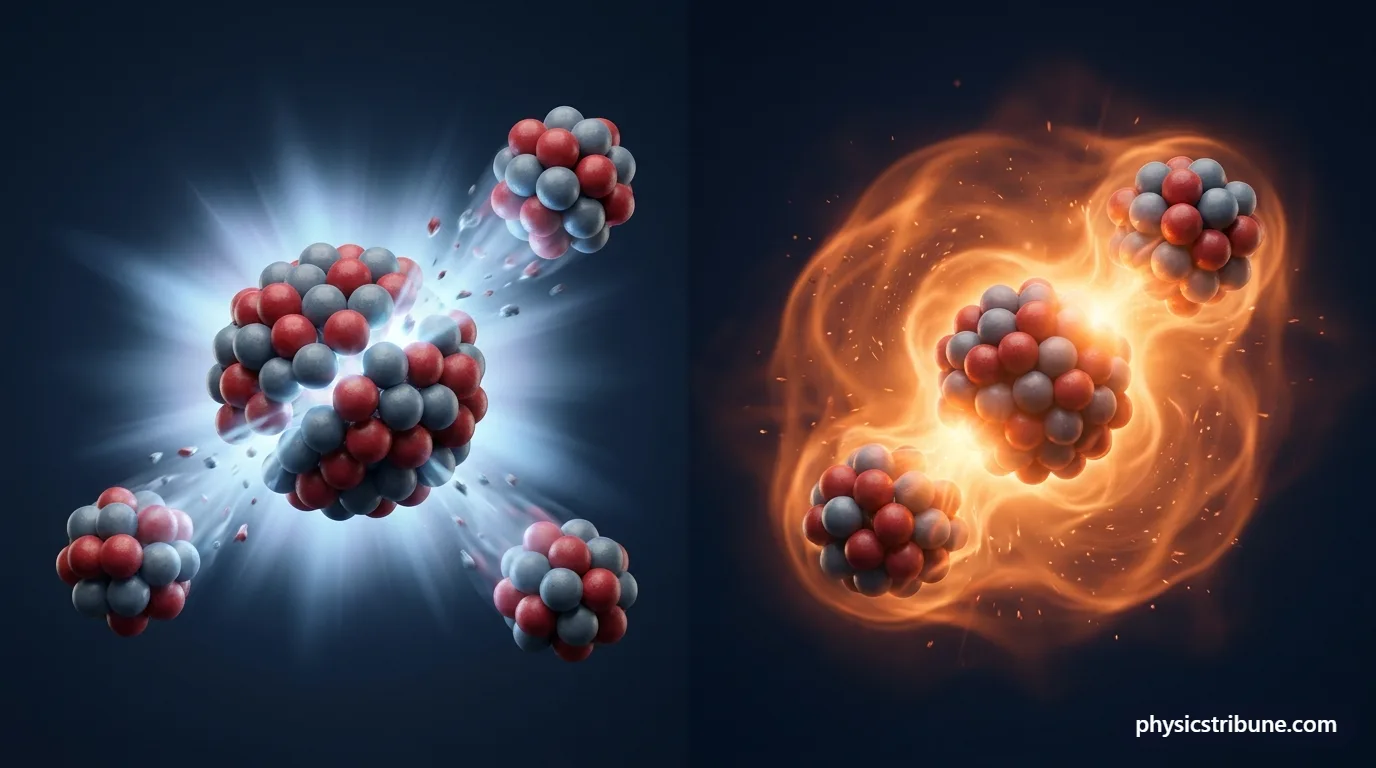
Fission splits heavy nuclei; nuclear fusion joins light ones, such as hydrogen isotopes, into heavier ones. Both release energy for the same reason: the products sit closer to the most tightly bound nuclei, around iron and nickel. Fission works today in hundreds of power plants, while controlled fusion that produces net power is still being developed. For a full side-by-side table, see fission vs fusion.
Practice Nuclear Physics Problems
To get comfortable with mass defects and energy release, try the E = mc² calculator, which converts between mass and energy step by step. Our radioactivity worksheets include printable problems on nuclear equations and decay, and the nuclear physics formulas sheet gathers every equation in one place. Then test yourself with the quiz below.
Common Misconceptions
Myth: Fission creates energy out of nothing.
Physics: Fission converts a small amount of mass into energy. The products always weigh slightly less than the starting nucleus and neutron, and that difference times c² is the energy released.
Myth: A nuclear reactor can explode like an atomic bomb.
Physics: Reactor fuel contains far too little uranium-235 and is arranged so that a runaway, bomb-like chain reaction is physically impossible. Reactor accidents involve overheating, steam and chemical explosions, not a nuclear blast.
Myth: Any uranium will sustain a chain reaction.
Physics: Natural uranium is more than 99 percent uranium-238, which does not split with slow neutrons. Most reactors need fuel enriched in uranium-235, or a very good moderator.
Myth: A nucleus always splits into the same two pieces.
Physics: The fragments vary from one fission to the next. Uranium-235 most often splits unevenly, into one fragment near mass 95 and another near mass 140.
Key Facts
- Nuclear fission is the splitting of a heavy nucleus into two lighter nuclei, plus two or three free neutrons.
- One fission of uranium-235 releases about 200 MeV, millions of times more than a chemical reaction between two atoms.
- The energy comes from a small loss of mass, given by Q = (m_initial - m_final)c².
- Neutrons released by one fission can trigger more fissions, forming a chain reaction.
- A reactor keeps the chain reaction exactly critical, with a multiplication factor of 1.
- Uranium-235, plutonium-239 and uranium-233 are fissile; uranium-238 and thorium-232 are fertile.
- Fission was discovered in 1938 by Hahn and Strassmann and explained by Meitner and Frisch.
Quick Quiz: How Well Do You Know Nuclear Fission?
6 questions. Tap an answer to check it.
What usually triggers fission in a uranium-235 nucleus?
A slow neutron is absorbed, forming excited uranium-236, which then splits.
About how much energy does one uranium-235 fission release?
A typical fission frees roughly 200 million electronvolts.
Where does the energy released in fission come from?
The products weigh slightly less, and the missing mass becomes energy through E = mc².
A chain reaction has a multiplication factor k = 1. What does this mean?
Each fission causes exactly one more on average, so the reaction is critical and steady.
Which of these nuclides is fertile rather than fissile?
Uranium-238 does not split with slow neutrons but can be turned into fissile plutonium-239.
Who explained that the uranium nucleus had split in two?
Meitner and Frisch interpreted Hahn and Strassmann's results as the splitting of the nucleus.
Frequently Asked Questions
What is nuclear fission in simple terms?
Nuclear fission is when the center of a heavy atom, its nucleus, breaks into two smaller pieces. This usually happens after the nucleus absorbs a neutron. The split releases two or three new neutrons and a huge amount of energy, mostly as the speed of the flying pieces, which turns into heat. Nuclear power plants use that heat to make electricity.
What is an example of nuclear fission?
The classic example is uranium-235 absorbing a slow neutron and splitting into barium-141 and krypton-92, while releasing three neutrons and about 200 MeV of energy. This exact type of reaction, with many different fragment pairs, takes place billions of times every second inside the fuel rods of a nuclear power reactor.
How much energy does nuclear fission release?
A single fission of uranium-235 releases about 200 MeV, which is about 3.2 × 10^-11 joules. That is tiny for one atom, but a kilogram of uranium-235 contains so many nuclei that fully fissioning it would release roughly 8 × 10^13 joules. Burning a kilogram of coal gives only about 24 million joules, a few million times less.
Why does fission release energy?
Fission releases energy because the two fragments are more tightly bound than the original heavy nucleus. Tighter binding means a lower total energy, and by mass-energy equivalence, a lower total mass. The products weigh slightly less than the starting nucleus plus neutron, and the missing mass appears as energy, mainly as the kinetic energy of the fragments.
Is nuclear fission used in nuclear power plants?
Yes. Every commercial nuclear power plant operating today runs on fission. Uranium fuel undergoes a controlled chain reaction in the reactor core, the heat boils water or heats a coolant, and the resulting steam spins turbines and generators. Control rods and the coolant keep the reaction steady at exactly the critical level.
What is the difference between nuclear fission and radioactive decay?
Radioactive decay is a nucleus spontaneously giving off a small particle, such as an alpha particle, an electron or a gamma ray, while staying largely intact. Fission splits the nucleus into two large fragments of similar size and releases far more energy. Fission is usually triggered by a neutron, while ordinary decay happens on its own at a steady statistical rate.
Why are neutrons used to start fission?
Neutrons have no electric charge, so the positively charged nucleus does not push them away. Even a very slow neutron can drift right into the nucleus and be absorbed. A proton or alpha particle, by contrast, would be repelled and would need enormous speed to get close. Slow neutrons are actually more likely to be captured by uranium-235 than fast ones.
Is nuclear fission dangerous?
The process itself is well understood and can be controlled safely, but its products are highly radioactive and must be shielded and stored for a long time. Uncontrolled supercritical fission is the basis of nuclear weapons. Power reactors use several layers of protection, including control rods, cooling systems and thick containment buildings, to keep both heat and radiation in check.
Keep Exploring
 nuclear physicsNuclear Fusion
 nuclear physicsHow a Nuclear Reactor Works
 nuclear physicsNuclear Chain Reaction
 nuclear physicsNuclear Binding Energy and Mass Defect
 compareFission vs Fusion
 calculatorsE = mc² Calculator (mass-energy)
 worksheetsRadioactivity Worksheets
 physicistsLise Meitner
 modern physicsMass-Energy Equivalence (E = mc²)
Sources
Constants come from NIST CODATA 2022 (public domain) and unit definitions from the BIPM SI Brochure (CC BY 4.0). Text, diagrams and illustrations are original work by Physics Tribune.