
At a Glance
A nuclear weapon works by suddenly creating a supercritical mass of uranium-235 or plutonium-239, so that a fission chain reaction multiplies faster than the material can blow apart. The energy comes from lost mass through E = mc². Thermonuclear weapons use a fission explosion to trigger fusion of hydrogen isotopes, reaching far larger yields.
- What it is
- An explosive that releases nuclear energy in an uncontrolled chain reaction
- Two main kinds
- Fission (atomic) bombs and thermonuclear (hydrogen) bombs
- Formula
- E = mc²; yield measured in kilotons of TNT
- Energy unit
- 1 kiloton of TNT = 4.184 × 10¹² J by convention
- Energy split (air burst)
- Roughly 50% blast, 35% heat, 15% nuclear radiation
- First test
- Trinity, New Mexico, 16 July 1945
On this page
- What Is a Nuclear Weapon?
- How Does a Nuclear Bomb Work Step by Step?
- What Makes a Chain Reaction Run Away?
- How Do Atomic (Fission) Bombs Work?
- How Is a Hydrogen Bomb Different?
- Where Does the Energy of a Nuclear Explosion Come From?
- What Happens When a Nuclear Weapon Explodes?
- Who Developed the First Nuclear Weapons?
- Common Misconceptions
- Key Facts
- Quiz
- FAQ
What Is a Nuclear Weapon?
A nuclear weapon is a bomb or warhead whose energy comes from the nucleus of the atom rather than from chemical reactions. Ordinary explosives such as TNT rearrange electrons between atoms and release a few megajoules per kilogram. Nuclear reactions change the nuclei themselves and release millions of times more energy per kilogram of material.
There are two broad families. Fission weapons, often called atomic bombs, split heavy nuclei of uranium-235 or plutonium-239. Thermonuclear weapons, often called hydrogen bombs, use a fission explosion to set off fusion of hydrogen isotopes and can be a thousand times more powerful.
This page explains the physics at the level of a high school or introductory college course: where the energy comes from, why the reaction runs away, and what the explosion does. Engineering details are tightly controlled by international law and are not covered here.
How Does a Nuclear Bomb Work Step by Step?
Every fission weapon follows the same basic sequence, compressed into far less than a millisecond:
- Safe, subcritical start. The fissile material is arranged so that most neutrons escape before causing a new fission. No chain reaction can grow.
- Rapid assembly. Conventional explosives suddenly bring the material into a much more compact, supercritical arrangement, where each fission leads on average to more than one new fission.
- Neutrons start the reaction. At the right moment, a burst of neutrons begins the chain reaction.
- Exponential growth. The number of fissions doubles over and over, each generation taking only billionths of a second.
- Disassembly. The enormous heat makes the material expand violently. Once it spreads out it becomes subcritical again and the chain reaction stops, but by then the energy has been released.
- The fireball forms. The released energy heats the weapon and surrounding air to tens of millions of degrees, creating a glowing fireball and a powerful shock wave.
The whole design challenge is to hold the material together long enough for many generations of fission before it blows itself apart.
What Makes a Chain Reaction Run Away?
When a uranium-235 or plutonium-239 nucleus absorbs a neutron and splits, it releases about 200 MeV of energy and two or three new neutrons. If those neutrons go on to split more nuclei, the result is a chain reaction. The key number is the multiplication factor k, the average number of new fissions caused by one fission.
In a nuclear reactor, control rods keep k at exactly 1, so power stays steady. In a weapon, k is made well above 1 using fast neutrons and very pure fissile material, and nothing slows it down. The graph compares the neutron population for k = 1 and k = 2 over ten generations: one stays flat while the other climbs past a thousand.
The smallest amount of material that can sustain a chain reaction is called the critical mass. It depends on the material, its density, its shape and what surrounds it. A compact sphere loses fewer neutrons through its surface than a flat sheet of the same mass, and squeezing material to a higher density lowers the critical mass further. By our calculation, about 81 doubling generations would be needed to reach the roughly 2 × 1024 fissions of a 15-kiloton explosion.
Example 2 How much uranium actually split?
Each uranium-235 fission releases about 200 MeV, and one uranium-235 atom has a mass of about 235.04 u. How many kilograms of uranium must fission to release 15 kilotons (1 kt = 4.184 × 10^12 J)?
- Given:
- Y:
- E_f:
- A:
- Y:
- Formula:
- Substitute:
- Answer:
Under a kilogram actually fissions; a weapon holds much more material, most of which is blown apart before it can react.

How Do Atomic (Fission) Bombs Work?
The two fission weapons used in war in 1945 show the two classic ways of assembling a supercritical mass. The weapon dropped on Hiroshima on 6 August used a gun-type design, firing one piece of highly enriched uranium into another. It was so simple that it was never tested before use. Its yield was about 15 kilotons.
The weapon dropped on Nagasaki on 9 August used implosion. A sphere of plutonium was surrounded by carefully shaped conventional explosives that squeezed it inward evenly, raising its density until it became supercritical. Its yield was about 21 kilotons.
Implosion became the basis of nearly all later weapons because it uses fissile material more efficiently. Even so, only a small fraction of the material in early bombs actually fissioned, as the worked example shows.
How Is a Hydrogen Bomb Different?
A thermonuclear weapon adds fusion to fission. The energy of a fission explosion creates, for a brief instant, the extreme temperature and pressure needed for nuclei of hydrogen isotopes to fuse, releasing still more energy.
Fusion fuel has no critical mass, so there is no basic physical limit on how much can be added. That is why thermonuclear weapons can reach yields of megatons, millions of tonnes of TNT. The neutrons from fusion can also split additional uranium in the weapon, adding more fission energy.
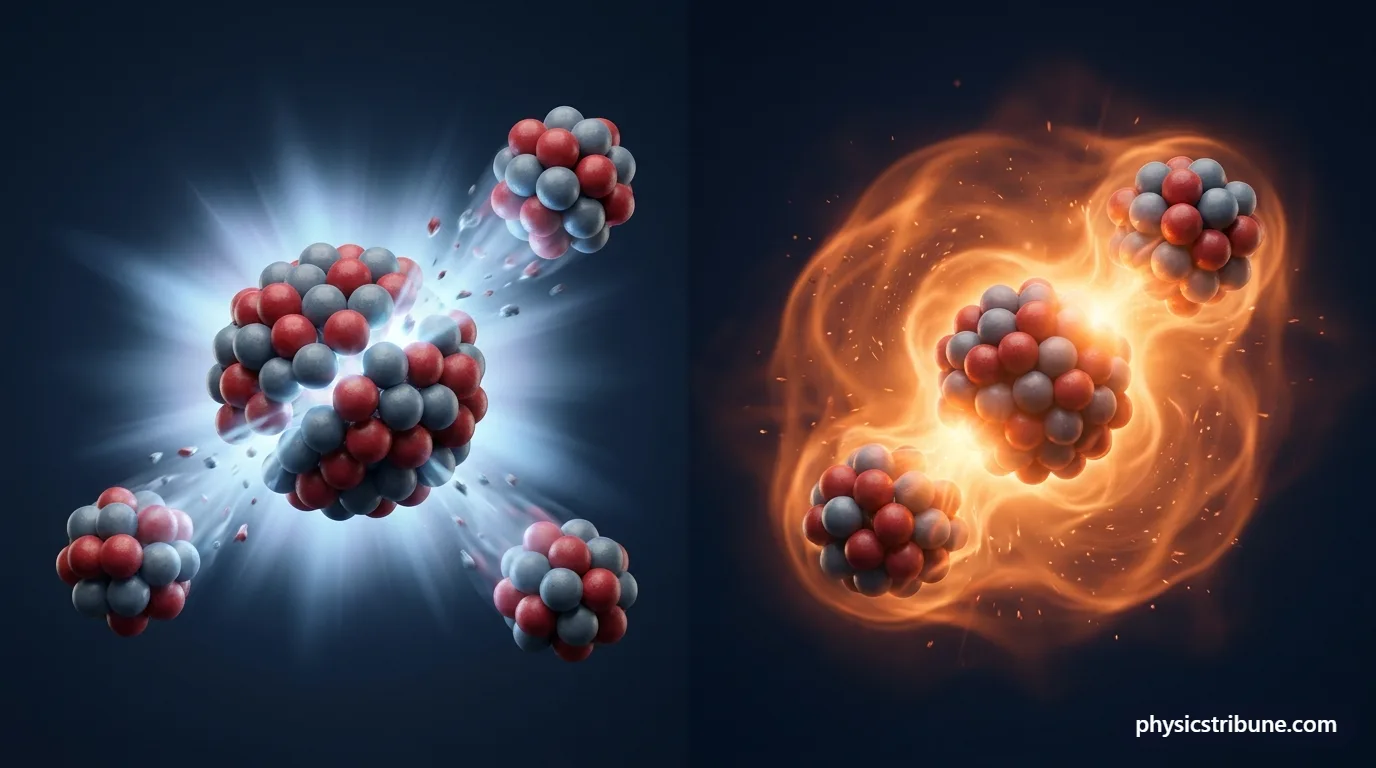
The first full-scale thermonuclear test, in November 1952, yielded about 10 megatons. The largest ever, a Soviet test in October 1961, released about 50 megatons, as the example below works through. The energy-per-reaction comparison is on our fission vs fusion page.
Example 3 Mass converted in the largest test
The largest nuclear test ever carried out had a yield of about 50 megatons, which is 50,000 kilotons at 4.184 × 10^12 J each. How many kilograms of mass were converted into energy?
- Given:
- Y:
- speed of light in vacuum:
- Y:
- Formula:
- Substitute:
- Answer:
A couple of kilograms of mass became energy, more than three thousand times the explosion in the first example.
| Feature | Fission (atomic) weapon | Thermonuclear (hydrogen) weapon |
|---|---|---|
| Main reaction | Splitting heavy nuclei | Fission primary that ignites fusion |
| Fuel | Uranium-235 or plutonium-239 | Fission fuel plus hydrogen isotopes |
| Limit on size | Set by how much material can be held together | No basic limit from critical mass |
| Typical yield range | Kilotons to hundreds of kilotons | Hundreds of kilotons to megatons |
| First test | July 1945 | November 1952 |
| Used in war | Yes, twice in August 1945 | Never |
| Source: General descriptions from the published historical record; yields are rounded · Retrieved October 2026 | ||
Where Does the Energy of a Nuclear Explosion Come From?
The products of a fission or fusion reaction weigh slightly less than the starting nuclei. The difference reflects the change in binding energy, and it is released according to mass-energy equivalence. Because the speed of light squared is such a huge number, a tiny mass corresponds to a vast amount of energy.
Weapon yields are quoted in tons of TNT, a unit chosen in the 1940s to compare with conventional bombs. By convention one ton of TNT equals exactly 4.184 × 10⁹ J, so a kiloton is 4.184 × 10¹² J and a megaton is 4.184 × 10¹⁵ J. The examples below turn yields into mass; try other values in our E = mc² calculator.
The energy of any nuclear explosion comes from mass that disappears, and this equation links the two.
| Symbol | Quantity | SI unit |
|---|---|---|
| rest energy | joule (J) | |
| rest mass | kilogram (kg) | |
| speed of light in vacuum (2.998 × 10⁸ m/s (exact: 299 792 458 m/s)) | meter per second (m/s) |
Rearranged to find another variable:
Valid for: rest energy of a body at rest; moving body: E = γmc².
Example 1 Mass converted in a 15-kiloton explosion
A fission explosion releases 15 kilotons of TNT equivalent, where 1 kiloton = 4.184 × 10^12 J. How many grams of mass were converted into energy?
- Given:
- Y:
- speed of light in vacuum:
- Y:
- Formula:
- Substitute:
- Answer:
Less than the mass of a paper clip vanished, yet the energy was enough to destroy a city.
| Yield | Energy (J) | Mass converted |
|---|---|---|
| 1 ton of TNT | 4.184 × 10⁹ | About 0.047 micrograms |
| 1 kiloton | 4.184 × 10¹² | About 0.047 grams |
| 15 kilotons | 6.276 × 10¹³ | About 0.70 grams |
| 21 kilotons | 8.786 × 10¹³ | About 0.98 grams |
| 1 megaton | 4.184 × 10¹⁵ | About 47 grams |
| 50 megatons | 2.092 × 10¹⁷ | About 2.3 kilograms |
| Source: Computed with E = mc², c from NIST CODATA 2022 and the convention 1 ton of TNT = 4.184 × 10⁹ J · Retrieved October 2026 | ||
What Happens When a Nuclear Weapon Explodes?
For a weapon exploded in the air, roughly half of the energy goes into the blast, a shock wave that spreads outward faster than sound and flattens buildings. About a third leaves as thermal radiation, a flash of light and heat that can cause burns and start fires kilometers away. The rest is nuclear radiation: an initial burst of neutrons and gamma rays in the first minute, then the lingering radioactivity of fission products.
The fireball rises like a hot-air balloon and forms the familiar mushroom cloud. When an explosion happens near the ground, it pulls soil and debris into the cloud, where they mix with radioactive fission products and fall back to Earth as fallout. Fallout is most intense in the first days, because many fission products have short half-lives, as the decay curve for iodine-131 shows.
The ionizing radiation from a nuclear explosion damages living cells, and high doses cause radiation sickness. A high-altitude burst also produces an electromagnetic pulse that can damage electronics over a wide area.

Who Developed the First Nuclear Weapons?
Nuclear fission was discovered in Berlin in late 1938 by Otto Hahn and Fritz Strassmann, and explained weeks later by Lise Meitner and Otto Frisch. Physicists quickly realized that a fission chain reaction could release enormous energy. In 1939, Leo Szilard drafted a letter signed by Albert Einstein warning President Roosevelt of the danger.
The United States launched the Manhattan Project. Enrico Fermi's team achieved the first controlled chain reaction in Chicago in December 1942, and the laboratory at Los Alamos, directed by J. Robert Oppenheimer, designed the bombs. The first test, code-named Trinity, took place in the New Mexico desert on 16 July 1945, and the two bombs used against Japan followed weeks later.
The Soviet Union tested its first fission weapon in 1949, and both superpowers developed thermonuclear weapons in the 1950s. Treaties have since limited testing and the spread of weapons, including the Partial Test Ban Treaty of 1963 and the Treaty on the Non-Proliferation of Nuclear Weapons, which entered into force in 1970.

Common Misconceptions
Myth: A nuclear power reactor can explode like an atomic bomb.
Physics: Reactor fuel is only slightly enriched and spread out among coolant and moderator, so a fast runaway chain reaction is impossible. Reactor accidents involve steam or hydrogen explosions, not nuclear blasts.
Myth: All of the uranium or plutonium in a bomb is used up.
Physics: The weapon blows itself apart within microseconds, so only a fraction of the material fissions. The rest is scattered as radioactive debris.
Myth: Radiation is the main destructive effect of a nuclear explosion.
Physics: Most of the energy goes into blast and heat. Radiation is a smaller share of the energy but adds long-lasting harm through fallout.
Key Facts
- A nuclear weapon releases energy from an uncontrolled chain reaction in about a millionth of a second.
- Fission weapons split uranium-235 or plutonium-239; thermonuclear weapons use fission to ignite fusion.
- A chain reaction runs away when each fission causes on average more than one new fission.
- One kiloton of TNT equals 4.184 × 10¹² J by convention, the energy of about 0.047 grams of mass.
- In an air burst, roughly half the energy becomes blast, about a third heat and the rest nuclear radiation.
- The first nuclear test, Trinity, took place in New Mexico on 16 July 1945.
- The largest test ever, in 1961, released about 50 megatons.
Quick Quiz: How Well Do You Know How Nuclear Weapons Work?
6 questions. Tap an answer to check it.
What process provides all the energy of an atomic (fission) bomb?
Fission weapons split uranium-235 or plutonium-239 nuclei.
A chain reaction grows rapidly when the multiplication factor k is...
Each fission must cause more than one new fission on average for the reaction to grow.
Why can hydrogen bombs be far more powerful than fission bombs?
Without a critical mass limit, more fusion fuel can simply be added.
In an air burst, where does the largest share of the energy go?
Roughly half of the energy goes into the blast wave.
About how much mass became energy in a 15-kiloton explosion?
E = mc² gives about 0.7 grams for 6.3 × 10¹³ J.
Where was the first nuclear test carried out?
The Trinity test took place in the New Mexico desert on 16 July 1945.
Frequently Asked Questions
How does a nuclear bomb work in simple terms?
A nuclear bomb suddenly squeezes or brings together uranium or plutonium so that the neutrons from each splitting nucleus split even more nuclei. The number of fissions doubles again and again in a few millionths of a second, turning a small amount of mass into a huge amount of energy before the material blows apart and the reaction stops.
What is the difference between an atomic bomb and a hydrogen bomb?
An atomic bomb gets all its energy from fission, the splitting of heavy uranium or plutonium nuclei. A hydrogen bomb uses a fission explosion as a trigger to compress and heat hydrogen isotopes until they fuse. Because fusion fuel has no critical mass, hydrogen bombs can be hundreds or thousands of times more powerful than the atomic bombs of 1945.
What is critical mass?
Critical mass is the smallest amount of fissile material that can sustain a chain reaction on its own. Below it, too many neutrons escape through the surface. It depends on the type of material, its purity, its density, its shape and whether a reflecting material surrounds it. A weapon must reach a supercritical state very quickly, faster than the material can heat up and expand.
How much energy does a nuclear weapon release?
Yields are measured in kilotons or megatons of TNT. One kiloton is 4.184 × 10¹² joules by convention. The bomb used on Hiroshima released about 15 kilotons and the one used on Nagasaki about 21 kilotons. Modern strategic warheads range from tens of kilotons to more than a megaton, and the largest test ever reached about 50 megatons.
Why do nuclear explosions make a mushroom cloud?
The fireball is far hotter and lighter than the surrounding air, so it rises rapidly like a hot-air balloon. As it climbs, it draws up a column of air, dust and debris beneath it, forming the stem. When the rising gas cools and reaches a level where it is no longer lighter than its surroundings, it spreads sideways into the cap of the mushroom.
What is nuclear fallout?
Fallout is radioactive material that falls back to the ground after a nuclear explosion. It forms when the fireball lifts soil and debris that mix with radioactive fission products and then settle downwind over hours to weeks. Its radioactivity drops quickly at first because many fission products have short half-lives, but some, such as cesium-137, last for decades.
Who invented the atomic bomb?
No single person invented it. The first atomic bombs were built by thousands of scientists, engineers and workers in the United States Manhattan Project during World War II, with British and Canadian contributions. J. Robert Oppenheimer directed the Los Alamos laboratory where the bombs were designed, and Enrico Fermi led the first controlled chain reaction in 1942.
How many nuclear weapons have been used in war?
Only two nuclear weapons have ever been used in war, both by the United States against Japan in August 1945, on Hiroshima on 6 August and on Nagasaki on 9 August. More than two thousand nuclear tests have been carried out since then, mostly before treaties banned tests in the atmosphere, underwater and in space.
Keep Exploring
 nuclear physicsNuclear Fission
 nuclear physicsNuclear Chain Reaction
 nuclear physicsNuclear Fusion
 compareFission vs Fusion
 nuclear physicsHow a Nuclear Reactor Works
 modern physicsMass-Energy Equivalence (E = mc²)
 calculatorsE = mc² Calculator (mass-energy)
 physicistsJ. Robert Oppenheimer
 nuclear physicsIonizing Radiation and Its Effects