
At a Glance
Nuclear fusion is the joining of two light nuclei, such as deuterium and tritium, into a heavier nucleus. The product has less mass than the starting nuclei, and the missing mass becomes energy through E = m c^2; one deuterium-tritium fusion releases about 17.6 MeV. Because nuclei are positively charged and repel each other, fusion only happens at extremely high temperatures and pressures, like those in the core of the Sun.
- Type of process
- Nuclear reaction: light nuclei combine into a heavier one
- Formula
- E = mc², with m the mass lost in the reaction
- Best-known reaction
- Deuterium + tritium → helium-4 + neutron + 17.6 MeV
- Where it happens
- Cores of stars, hydrogen bombs, experimental reactors
- Conditions needed
- Tens to hundreds of millions of kelvin, plus high density and confinement time
- Main obstacle
- Electric repulsion between positive nuclei (the Coulomb barrier)
On this page
- What Is Nuclear Fusion?
- Nuclear Fusion Explained Simply
- Why Does Fusion Release Energy?
- Why Does Fusion Need Such High Temperatures?
- How Does Fusion Power the Sun?
- What Are the Main Fusion Reactions?
- How Are Scientists Trying to Build Fusion Power?
- What Are the Advantages and Challenges of Fusion Energy?
- How Is Fusion Different From Fission?
- Who Discovered Nuclear Fusion?
- Practice Fusion and Mass-Energy Problems
- Common Misconceptions
- Key Facts
- Quiz
- FAQ
What Is Nuclear Fusion?
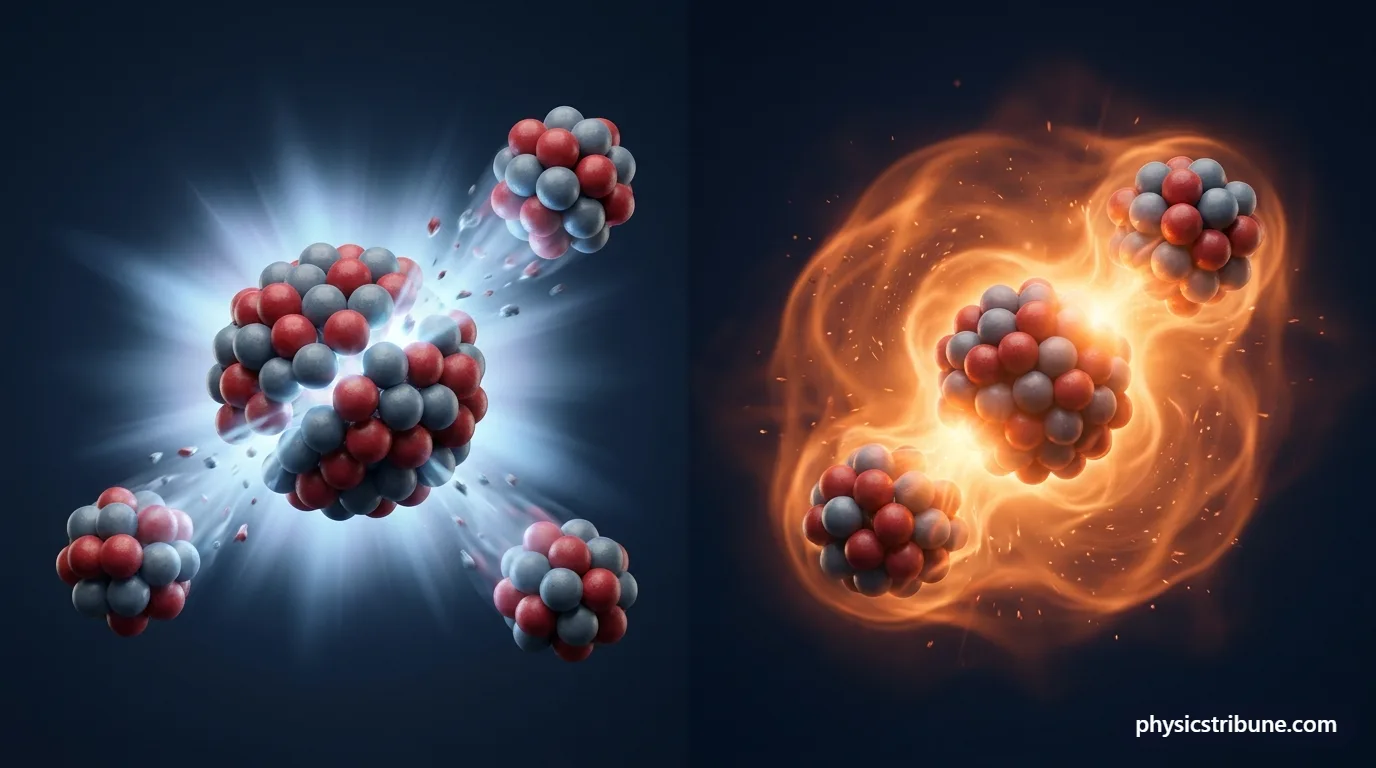
Nuclear fusion is the process of squeezing two small nuclei so close together that they merge into one. The simplest examples involve isotopes of hydrogen. Deuterium has one proton and one neutron, tritium has one proton and two neutrons, and when the two fuse they form helium-4 and throw out a spare neutron.
Fusion is a reaction of the atomic nucleus, so it releases energy on a nuclear scale. A single deuterium-tritium fusion frees about 17.6 MeV, millions of times more than a chemical reaction between two atoms. Gram for gram, fusion fuel holds more energy than any other fuel we know how to use, including uranium.
Fusion is also the reason the universe has more than hydrogen and helium. Stars build carbon, oxygen, silicon and iron by fusing lighter nuclei over millions of years, and almost every atom in your body other than hydrogen was made this way inside an earlier generation of stars.
Nuclear Fusion Explained Simply
Imagine two strong magnets that only stick together if you force them almost into contact. Bring them near each other and they shove back, but get them close enough and they suddenly snap together with a click. Nuclei behave in a similar way, except the push comes from their electric charge and the grip comes from the strong nuclear force.
Every nucleus is positively charged, so two nuclei repel each other. To make them fuse you have to throw them at each other so fast that they get within a tiny distance, about the width of a proton. At that point the strong force takes over, pulls them together, and the new nucleus settles into a lower-energy state. The energy it gives up is released, mostly as the speed of the particles that fly out.
Heat is just fast-moving particles. That is why fusion needs a gas heated to millions of degrees: only then are enough nuclei moving fast enough to get close.
Why Does Fusion Release Energy?
Fusion releases energy because the product nucleus is more tightly bound than the nuclei that formed it. In helium-4, the two protons and two neutrons are held together far more strongly, per particle, than in deuterium or tritium. A tighter bond means a lower energy, and a lower energy means a lower mass.
The binding energy per nucleon rises steeply from hydrogen up to helium and then more slowly up to iron and nickel, where it peaks at about 8.8 MeV. Joining nuclei lighter than iron therefore releases energy. Beyond iron the curve slopes down, which is why heavy nuclei release energy by splitting instead, in nuclear fission.
The size of the release comes straight from mass-energy equivalence. Weigh everything before and after, multiply the missing mass by
Fusion energy follows from mass-energy equivalence: the mass that disappears in the reaction, multiplied by the speed of light squared, is the energy released.
| Symbol | Quantity | SI unit |
|---|---|---|
| rest energy | joule (J) | |
| rest mass | kilogram (kg) | |
| speed of light in vacuum (2.998 × 10⁸ m/s (exact: 299 792 458 m/s)) | meter per second (m/s) |
Rearranged to find another variable:
Valid for: rest energy of a body at rest; moving body: E = γmc².
Example 1 Energy from one deuterium-tritium fusion
When a deuterium nucleus fuses with a tritium nucleus to make helium-4 and a neutron, the products weigh 0.018883 u less than the starting pair, which is 3.1356 × 10^-29 kg (computed from CODATA 2022 nuclear masses). How much energy does one fusion release?
- Given:
- rest mass:
- speed of light in vacuum:
- rest mass:
- Formula:
- Substitute:
- Answer:
Expressed in nuclear units, this is about 17.6 MeV (computed), one of the largest energy releases of any fusion reaction.
Why Does Fusion Need Such High Temperatures?
The obstacle is the Coulomb barrier. Two positive nuclei repel each other with an electric force that grows stronger as they approach, following Coulomb's law. The field-line picture shows how two positive charges push each other apart: no field lines connect them, and the region between them is a zone of repulsion. To fuse, the nuclei must climb this electric hill until the strong force can grab them.
Temperature measures the average energy of particles. In the Sun's core, at about 15 million kelvin, the typical particle energy is only about 1.3 keV (computed from the Boltzmann constant), far below the barrier of a few hundred keV. Fusion still happens because a small fraction of nuclei move much faster than average, and because quantum mechanics lets them tunnel through the barrier instead of climbing all the way over it.
At these temperatures, atoms lose their electrons and become plasma, a gas of free nuclei and electrons. Keeping that plasma hot, dense and confined long enough is the central problem of fusion power.

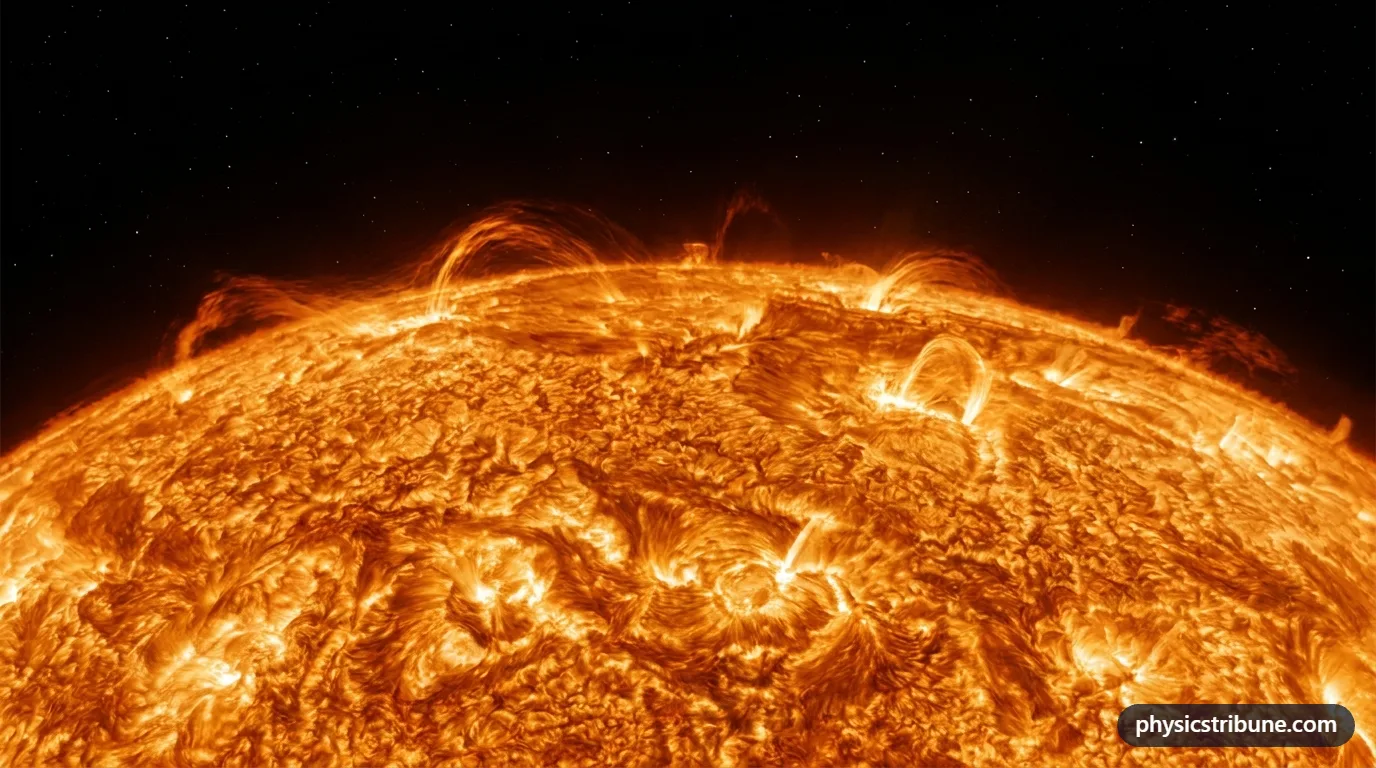
How Does Fusion Power the Sun?
The Sun shines by turning hydrogen into helium in its core through a series of steps called the proton-proton chain. In outline:
- Two protons fuse; one of them turns into a neutron, forming deuterium and releasing a positron and a neutrino. This step is extremely slow and sets the pace of the whole chain.
- The deuterium fuses with another proton to make helium-3 and a gamma ray.
- Two helium-3 nuclei fuse into helium-4, releasing two protons back into the core.
The net result is four protons becoming one helium-4 nucleus, with about 26.7 MeV released (computed from CODATA masses), a small share of which the neutrinos carry straight out of the Sun. The Sun's own gravity provides the confinement: its enormous weight squeezes and heats the core, a trick no Earth laboratory can copy, as the field diagram suggests.
Stars heavier than the Sun run an alternative route, the CNO cycle, in which carbon, nitrogen and oxygen nuclei act as catalysts for the same overall change from hydrogen to helium.
Example 2 How much mass does the Sun lose each second?
The Sun radiates about 3.8 × 10^26 J of energy every second, all of it produced by fusion in its core. How much mass does the Sun convert into energy each second?
- Given:
- rest energy:
- speed of light in vacuum:
- rest energy:
- Formula:
- Substitute:
- Answer:
That is about four million tonnes every second (computed), yet the Sun is so massive that it will lose well under one percent of its mass this way over its whole lifetime.

What Are the Main Fusion Reactions?
Several fusion reactions matter in physics and engineering. The table lists the main candidates with energies we computed from CODATA 2022 nuclear masses. Deuterium-tritium is the favorite for power plants because it fuses most readily, at the lowest temperature of any fusion fuel, and releases a large 17.6 MeV per reaction.
Other reactions trade convenience for cleanliness. Deuterium-deuterium fusion needs no tritium at all but requires a hotter plasma. Deuterium-helium-3 fusion releases a fast proton instead of a neutron, which would cause less radiation damage, but helium-3 is extremely rare on Earth.
Example 3 Fusing one kilogram of hydrogen
When hydrogen fuses into helium inside a star, about 0.7 percent of the mass disappears. For 1 kg of hydrogen, that is a mass loss of 0.007 kg. How much energy is released?
- Given:
- rest mass:
- speed of light in vacuum:
- rest mass:
- Formula:
- Substitute:
- Answer:
Burning a kilogram of gasoline gives about 46 million joules, so fusing hydrogen yields roughly 14 million times more energy per kilogram (computed).
| Reaction | Products | Energy released (MeV) | Where it matters |
|---|---|---|---|
| Deuterium + tritium | Helium-4 + neutron | 17.59 | Leading fuel for fusion power plants |
| Deuterium + helium-3 | Helium-4 + proton | 18.35 | Low-neutron fusion research |
| Deuterium + deuterium (branch 1) | Helium-3 + neutron | 3.27 | Fuel without tritium; happens alongside D-T |
| Deuterium + deuterium (branch 2) | Tritium + proton | 4.03 | Equally likely second branch of D-D fusion |
| Proton-proton chain (net) | Four protons → helium-4 | 26.73 | Main energy source of the Sun |
| Source: Computed from NIST CODATA 2022 nuclear masses (deuteron, triton, helion, alpha particle, proton, neutron, electron) with 1 u = 931.494 103 72 MeV/c²; the proton-proton total includes positron annihilation · Retrieved October 2026 | |||
How Are Scientists Trying to Build Fusion Power?
Without a star's gravity, engineers use two main strategies. Magnetic confinement holds a thin, hot plasma inside a doughnut-shaped chamber called a tokamak, using powerful magnetic fields so the plasma never touches the walls. Plasma temperatures above 100 million kelvin, several times hotter than the Sun's core, are routine in large tokamaks. The international ITER project in France is building the largest one yet. Our page on fusion reactors goes into the details.
Inertial confinement takes the opposite approach. Intense laser beams hit a tiny fuel capsule from all sides, crushing it so fast that the fuel fuses before it can fly apart. In December 2022, a laser facility in California released more fusion energy from a capsule than the laser light delivered to it, a milestone called ignition.
Neither approach yet produces more electricity than the whole plant consumes. The remaining challenges include keeping the plasma stable, handling the intense heat and neutron flux at the walls, and producing tritium inside the plant.

What Are the Advantages and Challenges of Fusion Energy?
Fusion has some striking advantages as an energy source:
- Abundant fuel. Deuterium can be extracted from ordinary seawater, and tritium can be bred from lithium inside the reactor.
- No carbon emissions from the reaction itself.
- No runaway chain reaction. If anything goes wrong, the plasma cools and fusion simply stops within seconds.
- Less long-lived waste. The products are helium and neutrons, not the long-lived fission products of uranium.
The challenges are just as real. Fast neutrons from deuterium-tritium fusion make the reactor walls radioactive over time and slowly damage materials. Tritium is radioactive, with a half-life of about 12 years, so it must be handled with care. Above all, sustaining a burning plasma that pays back the energy put into it, reliably and affordably, has proved much harder than early researchers hoped.
| Fuel and process | Energy per kg (MJ) | Compared with coal |
|---|---|---|
| Wood, burned | about 16 | about 0.7× |
| Coal, burned | about 24 | 1× |
| Gasoline, burned | about 46 | about 2× |
| Uranium-235, fully fissioned | about 82,000,000 | about 3.4 million× |
| Deuterium-tritium mix, fully fused | about 337,000,000 | about 14 million× |
| Hydrogen fused to helium (stars) | about 629,000,000 | about 26 million× |
| Source: Chemical fuels: typical heating values. Nuclear rows computed: U-235 from 200 MeV per fission and 235.04 u per nucleus; D-T from 17.59 MeV per 5.029 u of fuel; hydrogen from a 0.7% mass loss with E = mc² · Retrieved October 2026 | ||
How Is Fusion Different From Fission?
Fusion joins light nuclei, while fission splits heavy ones such as uranium-235. Fission is easy to start, since a slow neutron is enough, and has powered electricity grids since the 1950s. Fusion is hard to start, because of the Coulomb barrier, but yields more energy per kilogram of fuel and leaves less long-lived waste. Our fission vs fusion comparison lays out the differences point by point.
Who Discovered Nuclear Fusion?
The idea grew out of precise measurements of atomic masses around 1920, which showed that a helium atom weighs slightly less than four hydrogen atoms. The British astronomer Arthur Eddington suggested in 1920 that the Sun might shine by turning hydrogen into helium, with the missing mass appearing as energy through Albert Einstein's
In 1934, Ernest Rutherford's group in Cambridge fused deuterium nuclei in the laboratory for the first time using a particle accelerator. In 1938 and 1939 the physicist Hans Bethe worked out the detailed reaction chains that power stars, including the proton-proton chain and the CNO cycle. Controlled fusion research began in the 1950s and continues today.
Practice Fusion and Mass-Energy Problems
Try converting mass losses into energy with the E = mc² calculator, which shows each step. Our radioactivity worksheets include printable nuclear equations to balance, and the nuclear physics formulas sheet collects the binding-energy and Q-value equations. Then check your understanding with the quiz below.
Common Misconceptions
Myth: Fusion and fission are the same thing.
Physics: Fusion joins light nuclei into a heavier one, while fission splits a heavy nucleus into lighter ones. Both release energy, but from opposite ends of the periodic table.
Myth: The Sun is a giant fire burning hydrogen.
Physics: Burning is a chemical reaction with oxygen. The Sun runs on nuclear fusion, which releases millions of times more energy per kilogram than any fire could.
Myth: A fusion reactor could melt down or explode like a bomb.
Physics: A fusion plasma holds only a few grams of fuel at a time. Any disturbance cools the plasma and fusion stops on its own, so there is no runaway chain reaction.
Myth: Fusion needs high temperatures to break chemical bonds.
Physics: The heat is needed to give nuclei enough speed to overcome their electric repulsion. At fusion temperatures, atoms are already stripped of their electrons.
Key Facts
- Nuclear fusion joins two light nuclei into one heavier nucleus and releases energy.
- The energy comes from a small loss of mass, given by E = mc².
- One deuterium-tritium fusion releases about 17.6 MeV.
- Fusion needs extreme temperatures because positively charged nuclei repel each other.
- The Sun fuses hydrogen into helium through the proton-proton chain, converting about four million tonnes of mass into energy every second.
- Fusion releases energy only for nuclei lighter than iron; heavier nuclei release energy by fission.
- Fusion power plants are still experimental, but laser fusion first reached ignition in 2022.
Quick Quiz: How Well Do You Know Nuclear Fusion?
6 questions. Tap an answer to check it.
What happens in nuclear fusion?
Fusion combines light nuclei, such as hydrogen isotopes, into a heavier nucleus.
Why does fusion require extremely high temperatures?
Nuclei must move fast enough to get past the Coulomb barrier.
About how much energy does one deuterium-tritium fusion release?
The mass loss of about 0.0189 u corresponds to roughly 17.6 MeV.
What is the main fusion process in the Sun?
The proton-proton chain turns four protons into one helium-4 nucleus.
Fusing which nuclei can still release energy?
Binding energy per nucleon peaks near iron, so fusion releases energy only below it.
What does a tokamak use to confine fusion plasma?
Magnetic fields keep the charged plasma away from the walls of the chamber.
Frequently Asked Questions
What is nuclear fusion in simple terms?
Nuclear fusion is when two tiny atomic nuclei crash together so hard that they stick and become one bigger nucleus. The new nucleus weighs a bit less than the two that formed it, and that missing mass turns into a large amount of energy. Fusion is what makes the Sun and other stars shine.
What is an example of nuclear fusion?
The best-known example is a deuterium nucleus fusing with a tritium nucleus to make helium-4 and a free neutron, releasing about 17.6 MeV. Another example happens in the Sun every second: through a chain of steps, four hydrogen nuclei, which are protons, become one helium-4 nucleus. Hydrogen bombs also use fusion reactions.
Why is nuclear fusion so hard to achieve on Earth?
All nuclei are positively charged, so they strongly repel each other. To make them fuse, the fuel must be heated to over 100 million kelvin, turning it into plasma, and then held dense enough for long enough. No material container can touch such a plasma, so scientists use magnetic fields or ultra-fast laser compression to confine it.
Does nuclear fusion produce radioactive waste?
Fusion produces far less long-lived waste than fission. The reaction products, helium and neutrons, are not themselves a lasting problem. However, the neutrons make the reactor's structural materials radioactive over time, and the tritium fuel is mildly radioactive with a half-life of about 12 years. Most of this activated material would decay within decades to a century.
Is nuclear fusion better than nuclear fission?
In principle, fusion offers more energy per kilogram, abundant fuel from seawater and lithium, no possibility of a runaway reaction and much less long-lived waste. In practice, fission works today and supplies about a tenth of the world's electricity, while fusion has not yet produced net electricity. Which is better depends on whether fusion's engineering challenges can be solved affordably.
What temperature is needed for nuclear fusion?
The Sun's core fuses hydrogen at about 15 million kelvin, helped by its enormous density and quantum tunneling. Fusion reactors on Earth work with much thinner plasma, so they need roughly 100 to 150 million kelvin for deuterium-tritium fuel. Other fuels, such as deuterium alone, need even higher temperatures.
What elements are used in nuclear fusion?
Fusion uses the lightest elements. Power-plant designs mainly use deuterium and tritium, two heavy isotopes of hydrogen, with lithium used to breed more tritium. Stars fuse ordinary hydrogen into helium, and massive stars go on to fuse helium, carbon, oxygen and silicon, building heavier elements up to iron in their cores.
Can fusion happen at room temperature?
Not in any way that produces useful power. Claims of so-called cold fusion in a tabletop cell have not been confirmed by careful repeat experiments. A real but very weak form, muon-catalyzed fusion, can occur in cold hydrogen, but producing the muons costs more energy than the fusion releases.
Keep Exploring
 nuclear physicsNuclear Fission
 nuclear physicsFusion Reactors (Tokamaks)
 nuclear physicsNuclear Binding Energy and Mass Defect
 compareFission vs Fusion
 modern physicsMass-Energy Equivalence (E = mc²)
 calculatorsE = mc² Calculator (mass-energy)
 worksheetsRadioactivity Worksheets
 matterPlasma (Fourth State of Matter)
 physicistsAlbert Einstein
Sources
Constants come from NIST CODATA 2022 (public domain) and unit definitions from the BIPM SI Brochure (CC BY 4.0). Text, diagrams and illustrations are original work by Physics Tribune.