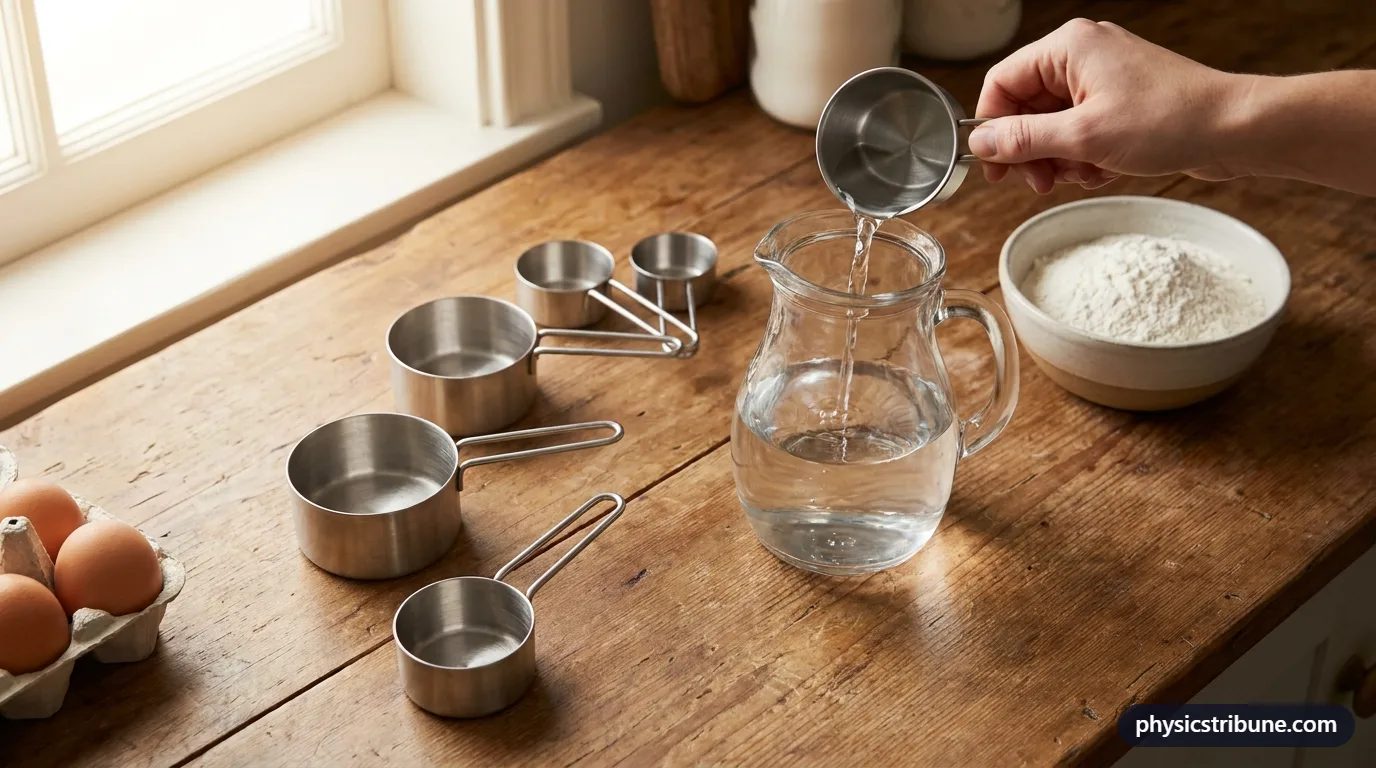
At a Glance
To convert units, multiply the quantity by a conversion factor written as a fraction equal to one, such as (1,000 m / 1 km), arranged so the old unit cancels. Chain several factors for compound units like km/h to m/s. For squared or cubed units, square or cube the factor as well.
- Main tool
- Conversion factor, a ratio equal to 1
- Key idea
- Units cancel like algebra symbols
- Target for formulas
- SI units: m, kg, s, A, K, mol, cd
- Example
- 1 km/h = 1/3.6 m/s
- Area and volume
- Square or cube the length factor
- Special case
- Temperature scales need an offset, not just a factor
On this page
- What Is Unit Conversion?
- Unit Conversion Explained Simply
- How Do You Convert Units Step by Step?
- How Do You Convert Within the Metric System?
- How Do You Convert km/h to m/s and Other Compound Units?
- How Do You Convert Area and Volume Units?
- Why Should You Convert to SI Units Before Using a Formula?
- Why Is Temperature Conversion Different?
- Does Converting Units Change the Precision of a Number?
- Common Misconceptions
- Key Facts
- Quiz
- FAQ
What Is Unit Conversion?
A length of one mile and a length of 1,609.344 meters are the same distance, just described with different units. Unit conversion is the skill of moving between such descriptions. The quantity stays fixed; only the number and the unit attached to it change.
In physics, conversion has a practical purpose. The formulas on this site, like those in most textbooks, are written for the International System of Units. If a problem gives you grams, centimeters, minutes or miles per hour, you convert to kilograms, meters, seconds and meters per second before you calculate.
Conversion also lets you check whether an answer makes sense. A sprinter's top speed of 12 m/s sounds abstract until you convert it to about 43 km/h, which is easy to compare with a car on a city street.
Unit Conversion Explained Simply
Imagine trading coins. Four quarters are worth one dollar, so the pile of money is the same whether you count it in quarters or in dollars. You only change the label and the count.
Units work the same way. Because 100 centimeters equal 1 meter, the fraction (1 m / 100 cm) is really just a fancy way of writing the number one. Multiplying anything by one does not change it, but it can swap centimeters for meters. That simple trick is the whole method.
How Do You Convert Units Step by Step?
- Write the starting value with its unit. For example, 250 cm.
- Find a relationship between the units. Here, 1 m = 100 cm.
- Build a conversion factor from it. Put the unit you want on top and the unit you want to remove on the bottom: (1 m / 100 cm).
- Multiply and cancel. 250 cm × (1 m / 100 cm) = 2.5 m. The centimeters cancel, leaving meters.
- Check the size. Meters are bigger than centimeters, so the number should get smaller. It did.
This approach, sometimes called the factor-label method, is closely related to dimensional analysis. Writing the units in every step means mistakes become visible: if the units do not cancel to what you want, the factor is upside down.
| From | To SI | Exact or rounded |
|---|---|---|
| 1 inch (in) | 0.0254 m | Exact |
| 1 foot (ft) | 0.3048 m | Exact |
| 1 mile (mi) | 1,609.344 m | Exact |
| 1 pound (lb), mass | 0.453 592 37 kg | Exact |
| 1 hour (h) | 3,600 s | Exact |
| 1 kilometer per hour (km/h) | 0.2778 m/s (1/3.6) | Rounded |
| 1 mile per hour (mph) | 0.44704 m/s | Exact |
| 1 liter (L) | 0.001 m³ | Exact |
| 1 US gallon (gal) | 0.003 785 411 784 m³ | Exact |
| 1 calorie (cal, thermochemical) | 4.184 J | Exact |
| 1 kilowatt-hour (kWh) | 3.6 × 10⁶ J | Exact |
| 1 standard atmosphere (atm) | 101,325 Pa | Exact |
| 1 electronvolt (eV) | 1.602 176 634 × 10-19 J | Exact |
| Source: Exact values from the 1959 international yard and pound definitions and NIST SP 811; liter and electronvolt from BIPM SI Brochure Table 8 (CC BY 4.0); km/h factor computed · Retrieved October 2026 | ||
How Do You Convert Within the Metric System?
Metric conversions are the easiest of all, because every step is a power of ten. Each SI prefix stands for a fixed factor: kilo for 103, centi for 10-2, milli for 10-3 and so on. Converting between them only moves the decimal point.
A useful habit is to pass through the base unit. To convert 4.8 mg to micrograms, write 4.8 × 10⁻³ g, then divide by 10-6 g per microgram to get 4,800 µg. Writing values in scientific notation keeps the powers of ten tidy.
How Do You Convert km/h to m/s and Other Compound Units?
Many physics quantities combine two or more units, such as kilometers per hour, grams per cubic centimeter or kilowatt-hours. Convert each piece with its own factor and chain the factors together. For speed: 1 km/h × (1,000 m / 1 km) × (1 h / 3,600 s) = 1/3.6 m/s, or about 0.278 m/s.
The shortcut follows directly: divide km/h by 3.6 to get m/s, and multiply m/s by 3.6 to go back. For miles per hour, use 1 mph = 0.44704 m/s exactly. The examples below show both cases, and our speed, distance and time calculator handles mixed units automatically.
Speed is the classic place where conversion matters. The formula gives meters per second only when distance is in meters and time is in seconds.
| Symbol | Quantity | SI unit |
|---|---|---|
| average speed | meter per second (m/s) | |
| distance traveled | meter (m) | |
| elapsed time | second (s) |
Rearranged to find another variable:
Valid for: gives the average over the time interval.
Example 1 A train at 72 km/h
A train travels 72 km every hour. Rewrite the distance as 72,000 m and the hour as 3,600 s, then find its speed in meters per second.
- Given:
- distance traveled:
- elapsed time:
- distance traveled:
- Formula:
- Substitute:
- Answer:
This is the same as dividing a speed in km/h by 3.6, the shortcut most physics students memorize.
Example 2 A bike ride measured in miles
A cyclist rides 18 miles in 1.5 hours. Using 1 mile = 1,609.344 m, the distance is 28,968.192 m and the time is 5,400 s. What is the average speed in m/s?
- Given:
- distance traveled:
- elapsed time:
- distance traveled:
- Formula:
- Substitute:
- Answer:
The original values have two significant figures, so a final report should round this result to two figures.


How Do You Convert Area and Volume Units?
This is where most conversion mistakes happen. Because 1 m = 100 cm, a square meter is 100 cm by 100 cm, which is 10,000 cm². A cubic meter is 100 cm × 100 cm × 100 cm, which is 1,000,000 cm³. The length factor is squared for area and cubed for volume.
Liters are a convenient volume unit outside the SI: one liter is exactly one cubic decimeter, so 1 m³ = 1,000 L and 1 cm³ = 1 mL. When you work out density in kg/m³ from a mass in grams and a volume in cubic centimeters, multiply g/cm³ by 1,000 to get kg/m³.
| Unit | Equals | Why |
|---|---|---|
| 1 cm² | 10-4 m² | (10-2)² |
| 1 mm² | 10-6 m² | (10-3)² |
| 1 km² | 106 m² | (103)² |
| 1 cm³ | 10-6 m³ = 1 mL | (10-2)³ |
| 1 m³ | 1,000 L | 1 L = 1 dm³ |
| 1 ft² | 0.092 903 04 m² | (0.3048)² |
| 1 ft³ | about 28.32 L | (0.3048)³ × 1,000 |
| 1 g/cm³ | 1,000 kg/m³ | 10-3 kg ÷ 10-6 m³ |
| Source: Computed with node from the exact length definitions above · Retrieved October 2026 | ||
Why Should You Convert to SI Units Before Using a Formula?
The SI is coherent, meaning its derived units are built from the base units with no extra numbers. A newton is exactly a kilogram meter per second squared, and a joule is exactly a newton meter. If every input is in SI units, the answer automatically comes out in SI units too.
Mixing units breaks that guarantee. In 1999 a Mars orbiter was lost partly because one team worked in pound-force seconds while another expected newton seconds, a mismatch of about a factor of 4.45. Converting first, then calculating, is the single best defense. The car example below shows how badly an unconverted speed can mislead you.
Example 3 Kinetic energy of a car at 54 km/h
A 1,200 kg car moves at 54 km/h. Convert the speed first (54 ÷ 3.6 = 15 m/s), then find the car's kinetic energy in joules.
- Given:
- mass:
- speed:
- mass:
- Formula:
- Substitute:
- Answer:
Plugging in 54 without converting would give an energy almost thirteen times too large, because the speed is squared.

Why Is Temperature Conversion Different?
Most conversions only need a multiplying factor, because zero means the same thing in both units: zero meters is zero feet. Temperature scales are different, because their zero points are in different places. Converting Celsius to Fahrenheit needs both a factor and an offset:
Celsius and kelvin share the same step size, so
Does Converting Units Change the Precision of a Number?
A conversion should keep the same precision as the original measurement. Defined factors such as 1 in = 2.54 cm or 1 h = 3,600 s are exact, so they never limit the number of significant figures. If you start with 3.2 miles, the converted distance should still have two significant figures.
The fastest way to build skill is repetition with feedback. Our physics unit conversion worksheets cover metric, US customary and compound units with answer keys, and the physics unit converter lets you check your work.
Common Misconceptions
Myth: Converting 1 m² to cm² means multiplying by 100.
Physics: Both sides of the square change, so the factor is 100 squared. One square meter is 10,000 cm².
Myth: You can convert Celsius to Fahrenheit by multiplying by a single number.
Physics: The two scales have different zero points, so you need both a factor of 9/5 and an offset of 32.
Myth: A bigger number after conversion means a bigger quantity.
Physics: The size never changes. Smaller units simply need a bigger number to describe the same amount, as in 2 m = 200 cm.
Myth: Kilograms and pounds measure the same thing, so weight in kg converts directly to newtons by 1 to 1.
Physics: Kilograms measure mass. To get weight in newtons, multiply the mass by the gravitational field strength, about 9.81 N/kg on Earth.
Key Facts
- Unit conversion changes the number and unit of a quantity but never the amount itself.
- A conversion factor is a fraction equal to one, such as (1 m / 100 cm).
- Arrange each factor so the unit you want to remove appears on the bottom and cancels.
- To convert km/h to m/s divide by 3.6, and to convert m/s to km/h multiply by 3.6.
- Area factors are squared and volume factors are cubed, so 1 m³ equals 1,000,000 cm³.
- Temperature scales need an offset as well as a factor, except for temperature differences between Celsius and kelvin.
- Defined conversion factors are exact and do not limit significant figures.
Quick Quiz: How Well Do You Know Unit Conversion?
6 questions. Tap an answer to check it.
What is 36 km/h in m/s?
Divide by 3.6: 36 ÷ 3.6 = 10 m/s.
How many square centimeters are in one square meter?
The factor of 100 is squared for area, giving 10,000 cm².
Which conversion factor turns 450 g into kilograms?
Grams must be on the bottom so they cancel, leaving kilograms.
How many liters are in 2 cubic meters?
One cubic meter is 1,000 L, so 2 m³ is 2,000 L.
Why can't you convert 20 °C to °F by multiplying by one number?
An offset of 32 is needed because 0 °C and 0 °F are different temperatures.
A conversion factor is always equal to what number?
Its top and bottom describe the same quantity, so the ratio is one.
Frequently Asked Questions
How do you convert units in physics?
Write the value with its unit, then multiply by one or more conversion factors, each a fraction equal to one. Put the unit you want on top and the unit you are removing on the bottom so it cancels. Keep going until only the desired unit remains, then check that the size of the answer makes sense. Most physics problems convert everything to SI units first.
How do you convert km/h to m/s?
Divide the speed in km/h by 3.6. This works because 1 km is 1,000 m and 1 hour is 3,600 s, so 1 km/h equals 1,000/3,600 m/s, which simplifies to 1/3.6. For example, 90 km/h divided by 3.6 is 25 m/s. To go from m/s back to km/h, multiply by 3.6 instead.
What is a conversion factor?
A conversion factor is a ratio of two equal quantities written in different units, such as 1 ft / 12 in or 1,000 g / 1 kg. Because the top and bottom describe the same amount, the factor equals one. Multiplying by it changes the units of a number without changing the quantity, which is why it is the basic tool of unit conversion.
How do you convert cm² to m²?
Divide by 10,000. A meter is 100 centimeters, so a square meter is 100 cm on each side, giving 100 × 100 = 10,000 cm². For example, a 600 cm² sheet of paper is 0.06 m². The same idea applies to volume, except the factor is cubed: divide cubic centimeters by 1,000,000 to get cubic meters.
Why do we convert units to SI before solving physics problems?
Physics formulas are written for SI units, and the SI is coherent, so plugging in kilograms, meters and seconds gives answers directly in newtons, joules or watts. If you mix in grams, hours or miles, the formula silently produces a wrong number. Converting first keeps every step consistent and makes it easy to check your work with the units.
Is a liter an SI unit?
The liter is not an SI unit, but it is accepted for use with the SI. One liter is defined as exactly one cubic decimeter, which is 0.001 cubic meters or 1,000 cubic centimeters. In physics calculations, convert liters to cubic meters before using formulas such as density or pressure, so the answer comes out in SI units.
How do you convert mass in grams to kilograms?
Divide the mass in grams by 1,000, because the prefix kilo means one thousand. A 350 g phone has a mass of 0.35 kg. Going the other way, multiply kilograms by 1,000. Remember that the kilogram, not the gram, is the SI base unit of mass, so physics formulas need masses in kilograms.
What is the most common unit conversion mistake?
The most common mistake is forgetting to square or cube a factor when converting area or volume. Another is turning a conversion factor upside down so the units multiply instead of cancel. Writing every unit in every step catches both errors, because the leftover units will not match what you expected if something went wrong.
Keep Exploring
 unitsSI (Metric) Prefixes
 unitsDimensional Analysis
 calculatorsPhysics Unit Converter (SI, prefixes, derived units)
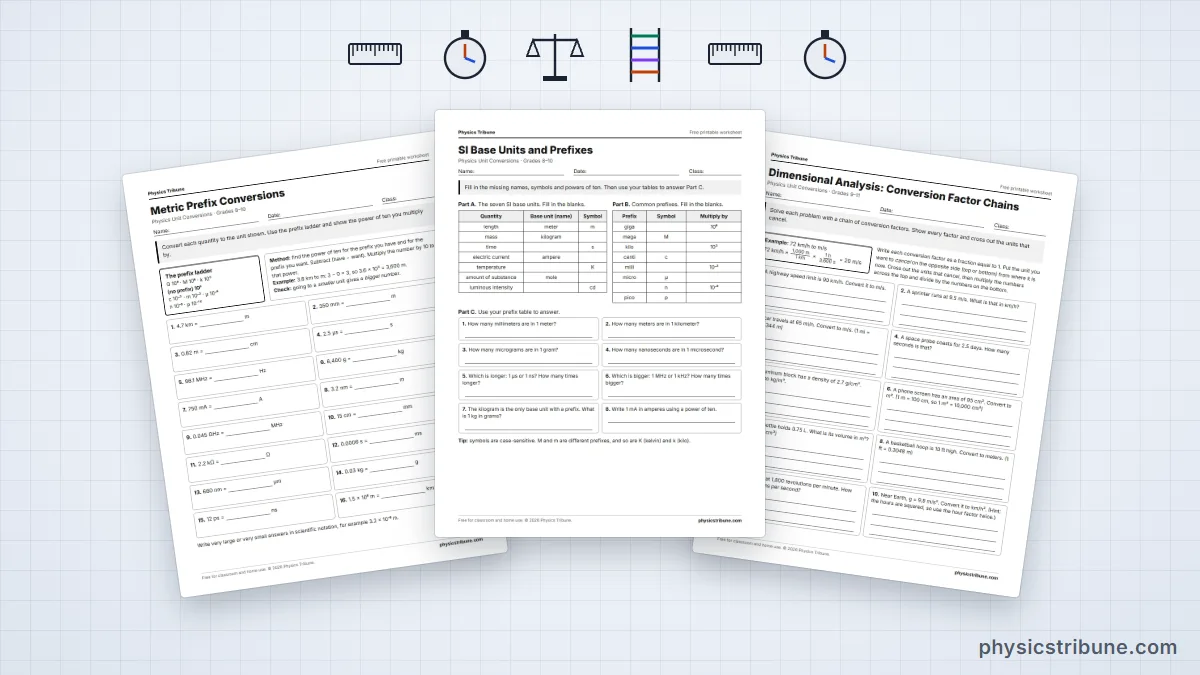 worksheetsPhysics Unit Conversion Worksheets
 unitsImperial and US Customary Units
 unitsSignificant Figures
 calculatorsTemperature Converter (°C, °F, K)
 compareCelsius vs Fahrenheit vs Kelvin
 unitsSI Units (International System of Units)
Sources
Constants come from NIST CODATA 2022 (public domain) and unit definitions from the BIPM SI Brochure (CC BY 4.0). Text, diagrams and illustrations are original work by Physics Tribune.