
At a Glance
Significant figures (sig figs) are the meaningful digits of a measurement: every nonzero digit, zeros between nonzero digits, and trailing zeros after a decimal point. Leading zeros never count. When multiplying or dividing, keep as many sig figs as the least precise input; when adding or subtracting, keep the fewest decimal places.
- Also called
- Significant digits, sig figs
- Always significant
- Nonzero digits and zeros between them
- Never significant
- Leading zeros, as in 0.004
- Multiply or divide
- Fewest significant figures wins
- Add or subtract
- Fewest decimal places wins
- Exact numbers
- Counted values have unlimited sig figs
On this page
- What Are Significant Figures?
- Significant Figures Explained Simply
- What Are the Rules for Counting Significant Figures?
- How Many Significant Figures Do You Keep When Multiplying or Dividing?
- How Do Significant Figures Work in Addition and Subtraction?
- How Do You Round to the Correct Number of Significant Figures?
- How Are Significant Figures Related to Uncertainty?
- Where Do Significant Figures Show Up Outside the Classroom?
- How Can You Practice Significant Figures?
- Common Misconceptions
- Key Facts
- Quiz
- FAQ
What Are Significant Figures?
Every measurement has a limit to how precise it can be. A kitchen scale might show 412 g, while a lab balance might show 412.07 g for the same apple. Significant figures are the digits that carry real information about the quantity, and the number of them tells you how finely it was measured.
The last significant digit is always a little uncertain. If a ruler is marked only in whole centimeters and you read a pencil as 14.3 cm, you are sure of the 1 and the 4 and you have estimated the 3. Writing 14.3000 cm would be a false claim, because the ruler cannot tell you those extra zeros.
Sig figs are a quick, built-in way to report measurement uncertainty without writing a separate plus-or-minus value every time. They matter in every lab report, in engineering drawings and in any physics answer built from measured data.
Significant Figures Explained Simply
Think of significant figures as the digits you would bet money on, plus one careful guess. If a friend says a trip took "about 2 hours", you would not repeat it as 2.000 hours. Doing so would make the time sound like it came from a stopwatch.
Zeros are the tricky part. Some zeros are real measured digits, and some are only placeholders that show where the decimal point sits. In 0.0052 kg, the zeros in front just locate the decimal, so only the 5 and the 2 count. In 5.20 kg, the final zero was measured, so it counts.

What Are the Rules for Counting Significant Figures?
Five rules cover almost every number you will meet:
- Nonzero digits always count. 3.82 has three significant figures.
- Zeros between nonzero digits count. 7.009 has four.
- Leading zeros never count. 0.0061 has two; the zeros only place the decimal point.
- Trailing zeros after a decimal point count. 6.400 has four, because someone chose to write those zeros.
- Trailing zeros in a whole number with no decimal point are ambiguous. 1,500 could have two, three or four. Writing it in scientific notation removes the doubt: 1.50 × 10³ clearly has three.
Exact numbers are a separate case. Counted items, like 12 marbles, and defined values, like 100 cm in 1 m, have unlimited significant figures and never limit the precision of an answer.
How Many Significant Figures Do You Keep When Multiplying or Dividing?
When you multiply or divide measured values, the answer keeps the same number of significant figures as the input with the fewest. A calculator might show eight or ten digits, but most of them are noise. A chain is only as strong as its weakest link, and a calculation is only as precise as its roughest measurement.
Suppose a rectangle measures 4.2 cm by 3.165 cm. The calculator gives 13.293 cm², but 4.2 has only two significant figures, so the area should be reported as 13 cm². The two examples below apply the same idea to speed and weight.
Example 1 Average speed of a cyclist
A cyclist covers 84.6 m in 12.43 s, timed with a stopwatch. Find the average speed, then report it with the correct number of significant figures.
- Given:
- distance traveled:
- elapsed time:
- distance traveled:
- Formula:
- Substitute:
- Answer:
The distance has three significant figures and the time has four, so round the calculator result to three significant figures before reporting it.
Example 2 Weight of a bag of rice
A bag of rice has a measured mass of 2.35 kg. Using g = 9.81 m/s², find its weight and decide how many significant figures to keep.
- Given:
- mass:
- acceleration due to gravity:
- mass:
- Formula:
- Substitute:
- Answer:
Both inputs have three significant figures, so the weight should be reported to three figures as well.
How Do Significant Figures Work in Addition and Subtraction?
Adding and subtracting follow a different rule: look at decimal places, not at the count of significant figures. The answer is rounded to the same decimal place as the input that stops earliest.
Add 152.4 g of water to a beaker of mass 38.17 g and the calculator shows 190.57 g. The first mass is only known to the tenths place, so the total is 190.6 g. Subtraction can also wipe out precision quickly: 9.86 m minus 9.81 m leaves 0.05 m, which has just one significant figure even though both inputs had three.
In a calculation that mixes both kinds of steps, keep one or two extra digits along the way and round only at the very end. Rounding at every step lets small errors pile up.
| Operation | Rule | Example | Reported answer |
|---|---|---|---|
| Multiplication | Fewest significant figures | 4.2 cm × 3.165 cm | 13 cm² |
| Division | Fewest significant figures | 9.0 m ÷ 2.734 s | 3.3 m/s |
| Addition | Fewest decimal places | 152.4 g + 38.17 g | 190.6 g |
| Subtraction | Fewest decimal places | 9.86 m − 9.81 m | 0.05 m |
| Exact factor | Ignore it when counting | 3 × 2.47 kg | 7.41 kg |
| Source: Computed with node; examples are invented for this page · Retrieved October 2026 | |||
How Do You Round to the Correct Number of Significant Figures?
Count from the first nonzero digit to the number of figures you want, then look at the next digit. If it is 5 or more, round the last kept digit up; if it is 4 or less, leave it alone. Replace any dropped digits to the left of the decimal point with zeros so the size of the number does not change.
For example, 0.046 381 rounded to two significant figures is 0.046, and 38,520 rounded to two is 39,000, best written as 3.9 × 10⁴ so the reader knows only two digits are meaningful. The table below shows more numbers and their sig fig counts.
| Number | Significant figures | Why |
|---|---|---|
| 3.82 | 3 | All digits are nonzero |
| 7.009 | 4 | Zeros between nonzero digits count |
| 0.0061 | 2 | Leading zeros only place the decimal point |
| 6.400 | 4 | Trailing zeros after the decimal point count |
| 0.07020 | 4 | Leading zeros do not count; the middle and final zeros do |
| 1,500 | 2, 3 or 4 | Trailing zeros in a whole number are ambiguous |
| 1.50 × 10³ | 3 | Scientific notation shows exactly which digits count |
| 90.010 | 5 | The zero between 9 and 1 and the trailing zero after the decimal point both count |
| 12 students | Unlimited | A counted number is exact |
| 100 cm in 1 m | Unlimited | A defined conversion factor is exact |
| Source: Examples written for this page; counts follow the standard significant-figure rules · Retrieved October 2026 | ||
How Are Significant Figures Related to Uncertainty?
The number of significant figures is a rough stand-in for the relative uncertainty of a measurement. A length of 25.4 cm, read to the nearest 0.1 cm, is uncertain by a fraction of a percent. A length written as 25 cm suggests an uncertainty of around a centimeter, which is several percent.
When precision really matters, scientists state the uncertainty directly, such as 25.4 ± 0.1 cm, and keep the measured value to the same decimal place as the uncertainty. This also helps when comparing your result to an accepted value with the percent error formula.
Do not confuse precision with correctness. A reading can have many significant figures and still be wrong if the instrument is badly calibrated. Our accuracy vs precision comparison explains the difference, and systematic and random errors covers where errors come from.
Significant figures are a shorthand for uncertainty. This formula states the uncertainty directly, as a percentage of the measured value.
| Symbol | Quantity | SI unit |
|---|---|---|
| percent uncertainty | dimensionless (1) | |
| absolute uncertainty of the measurement | dimensionless (1) | |
| measured value | dimensionless (1) |
Rearranged to find another variable:
Valid for: δA and A in the same units (any unit).
Example 3 Percent uncertainty of a ruler reading
You measure a book cover as 25.4 cm long with a ruler you can read to the nearest 0.1 cm. What is the percent uncertainty of the length?
- Given:
- absolute uncertainty of the measurement:
- measured value:
- absolute uncertainty of the measurement:
- Formula:
- Substitute:
- Answer:
Uncertainties are usually quoted to one significant figure, so this is best written as a fraction of a percent with a single digit.

Where Do Significant Figures Show Up Outside the Classroom?
Electronic parts are a neat example. The colored bands on a standard resistor give two significant digits and a power of ten, so a resistor with yellow, violet and red bands is 47 × 102 Ω. With a tolerance of ±5 percent, a third digit would be meaningless, which is exactly why the code stops at two. Precision resistors with a 1 percent tolerance often carry a third digit band for the same reason.
Medicine labels, food packaging and engineering drawings all use the same idea. A bolt drawn as 12.00 mm wide must be made far more carefully than one drawn as 12 mm wide. You can decode the bands of any resistor with our resistor color code calculator.

How Can You Practice Significant Figures?
Start by counting the sig figs in numbers from your own life: the mass on a food label, the distance on a race bib, the volume on a drink bottle. Then redo a few unit conversions and check that the converted value keeps the same number of significant figures as the original, since a conversion factor that is exact never adds or removes precision.
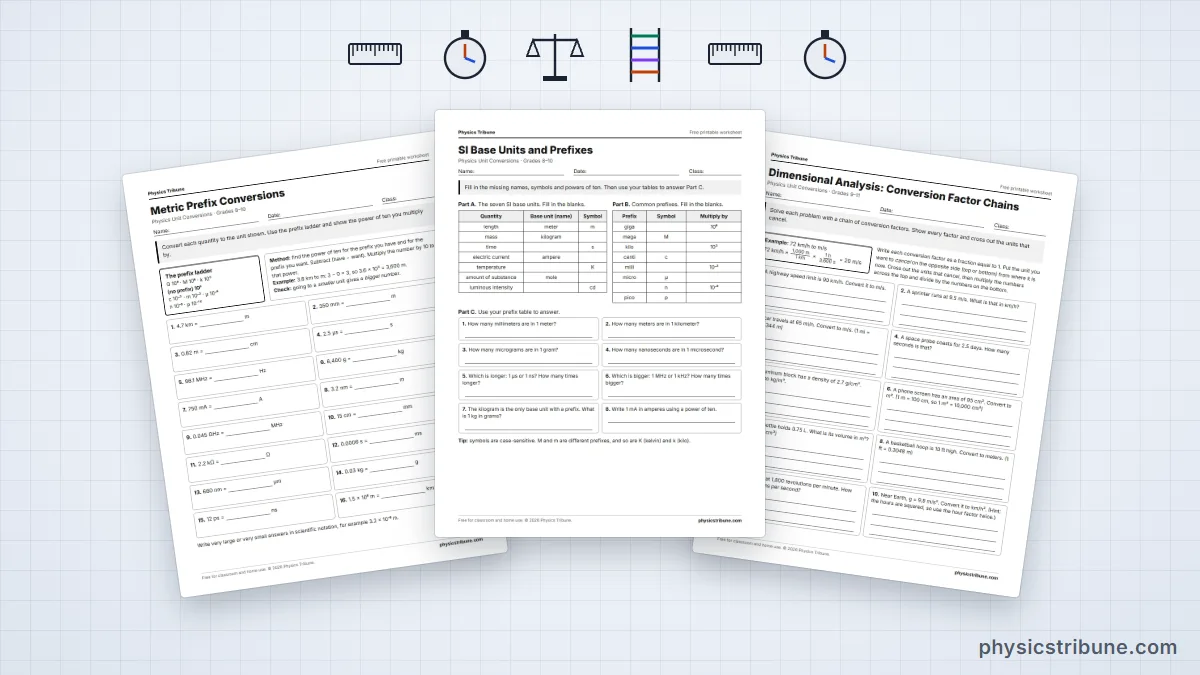
For printable practice that mixes sig figs with unit work, try our physics unit conversion worksheets, then take the short quiz below.
Common Misconceptions
Myth: More decimal places always make an answer more accurate.
Physics: Extra digits beyond the precision of your measurements are just noise. They make an answer look precise without making it any more correct.
Myth: All zeros in a number are significant.
Physics: Leading zeros only show where the decimal point is. In 0.008 there is just one significant figure.
Myth: Adding and multiplying use the same sig fig rule.
Physics: Multiplication and division follow the fewest significant figures, while addition and subtraction follow the fewest decimal places.
Myth: A conversion factor like 1 m = 100 cm limits your answer to one significant figure.
Physics: Defined conversion factors are exact, so they have unlimited significant figures and do not affect the count.
Key Facts
- Significant figures are the reliably known digits of a measurement plus one estimated digit.
- Nonzero digits and zeros between them are always significant, while leading zeros never are.
- Trailing zeros count only when a decimal point shows they were measured.
- When multiplying or dividing, the answer keeps the fewest significant figures of any input.
- When adding or subtracting, the answer keeps the fewest decimal places of any input.
- Counted numbers and defined conversion factors are exact and never limit an answer.
- Round only at the end of a calculation to avoid building up rounding errors.
Quick Quiz: How Well Do You Know Significant Figures?
6 questions. Tap an answer to check it.
How many significant figures are in 0.00408?
The leading zeros do not count; the 4, the middle 0 and the 8 do.
You multiply 3.6 m by 2.145 m. How many significant figures should the area have?
3.6 has two significant figures, the fewest of the inputs.
What is 52.37 g + 4.1 g, reported correctly?
4.1 is known only to the tenths place, so the sum is rounded to tenths.
Which number has exactly four significant figures?
In 25.00 the two trailing zeros after the decimal point are significant, giving four.
Why does the 100 in 1 m = 100 cm not limit significant figures?
Defined conversion factors are exact and have unlimited significant figures.
Round 0.07264 to two significant figures.
The first two significant digits are 7 and 2; the next digit, 6, rounds the 2 up to 3.
Frequently Asked Questions
How do you count significant figures?
Start at the first nonzero digit and count to the right. Include every nonzero digit, every zero sitting between nonzero digits, and every trailing zero that appears after a decimal point. Skip leading zeros, because they only locate the decimal point. If a whole number ends in zeros with no decimal point, the count is ambiguous unless the number is written in scientific notation.
Are trailing zeros significant?
Trailing zeros are significant when the number contains a decimal point, as in 3.20 or 450.0, because the writer chose to record them. In a whole number without a decimal point, such as 4,500, the trailing zeros may or may not be measured. Scientists remove the doubt by using scientific notation, writing 4.50 × 10^3 to show three significant figures.
How many significant figures does 0.0050 have?
It has two significant figures. The three zeros in front of the 5 are placeholders that show the size of the number, so they do not count. The zero after the 5 comes after the decimal point and at the end of the number, so it was measured and does count. In scientific notation the value is 5.0 × 10^-3.
Why are significant figures important in physics?
Physics answers usually come from measurements, and every measurement has limited precision. Significant figures stop a calculation from inventing precision that the data never had. They also let a reader judge, at a glance, how carefully something was measured. A result reported as 9.8 m/s² and one reported as 9.8067 m/s² make very different claims about the experiment behind them.
Do exact numbers affect significant figures?
No. Exact numbers have unlimited significant figures, so they never reduce the precision of an answer. Counted quantities, like 4 wheels on a car, and defined relationships, like 60 seconds in a minute or 2.54 cm in an inch, are exact. When you use them in a calculation, base the sig fig count only on the measured values.
What is the sig fig rule for adding numbers?
For addition and subtraction, look at decimal places rather than total significant figures. Find the input whose last digit sits furthest to the left, and round the answer to that same place. Adding 12.1 s and 0.358 s gives 12.458 s on a calculator, but the first time is only known to the tenths, so the answer is 12.5 s.
When should you round in a multi-step calculation?
Keep at least one or two extra digits in every intermediate step and round only once, at the end. If you round after each step, small rounding errors can add up and shift the final digit. Many teachers suggest storing intermediate results in the calculator memory so that nothing is lost, then applying the sig fig rules to the final answer.
What is the difference between significant figures and decimal places?
Significant figures count the meaningful digits from the first nonzero digit onward, no matter where the decimal point is. Decimal places count only the digits to the right of the decimal point. The number 0.0340 has three significant figures but four decimal places, while 340.5 has four significant figures and one decimal place.
Keep Exploring
 unitsMeasurement, Accuracy & Uncertainty
 unitsMeasurement Uncertainty
 compareAccuracy vs Precision
 unitsPercent Error
 unitsScientific Notation in Physics
 unitsSystematic and Random Errors
 unitsUnit Conversion
 calculatorsResistor Color Code Calculator (4, 5, 6 band)
 worksheetsPhysics Unit Conversion Worksheets