
At a Glance
A number in scientific notation has the form a × 10^n, where 1 ≤ |a| < 10 and n is an integer. Large numbers get positive exponents (93,000,000 = 9.3 × 10^7) and small numbers get negative exponents (0.00042 = 4.2 × 10^-4). To multiply, multiply the coefficients and add the exponents; to divide, divide the coefficients and subtract the exponents.
- General form
- a × 10^n, with 1 ≤ |a| < 10
- Coefficient a
- Holds the significant figures
- Exponent n
- Any integer; sets the size
- Large numbers
- Positive exponent (4.5 × 10^6)
- Small numbers
- Negative exponent (4.5 × 10^-6)
- Calculator form
- E notation, e.g. 6.02E23
On this page
- What Is Scientific Notation?
- Scientific Notation Explained Simply
- How Do You Write a Number in Scientific Notation?
- How Do You Convert Scientific Notation Back to a Regular Number?
- How Do You Multiply and Divide in Scientific Notation?
- How Do You Add and Subtract in Scientific Notation?
- How Does Scientific Notation Show Precision?
- Where Is Scientific Notation Used in Physics?
- What Is E Notation and How Does It Relate to SI Prefixes?
- Who Came Up With Scientific Notation?
- Common Misconceptions
- Key Facts
- Quiz
- FAQ
What Is Scientific Notation?
Scientific notation splits a number into two parts. The coefficient carries the meaningful digits and sits between 1 and 10. The power of ten tells you how many places to slide the decimal point. Together they can describe anything from the mass of an electron to the distance to a star in one short line.
Take the distance from Earth to the Sun, defined as one astronomical unit: 149,597,870,700 m. In scientific notation that is 1.495978707 × 10¹¹ m, and for most purposes 1.50 × 10¹¹ m is plenty. The exponent 11 tells you at a glance that this is a hundred billion meters, without counting digits.
Physicists also call this standard form or exponential notation. It is the default way to write constants such as the speed of light or the Avogadro constant.
Scientific Notation Explained Simply
Think of the exponent as a count of jumps. Every time you multiply by ten, the decimal point jumps one place to the right. So 103 means three jumps right, turning 1 into 1,000. A negative exponent means jumps to the left, so 10-3 turns 1 into 0.001.
Now attach a coefficient. The number 6.4 × 10³ means start with 6.4 and jump three places right: 6,400. The number 6.4 × 10⁻³ means start with 6.4 and jump three places left: 0.0064. The coefficient never changes; only the position of the decimal point does.
A useful habit is to read the exponent first. It gives the size of the quantity, its order of magnitude, before you even look at the digits.
How Do You Write a Number in Scientific Notation?
Converting any ordinary number takes four steps:
- Find the first nonzero digit and place the decimal point just after it. For 0.000362 that gives 3.62; for 58,100 it gives 5.81.
- Count the jumps the decimal point made to get there. From 0.000362 to 3.62 is four jumps; from 58,100 to 5.81 is four jumps.
- Choose the sign of the exponent. If the original number was smaller than 1, the exponent is negative; if it was 10 or larger, it is positive.
- Write the result: 0.000362 = 3.62 × 10⁻⁴ and 58,100 = 5.81 × 10⁴.
Numbers from 1 up to 10 get the exponent zero, since 100 = 1. So 7.2 is simply 7.2 × 100, and nobody bothers writing the power.
How Do You Convert Scientific Notation Back to a Regular Number?
Run the steps in reverse. A positive exponent moves the decimal point to the right by that many places, padding with zeros if you run out of digits. A negative exponent moves it to the left, again padding with zeros.
For example, 2.05 × 10⁵ becomes 205,000, and 8.1 × 10⁻⁶ becomes 0.0000081. A quick check is to compare sizes: a positive exponent should give a number larger than the coefficient, and a negative exponent a smaller one. If your answer went the wrong way, the decimal point moved in the wrong direction.
How Do You Multiply and Divide in Scientific Notation?
Multiplication and division are where scientific notation really pays off. To multiply, multiply the coefficients and add the exponents: (3.0 × 10⁸)(2.0 × 10⁻³) = 6.0 × 10⁵. To divide, divide the coefficients and subtract the exponents: (6.0 × 1024) ÷ (3.0 × 10⁶) = 2.0 × 10¹⁸.
Sometimes the new coefficient falls outside the range 1 to 10, and you need to tidy it. If you get 24 × 105, rewrite 24 as 2.4 × 101 and add the exponents to get 2.4 × 10⁶. If you get 0.5 × 10³, rewrite it as 5 × 10².
The diagram shows why physicists lean on this. A cell membrane holds about 0.07 V across a layer only about 7 × 10⁻⁹ m thick, and dividing gives a field near 1 × 10⁷ V/m, a value that is much easier to read with an exponent than with seven zeros.
Example 2 How many electrons make one coulomb?
Each electron carries a charge of magnitude e = 1.602176634 × 10^-19 C. How many electrons are needed for a total charge of 1 C?
- Given:
- total charge:
- elementary charge:
- total charge:
- Formula:
- Substitute:
- Answer:
Dividing by a negative power of ten flips its sign, which is why a tiny charge per electron means an enormous count, written with a positive exponent.
Example 3 Kinetic energy of a drifting dust grain
A dust grain with a mass of 2.0 × 10^-9 kg drifts through the air at 3.0 m/s. What is its kinetic energy in joules?
- Given:
- mass:
- speed:
- mass:
- Formula:
- Substitute:
- Answer:
Written out in full the answer would start with eight zeros after the decimal point, which is exactly the kind of number scientific notation is designed for.

How Do You Add and Subtract in Scientific Notation?
Adding and subtracting need one extra step: the exponents must match first. Rewrite the smaller number so it uses the same power of ten as the larger one, then add or subtract the coefficients and keep that power.
For example, 4.2 × 10⁵ + 3.1 × 10⁴ becomes 4.2 × 10⁵ + 0.31 × 105 = 4.51 × 10⁵. In a measured problem you would then round to match the least precise decimal place, as our significant figures guide explains, giving 4.5 × 10⁵. When the exponents differ by more than a few, the smaller number may barely change the result at all.
| Operation | Rule | Example |
|---|---|---|
| Multiply | Multiply coefficients, add exponents | (2 × 10³)(4 × 10⁵) = 8 × 10⁸ |
| Divide | Divide coefficients, subtract exponents | (9 × 10⁷) ÷ (3 × 10²) = 3 × 10⁵ |
| Add | Match exponents, add coefficients | 5.0 × 10⁴ + 2.0 × 103 = 5.2 × 10⁴ |
| Subtract | Match exponents, subtract coefficients | 7.5 × 10⁻³ − 5.0 × 10-4 = 7.0 × 10⁻³ |
| Power | Raise the coefficient, multiply the exponent | (3 × 10⁴)^2 = 9 × 10⁸ |
| Square root | Root of the coefficient, halve an even exponent | √(1.6 × 10⁹) = √(16 × 108) = 4 × 10⁴ |
| Tidy up | Shift so 1 ≤ a < 10 | 25 × 106 = 2.5 × 10⁷ |
| Source: Examples computed by us · Retrieved October 2026 | ||
How Does Scientific Notation Show Precision?
A big advantage of scientific notation is that it removes doubt about trailing zeros. Written as 1,500 m, a distance could have two, three or four significant figures. Written as 1.5 × 10³ m, it clearly has two; as 1.500 × 10³ m, it clearly has four.
Every digit in the coefficient counts as significant, and the exponent never does. That makes scientific notation the natural partner of measurement uncertainty: the coefficient states how well you know the value, and the exponent states how big it is.
Where Is Scientific Notation Used in Physics?
Almost every branch of physics needs it. Constants such as the Planck constant (6.62607015 × 10⁻³⁴ J s) and the elementary charge would be unreadable without it. Astronomy distances, atomic sizes, nuclear energies and the frequencies of the electromagnetic spectrum all span many powers of ten.
It also lets you estimate before you calculate. In
Wave formulas are a classic place where scientific notation does the heavy lifting, because frequencies of light are huge and wavelengths are tiny.
| Symbol | Quantity | SI unit |
|---|---|---|
| speed of light in vacuum (2.998 × 10⁸ m/s (exact: 299 792 458 m/s)) | meter per second (m/s) | |
| frequency | hertz (Hz) | |
| wavelength in vacuum | meter (m) |
Rearranged to find another variable:
Valid for: electromagnetic waves in vacuum.
Example 1 Frequency of green light
Green light has a wavelength of 5.5 × 10^-7 m (550 nm). Using c = 2.99792458 × 10^8 m/s, find its frequency and write the answer in scientific notation.
- Given:
- speed of light in vacuum:
- wavelength in vacuum:
- speed of light in vacuum:
- Formula:
- Substitute:
- Answer:
Dividing 10^8 by 10^-7 gives 10^15, so the answer must be a few times 10^14 Hz, a quick check you can make before touching a calculator.
| Quantity | Written out | Scientific notation |
|---|---|---|
| Speed of light in vacuum | 299,792,458 m/s | 2.99792458 × 10⁸ m/s (exact) |
| Astronomical unit (Earth to Sun) | 149,597,870,700 m | 1.495978707 × 10¹¹ m (exact) |
| Light-year | about 9,460,730,000,000,000 m | about 9.461 × 10¹⁵ m |
| Avogadro constant | 602,214,076,000,000,000,000,000 per mol | 6.02214076 × 10²³ mol^-1 (exact) |
| Elementary charge | 0.0000000000000000001602176634 C | 1.602176634 × 10⁻¹⁹ C (exact) |
| Planck constant | 33 zeros after the decimal point, then 662607015 | 6.62607015 × 10⁻³⁴ J s (exact) |
| Electron mass | 30 zeros after the decimal point, then 91093837139 | 9.1093837139 × 10⁻³¹ kg |
| Gravitational constant | 0.0000000000667430 m^3 kg^-1 s^-2 | 6.67430 × 10⁻¹¹ m^3 kg^-1 s^-2 |
| Diameter of an atom | about 0.0000000001 m | about 1 × 10⁻¹⁰ m |
| Source: Constants: NIST CODATA 2022 (physics.nist.gov) · public domain; astronomical unit as defined by the IAU (exact); light-year computed from c × 365.25 days; atom size is a typical value · Retrieved October 2026 | ||

What Is E Notation and How Does It Relate to SI Prefixes?
Calculators and spreadsheets use E notation, where the letter E stands for "times ten to the". So 6.02E23 means 6.02 × 10²³ and 1.6E-19 means 1.6 × 10⁻¹⁹. Most calculators have an EE or EXP key for typing these, and pressing it is safer than typing "× 10 ^" by hand.
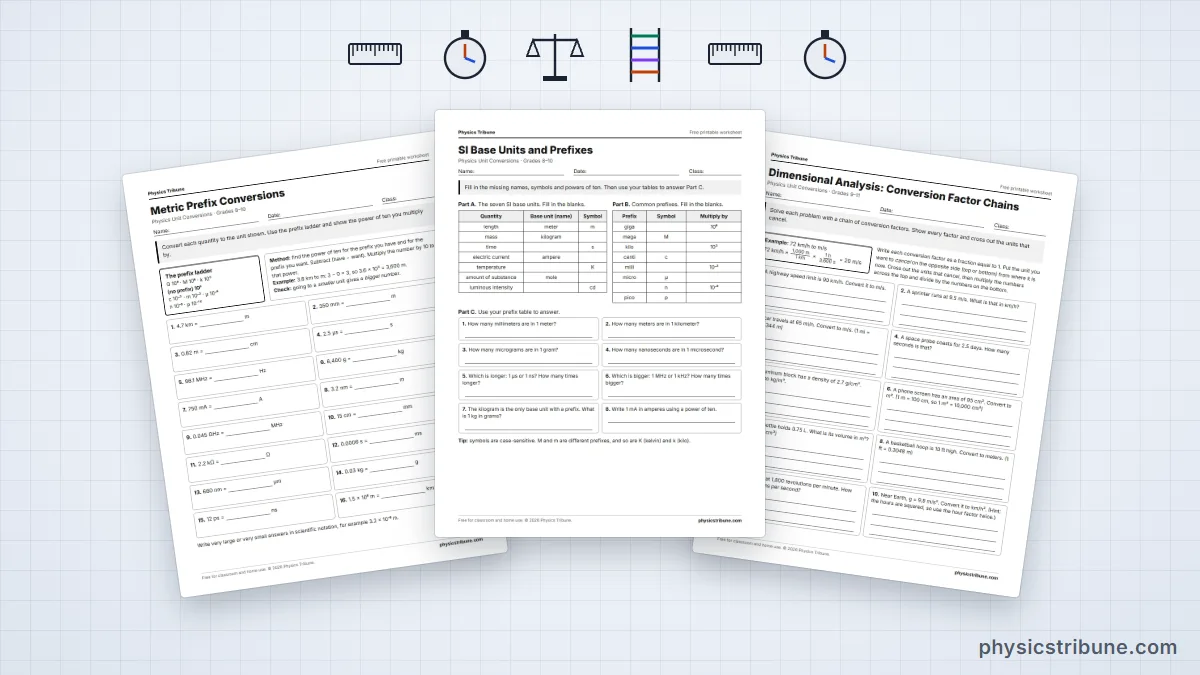
Engineers often prefer engineering notation, where the exponent is always a multiple of three. That lines up with the SI prefixes: 4.7 × 10³ Ω is 4.7 kΩ, and 2.2 × 10⁻⁶ F is 2.2 µF. Our unit converter moves between these forms, and the unit conversion worksheets give practice.
Who Came Up With Scientific Notation?
The idea of naming huge numbers by powers is old. Around the third century BC, Archimedes wrote a short work estimating how many grains of sand would fill the universe as he pictured it. He built a system of ever-larger orders of numbers to express the answer, which we would now write as about 1063.
Modern exponent notation grew out of algebra in the 1600s, and the form a × 10n became routine in science during the following centuries. Today it is built into every scientific calculator and programming language.

Common Misconceptions
Myth: A negative exponent means the number itself is negative.
Physics: A negative exponent only means the number is smaller than 1, such as 3 × 10^-2 = 0.03. A negative number has a minus sign in front of the coefficient, like −3 × 10^2.
Myth: The exponent tells you how many zeros the number has.
Physics: That only works when the coefficient is 1. For 4.7 × 10^5 the number is 470,000, which has four zeros, because some of the jumps are used up by the digit 7.
Myth: Any form like 32 × 10^4 counts as scientific notation.
Physics: The coefficient must be at least 1 and less than 10, so 32 × 10^4 should be written 3.2 × 10^5. Other forms are valid math but not standard scientific notation.
Myth: Adding numbers in scientific notation means adding the exponents.
Physics: Exponents are added only when multiplying. For addition, the exponents must first be made equal, then the coefficients are added.
Key Facts
- Scientific notation writes a number as a × 10^n with the coefficient a between 1 and 10.
- Positive exponents describe large numbers and negative exponents describe numbers smaller than 1.
- To multiply, multiply the coefficients and add the exponents; to divide, divide and subtract.
- To add or subtract, first rewrite the numbers with the same power of ten.
- Every digit in the coefficient is a significant figure; the exponent is not.
- Calculators show scientific notation as E notation, so 3E8 means 3 × 10^8.
- Engineering notation uses exponents that are multiples of three, matching SI prefixes.
Quick Quiz: How Well Do You Know Scientific Notation in Physics?
6 questions. Tap an answer to check it.
Which of these is 42,000 written in scientific notation?
The coefficient must be between 1 and 10, and moving the decimal four places gives 4.2 × 10^4.
What is 7.5 × 10^-3 as an ordinary number?
A negative exponent moves the decimal point left, three places here, giving 0.0075.
What is (3 × 10^5) × (2 × 10^4)?
Multiply the coefficients (3 × 2 = 6) and add the exponents (5 + 4 = 9).
What is (8 × 10^6) ÷ (2 × 10^-2)?
Divide the coefficients to get 4 and subtract the exponents: 6 − (−2) = 8.
How many significant figures does 3.040 × 10^5 have?
Every digit in the coefficient counts, including the trailing zero, so 3, 0, 4 and 0 make four.
A calculator shows 2.5E-6. What does it mean?
E notation means times ten to the power shown, so 2.5E-6 is 2.5 × 10^-6.
Frequently Asked Questions
What is scientific notation in physics?
It is a compact way to write numbers as a coefficient between 1 and 10 times a power of ten. Physics uses it constantly because measured quantities range from about 10^-35 m for the smallest meaningful lengths to over 10^26 m for the observable universe. It keeps numbers short, makes precision clear and lets you compare sizes quickly.
How do you write 0.00056 in scientific notation?
Move the decimal point to just after the first nonzero digit, giving 5.6. That took four jumps to the right, and the original number is smaller than 1, so the exponent is negative. The answer is 5.6 × 10^-4. You can check by moving the decimal four places left from 5.6, which returns 0.00056.
What are the rules for multiplying in scientific notation?
Multiply the two coefficients and add the two exponents. For example, (4 × 10^6)(2 × 10^-2) = 8 × 10^4. If the product of the coefficients is 10 or more, shift the decimal and raise the exponent by one, so 5 × 10^3 times 4 × 10^2 becomes 20 × 10^5, or 2 × 10^6.
Why do scientists use scientific notation?
It saves space, reduces errors from miscounted zeros and shows the number of significant figures without ambiguity. It also makes estimates easy, since you can multiply and divide powers of ten in your head. When values span many orders of magnitude, such as wavelengths in the electromagnetic spectrum, it is the only practical way to compare them.
What does E mean on a calculator?
E is shorthand for times ten to the power of. A display of 3.2E-7 means 3.2 × 10^-7, and 1.5E11 means 1.5 × 10^11. It has nothing to do with the number e, about 2.718, used in exponential functions. To enter such a number, use the EE or EXP key rather than typing the multiplication yourself.
Can the coefficient in scientific notation be 10?
No. The coefficient must be at least 1 and strictly less than 10. A result such as 10 × 10^4 should be rewritten as 1 × 10^5. Allowing only one digit before the decimal point gives every number a single standard form, which makes comparing values and counting significant figures straightforward.
What is the difference between scientific and engineering notation?
Scientific notation keeps the coefficient between 1 and 10 and allows any integer exponent. Engineering notation lets the coefficient run from 1 up to 1,000 and restricts the exponent to multiples of three. That matches SI prefixes, so 4.7 × 10^4 Ω in scientific notation becomes 47 × 10^3 Ω, or 47 kΩ, in engineering notation.
How do you add numbers with different exponents?
Rewrite one of them so both share the same power of ten, then add the coefficients. For 6.0 × 10^3 + 4.0 × 10^2, change the second to 0.40 × 10^3 and add to get 6.4 × 10^3. Matching to the larger exponent usually keeps the answer close to standard form.
Keep Exploring








Sources
Constants come from NIST CODATA 2022 (public domain) and unit definitions from the BIPM SI Brochure (CC BY 4.0). Text, diagrams and illustrations are original work by Physics Tribune.