
At a Glance
Dimensional analysis writes each quantity in terms of base dimensions, for example force = [M L T^-2] and energy = [M L^2 T^-2], and requires both sides of an equation to match. It shows that T = 2π√(L/g) is consistent, since √([L] / [L T^-2]) = [T], but it cannot find pure numbers such as 2π.
- What it tracks
- Dimensions: [M], [L], [T], [I], [Θ], [N], [J]
- Core rule
- Both sides of an equation have equal dimensions
- Example
- Force [M L T^-2], energy [M L^2 T^-2]
- Main uses
- Check equations, derive relations, convert units
- Cannot find
- Dimensionless constants like 2π or ½
- Related method
- Factor-label unit conversion
On this page
- What Is Dimensional Analysis?
- Dimensional Analysis Explained Simply
- What Are the Base Dimensions in Physics?
- How Do You Find the Dimensions of a Quantity?
- How Do You Check an Equation With Dimensional Analysis?
- How Can Dimensional Analysis Derive a Formula?
- How Is Dimensional Analysis Used for Unit Conversion?
- What Are the Limitations of Dimensional Analysis?
- Who Developed Dimensional Analysis?
- Common Misconceptions
- Key Facts
- Quiz
- FAQ
What Is Dimensional Analysis?
Every physical quantity has a kind, separate from its size. A distance is a length, whether it is 3 mm or 3 light-years. A speed is a length divided by a time. Dimensional analysis keeps track of these kinds, called dimensions, and uses them to test and build equations.
The method rests on one principle: you can only set equal, add or subtract quantities of the same kind. Adding a mass to a time makes no sense, just as adding apples to hours makes no sense. So if one side of an equation works out to a length and the other to a time, the equation is wrong, no matter how good the algebra looked.
Physicists use dimensional analysis to check homework, to sanity-test research results and to guess the form of a law before doing a full calculation. Engineers use the same ideas to scale up tests on small models of ships, bridges and aircraft.
Dimensional Analysis Explained Simply
Think of dimensions as labels that ride along with every number. When you multiply quantities, the labels multiply too. When you divide, they divide. At the end, the label on your answer has to be the right kind of thing.
Suppose you work out how long a trip takes and get an answer labeled "meters per second". You know right away that something went wrong, because a time should carry a time label. You have not found the mistake yet, but you know it is there. That instant warning is what makes dimensional analysis so handy.
What Are the Base Dimensions in Physics?
The SI builds every unit from seven base quantities, and each has its own dimension symbol. Mechanics needs only three of them: mass [M], length [L] and time [T]. Electricity adds current [I], heat adds temperature [Θ], chemistry adds amount of substance [N], and light measurement adds luminous intensity [J].
Square brackets mean "the dimensions of". So [v] = [L T-1] reads "the dimensions of velocity are length per time". Each base dimension matches one of the SI base units, listed in the table, though dimensions themselves do not depend on which unit system you choose.
| Base quantity | SI unit | Dimension symbol |
|---|---|---|
| Length | meter (m) | L |
| Mass | kilogram (kg) | M |
| Time | second (s) | T |
| Electric current | ampere (A) | I |
| Thermodynamic temperature | kelvin (K) | Θ |
| Amount of substance | mole (mol) | N |
| Luminous intensity | candela (cd) | J |
| Source: BIPM SI Brochure, 9th edition, Table 2 (CC BY 4.0) · Retrieved October 2026 | ||
How Do You Find the Dimensions of a Quantity?
Start from a defining equation and replace each quantity with its dimensions. Velocity is distance over time, so [v] = [L T-1]. Acceleration is change in velocity over time, giving [L T-2]. Force is mass times acceleration, so [F] = [M L T-2], and work is force times distance, giving [M L2 T-2].
Each step builds on the one before, so you rarely need to memorize these. Pure numbers like 2, ½ or π have no dimensions, and neither do ratios of like quantities, such as angles in radians or the coefficient of friction. Those are called dimensionless quantities.
| Quantity | Defining relation | Dimensions | SI unit |
|---|---|---|---|
| Area | length × length | L^2 | m^2 |
| Velocity | distance / time | L T^-1 | m/s |
| Acceleration | velocity / time | L T^-2 | m/s^2 |
| Density | mass / volume | M L^-3 | kg/m^3 |
| Momentum | mass × velocity | M L T^-1 | kg m/s |
| Force | mass × acceleration | M L T^-2 | newton (N) |
| Energy, work | force × distance | M L^2 T^-2 | joule (J) |
| Power | energy / time | M L^2 T^-3 | watt (W) |
| Pressure | force / area | M L^-1 T^-2 | pascal (Pa) |
| Frequency | 1 / period | T^-1 | hertz (Hz) |
| Electric charge | current × time | I T | coulomb (C) |
| Voltage | power / current | M L^2 T^-3 I^-1 | volt (V) |
| Gravitational constant G | F r^2 / (m1 m2) | M^-1 L^3 T^-2 | m^3 kg^-1 s^-2 |
| Source: Derived by us from the defining relations; unit names from the BIPM SI Brochure, 9th edition (CC BY 4.0) · Retrieved October 2026 | |||
How Do You Check an Equation With Dimensional Analysis?
Write the dimensions of every term and compare. Take the kinematics equation
The first term on the right is [L T-1][T] = [L]. The second is [L T-2][T2] = [L]. Every term is a length, so the equation is dimensionally consistent.
Now suppose a student writes
Passing the check does not prove an equation correct, but failing it always proves the equation wrong. That one-way test is still enormously useful.
Example 1 A ball thrown across a field
A 0.40 kg ball leaves a player's hand at 12 m/s. Find its kinetic energy and check that kilograms times meters squared per second squared really gives joules.
- Given:
- mass:
- speed:
- mass:
- Formula:
- Substitute:
- Answer:
The units multiply out to kg m²/s², which is exactly the joule, so the formula passes its dimensional check as well as giving the number.

How Can Dimensional Analysis Derive a Formula?
When you know which quantities matter but not how they combine, dimensions can fill in the rest. Ask what the period
Matching dimensions gives [T] = [M]a[L]b[L T-2]c. For mass, a = 0, so the period does not depend on mass at all. For time, −2c = 1, so c = −½. For length, b + c = 0, so b = ½. The result is
Three lines of bookkeeping predicted that heavier bobs swing no faster, and that a pendulum four times longer takes twice as long per swing. You can test those predictions with our pendulum calculator or the pendulum period lab.
Dimensional analysis predicts this formula almost completely; only the factor 2π has to come from a full solution of the motion.
| Symbol | Quantity | SI unit |
|---|---|---|
| period | second (s) | |
| length of the pendulum (pivot to center of mass of bob) | meter (m) | |
| acceleration due to gravity (9.80 m/s² (standard 9.80665 m/s²)) | meter per second squared (m/s²) |
Rearranged to find another variable:
Valid for: small amplitude (θ ≲ 15°), point-mass bob, massless string; independent of mass.
Example 2 Period of a swing seat model
A small weight hangs on a string 0.75 m long, with g = 9.80665 m/s². Use the pendulum formula that dimensional analysis predicts to find its period for small swings.
- Given:
- length of the pendulum (pivot to center of mass of bob):
- acceleration due to gravity:
- length of the pendulum (pivot to center of mass of bob):
- Formula:
- Substitute:
- Answer:
Meters divided by meters per second squared leaves seconds squared, and the square root leaves seconds, just as a period should.

How Is Dimensional Analysis Used for Unit Conversion?
In chemistry and introductory physics, the phrase dimensional analysis often means the factor-label method of unit conversion. You multiply by fractions equal to one, such as 1,000 m / 1 km, arranged so that unwanted units cancel. If the leftover units are the ones you wanted, the setup is right.
Both meanings share the same idea: units and dimensions are algebra, and they must balance. Mixing units can be costly. In 1999, NASA lost the Mars Climate Orbiter partly because one piece of software reported impulse in pound-force seconds while another expected newton seconds. Our unit converter and unit conversion worksheets help build the habit.
Example 3 Converting a highway speed
A car travels 72 km in one hour. Convert the distance to meters and the time to seconds, then find its speed in meters per second.
- Given:
- distance traveled:
- elapsed time:
- distance traveled:
- Formula:
- Substitute:
- Answer:
The factor-label chain is 72 km/h × 1,000 m/km × 1 h/3,600 s; the km and h cancel and leave m/s.
What Are the Limitations of Dimensional Analysis?
Dimensional analysis cannot find pure numbers. It predicted the pendulum formula up to the factor
It struggles when a quantity depends on several variables of the same kind, such as two different lengths, because many combinations then give the right dimensions. It says nothing about functions like sine, logarithm or exponential, except that their arguments must be dimensionless. And it can be fooled by quantities that share dimensions but differ in meaning: torque and energy are both [M L2 T-2], yet torque is not energy.

Who Developed Dimensional Analysis?
Scientists had used similar reasoning for a long time, but the French mathematician Joseph Fourier is usually credited with making dimensions a formal tool in his 1822 book on the theory of heat. He insisted that every term in an equation must have matching dimensions.
Later in the nineteenth century, Lord Rayleigh used dimensional arguments widely, including in his reasoning about why the sky is blue. In 1914 the American physicist Edgar Buckingham published the result now called the Buckingham π theorem, which tells you how many independent dimensionless groups a problem has. It remains the backbone of model testing in engineering.
Common Misconceptions
Myth: If the dimensions on both sides match, the equation must be correct.
Physics: Matching dimensions is necessary but not enough. KE = mv² has the right dimensions but is wrong by a factor of ½, which dimensional analysis cannot detect.
Myth: Dimensions and units are the same thing.
Physics: A dimension is the kind of quantity, such as length. Units are particular sizes of it, such as meters, feet or miles. One dimension can be measured in many units.
Myth: Quantities with the same dimensions are always the same kind of physical thing.
Physics: Torque and energy share the dimensions [M L^2 T^-2] but mean different things, which is why torque is written in N m and never in joules.
Myth: Angles have dimensions because they have units like degrees and radians.
Physics: An angle in radians is an arc length divided by a radius, a length over a length, so it is dimensionless even though it carries a unit name.
Key Facts
- Dimensional analysis tracks the kinds of quantities, such as mass [M], length [L] and time [T].
- Every term added or set equal in a valid equation must have the same dimensions.
- Force has dimensions [M L T^-2] and energy has dimensions [M L^2 T^-2].
- An equation that fails a dimensional check is certainly wrong; one that passes may still be wrong.
- Dimensional analysis predicts that a pendulum's period depends on √(L/g) and not on its mass.
- It cannot find dimensionless numbers such as 2π, ½ or e.
- The factor-label method of unit conversion uses the same idea of cancelling units.
Quick Quiz: How Well Do You Know Dimensional Analysis?
6 questions. Tap an answer to check it.
What are the dimensions of acceleration?
Acceleration is velocity [L T^-1] divided by time [T], giving [L T^-2].
Which quantity has dimensions [M L^2 T^-2]?
Energy is force [M L T^-2] times distance [L], giving [M L^2 T^-2].
A student writes x = vt². Is it dimensionally consistent?
[L T^-1][T^2] = [L T], which is not a length, so the equation must be wrong.
Dimensional analysis shows that a simple pendulum's period depends on which of these?
Matching dimensions forces the mass exponent to zero and gives T proportional to √(L/g).
Which of these is dimensionless?
The coefficient of friction is a force divided by a force, so its dimensions cancel.
What can dimensional analysis NOT tell you about KE = ½mv²?
Pure numbers like ½ have no dimensions, so they cannot be found this way.
Frequently Asked Questions
What is dimensional analysis in physics?
It is a technique that describes every quantity by its basic dimensions, such as mass, length and time, and uses the rule that both sides of an equation must match. It lets you check formulas for errors, convert units reliably and predict how one quantity depends on others before solving a problem in full.
What are the dimensions of force?
Force equals mass times acceleration. Mass has dimension [M] and acceleration has [L T^-2], so force has dimensions [M L T^-2]. In SI units that is kilogram meter per second squared, which is the newton. Any quantity measured in newtons, including weight, tension and friction, shares these dimensions.
How do you check if an equation is dimensionally correct?
Write each term in base dimensions and simplify. Every term that is added, subtracted or set equal must reduce to the same combination. For v = u + at, both u and at reduce to [L T^-1], matching v. If any term disagrees, the equation contains an error and should be rechecked.
What is the difference between dimensions and units?
Dimensions describe what kind of quantity something is, such as a length or a time. Units are agreed sizes for measuring it, like the meter or the foot. Changing units changes the number you write but never the dimensions. That is why dimensional analysis works the same in SI, US customary or any other system.
Can dimensional analysis find constants like 2π?
No. Pure numbers have no dimensions, so they are invisible to the method. Dimensional analysis can tell you that a pendulum's period is proportional to the square root of length over g, but the factor 2π comes from solving the equation of motion or from experiment. The same is true for the ½ in kinetic energy.
What is a dimensionless quantity?
A dimensionless quantity has no net dimensions because its units cancel. Examples include the coefficient of friction, refractive index, strain, angles in radians and efficiency. They often appear as ratios of two quantities of the same kind. Many important engineering numbers, such as the Reynolds number in fluid flow, are dimensionless groups.
Is dimensional analysis the same as unit conversion?
They are closely related. In chemistry classes, dimensional analysis usually means the factor-label method, where conversion fractions are chained so units cancel. In physics the term more often means checking or deriving equations with base dimensions. Both rely on treating units and dimensions like algebraic symbols that must balance.
What is the Buckingham pi theorem?
It is a result published by Edgar Buckingham in 1914. It says that if a problem involves n variables built from k independent dimensions, the physics can be written using n minus k dimensionless groups. Engineers use it to plan model tests, so a small model in a wind tunnel or water tank behaves like the full-size object.
Keep Exploring
 unitsUnit Conversion
 unitsThe 7 SI Base Units
 unitsPhysical Quantities
 wavesSimple Pendulum (Period of a Pendulum)
 calculatorsPendulum Period Calculator & Simulator
 calculatorsPhysics Unit Converter (SI, prefixes, derived units)
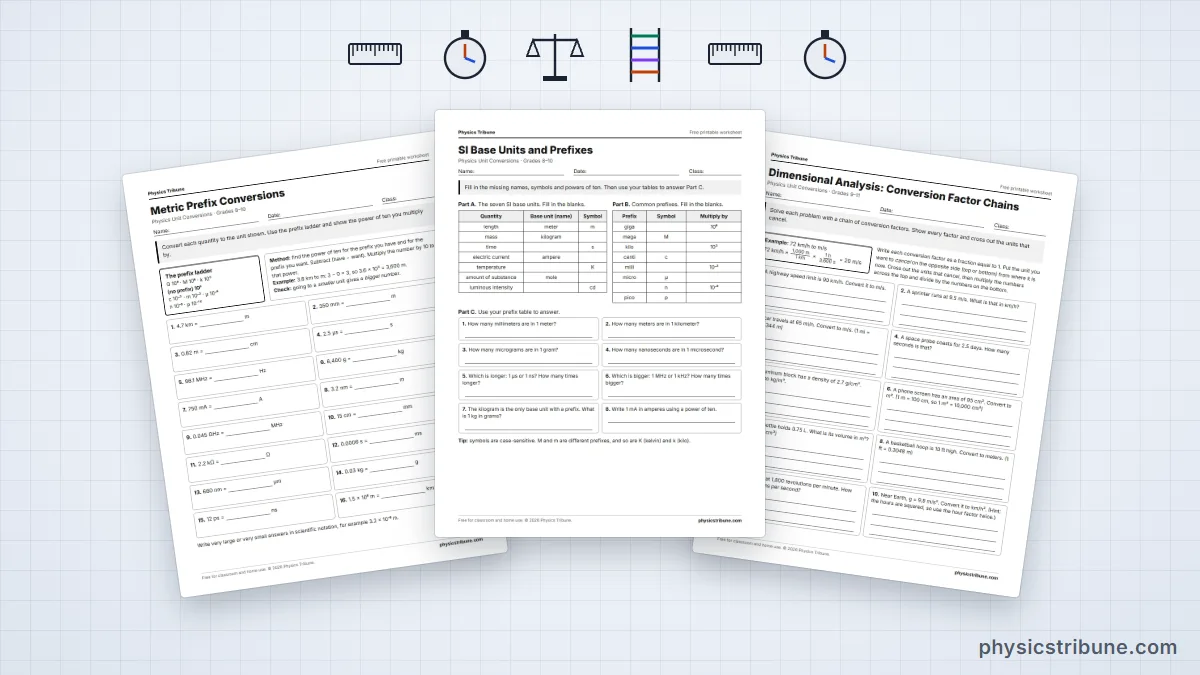 worksheetsPhysics Unit Conversion Worksheets
 compareMass vs Weight
 physicistsLord Rayleigh