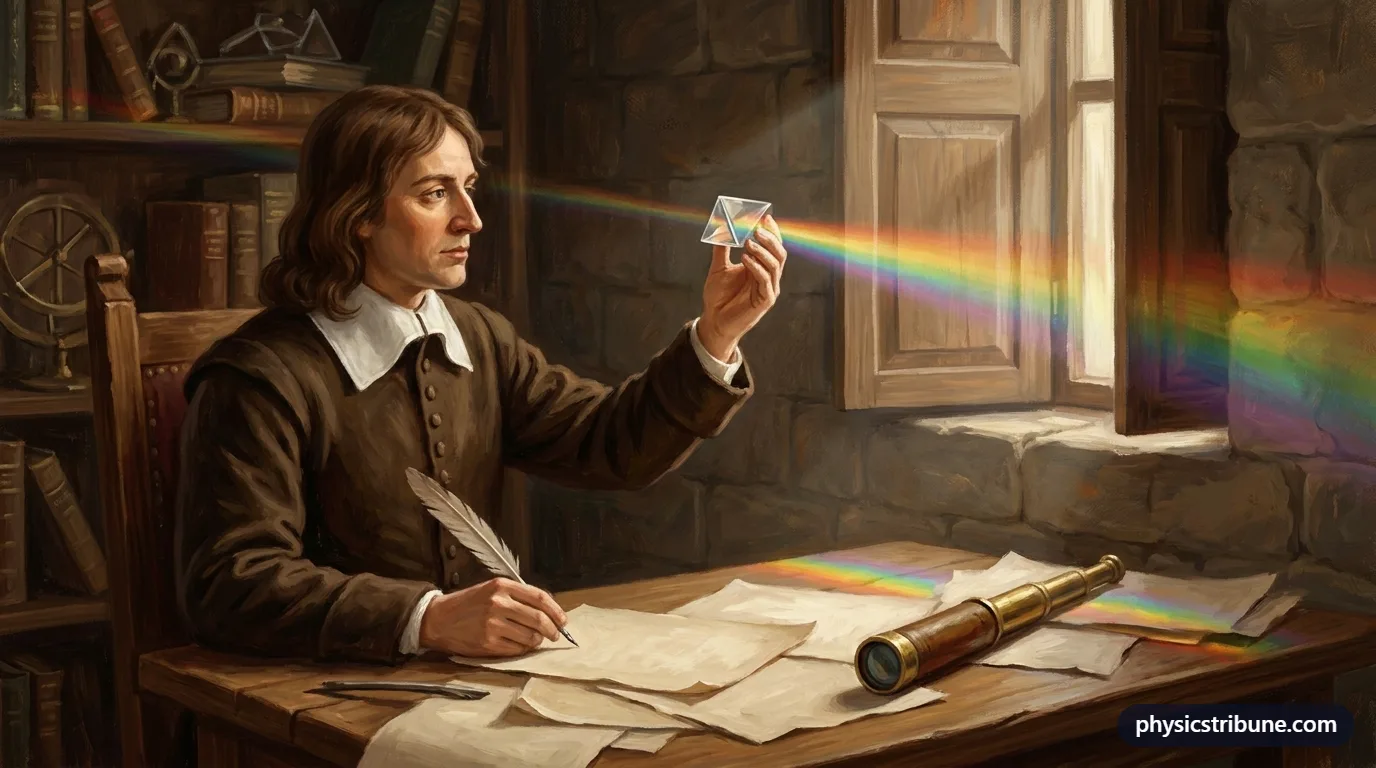
At a Glance
Thomas Young (born June 13, 1773, died May 10, 1829) was an English polymath best known for his double-slit experiment, which showed that light is a wave because two overlapping beams create a pattern of bright and dark fringes. The fringe spacing follows Δy = λL / d, where λ is the wavelength, L the distance to the screen and d the slit separation.
- Born
- June 13, 1773, in Somerset, England
- Died
- May 10, 1829, in London, age 55
- Nationality
- United Kingdom of Great Britain and Ireland
- Known for
- Double-slit experiment and the wave nature of light
- Other work
- Three-color theory of vision, Young's modulus, hieroglyphs
- Key equation
- Δy = λL / d (double-slit fringe spacing)
On this page
- Who Was Thomas Young?
- Early Life and Education
- How Did Young Explain Vision and Color?
- What Did Young's Double-Slit Experiment Show?
- Why Did People Doubt Young's Wave Theory?
- What Is Young's Modulus Named After?
- Did Thomas Young Decode the Rosetta Stone?
- Young's Key Equation
- Later Life and Legacy
- Key Facts
- Quiz
- FAQ
Who Was Thomas Young?
Thomas Young was a doctor by training and a scientist by temperament who worked across an astonishing range of subjects. His most lasting result in physics is the demonstration that light spreads and overlaps like ripples on water. When two beams cross, they can add to make extra brightness or cancel to make darkness, an effect called interference.
He lived at a time when most British scientists followed Newton's view that light is a stream of tiny particles. Young challenged that view with careful experiments and simple reasoning, and his work paved the way for the full wave theory that Augustin-Jean Fresnel developed a few years later.
Outside optics, Young studied how the eye focuses, how we see color, how materials stretch, how liquids form drops, and how ancient Egyptian writing works. Friends and critics alike described him as someone who seemed to know a little about everything and a lot about most things.
Early Life and Education
Young was born in 1773 in the village of Milverton in Somerset, England, the eldest of ten children in a Quaker family. He learned to read very early and as a boy worked his way through many languages, including Latin, Greek, Hebrew and several modern ones. He also built optical instruments and studied natural history on his own.
A great-uncle who was a respected London physician encouraged him toward medicine. Young studied in London and Edinburgh and then at the University of Göttingen in Germany, where he earned a medical doctorate in 1796. He later spent time at Emmanuel College, Cambridge, before settling into medical practice in London.
An inheritance from that great-uncle gave him financial freedom. That mattered, because his patients were never numerous and his real passion was research, which he could now pursue without needing a large practice.
| Year | Event |
|---|---|
| 1773 | Born on June 13 in Milverton, Somerset, England |
| 1794 | Elected to the Royal Society for work on how the eye focuses |
| 1796 | Earns a medical doctorate at the University of Göttingen |
| 1801 | Becomes professor of natural philosophy at the Royal Institution in London |
| 1801 to 1803 | Presents his work on the interference of light to the Royal Society |
| 1802 | Proposes that color vision relies on three kinds of receptors |
| 1807 | Publishes his lectures on natural philosophy, describing the stiffness modulus |
| About 1814 | Begins studying the Rosetta Stone and Egyptian scripts |
| 1818 | Takes charge of the Nautical Almanac |
| 1829 | Dies in London on May 10, aged 55 |
| Source: Birth and death dates from our physicists data file (Wikidata, CC0); other years are standard biographical dates · Retrieved October 2026 | |
How Did Young Explain Vision and Color?
Young's first scientific success concerned the human eye. While still a student he studied how the eye changes focus between near and far objects, and he concluded that the lens itself changes shape. This work helped earn him election to the Royal Society in 1794 at about the age of 21. He also described astigmatism, the blurring caused by an eye that curves unevenly, from his own vision.
In 1802 he made a bolder proposal. Rather than needing a separate sensor for every shade, he suggested the eye has just three kinds of receptors, each most sensitive to a different part of the spectrum. Every color we see would then be a mix of three signals.
Decades later Hermann von Helmholtz developed the idea further, and it is now called the Young-Helmholtz theory. The three types of cone cells found in the retina in the twentieth century confirmed the core of what Young had guessed from reasoning alone.
What Did Young's Double-Slit Experiment Show?
Young's key idea was that if light is a wave, two beams from the same source should interfere. Where the crest of one wave meets the crest of the other, the light grows brighter. Where a crest meets a trough, the two cancel and leave darkness. Particles, on the other hand, should simply add up and never cancel.
In his experiments in the early 1800s, he let sunlight pass through a small opening and then split it into two closely spaced paths, in some versions by holding a thin card edge-on in the beam. On a screen beyond, he saw a row of evenly spaced light and dark bands, called fringes. Blocking one path made the fringes vanish, which showed they came from the two beams working together.
Even better, he used the spacing of the fringes to estimate the wavelength of different colors, and he found values far smaller than a hair's width, with red longer than violet. Today the setup is usually taught with two narrow slits, and you can try it yourself with our guide to Young's double-slit experiment. The theory behind the pattern is explained on our page about double-slit interference.

Why Did People Doubt Young's Wave Theory?
Young presented his results to the Royal Society between 1801 and 1803, but the reaction in Britain was cool and at times hostile. Newton's particle theory carried enormous authority, and one reviewer attacked Young's papers in harsh terms in a popular journal. Young's habit of writing tersely, without much mathematics, did not help his case.
The tide turned in the late 1810s, when Fresnel in France built a detailed mathematical wave theory that explained diffraction with great precision. Young also suggested that light waves vibrate sideways to their direction of travel, which explained polarization and became part of the accepted picture.
The story did not end there. In the twentieth century, quantum physics showed that light also arrives in packets called photons, yet even single photons sent one at a time build up Young's fringes. That result sits at the heart of wave-particle duality.
What Is Young's Modulus Named After?
Young's modulus is named after Thomas Young because he described a material's resistance to stretching as a single number in his 1807 lectures on natural philosophy. The idea is that a stiff material like steel needs a large stress to produce a small stretch, while rubber stretches a lot under a small stress. Engineers still use Young's modulus to choose materials for bridges, aircraft and medical implants.
The same lectures used the word energy in something close to its modern sense, for the capacity of a moving body to do work. Young was not the only person moving in this direction, but his usage was an early step toward the language of kinetic energy that physics uses today.
He also worked on capillary action and the shape of liquid surfaces. A relation describing the angle where a droplet meets a solid still carries his name and connects to our page on surface tension.
Did Thomas Young Decode the Rosetta Stone?
Young made the first real breakthroughs but did not finish the job. From around 1814 he studied the Rosetta Stone, which carries the same decree in Greek and in two Egyptian scripts. He showed that the oval rings called cartouches held royal names and correctly matched several signs to sounds in the name of Ptolemy.
The French scholar Jean-François Champollion took the work much further and, in 1822, announced a system that could read hieroglyphs as a full language. Young's contribution is now recognized as an important early step, even though Champollion is rightly credited with the decipherment.
Young's Key Equation
Young described his fringes in words, but the physics boils down to a short relation. The distance between neighboring bright fringes grows with the wavelength of the light and with the distance to the screen, and it shrinks when the two slits are farther apart. Written as
The same geometry gives the angle of each bright fringe through
This is the modern form of the rule hidden in Young's fringes, with each variable and its SI unit.
| Symbol | Quantity | SI unit |
|---|---|---|
| distance between adjacent bright fringes on the screen | meter (m) | |
| wavelength | meter (m) | |
| slit-to-screen distance | meter (m) | |
| slit separation | meter (m) |
Rearranged to find another variable:
Valid for: small angles (L >> Δy); position of mth bright fringe y_m = mλL/d.
Example 1 Fringes from a red laser
A red laser with a wavelength of 650 nm (6.5 × 10^-7 m) shines on two slits 0.25 mm (2.5 × 10^-4 m) apart. The screen is 2.0 m away. How far apart are neighboring bright fringes?
- Given:
- wavelength:
- slit-to-screen distance:
- slit separation:
- wavelength:
- Formula:
- Substitute:
- Answer:
A spacing of a few millimeters is easy to see on a wall, which is why a classroom double-slit demo works with an ordinary laser pointer.
Example 2 Measuring a wavelength the way Young did
In a darkened room, a student measures bright fringes 1.8 mm (1.8 × 10^-3 m) apart on a screen 1.0 m from a pair of slits that are 0.30 mm (3.0 × 10^-4 m) apart. What is the wavelength of the light?
- Given:
- distance between adjacent bright fringes on the screen:
- slit-to-screen distance:
- slit separation:
- distance between adjacent bright fringes on the screen:
- Formula:
- Substitute:
- Answer:
The answer lands in the green part of the visible range, and turning a ruler measurement into a wavelength this small is exactly the trick Young first pulled off.
Later Life and Legacy
Young served for many years as foreign secretary of the Royal Society and took on practical scientific posts for the government. From 1818 he oversaw the Nautical Almanac, the tables sailors used to find their position at sea. He also wrote dozens of articles for the Encyclopaedia Britannica on topics ranging from bridges to languages.
He died in London in May 1829 at the age of 55. Recognition of his optics came mostly after his death, as the wave theory he championed became standard physics through the work of Fresnel and, later, James Clerk Maxwell, who showed that light is an electromagnetic wave.
Every student who watches laser light split into fringes is repeating Young's experiment. Few simple setups have taught physicists more, from the wavelength of visible light to the strange behavior of single photons and electrons.
Key Facts
- Thomas Young was born on June 13, 1773, in Somerset, England, and died in London on May 10, 1829.
- His double-slit experiment showed that light produces interference fringes, strong evidence that light behaves as a wave.
- He used the spacing of the fringes to estimate the wavelengths of different colors of visible light.
- Young proposed that color vision depends on three kinds of receptors in the eye, an idea now called the Young-Helmholtz theory.
- Young's modulus, the measure of a material's stiffness, is named after him.
- He made early progress on reading Egyptian hieroglyphs before Champollion completed the decipherment.
- He trained and worked as a physician in London alongside his scientific research.
Quick Quiz: How Well Do You Know Thomas Young?
6 questions. Tap an answer to check it.
What pattern did Young see on the screen in his interference experiments?
Overlapping waves reinforce in some places and cancel in others, which produces alternating bright and dark fringes.
Why did the dark fringes support the wave theory of light?
A crest meeting a trough cancels, something that streams of particles adding together cannot do.
If the two slits are moved farther apart, what happens to the fringe spacing?
In Δy = λL / d, a larger slit separation d gives a smaller spacing between fringes.
Young's theory of color vision proposed how many kinds of receptors in the eye?
He suggested three receptor types, an idea later confirmed by the discovery of three kinds of cone cells.
Which quantity is named after Thomas Young?
Young's modulus describes how strongly a material resists being stretched or compressed.
Who completed the decipherment of Egyptian hieroglyphs after Young's early work?
Champollion announced a working system for reading hieroglyphs in 1822, building on earlier clues including Young's.
Frequently Asked Questions
What is Thomas Young best known for?
Young is best known for his double-slit experiment, which showed that light passing through two closely spaced openings forms a pattern of bright and dark bands. Only waves can cancel each other to make dark bands, so the result was strong evidence that light is a wave. He is also remembered for Young's modulus and for the three-color theory of vision.
What did Thomas Young's double-slit experiment prove?
It showed that light can interfere with itself. Where waves from the two slits arrive in step they reinforce and make a bright fringe, and where they arrive out of step they cancel and make a dark fringe. This behavior is the signature of a wave, and it let Young measure wavelengths of visible light for the first time.
When did Thomas Young do the double-slit experiment?
Young presented his interference experiments to the Royal Society between 1801 and 1803, with his best-known account given in 1803. The exact form of his setup varied, and some versions split a sunbeam with a thin card rather than two cut slits. The two-slit arrangement taught in classrooms today is a clean version of the same idea.
Why is Young's modulus named after Thomas Young?
In his 1807 lectures, Young described the resistance of a material to stretching or squashing as a single characteristic number. Later scientists refined the definition into stress divided by strain, and they attached his name to it. Young's modulus is measured in pascals, and stiff materials such as steel have values hundreds of times larger than soft plastics.
Was Thomas Young a doctor?
Yes. Young earned a medical doctorate at the University of Göttingen in 1796 and practiced medicine in London for much of his life, including work at St George's Hospital. His medical training led him to study the eye, which in turn sparked his interest in light and color and set him on the path to his work in optics.
Did Thomas Young decipher hieroglyphs?
He made important early progress but did not complete the decipherment. Working on the Rosetta Stone from about 1814, he showed that cartouches held royal names and matched several signs to sounds. Jean-François Champollion built on this and other evidence to read hieroglyphs as a full language in 1822, so he receives the main credit.
How did Thomas Young explain color vision?
Young suggested in 1802 that the eye contains three kinds of receptors, each most sensitive to a different range of light. The brain would then build every color from the mix of three signals. Hermann von Helmholtz developed the idea later in the century, and the discovery of three types of cone cells confirmed it.
Why was Thomas Young called a polymath?
A polymath is someone with deep knowledge in many unrelated fields. Young made contributions to optics, the physiology of the eye, materials science, fluids, medicine, linguistics and Egyptology, and he wrote many encyclopedia articles on subjects from tides to languages. Few scientists of any era have worked seriously in so many different areas.