
At a Glance
Georg Ohm (born March 16, 1789, died July 6, 1854) was a German physicist who showed in the 1820s that the current in a wire equals the voltage across it divided by its resistance. His law, written today as V = I R, is the starting point for analyzing almost every electric circuit.
- Born
- March 16, 1789, Erlangen, Bavaria
- Died
- July 6, 1854, Munich, Bavaria, age 65
- Nationality
- Kingdom of Bavaria (German)
- Known for
- Ohm's law relating voltage, current and resistance
- Key work
- The Galvanic Circuit Investigated Mathematically (1827)
- Key equation
- V = I R (Ohm's law)
On this page
Who Was Georg Ohm?
Georg Ohm was a schoolteacher who found one of the most useful rules in all of physics. In the 1820s, working with homemade equipment, he measured how much current flowed through wires of different lengths and thicknesses. He discovered that, for a given wire, the current rises in step with the push driving it, a push we now call voltage.
He described his results with mathematics borrowed from the study of heat flow, and he published them in a short book in 1827. The idea seems obvious to students today, but at the time it was new, and many German scientists ignored or dismissed it.
Recognition came slowly but fully. He received a major award from the Royal Society of London, ended his career as a professor in Munich, and the unit of electrical resistance, the ohm, carries his name.
Early Life and Education
Ohm was born in Erlangen, in Bavaria, in March 1789. His father was a skilled locksmith with no university education, but he had taught himself mathematics and philosophy, and he taught both to his sons at home. Georg's younger brother Martin also grew up to become a well-known mathematician.
Georg entered the University of Erlangen as a teenager, but his father thought he was spending too much time on dancing, billiards and ice skating and sent him away to work as a teacher in Switzerland. He kept studying mathematics on his own and later returned to Erlangen, where he earned his doctorate in 1811.
For years after that he struggled to find a good post. He taught mathematics and physics at schools, and in 1817 he joined a secondary school in Cologne that had a well-equipped physics laboratory. That laboratory gave him the chance to start his own experiments on electricity.
| Year | Event |
|---|---|
| 1789 | Born in Erlangen, Bavaria, on March 16 |
| 1811 | Earns his doctorate at the University of Erlangen |
| 1817 | Begins teaching mathematics and physics in Cologne |
| 1825 to 1826 | Publishes his first papers on current in wires |
| 1827 | Publishes The Galvanic Circuit Investigated Mathematically |
| 1833 | Becomes professor at the polytechnic school in Nuremberg |
| 1841 | Awarded the Copley Medal by the Royal Society of London |
| 1843 | Proposes his acoustic law about how the ear hears tones |
| 1852 | Appointed professor of physics at the University of Munich |
| 1854 | Dies in Munich on July 6, aged 65 |
| 1881 | The ohm is adopted as the international unit of resistance |
| Source: Birth and death dates from our physicists data file (Wikidata, CC0); other years are standard biographical dates · Retrieved October 2026 | |
How Did Ohm Discover His Law?
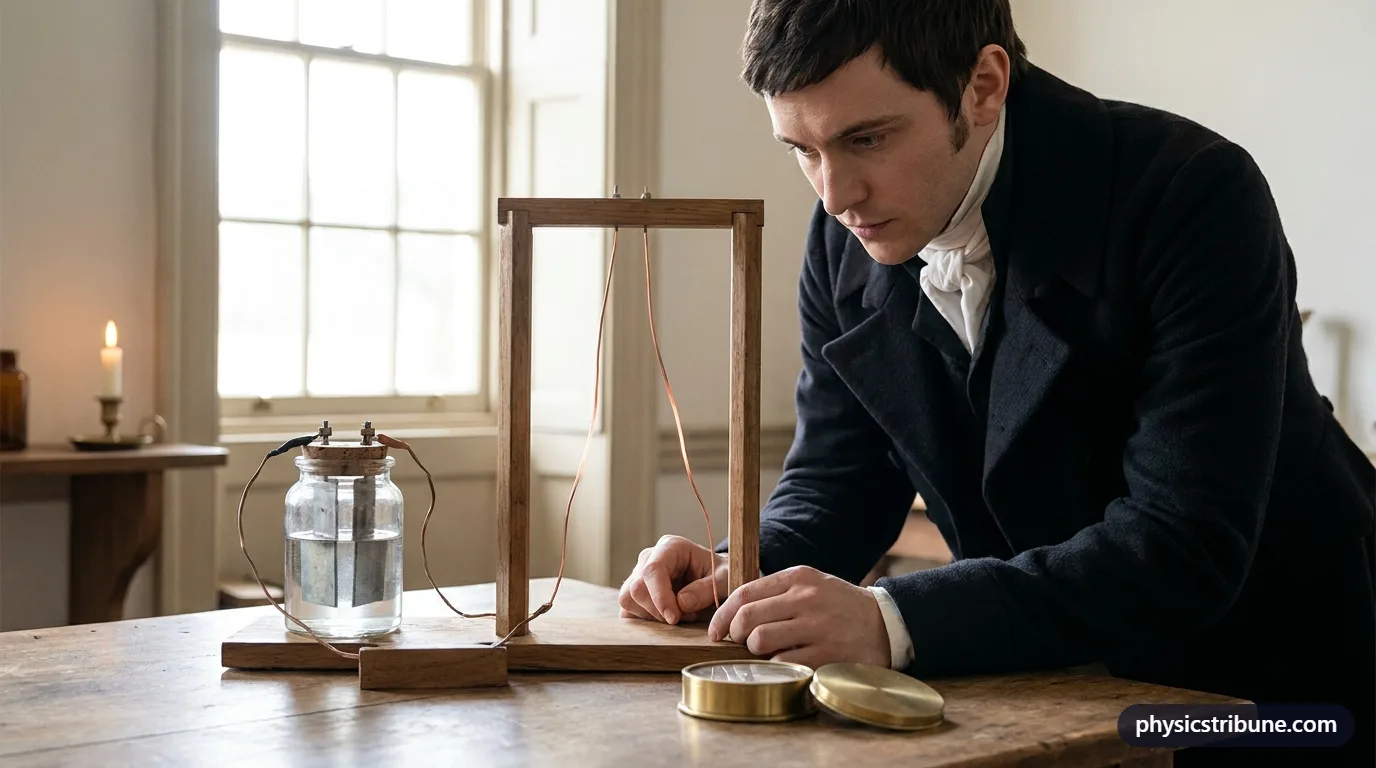
Ohm wanted to know how the current in a circuit depends on the wire it flows through. His first experiments used voltaic piles, the batteries of the day, but their output drifted as they ran, so his readings would not repeat. Following a suggestion from a fellow scientist, he switched to a thermocouple: two different metals joined at two points, with one junction held in boiling water and the other in ice. The steady temperature difference produced a very steady voltage.
To measure the current, he hung a magnetized needle from a thin twisted wire above his circuit. The current turned the needle, and he twisted the wire back until the needle returned to its starting point. The amount of twist told him the strength of the current.
He then connected wires of different lengths and thicknesses and recorded the current for each. The pattern was clear: longer wires let less current through, thicker wires let more through, and for each wire the current was proportional to the driving voltage. You can repeat the modern version of this test in our Ohm's law V-I graph experiment.
What Is Ohm's Law?
Ohm's law states that the current through a conductor is directly proportional to the voltage across it, as long as its temperature and other conditions stay the same. The constant that links them is the resistance. In symbols,
Think of a garden hose. The water pressure is like voltage, the flow of water is like current, and a narrow or kinked hose is like a high resistance. Raise the pressure and more water flows; squeeze the hose and less does. Ohm was the first to show that this relationship is exact and linear for metal wires.
Not every material follows the law. Diodes, glowing bulb filaments and many electronic parts do not keep a fixed resistance, which is the difference explained on our page about ohmic and non-ohmic conductors.
Why Was Ohm's Work Rejected at First?
In 1827 Ohm published his full theory in a book titled Die galvanische Kette, mathematisch bearbeitet, which means The Galvanic Circuit Investigated Mathematically. He modeled the flow of electricity through a wire in the same way that Joseph Fourier had modeled the flow of heat through a metal bar.
The book was mostly theory and mathematics, and many German physicists of the time preferred to describe nature through experiments alone. Some critics called his ideas speculation, and the cool reception hurt his career. He left his school post in Cologne and spent several difficult years in lower-paid teaching jobs, including at a military school in Berlin.
His fortunes turned in the 1830s. He became a professor at the polytechnic school in Nuremberg in 1833, and in 1841 the Royal Society of London awarded him its Copley Medal, one of the highest honors in science, for his work on circuits.
Ohm's Key Equation
Ohm's law ties together the three basic quantities of a circuit: voltage
Engineers use the law every day to choose resistors, check wiring and size fuses. Our Ohm's law calculator solves it for any one of the three quantities, and the Ohm's law worksheets give you printable practice. The worked examples below show the law in action.
Here is Ohm's law in its modern form, with each symbol and its SI unit, plus the two rearranged versions.
| Symbol | Quantity | SI unit |
|---|---|---|
| voltage across the resistor | volt (V) | |
| current | ampere (A) | |
| resistance | ohm (Ω) |
Rearranged to find another variable:
Valid for: ohmic conductors (R independent of V and I).
Example 1 A flashlight bulb
A small flashlight bulb has a resistance of 15 Ω when lit and runs from a 4.5 V battery pack. What current flows through it?
- Given:
- voltage across the resistor:
- resistance:
- voltage across the resistor:
- Formula:
- Substitute:
- Answer:
A bulb filament is not perfectly ohmic, because its resistance rises as it heats up, so we use its resistance while glowing.
Example 2 Ohm's longer wire
A 24 Ω coil of thin wire carries a steady current of 0.25 A. What voltage must be across it?
- Given:
- current:
- resistance:
- current:
- Formula:
- Substitute:
- Answer:
Doubling the length of the same wire would double its resistance, so the same current would then need twice the voltage, the pattern Ohm saw with his wires of different lengths.
How Does Ohm's Law Apply to a Real Circuit?
In a simple circuit with a battery and one resistor, the battery sets the voltage and the resistor sets how much current can flow. An ammeter placed in line with the resistor reads the current, and a voltmeter connected across the resistor reads the voltage. Dividing one reading by the other gives the resistance.
When there are several resistors, Ohm's law still applies to each one separately. Together with the rules for resistors in series and parallel and Kirchhoff's rules for junctions and loops, it lets you work out the current in every branch of a complicated network.

Later Life and Legacy
After the Copley Medal, Ohm was elected a foreign member of the Royal Society. He also studied sound and proposed that the human ear breaks a complex musical tone into a set of pure tones, an idea known as Ohm's acoustic law. In 1852, two years before his death, he finally received the post he had wanted for most of his life: professor of physics at the University of Munich. He died in Munich in July 1854.
In 1881 the international electrical congress adopted the ohm, a name already used by British engineers, as the international unit of resistance, with the Greek letter omega, Ω, as its symbol. The unit of conductance was once playfully called the mho, which is ohm spelled backward, before it was renamed the siemens.
Today Ohm's law is usually the very first equation students learn about circuits. Every phone charger, toaster and car headlight is designed with it in mind.
Key Facts
- Georg Ohm was born on March 16, 1789, in Erlangen, Bavaria, and died on July 6, 1854, in Munich.
- He discovered that the current through a wire is proportional to the voltage across it, the rule now written V = I R.
- He used a thermocouple as a steady voltage source because the batteries of his time drifted too much.
- His 1827 book The Galvanic Circuit Investigated Mathematically was at first poorly received in Germany.
- The Royal Society of London awarded him the Copley Medal in 1841.
- The SI unit of resistance, the ohm (Ω), is named after him.
- He also proposed an acoustic law describing how the ear separates a complex sound into pure tones.
Quick Quiz: How Well Do You Know Georg Ohm?
6 questions. Tap an answer to check it.
What does Ohm's law state?
For an ohmic conductor, V = I R, so current rises in proportion to voltage.
Why did Ohm switch from batteries to a thermocouple?
Early voltaic piles drifted as they ran, while a thermocouple with fixed hot and cold junctions gave a steady voltage.
If the resistance of a circuit doubles and the voltage stays the same, what happens to the current?
With I = V / R, doubling R at fixed V halves the current.
Which award did the Royal Society of London give Ohm in 1841?
The Copley Medal recognized his work on the galvanic circuit.
What is the symbol of the unit named after Ohm?
The ohm is written with the Greek capital letter omega, Ω.
Whose mathematical treatment of heat flow inspired Ohm's theory of the circuit?
Ohm modeled electric flow in a wire the way Fourier had modeled heat flowing through a bar.
Frequently Asked Questions
What is Georg Ohm best known for?
Ohm is best known for Ohm's law, which says that the current through a conductor equals the voltage across it divided by its resistance. He found it through careful experiments with wires in the 1820s and published it in 1827. The SI unit of electrical resistance, the ohm, is named after him.
What did Georg Ohm discover?
He discovered the exact relationship between voltage, current and resistance in a conductor. By testing wires of different lengths and thicknesses, he found that longer wires carry less current, thicker wires carry more, and the current in any given wire rises in direct proportion to the voltage pushing it.
What is Ohm's law in simple words?
Ohm's law says that more voltage pushes more current through a wire, and more resistance lets less current through. If you double the voltage across a fixed resistor, the current doubles. If you double the resistance with the same voltage, the current halves. The rule is written V = I R.
When did Ohm discover Ohm's law?
Ohm carried out his key experiments in 1825 and 1826 and published his first results in scientific journals in those years. His complete theory followed in 1827 in a book on the galvanic circuit. It took more than a decade for his work to be widely accepted, especially in Germany.
Why is the unit of resistance called the ohm?
In 1881 an international congress of electrical scientists adopted a set of practical electrical units named after pioneers of the field. Resistance became the ohm, honoring the man who first measured it precisely. Its symbol is the Greek capital letter omega, Ω, and one ohm is the resistance that lets one ampere flow when one volt is applied.
Does Ohm's law work for every material?
No. Ohm's law describes ohmic conductors, such as metal wires and most resistors kept at a steady temperature, whose resistance stays the same as the voltage changes. Diodes, transistors and hot bulb filaments are non-ohmic, because their resistance changes with the voltage or the current passing through them.
How did Ohm measure electric current?
Ohm hung a magnetized needle from a fine twisted wire above his circuit. The current made the needle turn, and he twisted the hanging wire back until the needle returned to its original position. The angle he had to twist it was a measure of the strength of the current.
What is Ohm's acoustic law?
Ohm's acoustic law, proposed in 1843, says that the human ear breaks a complex musical sound into a set of simple pure tones and hears each of them separately. It is a different idea from his law of circuits and was later developed further by Hermann von Helmholtz in his studies of hearing.
Keep Exploring
 electricityOhm's Law
 unitsOhm (Ω): SI Unit of Electric Resistance
 calculatorsOhm's Law Calculator
 electricityElectrical Resistance
 experimentsOhm's law: voltage-current graph
 worksheetsOhm's Law Worksheets
 electricityOhmic and Non-Ohmic Conductors (I-V Characteristics)
 compareVoltage vs Current
 physicistsAndré-Marie Ampère