
At a Glance
A rocket moves forward because it pushes exhaust backward, and by conservation of momentum the rocket gains as much forward momentum as the exhaust carries backward. Thrust equals the mass of exhaust expelled per second times the exhaust speed. The total speed gain is given by the rocket equation, Δv = v_e ln(m0/m).
- Principle
- Conservation of momentum (recoil)
- Thrust
- F = ṁ ve (exhaust mass per second × exhaust speed)
- Rocket equation
- Δv = ve ln(m0/m)
- Needs air?
- No; works best in a vacuum
- Key ratio
- Mass ratio m0/m (fueled ÷ empty)
- Thrust unit
- newton (N)
On this page
- What Is Rocket Propulsion?
- Rocket Propulsion Explained Simply
- How Does Conservation of Momentum Explain Rocket Motion?
- What Determines a Rocket's Thrust?
- Why Does a Rocket Speed Up Faster as It Climbs?
- What Is the Rocket Equation?
- Why Do Rockets Carry So Much Fuel?
- Why Do Rockets Use Stages?
- What Are the Main Types of Rocket Engines?
- Do Rockets Need Air to Push Against?
- Who Worked Out the Physics of Rockets?
- Practice Rocket Propulsion Problems
- Common Misconceptions
- Key Facts
- Quiz
- FAQ
What Is Rocket Propulsion?
Rocket propulsion is motion produced by throwing mass out of a vehicle. A rocket carries both its fuel and the oxygen (or other oxidizer) needed to burn it. Burning the two together makes extremely hot, high-pressure gas, and a nozzle at the back lets that gas escape in one direction at thousands of meters per second.
The rocket is pushed the opposite way. This is the same recoil you feel when you throw a heavy ball while standing on a skateboard, only repeated continuously with countless tiny parcels of gas. A jet engine works on a similar principle but gulps oxygen from the air around it; a rocket brings everything with it, so it keeps working where there is no air at all.
Rocket Propulsion Explained Simply
Blow up a party balloon and let it go without tying the neck. Air rushes out of the opening, and the balloon zooms off the other way. That balloon is a simple rocket.
Inside, the squeezed air pushes on every part of the balloon wall. Where the opening is, there is no wall to push on, so the push on the front wall is not balanced by a push on the back. The leftover push drives the balloon forward while the escaping air shoots backward.
A real rocket does the same thing with burning fuel instead of squeezed air. It throws gas backward very fast, and the gas shoves the rocket forward, even in empty space.
How Does Conservation of Momentum Explain Rocket Motion?
Think of the rocket and all of its propellant as one system. Before ignition in deep space, the system's total momentum is zero. Once the engine runs, exhaust gas streams backward carrying backward momentum, so by the law of conservation of momentum the rocket must carry an equal amount forward.
The difference from a single throw is that the rocket keeps throwing. Every instant, a small mass of gas leaves at the exhaust speed relative to the rocket, and every instant the rocket gains a little speed. Meanwhile the rocket keeps getting lighter, so each later kilogram of exhaust gives it a slightly larger boost than the one before.
Viewed through forces, the hot gas presses on the inside of the combustion chamber and nozzle. The rocket pushes the gas out the back, and by Newton's third law the gas pushes the rocket forward with the same force. That forward force is the thrust.
What Determines a Rocket's Thrust?
Thrust is the force on the rocket, and it equals the rate at which the engine gives momentum to the exhaust. If the engine expels a mass flow
Engineers can raise thrust in two ways: burn propellant faster or make the exhaust leave faster. A faster exhaust is more valuable, because it gets more push out of every kilogram of propellant. A higher burn rate gives more force but empties the tanks sooner.
To lift off from the ground, thrust must exceed the rocket's weight. Only the difference accelerates the rocket upward, as the force diagram and the second example below show. The ratio of thrust to weight at launch is usually a little above 1, often somewhere around 1.2 to 1.5 for large launch vehicles.
Example 1 Thrust of a first-stage engine
A rocket engine burns propellant and expels exhaust at a rate of 250 kg every second. The exhaust leaves the nozzle at 2,800 m/s relative to the rocket. What thrust does the engine produce?
- Given:
- mdot:
- v_e:
- mdot:
- Formula:
- Substitute:
- Answer:
Each second, 250 kg of gas gains 2,800 m/s of backward speed, and the push needed to do that is the push the rocket feels forward.
Example 2 How fast does the rocket accelerate at liftoff?
A rocket with a total mass of 50,000 kg sits on the pad. Its engines produce 700,000 N of thrust straight up. Using g = 9.81 m/s² and ignoring air resistance at this low speed, what is the rocket's upward acceleration at the moment of liftoff?
- Given:
- F_t:
- mass:
- g:
- F_t:
- Formula:
- Substitute:
- Answer:
Thrust has to beat weight before the rocket can rise at all; only the 209,500 N left over accelerates it.

Why Does a Rocket Speed Up Faster as It Climbs?
The engines of a rocket usually produce a nearly steady thrust, but the rocket's mass drops quickly as propellant burns. Using Newton's second law,
Air resistance pulls the other way. It grows as the rocket speeds up, peaks while the rocket is still in thick air, then fades as the air thins with height. By the time the first stage is nearly empty, its acceleration can be several times larger than at liftoff, which is why some vehicles throttle down their engines to protect the crew and cargo.

What Is the Rocket Equation?
The rocket equation gives the total change in speed, written Δv ("delta-v"), that a rocket gains by burning propellant, assuming no gravity or drag. It depends on only two things: the exhaust speed
The natural logarithm in the formula is the important part. It comes from adding up the tiny speed boosts as the rocket gets lighter, and it grows very slowly. Doubling the mass ratio does not double Δv; it adds only about 0.69 times the exhaust speed.
Real flights subtract losses. Climbing against gravity and pushing through the air cost a launch vehicle a significant share of its Δv, so mission planners add these losses to the speed they need at the end. Reaching low Earth orbit takes about 9 to 10 km/s of Δv in total, even though the orbital speed itself is a little under 8 km/s.
Here is the rocket equation with each variable and its SI unit, plus the rearranged forms for exhaust speed and for the starting or final mass.
| Symbol | Quantity | SI unit |
|---|---|---|
| change in rocket speed | meter per second (m/s) | |
| exhaust speed relative to the rocket | meter per second (m/s) | |
| initial total mass (with fuel) | kilogram (kg) | |
| final mass | kilogram (kg) |
Rearranged to find another variable:
Valid for: no external forces (gravity and drag neglected), constant exhaust speed.
Example 3 Speed gained by burning most of the fuel
A small rocket stage has a mass of 50,000 kg when fueled and 15,000 kg when its tanks are empty. Its exhaust speed is 3,000 m/s. Ignoring gravity and drag, how much speed does it gain by burning all of its fuel?
- Given:
- exhaust speed relative to the rocket:
- initial total mass (with fuel):
- final mass:
- exhaust speed relative to the rocket:
- Formula:
- Substitute:
- Answer:
Even after burning 70 percent of its starting mass, the stage gains only a little more than its own exhaust speed.
Why Do Rockets Carry So Much Fuel?
Because of the logarithm, every extra unit of speed demands a multiplying, not adding, amount of propellant. The table shows the pattern for two typical exhaust speeds. To reach a speed change equal to three times the exhaust speed, a rocket must start out about 20 times heavier than it ends, with 95 percent of its launch mass as propellant.
This is why large launch vehicles look like flying fuel tanks. Their payloads are usually only a few percent of the mass on the pad. It also explains why engineers fight hard for even small gains in exhaust speed: a faster exhaust raises Δv for the same mass ratio, so less propellant is needed for the same job.
Example 4 How much fuel does a probe need?
A space probe with a dry mass of 2,000 kg must change its speed by 4,000 m/s in deep space, using an engine with an exhaust speed of 3,200 m/s. What must its total mass be at the start, including fuel?
- Given:
- change in rocket speed:
- exhaust speed relative to the rocket:
- final mass:
- change in rocket speed:
- Formula:
- Substitute:
- Answer:
Roughly five of every seven kilograms at launch are propellant, because the required speed change is larger than the exhaust speed.
| Mass ratio m0/m | ln(m0/m) | Share of launch mass that is propellant | Δv with v_e = 3,000 m/s | Δv with v_e = 4,400 m/s |
|---|---|---|---|---|
| 1.5 | 0.405 | 33.3% | 1,216 m/s | 1,784 m/s |
| 2 | 0.693 | 50.0% | 2,079 m/s | 3,050 m/s |
| 3 | 1.099 | 66.7% | 3,296 m/s | 4,834 m/s |
| 5 | 1.609 | 80.0% | 4,828 m/s | 7,082 m/s |
| 10 | 2.303 | 90.0% | 6,908 m/s | 10,131 m/s |
| 20 | 2.996 | 95.0% | 8,987 m/s | 13,181 m/s |
| Source: Computed with Δv = v_e ln(m0/m); propellant share = 1 − m/m0; exhaust speeds are typical values · Retrieved October 2026 | ||||
Why Do Rockets Use Stages?
A single rocket would have to carry its big empty tanks and heavy engines all the way to orbit. That dead weight keeps the final mass high and the mass ratio low. Staging solves the problem by throwing away hardware that is no longer useful.
A multistage rocket is a stack of rockets. The first stage lifts everything off the ground, burns out and drops away. The second stage then starts with a much lighter load, and its own mass ratio applies on top of the speed already gained. The Δv values of the stages add, so two moderate mass ratios can achieve what one rocket could not.
What Are the Main Types of Rocket Engines?
- Solid-propellant motors burn a rubbery mix of fuel and oxidizer packed into a casing. They are simple and powerful, but once lit they usually cannot be stopped. Typical exhaust speeds are about 2,500 to 2,800 m/s.
- Liquid-propellant engines pump fuel and oxidizer from separate tanks into a combustion chamber. They can be throttled and restarted. Kerosene with liquid oxygen gives about 2,700 m/s at sea level to 3,400 m/s in a vacuum, and liquid hydrogen with liquid oxygen about 4,400 m/s in a vacuum.
- Electric (ion) thrusters use electric fields to fling charged atoms out at tens of kilometers per second. Their thrust is tiny, far too weak for launch, but their huge exhaust speed lets deep-space probes build up large Δv over months.
- Cold-gas thrusters simply release compressed gas. They are weak and inefficient but very reliable, so they are used for small attitude adjustments.

Do Rockets Need Air to Push Against?
No. A rocket pushes on its own exhaust, not on the air behind it. Air actually gets in the way: it causes drag, and the surrounding air pressure slightly reduces the thrust of a nozzle. Rocket engines produce a little more thrust in the vacuum of space than at sea level.
This was not obvious when rockets were new, and early skeptics argued that a rocket in a vacuum would have nothing to push on. The answer comes straight from momentum conservation, which does not need any outside surface. Our question page how does a rocket work in space walks through this step by step.
Who Worked Out the Physics of Rockets?
Gunpowder rockets were used in China many centuries ago, long before anyone could explain them. The explanation became possible after Isaac Newton published his laws of motion in 1687, since a rocket is a direct application of the third law and of momentum conservation.
In 1903 the Russian teacher Konstantin Tsiolkovsky published the equation that links speed gain, exhaust speed and mass ratio, which is why it often carries his name. In 1926 the American physicist Robert Goddard launched the first liquid-fueled rocket. Both men argued that rockets could one day reach space, an idea that was proven within a few decades.
Practice Rocket Propulsion Problems
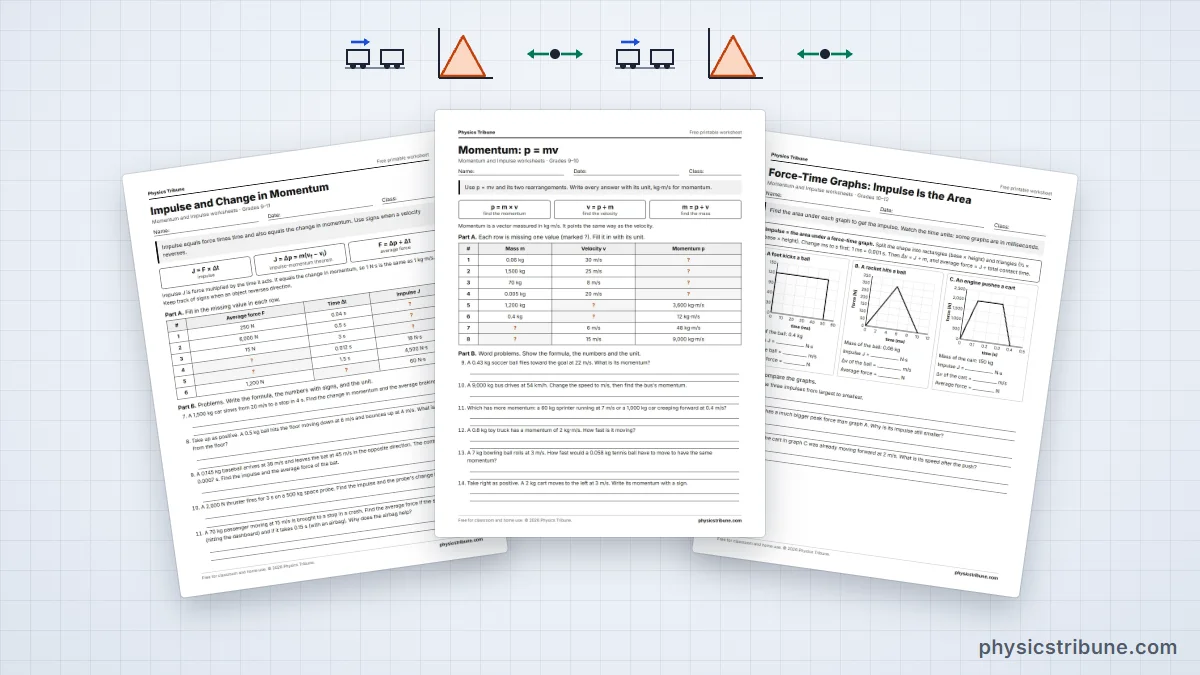
Try the examples above with different numbers and predict whether Δv will rise more from a larger mass ratio or a faster exhaust. Then work through the printable sets in our momentum and impulse worksheets. The momentum calculator helps with thrust and recoil steps, and the momentum formulas sheet collects every equation in this branch, including the rocket equation.
Common Misconceptions
Myth: A rocket moves by pushing against the air or the launch pad.
Physics: A rocket pushes on its own exhaust gas. It needs no outside surface and works in the vacuum of space, where it is even slightly more effective.
Myth: Doubling the fuel doubles a rocket's final speed.
Physics: Speed gain depends on the logarithm of the mass ratio, so extra fuel gives diminishing returns. The added fuel also has to be accelerated itself.
Myth: A rocket cannot go faster than its exhaust speed.
Physics: The exhaust speed is measured relative to the rocket, not the ground. With a mass ratio above about 2.72 the rocket's speed change exceeds the exhaust speed.
Myth: Thrust only has to be large; weight does not matter at liftoff.
Physics: Thrust must be greater than the rocket's weight before it can rise at all, and only the difference produces upward acceleration.
Key Facts
- A rocket moves by expelling exhaust backward; the exhaust carries momentum one way and the rocket gains equal momentum the other way.
- Thrust equals the exhaust mass flow rate times the exhaust speed, F = ṁv_e.
- The rocket equation, Δv = v_e ln(m0/m), gives the speed gained from the exhaust speed and the mass ratio.
- Because of the logarithm, large speed changes require enormous amounts of propellant.
- Rockets do not need air to push against and produce slightly more thrust in a vacuum.
- Staging discards empty tanks and engines so that later stages start lighter and reach higher speeds.
- A rocket's acceleration usually increases during a burn, because its mass falls while the thrust stays nearly constant.
Quick Quiz: How Well Do You Know Rocket Propulsion?
6 questions. Tap an answer to check it.
What does a rocket push against to move forward?
The rocket and its exhaust push on each other, so no outside surface is needed.
An engine expels 200 kg of exhaust per second at 2,500 m/s. What is its thrust?
F = ṁv_e = 200 × 2,500 = 500,000 N.
In the rocket equation, what does the ratio m0/m compare?
The mass ratio divides the fueled mass by the mass left after the burn.
What must be true for a rocket to lift off the pad?
Only when thrust exceeds weight is there a net upward force.
Why do large rockets use stages?
Dropping dead weight raises the mass ratio of the remaining stages.
Which change raises Δv without adding any propellant?
Δv is proportional to the exhaust speed for a given mass ratio.
Frequently Asked Questions
How does rocket propulsion work?
A rocket burns fuel with an oxidizer in a combustion chamber, producing hot, high-pressure gas. The gas escapes through a nozzle at the back at very high speed. Because the gas carries momentum backward, the rocket gains an equal amount of momentum forward. In force terms, the rocket pushes the gas out and the gas pushes the rocket ahead.
What law of physics explains rocket propulsion?
Rocket propulsion is explained by conservation of momentum and by Newton's third law of motion. The rocket and its exhaust push on each other with equal and opposite forces, and the momentum gained by the rocket equals the momentum carried away by the exhaust. Newton's second law then tells you how fast the rocket accelerates for its mass.
What is the formula for rocket thrust?
Thrust equals the mass flow rate of the exhaust multiplied by the exhaust speed, F = ṁ v_e. For example, an engine expelling 100 kg of gas per second at 3,000 m/s makes 300,000 N of thrust. A more complete engineering formula adds a pressure term that depends on the difference between the nozzle exit pressure and the outside air pressure.
What is the Tsiolkovsky rocket equation?
It is the equation Δv = v_e ln(m0/m), which gives the change in speed a rocket gains from burning propellant. Here v_e is the exhaust speed, m0 is the starting mass with fuel and m is the final mass. It assumes no gravity or air drag. Konstantin Tsiolkovsky published it in 1903, so it is often named after him.
Why do rockets work in space where there is no air?
Rockets do not push on air. They push on their own exhaust, which they carry with them as propellant. The engine throws the exhaust backward and the exhaust pushes the engine forward, a pair of forces that needs no outside surface. Air is actually a nuisance, because it causes drag and slightly lowers the thrust of the nozzle.
Why do rockets have multiple stages?
Staging lets a rocket drop heavy empty tanks and engines once their fuel is used up. Each later stage then begins with less dead weight, so its mass ratio, and therefore its speed gain, is larger. The speed gains of the stages add together. Without staging, reaching orbit with today's propellants would be extremely difficult.
What is delta-v in rocketry?
Delta-v, written Δv, is the total change in speed a rocket or spacecraft can achieve with its propellant. Mission planners treat it like a budget. Every maneuver, from reaching orbit to changing orbits or landing, costs a certain amount of delta-v, and the rocket equation tells you how much propellant is needed to afford it.
Why does a rocket accelerate faster as it burns fuel?
Most engines produce a fairly steady thrust, but the rocket loses mass every second as propellant burns. With the same force acting on a smaller mass, Newton's second law gives a larger acceleration. Its weight also drops, leaving more of the thrust free to accelerate it. Near burnout, acceleration can be several times larger than at liftoff.
Keep Exploring






Sources
Constants come from NIST CODATA 2022 (public domain) and unit definitions from the BIPM SI Brochure (CC BY 4.0). Text, diagrams and illustrations are original work by Physics Tribune.