
At a Glance
In recoil and explosions, total momentum is conserved. If the system starts at rest, the momenta of the pieces add to zero, so m1 v1 = −m2 v2 and the speeds are inversely proportional to the masses. Kinetic energy is not conserved; it is created from stored chemical or elastic energy, and most of it goes to the lighter piece.
- Key law
- Conservation of momentum
- Starting from rest
- m1v1' + m2v2' = 0
- Speed ratio
- vlight / vheavy = mheavy / mlight
- Kinetic energy
- Increases; supplied by stored chemical or elastic energy
- Momentum unit
- kilogram meter per second (kg·m/s)
- Related law
- Newton's third law
On this page
- What Are Recoil and Explosions in Physics?
- Recoil Explained Simply
- Why Is Momentum Conserved in an Explosion?
- How Is Recoil Related to Newton's Third Law?
- Where Does the Kinetic Energy in an Explosion Come From?
- What Are Everyday Examples of Recoil?
- How Can an Astronaut Move by Throwing Something?
- What Happens When a Moving Object Explodes?
- How Do Engineers Reduce Recoil?
- Practice Recoil and Explosion Problems
- Common Misconceptions
- Key Facts
- Quiz
- FAQ
What Are Recoil and Explosions in Physics?
Recoil is the motion of an object in the opposite direction to something it pushes, throws or fires. A garden hose that jerks back when the water comes on, a rowboat that slides away as you step onto a dock, and a launcher that kicks backward are all recoiling. An explosion, in physics, is any event where a single body splits into parts that move away from each other, whether it is a firework, a popped seed pod or two carts pushed apart by a spring.
Both are the reverse of a perfectly inelastic collision. In that kind of collision, separate objects join and move as one. In recoil and explosions, one object becomes several. The same rule governs both directions: the total momentum of the system does not change.
Recoil Explained Simply
Sit on a chair with wheels and throw a heavy bag away from you. You roll the other way. You did not touch a wall or the floor to push yourself; the bag pushed you back while you were pushing it.
Before the throw, nothing was moving, so the total "amount of motion" was zero. After the throw, the bag moves one way, so you must move the other way to keep the total at zero. You move slowly because you are heavy, and the bag moves fast because it is light.
Every recoil and every explosion works this way. The pieces fly apart in balanced directions so that, added together with their directions, their motion still totals what it was at the start.
Why Is Momentum Conserved in an Explosion?
The forces that push the pieces apart act only between the pieces themselves. Expanding gas, a released spring or your arm throwing a ball pushes on both parts at once, equally hard, for the same time. Each part receives the same size of impulse in opposite directions, so the momentum one gains is exactly the momentum the other gains the other way.
That is the law of conservation of momentum applied to things moving apart. For a system that starts at rest, the total momentum before is zero, so afterward
This holds only while outside forces are small compared with the internal push. Gravity and friction act all the time, but the burst is so brief and so strong that they barely change the momentum during it. They matter afterward, when they gradually slow or redirect the pieces.
Recoil and explosions use the same momentum balance as collisions; with both objects starting at rest, the left side is simply zero.
| Symbol | Quantity | SI unit |
|---|---|---|
| mass of object 1 | kilogram (kg) | |
| initial velocity of object 1 | meter per second (m/s) | |
| mass of object 2 | kilogram (kg) | |
| initial velocity of object 2 | meter per second (m/s) | |
| final velocity of object 1 | meter per second (m/s) | |
| final velocity of object 2 | meter per second (m/s) |
Rearranged to find another variable:
Valid for: isolated system (net external force = 0); velocities are signed in 1D.
Example 1 A skateboarder throws a medicine ball
A skateboarder and board, 55 kg together, stand still on smooth pavement holding a 4.0 kg medicine ball. She throws the ball straight ahead at 5.0 m/s. Taking forward as positive, what is her velocity just after the throw?
- Given:
- mass of object 1:
- initial velocity of object 1:
- mass of object 2:
- initial velocity of object 2:
- final velocity of object 1:
- mass of object 1:
- Formula:
- Substitute:
- Answer:
The negative sign means she rolls backward. Her speed is small because her mass is almost fourteen times the ball's.
How Is Recoil Related to Newton's Third Law?
Newton's third law, first stated by Isaac Newton in 1687, says that when one object pushes on another, the second pushes back on the first with a force of equal size in the opposite direction. During a throw, your hand pushes the ball forward and the ball pushes your hand backward at every instant.
Because these paired forces last for exactly the same time, the impulses they deliver are equal and opposite. Impulse is the change in momentum, so the momentum changes are equal and opposite too. Conservation of momentum is, in this sense, Newton's third law added up over time. You can explore the time side of this idea on our impulse page.
The forces are equal, but the effects are not. An 80 N push on a 4 kg ball gives it nearly fourteen times more acceleration than the same push gives a 55 kg skateboarder, as the free-body diagram below shows.

Where Does the Kinetic Energy in an Explosion Come From?
An explosion starts with little or no kinetic energy and ends with a lot. That energy is not made from nothing. It comes from stored energy: the chemical energy in a propellant, the elastic energy in a compressed spring, or the energy in your muscles during a throw.
Momentum and energy split very differently. The pieces share the momentum equally, one forward and one backward. Kinetic energy, however, goes mostly to the lighter piece, because kinetic energy can be written as
The table shows what this means in practice. When a launcher is hundreds of times heavier than its projectile, almost all of the released energy goes into the projectile, which is exactly what a designer wants.
Example 2 Spring-loaded lab carts pushed apart
Two carts sit at rest on a level track with a compressed spring between them. When a pin is released, the 0.50 kg cart moves left at 0.90 m/s. Taking right as positive, what is the velocity of the 1.5 kg cart?
- Given:
- mass of object 1:
- initial velocity of object 1:
- mass of object 2:
- initial velocity of object 2:
- final velocity of object 1:
- mass of object 1:
- Formula:
- Substitute:
- Answer:
The heavier cart moves right at one third of the light cart's speed, so the two momenta cancel exactly.
| Example | Heavy mass ÷ light mass | Light speed ÷ heavy speed | Light piece's share of KE | Heavy piece's share of KE |
|---|---|---|---|---|
| Two identical carts | 1 | 1 | 50.0% | 50.0% |
| Firework shell, 0.40 kg and 0.20 kg pieces | 2 | 2 | 66.7% | 33.3% |
| Lab carts, 1.5 kg and 0.50 kg | 3 | 3 | 75.0% | 25.0% |
| Skateboarder (55 kg) and medicine ball (4 kg) | 13.75 | 13.75 | 93.2% | 6.8% |
| Astronaut (100 kg) and wrench (1.5 kg) | 66.7 | 66.7 | 98.5% | 1.5% |
| Launcher 200 times heavier than its projectile | 200 | 200 | 99.5% | 0.5% |
| Source: Computed with m1v1' = −m2v2' and KE = p²/2m; light share = m_heavy/(m1 + m2) · Retrieved October 2026 | ||||

What Are Everyday Examples of Recoil?
- Stepping off a small boat: as you push yourself toward the dock, the boat slides away from it, which is why people sometimes end up in the water.
- Fire hoses and garden hoses: water leaving the nozzle at speed pushes the hose backward, so firefighters brace themselves or work in pairs.
- Cannons and firearms: the gun kicks back as the projectile leaves, and heavy mountings or the shooter's body absorb the motion.
- Swimming and rowing: a swimmer pushes water backward and moves forward; an oar does the same for a boat.
- Squids and jellyfish: they squirt water out to shoot themselves the other way, a natural form of jet propulsion.
- Radioactive decay: when a nucleus emits an alpha particle, the remaining nucleus recoils in the opposite direction.
- Rockets: a rocket is a recoil machine that throws out exhaust continuously; see rocket propulsion.
How Can an Astronaut Move by Throwing Something?
An astronaut floating outside a spacecraft has nothing to push against. Waving arms or kicking legs only moves parts of the body around the center of mass, and the center of mass stays put. Throwing an object is different, because the object leaves the system and carries momentum with it.
The astronaut recoils with a momentum equal and opposite to the thrown object's. The speed is small, because she is much heavier than a tool, but there is no friction or air drag to slow her. Real spacewalkers are tethered and use small gas thrusters, which work on exactly the same recoil principle.
Example 3 Getting back to the station by throwing a wrench
An astronaut floating 20 m from her station has a total mass of 100 kg with her suit. She throws a 1.5 kg wrench directly away from the station at 6.0 m/s. How long does she take to drift back to the station?
- Given:
- m_w:
- v_w:
- M:
- distance traveled:
- m_w:
- Formula:
- Substitute:
- Answer:
Her recoil speed is only 0.09 m/s, so the trip takes nearly four minutes, slow but steady, since nothing in space slows her down.
What Happens When a Moving Object Explodes?
If the object is already moving when it bursts, the total momentum after the burst equals the momentum it had before, not zero. The pieces fly apart in every direction, yet their momenta still add up to the original value.
A useful way to picture this is through the center of mass. An internal explosion cannot change the motion of the system's center of mass. If a firework shell bursts partway along its arc, the fragments scatter, but their center of mass keeps following the same smooth path the unbroken shell would have taken, until fragments start hitting the ground.
The simplest case is a shell that bursts at the very top of a straight-up flight, where it is momentarily at rest. Then the problem is the same as one that starts from rest, and the two-piece example below works it out.
Example 4 A firework shell bursting at the top of its climb
A 0.60 kg firework shell, launched straight up, is momentarily at rest at the top of its path when it bursts into two pieces. A 0.20 kg piece flies east at 30 m/s. Taking east as positive, what is the velocity of the 0.40 kg piece?
- Given:
- mass of object 1:
- initial velocity of object 1:
- mass of object 2:
- initial velocity of object 2:
- final velocity of object 1:
- mass of object 1:
- Formula:
- Substitute:
- Answer:
The heavier piece heads west at half the speed. The light piece carries 90 J of kinetic energy and the heavy one only 45 J.

How Do Engineers Reduce Recoil?
Momentum conservation fixes how much momentum the launcher must receive, so the recoil cannot be eliminated, only managed. Designers use three main ideas.
- Add mass: a heavier launcher gets the same momentum at a lower speed, and its kinetic energy is smaller still.
- Stretch the push over time: springs, pads and sliding mounts spread the backward impulse over a longer time, which lowers the force on whoever holds or supports the device.
- Connect to something big: bolting a launcher to the ground or a ship makes the Earth or the hull share the recoil, and its huge mass makes the resulting speed negligible.
The second idea is the same physics that makes airbags and crumple zones work; our car safety physics page explains it in detail.
Practice Recoil and Explosion Problems
Try changing the masses in the examples and predict the speeds before you calculate. Then work through the printable sets in our momentum and impulse worksheets. The momentum calculator checks individual values, the collision calculator handles two-body problems, and our momentum formulas sheet keeps every equation on one page.
Common Misconceptions
Myth: An explosion creates momentum out of nothing.
Physics: An explosion creates kinetic energy from stored energy, but the total momentum is unchanged. Pieces moving in opposite directions cancel each other's momentum.
Myth: The recoiling object and the projectile get equal kinetic energy.
Physics: They get equal and opposite momentum. Kinetic energy goes mostly to the lighter piece, because for equal momenta a smaller mass means more energy.
Myth: A rocket or a thrown ball moves because it pushes against the air or the ground.
Physics: Recoil needs no outside surface. The object and what it throws push on each other, which is why recoil works perfectly well in empty space.
Myth: Recoil is caused by the launcher being weaker than the projectile.
Physics: The forces on the launcher and projectile are always equal in size. The launcher moves less only because it has more mass.
Key Facts
- Recoil is the backward motion of an object that pushes, throws or fires something forward.
- In any explosion or recoil, the total momentum of the system stays the same as before the event.
- When the system starts at rest, the pieces have equal and opposite momenta, so m1v1' = −m2v2'.
- The speeds of the pieces are inversely proportional to their masses: the lighter piece moves faster.
- Kinetic energy increases in an explosion, supplied by stored chemical, elastic or muscular energy.
- Most of the kinetic energy goes to the lighter piece, in the share m_heavy/(m1 + m2).
- An internal explosion does not change the motion of the system's center of mass.
Quick Quiz: How Well Do You Know Recoil and Explosions?
6 questions. Tap an answer to check it.
A 2 kg ball and a 6 kg cart are pushed apart from rest by a spring. The ball moves at 3 m/s. How fast does the cart move?
Equal momenta: 2 × 3 = 6 × v, so v = 1 m/s in the opposite direction.
What is the total momentum of the fragments when an object at rest explodes?
Internal forces cannot change total momentum, which was zero before the explosion.
Which piece gets more kinetic energy when two pieces fly apart from rest?
With equal momenta, KE = p²/2m, so the smaller mass has more kinetic energy.
Where does the kinetic energy of a firework's fragments come from?
The burst converts chemical energy in the charge into kinetic energy, heat, light and sound.
An astronaut throws a wrench away from her station. What happens to her?
She recoils in the direction opposite to the wrench, which is toward the station.
Which change reduces the recoil speed of a launcher firing the same projectile at the same speed?
The launcher receives a fixed momentum, so more mass means a lower speed.
Frequently Asked Questions
What is recoil in physics?
Recoil is the backward motion an object gains when it pushes another object forward. A launcher kicks back when it fires, a boat moves away when you jump off it, and a skateboarder rolls back after throwing a heavy ball. It happens because the two objects push on each other with equal and opposite forces, so the total momentum of the pair stays the same.
Is momentum conserved in an explosion?
Yes. The forces that push the pieces apart are internal to the system, so they cannot change its total momentum. If an object at rest explodes, the momenta of all the fragments still add up to zero. Outside forces such as gravity do act, but the burst is so short that they change the momentum very little during it.
Is kinetic energy conserved in an explosion?
No. An explosion turns stored energy into kinetic energy, so the pieces have far more kinetic energy afterward than the object had before. The stored energy might be chemical, as in a firework, elastic, as in a compressed spring, or muscular, as in a throw. Total energy is still conserved once you count those stored forms.
How do you calculate recoil velocity?
Use conservation of momentum. If the launcher and projectile start at rest, set the momenta equal and opposite: the launcher's velocity equals minus the projectile's mass times its velocity, divided by the launcher's mass. The minus sign shows the launcher moves backward. A heavier launcher or a lighter, slower projectile gives a smaller recoil velocity.
Why does a gun recoil?
Expanding gas pushes the bullet forward down the barrel and pushes the gun backward with an equal force at the same time. The bullet leaves with forward momentum, so the gun must take an equal amount of backward momentum. Because the gun is far heavier, its backward speed is much smaller than the bullet's forward speed.
Why does the lighter piece move faster after an explosion?
Both pieces receive the same size of momentum, which is mass times velocity. To carry the same momentum with less mass, a piece must move faster. If one fragment has a third of the other's mass, it moves three times as fast. The same rule explains why a thrown ball flies off quickly while the thrower barely moves.
How is recoil related to Newton's third law?
Newton's third law says forces come in equal and opposite pairs. During a throw or a blast, the two objects push on each other with equal forces for the same length of time. That gives them equal and opposite impulses, and therefore equal and opposite changes in momentum. Recoil is the visible result of that force pair.
Does recoil work in space?
Yes, and it works even better there. Recoil depends only on the objects pushing on each other, not on air or the ground. In space there is no friction or drag to slow the recoiling object, so an astronaut who throws a tool keeps drifting the other way until something stops her. Spacecraft thrusters and rockets rely on the same effect.
Keep Exploring
 momentumLaw of Conservation of Momentum
 forcesNewton's Third Law of Motion
 momentumRocket Propulsion
 momentumPerfectly Inelastic Collisions
 momentumImpulse and the Impulse-Momentum Theorem
 calculatorsMomentum Calculator
 compareMomentum vs Impulse
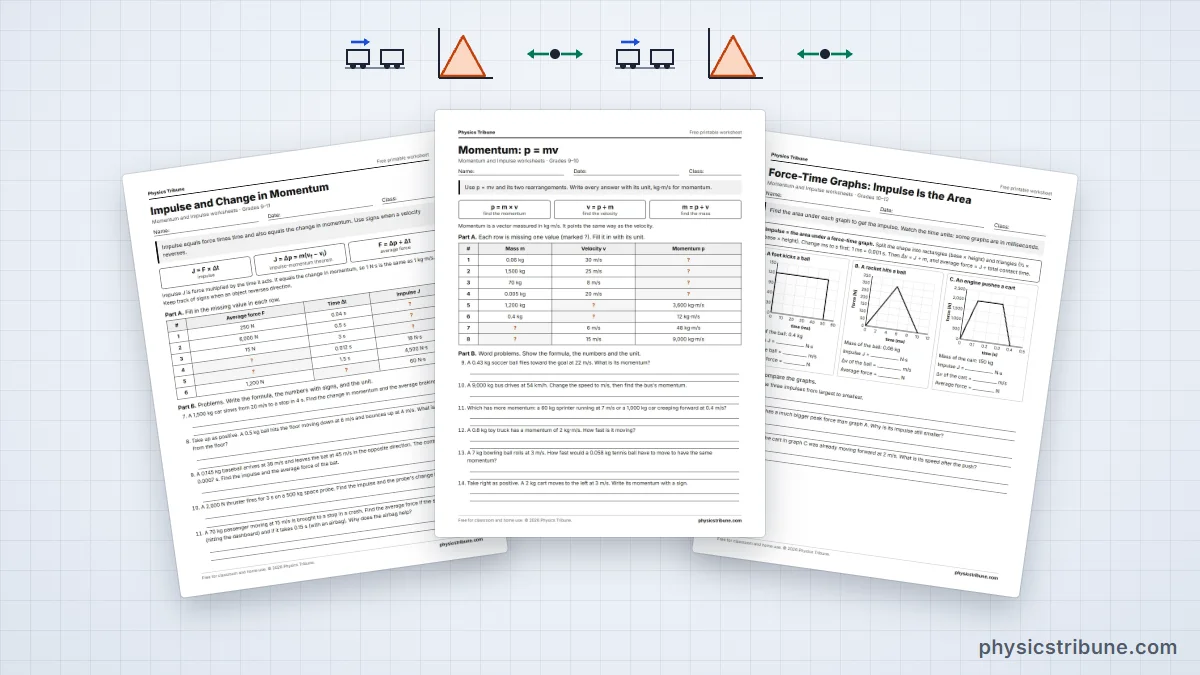 worksheetsMomentum and Impulse Worksheets
 physicistsIsaac Newton