
At a Glance
Your body converts food energy into work and heat. Power is energy per unit time, P = W/t, measured in watts; a resting adult runs at about 80 W and a hard-working one at several hundred watts. Muscles are only about 20 to 25 percent efficient, so most of the energy you burn leaves your body as heat.
- Resting power
- About 80 W for an average adult
- Power formula
- P = W/t (watts = joules per second)
- Food energy unit
- 1 food Calorie (kcal) = 4,184 J
- Muscle efficiency
- About 20 to 25 percent
- Where most energy goes
- Heat, released through the skin and breath
- Quantity type
- Energy, work and power are all scalars
On this page
- How Does the Human Body Use Energy?
- Energy and Power in the Body Explained Simply
- What Is Metabolic Rate and How Many Watts Do You Use at Rest?
- How Do Muscles Do Work?
- How Do You Calculate the Power of a Person?
- How Is Food Energy Converted to Joules?
- How Efficient Is the Human Body?
- How Does the Body Get Rid of Extra Heat?
- How Can You Practice Work and Power Problems?
- Common Misconceptions
- Key Facts
- Quiz
- FAQ
How Does the Human Body Use Energy?
Food is stored chemical energy. When your cells break down sugars, fats and proteins, they release that energy and store part of it in a molecule called ATP, the body's short-term energy currency. ATP then powers everything else: muscles contracting, the heart pumping, nerves firing and cells repairing themselves.
None of this escapes the law of conservation of energy. Every joule you eat ends up somewhere. Some is stored as fat or glycogen, some does mechanical work on the world, and the rest becomes thermal energy, which keeps you warm and is eventually lost to your surroundings.
Physicists find it useful to treat the body like an engine. It has a fuel (food), an output (work), a waste product (heat) and an efficiency, the fraction of fuel that becomes useful work.
Energy and Power in the Body Explained Simply
Your body is like a car that burns food instead of gasoline. Food gives you energy, measured in joules or Calories. Energy lets you move, think and stay warm.
Power tells you how fast you are using that energy. Walking up a hill slowly and running up it fast take the same energy to lift you, but running needs more power because you do it in less time. Even when you sleep, your heart, lungs and brain keep working, so your body never drops to zero power.
What Is Metabolic Rate and How Many Watts Do You Use at Rest?
Your metabolic rate is the rate at which your body converts chemical energy, which makes it a power. The minimum rate needed to stay alive while lying still and awake is the basal metabolic rate. For a typical adult it is around 1,700 food Calories a day, which works out to about 82 W (computed).
The energy is not spread evenly. The brain uses roughly a fifth of your resting energy even though it is about 2 percent of your mass. The liver, kidneys and heart also take large shares, while resting muscle uses relatively little until you start to move.
Metabolic rate rises with activity, body size and temperature. Shivering in the cold and fighting off a fever both raise it, because the body is deliberately producing more heat.
| Activity | Metabolic power (W) | Food Calories per hour |
|---|---|---|
| Sleeping | about 80 | 69 |
| Sitting quietly | about 115 | 99 |
| Walking at a brisk pace | about 280 | 241 |
| Cycling at a moderate pace | about 500 | 430 |
| Running | about 900 | 774 |
| Source: Power values are typical estimates; Calories per hour computed with 1 kcal = 4,184 J · Retrieved October 2026 | ||
How Do Muscles Do Work?
In physics, work is done when a force moves something through a distance,
Climbing is the cleanest example. Raising your body through a height h stores
Holding a heavy box perfectly still does no work in the physics sense, since nothing moves. You still tire, because muscle fibers keep contracting and relaxing many times a second to hold the load, and each contraction uses ATP. The body pays an energy cost even when the physics work is zero.

How Do You Calculate the Power of a Person?
Power is the rate of doing work,
Short bursts can be impressive. A sprinter pushing off the blocks or a jumper leaving the ground can deliver well over a thousand watts for a fraction of a second. Sustained power is much lower: trained cyclists hold a few hundred watts for an hour, and a person doing steady manual labor all day manages roughly 75 to 100 W of useful output. One horsepower, 746 W, is more than most people can sustain for long.
Power links the work you do with the time it takes; the same formula applies to an engine, a light bulb or your legs.
| Symbol | Quantity | SI unit |
|---|---|---|
| average power | watt (W) | |
| work done or energy transferred | joule (J) | |
| time | second (s) |
Rearranged to find another variable:
Example 1 Running up a flight of stairs
A 68 kg student runs up a staircase that rises 3.2 m in 4.5 s. What useful power do her legs deliver against gravity? Use g = 9.81 m/s².
- Given:
- m:
- h:
- time:
- m:
- Formula:
- Substitute:
- Answer:
This is only the useful output; with muscles near 25 percent efficient, her body is burning energy about four times faster than this.
How Is Food Energy Converted to Joules?
Food labels in the United States list energy in Calories with a capital C, which are really kilocalories. One food Calorie equals 4,184 joules. A typical adult diet of about 2,000 Calories therefore supplies a little over eight million joules a day.
Different nutrients carry different amounts of energy. Fat stores about 9 Calories per gram, while carbohydrates and protein each store about 4. That is why fat is the body's long-term energy reserve: it packs more than twice the energy into the same mass.
To get a feel for these numbers, a medium banana holds about 105 Calories, or about 439,000 J. With muscles about 25 percent efficient, that is enough for a 70 kg person to climb roughly 160 m of stairs (computed), close to the height of a 50-story building.
Example 2 A day of food as average power
An adult eats 2,000 food Calories in a day, which is 8,368,000 J. If all of it is used evenly over 24 hours (86,400 s), what is the average power?
- Given:
- work done or energy transferred:
- time:
- work done or energy transferred:
- Formula:
- Substitute:
- Answer:
A whole day of eating works out to roughly the power of one bright old-fashioned light bulb running nonstop.
| Nutrient | Food Calories per gram | Energy per gram (kJ) |
|---|---|---|
| Fat | about 9 | about 37.7 |
| Carbohydrate | about 4 | about 16.7 |
| Protein | about 4 | about 16.7 |
| Alcohol | about 7 | about 29.3 |
| Source: Typical nutrition values; kilojoules computed with 1 kcal = 4,184 J · Retrieved October 2026 | ||
How Efficient Is the Human Body?
Efficiency is the useful work out divided by the energy put in. Human muscles convert about 20 to 25 percent of their chemical energy into mechanical work during activities like cycling or rowing. That is in the same range as many gasoline car engines.
The remaining 75 to 80 percent becomes heat. That is why you get hot when you exercise, even on a cold day, and why your body needs ways to shed the extra heat quickly. A Sankey diagram of a cyclist shows a thin arrow for useful work and a much wider arrow for heat.
Some movements are even less efficient. Walking downhill still costs energy because your muscles act as brakes, absorbing energy rather than delivering it, and that absorbed energy also turns into heat.
Example 3 Fuel needed for an hour of cycling
A cyclist keeps up 150 W at the pedals for one hour, which is 540,000 J of mechanical work. If her muscles are 22 percent efficient, how much food energy does her body use?
- Given:
- useful work or energy output:
- efficiency (fraction, × 100 for %):
- useful work or energy output:
- Formula:
- Substitute:
- Answer:
Divide by 4,184 to convert to food Calories; the rest of the energy beyond the 540,000 J of work leaves her body as heat.

How Does the Body Get Rid of Extra Heat?
To keep its core near 37 °C, the body must lose heat as fast as it makes it. It uses all three methods of heat transfer plus one more. Radiation carries infrared energy away from warm skin. Convection carries heat away in moving air. Conduction passes heat into anything cooler you touch, like a cold chair.
The extra method is evaporation. When sweat evaporates, each kilogram takes about 2.4 million joules with it as latent heat. During hard exercise in warm weather evaporation becomes the main way to cool down, which is why humid air, which slows evaporation, makes exercise feel so much harder.

How Can You Practice Work and Power Problems?
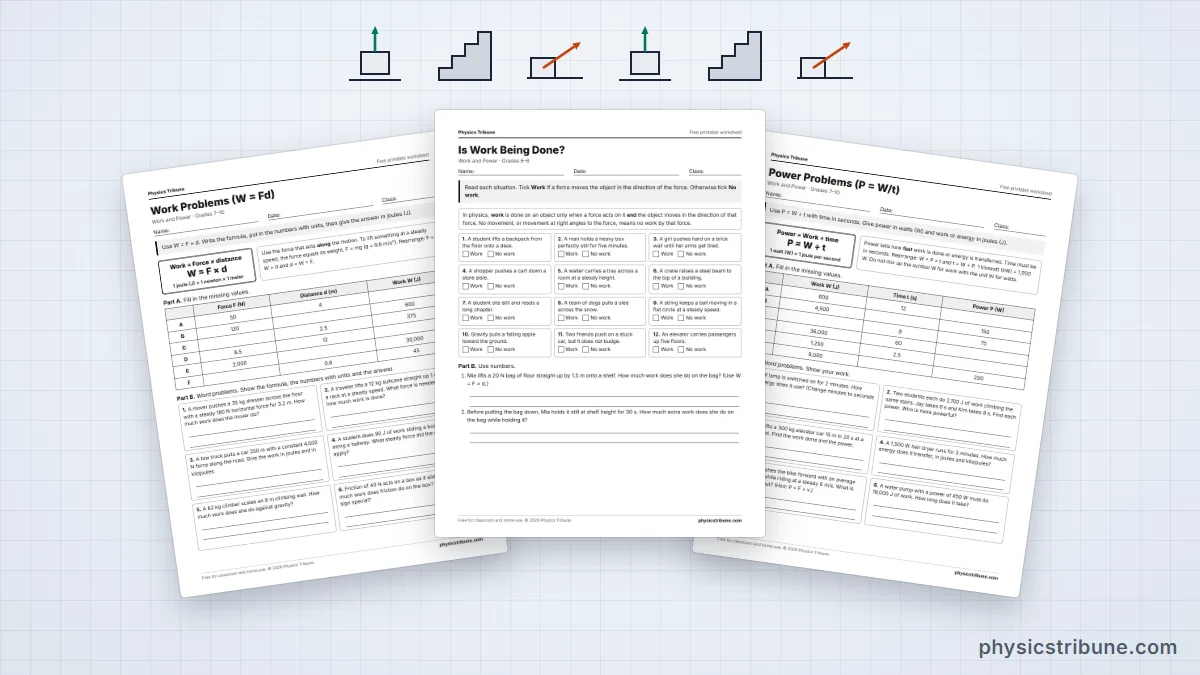
Measuring your own stair-climbing power is one of the best ways to make these ideas concrete. Then try the printable work and power worksheets, check your answers with the power calculator, and keep the energy formulas sheet nearby. If you mix up the two quantities, read work vs power. The SI unit of power honors James Watt, and the electrical side of the body is covered in electricity in the body.
Common Misconceptions
Myth: Holding a heavy object still is hard work in the physics sense.
Physics: If the object does not move, no physics work is done on it. Your muscles still use energy because their fibers keep contracting to hold it, and that energy becomes heat.
Myth: Most of the food energy you burn during exercise goes into movement.
Physics: Only about a quarter becomes useful work. The rest turns into heat, which is why exercise makes you warm.
Myth: Your body stops using energy when you are asleep.
Physics: Your heart, lungs, brain and other organs keep working, so a sleeping adult still uses about 80 watts.
Myth: Running up stairs takes more energy than walking up them.
Physics: The minimum energy to lift your body, mgh, is the same either way. Running takes more power because the same work is done in less time.
Key Facts
- The body converts chemical energy from food into work, electrical signals and heat.
- A resting adult uses energy at about 80 watts, roughly the power of an old incandescent bulb.
- Power is work divided by time, P = W/t, so climbing stairs faster takes more power but the same energy.
- One food Calorie equals 4,184 joules.
- Human muscles are only about 20 to 25 percent efficient; the rest of the energy becomes heat.
- Holding a load still does no physics work, yet it still costs the body energy.
- Evaporating sweat removes about 2.4 million joules of heat per kilogram, the main way the body cools during hard exercise.
Quick Quiz: How Well Do You Know Work, Energy and Power in the Human Body?
6 questions. Tap an answer to check it.
What is the approximate resting power of an average adult?
A resting adult converts energy at roughly 80 watts.
How many joules are in one food Calorie?
One food Calorie is a kilocalorie, which equals 4,184 joules.
About what fraction of food energy do muscles turn into useful work?
Muscles are about 20 to 25 percent efficient; the rest becomes heat.
Two students of equal mass climb the same stairs, one in 10 s and one in 5 s. Which statement is true?
Both do the same work, mgh, but the faster student does it in half the time, so with twice the power.
What is the main way the body cools itself during hard exercise in warm weather?
Evaporating sweat carries away a large amount of latent heat.
A person holds a heavy box perfectly still. How much physics work is done on the box?
Work needs a displacement, and the box does not move.
Frequently Asked Questions
How many watts does the human body produce?
At rest an average adult converts energy at about 80 watts, almost all of it as heat. Light activity such as walking raises this to a few hundred watts, and hard running can push it close to 1,000 watts. Useful mechanical output is much smaller, typically 75 to 100 watts for steady work and a few hundred watts for trained athletes.
How do you calculate human power?
Divide the work done by the time taken, P = W/t. For climbing stairs or a hill, the useful work is your weight times the height gained, mgh. Measure your mass in kilograms, the vertical height in meters and the time in seconds, then compute mgh divided by t to get your useful power output in watts.
How efficient is the human body at converting food to work?
Human muscles turn about 20 to 25 percent of their chemical energy into mechanical work during activities such as cycling. The remaining 75 to 80 percent becomes heat. This efficiency is similar to that of a typical car engine, and it explains why exercise warms you up and makes you sweat.
How many joules are in a food Calorie?
One food Calorie, written with a capital C, is a kilocalorie and equals 4,184 joules. A small calorie, with a lowercase c, is a thousand times smaller at 4.184 joules. So a snack labeled 200 Calories contains 836,800 joules of chemical energy that your body can release by digesting it.
Why do you get hot when you exercise?
Your muscles are only about a quarter efficient, so most of the chemical energy they release becomes thermal energy instead of motion. During intense exercise the body may produce several hundred watts of extra heat. It sheds this heat by sweating, by sending more blood to the skin and by breathing faster.
Does the body do work when holding something still?
Not in the physics sense. Work requires a force acting through a distance, and a load held still does not move. Your muscles still burn energy, though, because muscle fibers repeatedly contract and relax to maintain the force. All of that energy turns into heat, which is why holding a heavy box soon becomes tiring.
What is basal metabolic rate in watts?
Basal metabolic rate is the energy use of a person lying still, awake and at a comfortable temperature. For a typical adult it is around 1,700 food Calories per day, or roughly 80 watts. It varies with body size, age, sex and muscle mass, and is lower for small people and higher for large, muscular ones.
How much power can a human produce?
For a few seconds, a strong sprinter or weightlifter can produce more than 1,000 watts of mechanical power. Over an hour, elite cyclists sustain a few hundred watts, and fit amateurs often manage around 150 to 250 watts. Over a full working day, most people can keep up only about 75 to 100 watts of useful output.
Keep Exploring







Sources
Constants come from NIST CODATA 2022 (public domain) and unit definitions from the BIPM SI Brochure (CC BY 4.0). Text, diagrams and illustrations are original work by Physics Tribune.