
At a Glance
Hearing turns pressure waves into nerve signals in three stages: the outer ear collects sound, the middle-ear bones match it from air into the fluid of the inner ear, and the cochlea splits it by frequency so different hair cells respond to different pitches. People hear roughly 20 Hz to 20,000 Hz, and loudness is measured in decibels with β = 10 log10(I/I0), where I0 = 10^-12 W/m².
- Hearing range (young adult)
- About 20 Hz to 20,000 Hz
- Most sensitive range
- About 2,000 to 5,000 Hz
- Threshold of hearing
- About 10⁻¹² W/m² (0 dB) near 1,000 Hz
- Key formula
- β = 10 log₁₀(I/I₀)
- Three main parts
- Outer ear, middle ear (ossicles), inner ear (cochlea)
- Sensors
- Hair cells on the basilar membrane
On this page
- How Do We Hear Sound?
- Hearing Explained Simply
- What Does the Outer Ear Do?
- How Does the Middle Ear Amplify Sound?
- How Does the Cochlea Sort Sounds by Pitch?
- How Do Hair Cells Turn Vibration Into Nerve Signals?
- How Loud Can We Hear? (Decibels and Intensity)
- What Is the Range of Human Hearing?
- How Do We Tell Where a Sound Comes From?
- How Does Noise Damage Hearing?
- Practice With Sound Problems
- Common Misconceptions
- Key Facts
- Quiz
- FAQ
How Do We Hear Sound?
Every sound starts as a vibration. A guitar string, a voice or a slamming door pushes on nearby air, creating a sound wave: a pattern of slightly higher and lower pressure that travels outward at about 343 m/s. By the time it reaches you, the pressure changes are tiny, often far less than a millionth of normal air pressure.
Your ear's job is to catch those faint ripples and turn them into electrical signals your brain can read. It does this in three stages. The outer ear gathers sound and funnels it inward. The middle ear converts the vibration of air into the vibration of fluid. The inner ear sorts the vibration by frequency and turns it into nerve impulses.
Each stage solves a real physics problem, from collecting a weak wave to matching two very different materials to analyzing a complex mix of frequencies in real time.
| Part | Medium | What it does | Physics at work |
|---|---|---|---|
| Pinna | Air | Collects and directs sound | Reflection; direction clues |
| Ear canal | Air | Carries sound to the eardrum | Resonance of a tube closed at one end |
| Eardrum | Membrane | Turns pressure waves into vibration | Forced oscillation |
| Ossicles | Bone | Pass on and strengthen the vibration | Lever action and area ratio |
| Oval window | Membrane | Pushes on the inner-ear fluid | Pressure on a small area |
| Cochlea | Fluid | Separates sound by frequency | Graded stiffness of the basilar membrane |
| Hair cells | Cells | Turn motion into electrical signals | Mechanically opened ion channels |
| Source: Summary of standard ear anatomy and acoustics · Retrieved October 2026 | |||
Hearing Explained Simply
Think of your ear as a relay team. The outer ear is a funnel that catches sound. The eardrum is a thin drum skin that wiggles when the sound hits it. Three tiny bones act like a lever and pass the wiggle along, making it stronger. Deep inside, a snail-shaped tube full of fluid sloshes, and tiny hairs inside it bend.
When those hairs bend, they send a message to the brain. Hairs near the start of the tube respond to high sounds, and hairs near the far end respond to low sounds. Your brain reads which hairs moved and how much, and that is how you know whether you heard a whistle or a drum.
What Does the Outer Ear Do?
The outer ear has two parts: the visible flap, called the pinna, and the ear canal, a tube about 2.5 cm long that ends at the eardrum. The pinna collects sound and guides it inward. Its folds also reflect sound in slightly different ways depending on where it comes from, which helps you tell whether a sound is in front of you, behind you, above or below.
The ear canal does more than carry sound. Because it is open at one end and closed by the eardrum at the other, it behaves like a small organ pipe. Sounds near its natural frequency set up a standing wave and get a boost of several decibels, the same physics described on our page about resonance in air columns. The worked example below finds that frequency.
Example 2 Why the ear canal boosts certain pitches
The ear canal acts like a tube about 0.025 m long, open at the outer end and closed by the eardrum. With sound traveling at 343 m/s, what is the frequency of its lowest resonance (n = 1)?
- Given:
- harmonic number (odd integer):
- speed of sound:
- length of the pipe:
- harmonic number (odd integer):
- Formula:
- Substitute:
- Answer:
This resonance, in the low thousands of hertz, is one reason our hearing is most sensitive between about 2,000 and 5,000 Hz.

How Does the Middle Ear Amplify Sound?
The eardrum, or tympanic membrane, is a thin cone of tissue that vibrates when sound waves strike it. Attached to it are the three smallest bones in the body, the ossicles: the malleus (hammer), the incus (anvil) and the stapes (stirrup). The stapes presses on a small membrane called the oval window, the entrance to the fluid-filled inner ear.
Here the ear faces a problem. Sound in air hitting a body of water mostly bounces off, just as most of your shout to a swimmer underwater never reaches them. The middle ear fixes this in two ways. The eardrum is much larger than the oval window, so the same force is concentrated onto a smaller area, which raises the pressure. The ossicles also act as a small lever that trades some motion for extra force.
Together these effects raise the pressure at the oval window by a factor of roughly twenty or more. Engineers call this impedance matching: it lets the energy of a wave in air pass into fluid instead of being reflected away.
How Does the Cochlea Sort Sounds by Pitch?
The cochlea is a coiled tube about the size of a pea, filled with fluid and divided along its length by a flexible strip called the basilar membrane. When the stapes pushes the oval window in and out, it sends a pressure wave through the fluid, and the basilar membrane ripples in response.
The key is that the membrane is not the same all along its length. Near the oval window it is narrow and stiff; at the far end it is wider and floppier. Stiff parts respond best to fast vibrations and floppy parts to slow ones, so each frequency produces its biggest ripple at a particular place. High-pitched sounds peak near the entrance, low-pitched sounds near the tip.
This place coding turns the cochlea into a natural frequency analyzer. A chord with three notes produces three separate peaks of motion, so your brain receives the notes as separate signals, even though they arrived mixed together in a single superposed pressure wave.

How Do Hair Cells Turn Vibration Into Nerve Signals?
Sitting on the basilar membrane are rows of hair cells, each topped with a tiny bundle of stiff projections. Each ear has only about 15,000 of them. When the membrane moves, the bundles tilt against an overlying layer of tissue. Tilting one way opens tiny channels that let charged particles flow into the cell, changing its voltage and triggering signals in the auditory nerve.
There are two kinds of hair cells. Inner hair cells do most of the reporting to the brain. Outer hair cells act as amplifiers: they change length in time with the sound, adding energy to the membrane's motion and sharpening its tuning. This active boost is a big reason the ear can detect such faint sounds.
Hair cells are delicate. Very loud sounds can bend or break their bundles, and in humans they do not grow back, which is why noise damage to hearing is usually permanent.
How Loud Can We Hear? (Decibels and Intensity)
The physical strength of a sound is its intensity, the power it carries through each square meter, in watts per square meter. The quietest sound a young person can hear near 1,000 Hz has an intensity of about
To handle that enormous range, we use the decibel scale, which counts powers of ten. Every 10 dB step means ten times the intensity, so 60 dB is a million times the intensity of 0 dB. Our sense of loudness follows a similar pattern: a 10 dB increase sounds roughly twice as loud, not ten times.
Sensitivity also depends on frequency. The ear is most sensitive between about 2,000 and 5,000 Hz and much less sensitive at the low and high ends, so a 50 Hz hum needs far more intensity to sound as loud as a 3,000 Hz beep.
Because the ear spans such a huge range of intensities, loudness is measured on a logarithmic scale. Here is the formula with each symbol and its unit:
| Symbol | Quantity | SI unit |
|---|---|---|
| sound intensity level | decibel (dB) | |
| sound intensity | watt per square meter (W/m²) | |
| reference intensity (threshold of hearing) (1.0 × 10⁻¹² W/m²) | watt per square meter (W/m²) |
Rearranged to find another variable:
Valid for: the decibel is a dimensionless logarithmic unit.
Example 1 Decibel level of a busy street
Sound from a busy street reaches your ear with an intensity of 0.00001 W/m² (10⁻⁵ W/m²). Using the threshold of hearing I₀ = 10⁻¹² W/m², what is the sound intensity level?
- Given:
- sound intensity:
- reference intensity (threshold of hearing):
- sound intensity:
- Formula:
- Substitute:
- Answer:
The street delivers ten million times the threshold intensity, yet it sounds only moderately loud, which shows how strongly the ear compresses its huge range.
| Example | Level (dB) | Intensity (W/m²) | Times the threshold |
|---|---|---|---|
| Threshold of hearing | 0 | 10⁻¹² | 1 |
| Rustling leaves | 10 | 10⁻¹¹ | 10 |
| Quiet whisper nearby | 30 | 10⁻⁹ | 1,000 |
| Normal conversation | 60 | 10⁻⁶ | 1 million |
| Heavy traffic | 85 | 3.2 × 10⁻⁴ | About 316 million |
| Loud music near speakers | 100 | 10⁻² | 10 billion |
| Threshold of pain region | 120 | 1 | 1 trillion |
| Source: Intensities computed with I = I₀ × 10^(β/10), I₀ = 10⁻¹² W/m²; example levels are typical values · Retrieved October 2026 | |||
What Is the Range of Human Hearing?
A healthy young person hears from about 20 Hz to about 20,000 Hz. Sounds below that range are infrasound and sounds above it are ultrasound. The perceived pitch of a sound rises with its frequency, and doubling the frequency raises the pitch by one octave.
The upper limit drops with age. Most adults lose some high-frequency hearing over time, often hearing only up to about 15,000 Hz or lower by middle age, partly because the hair cells near the cochlea's entrance, which handle the highest pitches, wear out first. Many animals hear far beyond our range: dogs hear higher pitches, and bats and dolphins hear well into ultrasound.
How Do We Tell Where a Sound Comes From?
Having two ears lets the brain locate sounds. A sound from your left reaches your left ear a fraction of a millisecond before your right ear, and the brain can notice timing differences of just a few hundred microseconds or less. For low-pitched sounds, whose long wavelengths bend easily around the head, this timing clue is the main one.
For high-pitched sounds, the head casts an acoustic shadow, so the far ear receives a slightly quieter sound. The brain compares the loudness at the two ears to judge direction. This two-clue idea is often called the duplex theory and is associated with the physicist Lord Rayleigh, who studied sound localization in the early 1900s. The shape of the pinna adds a third clue for up, down, front and back.
Example 3 The timing clue between your two ears
A sound arrives from directly to your left. The extra path to your right ear is about 0.2 m, and sound travels at 343 m/s. How much later does the sound reach the right ear?
- Given:
- average speed:
- distance traveled:
- average speed:
- Formula:
- Substitute:
- Answer:
Less than a thousandth of a second, yet the brain uses delays far smaller than this to judge where a sound comes from.
How Does Noise Damage Hearing?
Loud sound carries enough energy to damage the hair cells. Long exposure to levels above about 85 dB, such as heavy traffic, power tools or loud music in headphones, can slowly wear them out. A single extremely loud event, such as an explosion close by, can cause instant damage. Ringing in the ears after a concert is a warning sign that the hair cells have been overworked.
Because damaged hair cells do not regrow, prevention matters. Turning the volume down, taking breaks and wearing earplugs or earmuffs in noisy places all lower the intensity reaching the cochlea. Hearing aids help by amplifying sound, and cochlear implants bypass damaged hair cells by stimulating the auditory nerve directly with electrical signals.

Practice With Sound Problems
Hearing physics uses the same tools as the rest of acoustics. Work through our sound waves worksheets, check decibel answers with the decibel calculator, and find every equation on the wave formula sheet. For how sound differs from light, read sound waves vs light waves.
Common Misconceptions
Myth: The ear just passes sound straight to the brain like a tube.
Physics: The ear actively processes sound. It amplifies it, matches it from air into fluid, splits it into frequencies and turns it into electrical nerve signals before the brain receives anything.
Myth: A sound of 60 dB is twice as intense as one of 30 dB.
Physics: Decibels are logarithmic. A 30 dB increase means 10 × 10 × 10 = 1,000 times the intensity.
Myth: Pitch is decided by how loud a sound is.
Physics: Pitch depends mainly on frequency. Loudness depends mainly on intensity, so a quiet sound and a loud sound can have the same pitch.
Myth: Hearing damage from loud noise always heals after a few days.
Physics: Temporary dullness or ringing can fade, but hair cells destroyed by noise do not regrow in humans, so repeated exposure causes permanent loss.
Key Facts
- Hearing turns tiny air-pressure waves into nerve signals in three stages: outer ear, middle ear and inner ear.
- The three middle-ear bones and the large eardrum raise the pressure at the oval window so sound can pass from air into fluid.
- The basilar membrane in the cochlea is stiff at the entrance and floppy at the tip, so high pitches peak near the start and low pitches near the end.
- About 15,000 hair cells in each ear turn the membrane's motion into electrical signals.
- Young people hear from about 20 Hz to 20,000 Hz and are most sensitive between about 2,000 and 5,000 Hz.
- The decibel level is β = 10 log₁₀(I/I₀), and every 10 dB step means ten times the intensity.
- The brain locates sounds using tiny timing and loudness differences between the two ears.
Quick Quiz: How Well Do You Know How We Hear (Physics of the Ear)?
6 questions. Tap an answer to check it.
Which part of the ear first turns air-pressure waves into mechanical vibration?
The eardrum is a thin membrane that vibrates when sound waves strike it.
Why does the middle ear increase the pressure of the vibration?
Without this pressure boost, most sound energy would reflect off the fluid boundary.
Where on the basilar membrane do high-pitched sounds cause the most motion?
Stiff parts of the membrane respond best to fast vibrations.
A sound is 20 dB louder than another. How many times greater is its intensity?
Each 10 dB step is ten times the intensity, so 20 dB is 10 × 10 = 100 times.
What is the approximate frequency range of human hearing?
Young, healthy ears respond from about 20 Hz to 20,000 Hz.
Which cells in the cochlea turn motion into nerve signals?
Hair cells open ion channels when their bundles tilt, creating electrical signals.
Frequently Asked Questions
How do we hear sound step by step?
First, the outer ear collects a sound wave and funnels it down the ear canal. Second, the wave makes the eardrum vibrate. Third, the three ossicles pass the vibration to the oval window and strengthen it. Fourth, the vibration sends a wave through the fluid of the cochlea. Fifth, hair cells on the basilar membrane bend and fire nerve signals. Finally, the brain interprets those signals as sound.
What part of the ear detects pitch?
Pitch is detected in the cochlea, on the basilar membrane. The membrane changes from narrow and stiff at the entrance to wide and floppy at the tip, so each frequency makes it vibrate most at one particular place. Hair cells at that place send the strongest signals, and the brain reads the location as pitch. High pitches act near the entrance, low pitches near the tip.
What is the range of human hearing?
A healthy young person can hear sounds from about 20 Hz to about 20,000 Hz. The ear is most sensitive between roughly 2,000 and 5,000 Hz, the range of many speech sounds. With age, the upper limit usually falls, and many adults hear little above about 15,000 Hz. Sounds below 20 Hz are called infrasound and sounds above 20,000 Hz ultrasound.
Why are the middle ear bones important?
Without them, most sound energy would reflect off the boundary between the air and the fluid of the inner ear. The eardrum collects force over a large area and the ossicles focus it onto the much smaller oval window, acting as a lever along the way. This raises the pressure enough to drive the fluid efficiently, so far more of the sound's energy reaches the hair cells.
How does the ear convert sound into electrical signals?
Hair cells in the cochlea do the conversion. Each one has a bundle of tiny projections on top. When the basilar membrane moves, the bundles tilt, which mechanically opens channels in the cell membrane. Charged particles flow in, changing the cell's voltage, and the cell releases chemical messengers that trigger electrical impulses in the auditory nerve leading to the brain.
Why does my recorded voice sound different?
When you speak, you hear your voice through two paths: sound traveling through the air into your ears and vibrations traveling through the bones of your skull directly to the cochlea. Bone conduction carries low frequencies especially well, so your voice sounds deeper to you. A recording captures only the airborne sound, which is how other people hear you.
Why do my ears pop on a plane?
The middle ear is an air-filled space behind the eardrum, connected to the throat by the Eustachian tube. When cabin pressure changes during climb or descent, the air pressure on the two sides of the eardrum becomes unequal and pushes the drum in or out, which muffles sound. Swallowing or yawning opens the tube, the pressures equalize, and you feel the pop.
How loud is too loud for your ears?
Long or repeated exposure above about 85 dB can damage hearing over time, and the safe listening time drops quickly as the level rises. Because the decibel scale is logarithmic, every extra 3 dB roughly doubles the sound energy reaching your ears. Very loud sounds, such as fireworks or gunshots at close range, can cause instant damage, so ear protection is worth using.
Keep Exploring
 wavesSound Waves
 wavesDecibel Scale (Sound Intensity Level)
 wavesPitch and Frequency of Sound
 calculatorsDecibel & Sound Intensity Calculator
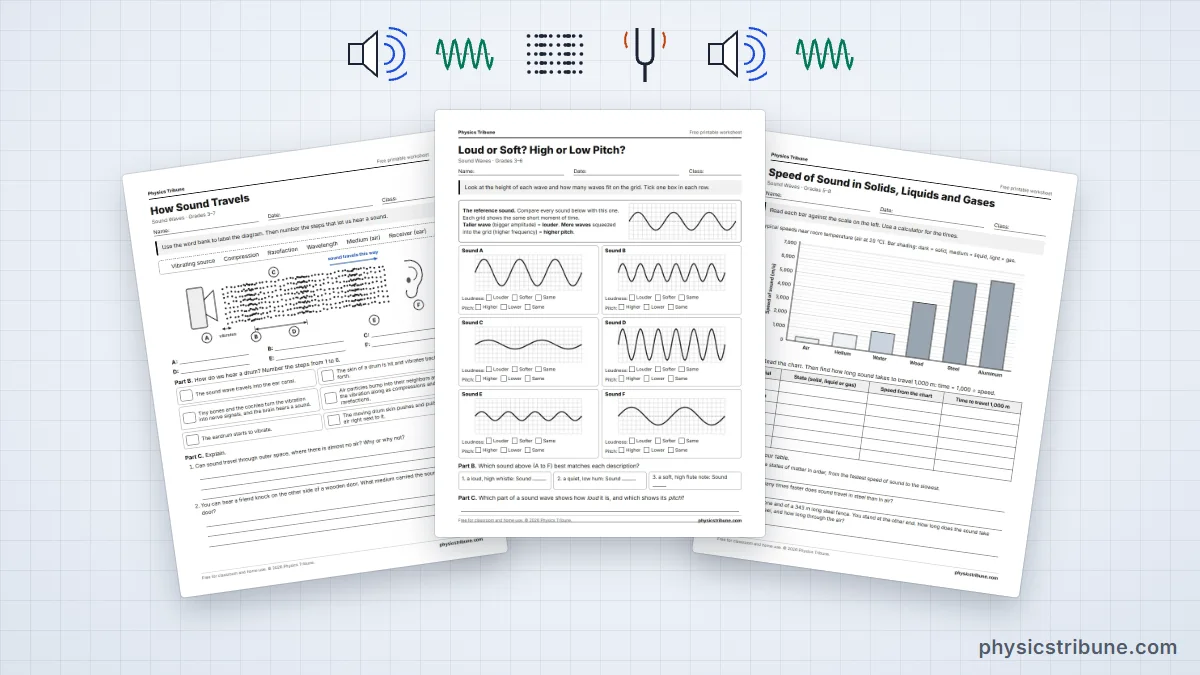 worksheetsSound Waves Worksheets
 compareDifference Between Sound and Light Waves
 wavesResonance in Air Columns (Open and Closed Pipes)
 physicistsLord Rayleigh
 wavesInfrasound