At a Glance
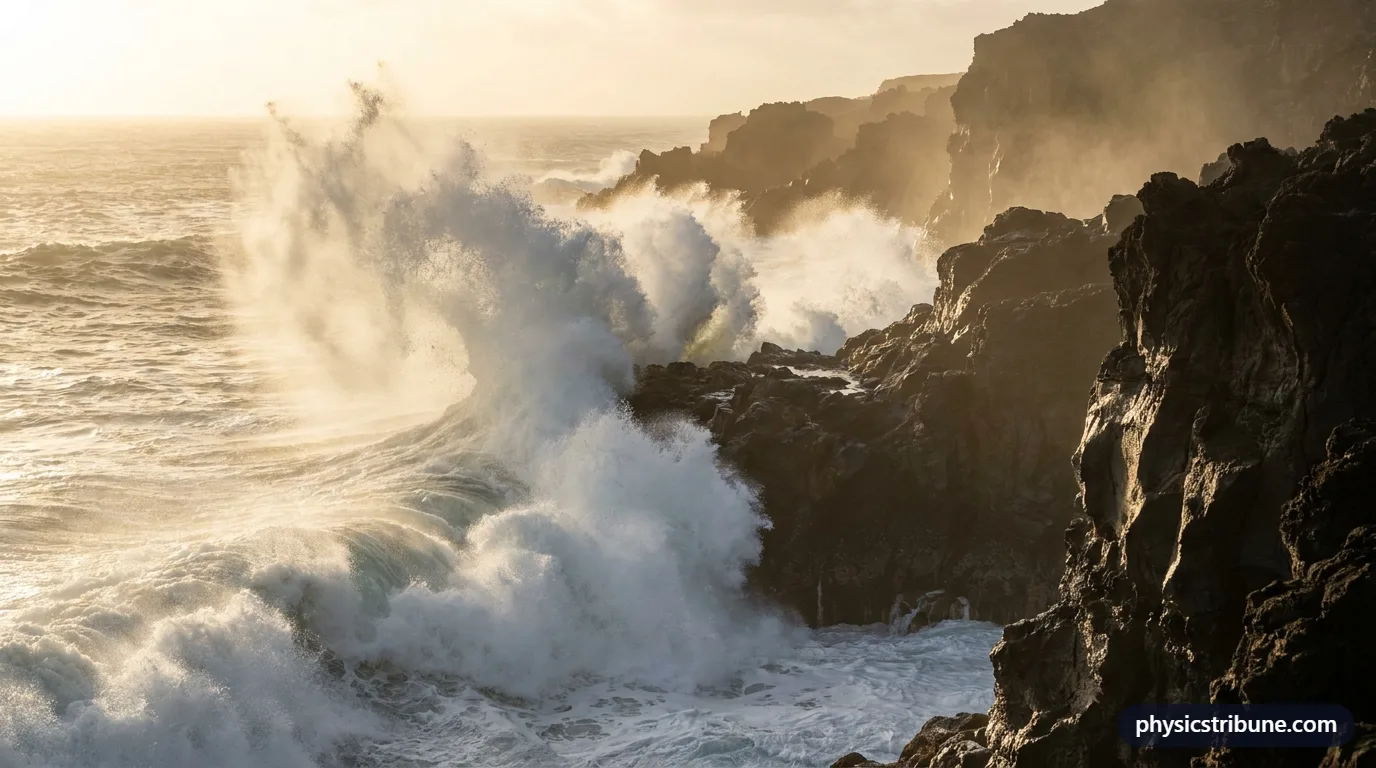
Wave intensity is power per unit area, I = P / A, in watts per square meter (W/m²). It is proportional to the amplitude squared, so doubling the amplitude gives four times the intensity, and for a point source it follows the inverse-square law I = P / (4 π r^2).
- Symbol
- I
- SI unit
- watt per square meter (W/m²)
- Formula
- I = P/A
- Point source
- I = P/(4πr²)
- Depends on
- Amplitude squared and frequency squared
- Scalar or vector
- Treated as a scalar (energy flows along the direction of travel)
On this page
- What Is Wave Energy?
- Wave Energy Explained Simply
- What Is Wave Intensity and How Do You Calculate It?
- How Does Amplitude Affect the Energy of a Wave?
- Why Does Intensity Decrease With Distance?
- How Is Sound Intensity Measured in Decibels?
- What Are Some Examples of Wave Energy and Intensity?
- What Is the Difference Between Wave Energy, Power and Intensity?
- Practice Wave Energy Problems
- Common Misconceptions
- Key Facts
- Quiz
- FAQ
What Is Wave Energy?
A wave is a traveling disturbance, and every disturbance needs energy to create. When you shake one end of a rope, the work your hand does is handed from one piece of rope to the next. The rope itself stays where it is, but the energy moves down its length. That is the central idea of all waves: they carry energy from place to place without carrying the medium along.
In a mechanical wave the energy is shared between two forms. Each moving bit of the medium has kinetic energy, and each stretched or squeezed bit stores potential energy. Ocean swells, sound and vibrations in the ground all work this way. Light and other electromagnetic waves carry energy in their electric and magnetic fields, so they need no medium at all.
The rate at which a wave delivers energy is its power, in watts. One watt is one joule per second.
Wave Energy Explained Simply
Stand in shallow water at the beach. Small ripples barely nudge your legs, while big waves can knock you over. Both kinds move past you in a similar way, but the big ones carry far more energy. The height of a wave, its amplitude, is the clearest sign of how much energy it holds.
Intensity adds one more idea: how concentrated that energy is. A flashlight beam focused on a small spot feels warm, but the same light spread across a whole wall hardly does anything. The energy per second is the same; it is just shared over a bigger area. Intensity measures how much arrives on each square meter.

What Is Wave Intensity and How Do You Calculate It?
Intensity is the power that passes through a surface divided by the area of that surface, measured at right angles to the direction the wave travels:
To calculate it, find the power reaching the surface in watts, find the area it falls on in square meters, and divide. If the wave strikes the surface at a slant, only the area facing the wave counts, which is one reason sunlight is weaker in winter, when it arrives at a low angle.
Intensity is what your senses respond to. Your ears react to the intensity of sound, and your eyes to the intensity of light, which is why distance and focus change how loud or bright things seem.
Intensity divides the power a wave carries by the area it passes through. Here is the formula with each symbol and its SI unit.
| Symbol | Quantity | SI unit |
|---|---|---|
| intensity | watt per square meter (W/m²) | |
| power carried by the wave | watt (W) | |
| area perpendicular to the direction of travel | square meter (m²) |
Rearranged to find another variable:
Example 1 Light falling on a page
A small desk lamp delivers 0.30 W of light evenly onto an open book page with an area of 0.02 m². What is the intensity of the light on the page?
- Given:
- power carried by the wave:
- area perpendicular to the direction of travel:
- power carried by the wave:
- Formula:
- Substitute:
- Answer:
Spreading the same light over a bigger page would lower the intensity and make the page look dimmer.
How Does Amplitude Affect the Energy of a Wave?
The energy a wave carries is proportional to the square of its amplitude. Double the amplitude and the energy, power and intensity all become four times larger. Triple it and they become nine times larger.
The reason is the same as for a mass on a spring. Each piece of the medium behaves like a tiny oscillator, and an oscillator's energy is
The diagram shows two equal waves meeting in step. The combined wave has twice the amplitude of each one, so its intensity is four times that of a single wave, not two times. The extra energy comes from regions of destructive interference elsewhere, so the total is still conserved.

Why Does Intensity Decrease With Distance?
A small source that sends energy out equally in all directions, like a siren or a light bulb, spreads its power over the surface of a growing sphere. A sphere of radius r has an area of
Twice as far away, the same power covers four times the area, so the intensity drops to a quarter. Ten times farther, it drops to one hundredth. The table below follows a 20 W sound source outward and also gives the level in decibels.
Real waves often fade faster than the law predicts. Air absorbs high-pitched sound, fog scatters light, and the ground soaks up earthquake waves. Waves confined to a beam, such as a laser, barely spread at all, so their intensity stays nearly constant over long distances.
Example 2 A siren heard from down the street
A siren on a pole sends out 20 W of sound power evenly in all directions. What is the sound intensity 50 m away, ignoring absorption by the air and reflections?
- Given:
- power of the point source:
- distance from the source:
- power of the point source:
- Formula:
- Substitute:
- Answer:
That is still about 88 dB, loud enough to stop a conversation, even though the power is spread over a sphere of more than 31,000 m².
Example 3 How far until the siren is fairly quiet?
At what distance does the same 20 W siren produce an intensity of 1.0 × 10⁻⁶ W/m², about the level of quiet conversation?
- Given:
- power of the point source:
- intensity at distance r:
- power of the point source:
- Formula:
- Substitute:
- Answer:
In real air the sound fades faster than this, because the atmosphere absorbs some energy and buildings block and scatter it.
| Distance (m) | Intensity (W/m²) | Level (dB) |
|---|---|---|
| 1 | 1.59 | 122.0 |
| 2 | 0.398 | 116.0 |
| 5 | 0.0637 | 108.0 |
| 10 | 0.0159 | 102.0 |
| 20 | 0.00398 | 96.0 |
| 50 | 0.000637 | 88.0 |
| 100 | 0.000159 | 82.0 |
| 1,000 | 0.00000159 | 62.0 |
| Source: Computed with I = P/(4πr²) and β = 10 log₁₀(I/10⁻¹² W/m²) · Retrieved October 2026 | ||

How Is Sound Intensity Measured in Decibels?
Human hearing covers an enormous range, from about
Every factor of 10 in intensity adds 10 dB. A factor of 2 adds about 3 dB, and the factor of 4 from doubling the distance takes away about 6 dB. The decibel scale page explains the logarithm in detail, and the decibel calculator converts between W/m² and dB.
What Are Some Examples of Wave Energy and Intensity?
- Sunlight. Above the atmosphere the Sun delivers about 1,360 W/m². That intensity is what solar panels harvest, minus what the air absorbs and scatters.
- Ocean waves. Swells carry energy across whole oceans from distant storms and can be tapped by wave energy machines along the coast.
- Sound. A whisper reaches your ear at roughly a billionth of a watt per square meter, while a jet engine nearby can exceed 1 W/m².
- Earthquakes. Seismic waves carry energy through rock, and the shaking weakens with distance from the source as the energy spreads and is absorbed.
- Medical ultrasound. Low intensities form images, while focused high-intensity beams can heat and destroy small regions of tissue.
What Is the Difference Between Wave Energy, Power and Intensity?
The three ideas are linked but not the same. Energy, in joules, is the total amount a wave delivers. Power, in watts, is the rate of delivery, energy per second. Intensity, in W/m², is power per unit area, which tells you how concentrated the delivery is. A 100 W lamp and a 100 W laser have the same power, but the laser's intensity on a tiny spot is vastly higher.
Mixing up energy and power is a common slip outside of waves too; our energy vs power comparison sorts it out. The watt itself is named after the engineer James Watt.
Practice Wave Energy Problems
Every wave equation used here, from
Common Misconceptions
Myth: A wave carries the water or air along with it.
Physics: The medium only oscillates around its resting position. The energy moves forward, while the particles stay roughly where they started.
Myth: Doubling a wave's amplitude doubles its energy.
Physics: Energy depends on amplitude squared, so doubling the amplitude gives four times the energy and intensity.
Myth: Twice as far from a sound source means half the intensity.
Physics: For a point source the power spreads over an area that grows with r², so twice the distance gives a quarter of the intensity.
Myth: Intensity and power are the same thing.
Physics: Power is energy per second in watts. Intensity is power per square meter, so the same power can give very different intensities depending on how widely it is spread.
Key Facts
- Waves carry energy from place to place without carrying the medium along with them.
- Wave intensity is power per unit area, I = P/A, measured in watts per square meter.
- The energy and intensity of a wave are proportional to the square of its amplitude.
- At the same amplitude, a higher-frequency mechanical wave carries more power, in proportion to the frequency squared.
- For a point source the intensity falls with distance as I = P/(4πr²), the inverse-square law.
- Doubling the distance from a point source cuts the intensity to one quarter, about 6 dB lower.
- Sound intensity is often expressed in decibels, with 10⁻¹² W/m² as the 0 dB reference.
Quick Quiz: How Well Do You Know Energy and Intensity of Waves?
6 questions. Tap an answer to check it.
What is the SI unit of wave intensity?
Intensity is power per area, so its unit is W/m².
If the amplitude of a wave triples, its intensity becomes:
Intensity depends on amplitude squared, and 3² = 9.
You move from 3 m to 6 m away from a small sound source. The intensity becomes:
By the inverse-square law, doubling the distance divides intensity by 2² = 4.
What does a wave transport from one place to another?
The medium oscillates in place while the energy travels along.
A 2.0 W beam falls evenly on 0.5 m². What is its intensity?
I = P/A = 2.0 W ÷ 0.5 m² = 4 W/m².
An increase of 10 dB in sound level corresponds to intensity multiplied by:
Each 10 dB step is a factor of 10 in intensity.
Frequently Asked Questions
What is wave intensity?
Wave intensity is the amount of power a wave carries through each square meter of area at right angles to its direction of travel. It is written I = P/A and measured in watts per square meter. Intensity tells you how concentrated the energy of a wave is, which is what decides how loud a sound or how bright a light seems.
What is the unit of intensity of a wave?
The SI unit of intensity is the watt per square meter, W/m². It comes from dividing power in watts by area in square meters. For sound, intensity is often converted into a level in decibels, which compares it with the reference value of 10⁻¹² W/m², roughly the quietest sound a healthy young ear can detect.
How is the energy of a wave related to its amplitude?
The energy of a wave is proportional to the square of its amplitude. If the amplitude doubles, the energy becomes four times larger; if it triples, nine times larger. This is because every part of the medium oscillates like a small spring, and the energy of an oscillator grows with the square of how far it swings.
Does frequency affect the energy of a wave?
For mechanical waves, yes. At the same amplitude, a wave with a higher frequency makes the medium move faster, so it carries more power, in proportion to the frequency squared. For light, each photon's energy is proportional to frequency, but the total intensity of a beam also depends on how many photons arrive each second.
What is the inverse-square law for intensity?
The inverse-square law says that the intensity from a point source falls with the square of the distance, I = P/(4πr²). The power spreads over the surface of a sphere whose area grows as r². Twice the distance gives a quarter of the intensity, and three times the distance gives one ninth.
Do waves transfer matter or energy?
Waves transfer energy, not matter. The particles of the medium oscillate around fixed positions as the wave passes, handing energy to their neighbors. A floating ball bobs up and down as ocean swells pass under it but stays roughly in the same place, while the swells carry energy all the way to the shore.
Why does sound get quieter as you move away?
Two effects work together. First, the sound power spreads over a larger and larger area, so the intensity falls with the square of the distance. Second, the air itself absorbs some energy, especially at high frequencies, and obstacles reflect or scatter it. That is why distant thunder sounds like a low rumble.
What is the difference between intensity and loudness?
Intensity is a physical quantity, the power per square meter in W/m², that an instrument can measure. Loudness is how strong a sound seems to a listener. Loudness rises with intensity but not in a straight line, and it also depends on frequency, since human ears are most sensitive between about 2,000 and 5,000 Hz.
Keep Exploring






Sources
Constants come from NIST CODATA 2022 (public domain) and unit definitions from the BIPM SI Brochure (CC BY 4.0). Text, diagrams and illustrations are original work by Physics Tribune.