
At a Glance
Equipartition says each degree of freedom of a molecule carries an average energy of ½ k_B T, where k_B is the Boltzmann constant and T the absolute temperature. A monatomic gas has 3 such degrees of freedom, so its molar heat capacity at constant volume is Cv = 3/2 R; a diatomic gas like nitrogen adds 2 rotational ones, giving Cv = 5/2 R near room temperature.
- Energy per degree of freedom
- ½ k_B T per molecule (½ RT per mole)
- Translational energy
- KE_avg = 3/2 k_B T for every gas
- Monatomic gas
- f = 3, Cv = 3/2 R ≈ 12.47 J/(mol·K), γ = 5/3
- Diatomic gas (room temperature)
- f = 5, Cv = 5/2 R ≈ 20.79 J/(mol·K), γ = 7/5
- SI unit of heat capacity
- joule per mole kelvin, J/(mol·K)
- Holds when
- k_B T is large compared with the quantum energy steps of that motion
On this page
- What Is the Equipartition Theorem?
- Equipartition Explained Simply
- What Are Degrees of Freedom in a Gas Molecule?
- Why Is Cv = 3/2 R for a Monatomic Gas?
- Why Is Cv = 5/2 R for Air?
- How Does Equipartition Predict Heat Capacity?
- When Does the Equipartition Theorem Fail?
- Do All Gas Molecules Have the Same Energy at the Same Temperature?
- Who Discovered the Equipartition of Energy?
- Practice Equipartition Problems
- Common Misconceptions
- Key Facts
- Quiz
- FAQ
What Is the Equipartition Theorem?
The equipartition theorem is a rule from classical statistical physics about how thermal energy is shared out. Molecules in a gas collide billions of times per second, swapping energy until no form of motion is favored over another. The theorem says that, once things settle into thermal equilibrium, each independent quadratic energy term gets the same average share:
A quadratic energy term is any energy that depends on the square of one coordinate or one speed. Kinetic energy along the x direction,
Each of these is called a degree of freedom, written
The translational part of equipartition, three degrees of freedom at ½k_BT each, gives the best-known result of kinetic theory.
| Symbol | Quantity | SI unit |
|---|---|---|
| average translational kinetic energy per molecule | joule (J) | |
| Boltzmann constant (1.381 × 10⁻²³ J/K (exact: 1.380649 × 10⁻²³)) | joule per kelvin (J/K) | |
| absolute temperature | kelvin (K) |
Rearranged to find another variable:
Valid for: ideal gas; translational motion only.
Example 1 Average kinetic energy of an air molecule on a mild day
Air in a classroom is at 300 K. What is the average translational kinetic energy of one molecule, using k_B = 1.380649 × 10⁻²³ J/K?
- Given:
- Boltzmann constant:
- absolute temperature:
- Boltzmann constant:
- Formula:
- Substitute:
- Answer:
The answer is the same for nitrogen, oxygen and argon in that room, because equipartition does not care about molecular mass.
Equipartition Explained Simply
Imagine a crowded room where everyone keeps trading coins at random. After a while, it does not matter who started rich. Everyone ends up with roughly the same number of coins on average. Collisions do the same with energy: they keep passing it around until every type of motion holds a fair share.
Temperature tells you how big that fair share is. Double the absolute temperature and every share doubles. A molecule with more ways to move, such as one that can also tumble end over end, collects more shares and so stores more energy at the same temperature.
That is the whole reason some gases need more heat than others to warm up. Heat you add has to fill every share, not just the ones that make the molecules fly faster.
What Are Degrees of Freedom in a Gas Molecule?
Every molecule can move through space in three directions, so every gas has 3 translational degrees of freedom. That is why the average translational energy is
Molecules made of several atoms can also rotate. A straight molecule such as N₂ or O₂ can spin about the two axes at right angles to its bond, adding 2 rotational degrees of freedom. Spin about the bond itself does not count, because the moment of inertia about that axis is so tiny that the first quantum step is far too large to reach. A bent molecule such as water can rotate about all three axes, adding 3.
Finally, atoms in a molecule can vibrate along their bonds. Each vibration counts twice, once for the kinetic energy of the motion and once for the spring-like potential energy. As the next sections show, these vibrations are usually frozen out at room temperature.
Why Is Cv = 3/2 R for a Monatomic Gas?
Helium, neon and argon atoms are single atoms. They behave like tiny smooth spheres, and the only motion that holds energy is flying through space. With
The molar heat capacity at constant volume is the energy needed to warm one mole by one kelvin, so
At constant pressure the gas also pushes back the surroundings as it expands, which costs an extra

Why Is Cv = 5/2 R for Air?
Air is mostly nitrogen and oxygen, both diatomic. Near room temperature each molecule has 3 translational and 2 rotational degrees of freedom, so
If vibration were active too, it would add 2 more degrees of freedom and push
The ratio
Example 2 Internal energy stored in a balloon of nitrogen
A sealed balloon holds 2.0 mol of nitrogen at 300 K. Treating N₂ as a diatomic gas with 5 active degrees of freedom, what is its internal energy? Use R = 8.314462618 J/(mol·K).
- Given:
- amount of gas:
- ideal gas constant:
- absolute temperature:
- amount of gas:
- Formula:
- Substitute:
- Answer:
A monatomic gas at the same temperature would store only three fifths of this, since it has no rotational degrees of freedom.

How Does Equipartition Predict Heat Capacity?
The recipe is short. Count the active degrees of freedom
These are molar values. To compare with the specific heat capacity per kilogram that you meet in calorimetry, divide by the molar mass. That is why helium, with very light atoms, has a huge specific heat per kilogram even though its molar heat capacity is the smallest of any gas.
Our table compares the equipartition predictions with typical measured values near room temperature. Our specific heat calculator turns a heat capacity into the heat needed for any temperature change.
Example 3 Heat needed to warm nitrogen in a rigid tank
A rigid steel tank holds 0.50 mol of nitrogen. How much heat must be added to raise its temperature by 40 K, if Cv = 5/2 R? Use R = 8.314462618 J/(mol·K).
- Given:
- amount of gas:
- ideal gas constant:
- temperature rise:
- amount of gas:
- Formula:
- Substitute:
- Answer:
In a rigid tank no work is done, so all the heat goes into internal energy, exactly the case Cv describes.
| Kind of molecule | Active degrees of freedom f | Cv (J/(mol·K)) | Cp (J/(mol·K)) | γ = Cp/Cv | Examples |
|---|---|---|---|---|---|
| Monatomic | 3 (translation) | 12.47 | 20.79 | 1.667 | He, Ne, Ar |
| Diatomic, rigid | 5 (3 translation + 2 rotation) | 20.79 | 29.10 | 1.400 | N₂, O₂, air near room temperature |
| Nonlinear, rigid | 6 (3 translation + 3 rotation) | 24.94 | 33.26 | 1.333 | H₂O vapor, CH₄ (approximately) |
| Diatomic with vibration | 7 (adds 2 for one vibration) | 29.10 | 37.42 | 1.286 | Diatomic gases at thousands of kelvin |
| Source: Computed with Cv = (f/2)R, Cp = Cv + R, R = 8.314462618 J/(mol·K) (NIST CODATA 2022) · Retrieved October 2026 | |||||
When Does the Equipartition Theorem Fail?
Equipartition is a classical result. It works when
Hydrogen gas shows this beautifully. At very low temperatures its molar heat capacity drops to about
The same failure appears in solids and in light. The classical Dulong and Petit value of
| Gas | Prediction | Predicted Cv (J/(mol·K)) | Typical measured Cv (J/(mol·K)) |
|---|---|---|---|
| Helium | 3/2 R | 12.47 | about 12.5 |
| Argon | 3/2 R | 12.47 | about 12.5 |
| Nitrogen | 5/2 R | 20.79 | about 20.8 |
| Oxygen | 5/2 R | 20.79 | about 21 |
| Carbon dioxide | 5/2 R (linear, rigid) | 20.79 | about 28.5 (vibrations partly active) |
| Source: Predictions computed with R = 8.314462618 J/(mol·K) · measured values are typical rounded figures · Retrieved October 2026 | |||
Do All Gas Molecules Have the Same Energy at the Same Temperature?
On average, yes, for translation. A helium atom and a nitrogen molecule in the same room carry the same average translational kinetic energy,
Individual molecules vary a lot. At any instant some are nearly at rest and some move several times faster than average, a spread described by the Maxwell-Boltzmann distribution. Equipartition is a statement about averages over many molecules or over a long time, not about any single molecule.
The speed curves below show helium and nitrogen at 300 K. Helium's curve is wider and shifted to much higher speeds, yet the average kinetic energy of the two gases is identical.

Who Discovered the Equipartition of Energy?
The idea grew out of kinetic theory in the middle of the 1800s. James Clerk Maxwell showed around 1860 that colliding gas molecules share translational energy equally, and he later saw that the rule seemed to apply to rotation as well. Ludwig Boltzmann generalized it in the 1870s into the theorem we use today.
Maxwell himself was troubled by the result. Atoms were thought to have internal motions, yet measured heat capacities showed no sign of them storing energy. The puzzle was only resolved in the early 1900s, when quantum theory explained why some motions freeze out. Our page on who discovered thermodynamics places this story in the wider history of heat.
Practice Equipartition Problems
Try predicting
Our specific heat worksheets give printable practice with heat capacity, and the ideal gas law page links temperature, pressure and volume for the same gases. If you are unsure about the difference between the energy stored and the reading on a thermometer, see heat vs temperature.
Common Misconceptions
Myth: Heavier gas molecules have more kinetic energy at the same temperature.
Physics: At the same temperature, all gas molecules have the same average translational kinetic energy, 3/2 k_BT. Heavier ones simply move more slowly.
Myth: Every possible motion of a molecule always counts as a degree of freedom.
Physics: Only motions whose quantum energy steps are small compared with k_BT count. Vibrations, and spin about a linear molecule's own axis, are usually frozen out.
Myth: Equipartition means every molecule has exactly the same energy.
Physics: It is a statement about averages. Individual molecules have a wide spread of energies, described by the Maxwell-Boltzmann distribution.
Myth: Cv and Cp are the same thing for a gas.
Physics: At constant pressure the gas does work as it expands, so it needs an extra R per mole per kelvin: Cp = Cv + R.
Key Facts
- Equipartition gives an average energy of ½k_BT per molecule to each active quadratic degree of freedom.
- Every gas has 3 translational degrees of freedom, so its average translational kinetic energy is 3/2 k_BT.
- A monatomic ideal gas has Cv = 3/2 R ≈ 12.47 J/(mol·K) and γ = 5/3.
- Diatomic gases such as nitrogen and oxygen have Cv ≈ 5/2 R near room temperature because they also rotate about two axes.
- Molecular vibrations are mostly frozen at room temperature because their quantum energy steps exceed k_BT.
- For an ideal gas, Cp = Cv + R and γ = (f + 2)/f.
- The failures of equipartition at low temperatures were key clues that led to quantum physics.
Quick Quiz: How Well Do You Know Equipartition of Energy and Heat Capacity of Gases?
6 questions. Tap an answer to check it.
What is the average energy per degree of freedom per molecule according to equipartition?
Each active quadratic degree of freedom holds ½k_BT on average.
How many active degrees of freedom does nitrogen have near room temperature?
Three translational plus two rotational; vibration is frozen out.
What is Cv for a monatomic ideal gas?
With f = 3, Cv = (3/2)R.
Helium and nitrogen are at the same temperature. Which statement is true?
Average translational kinetic energy depends only on temperature: 3/2 k_BT.
What is γ for a gas with f = 5?
γ = (f + 2)/f = 7/5 = 1.40.
Why does hydrogen's heat capacity fall at very low temperatures?
When k_BT is smaller than the rotational energy steps, rotation stops storing energy.
Frequently Asked Questions
What does the equipartition theorem state?
It states that in thermal equilibrium, each independent quadratic term in a molecule's energy holds an average of ½k_BT, where k_B is the Boltzmann constant and T is the absolute temperature. Translation along x, y and z, rotation about each allowed axis, and the kinetic and potential parts of each vibration all count as separate terms, as long as they are not frozen out.
How many degrees of freedom does a diatomic molecule have?
A diatomic molecule has 3 translational and 2 rotational degrees of freedom, for 5 near room temperature. Its single vibration would add 2 more, one kinetic and one potential, but it is usually frozen out until temperatures reach thousands of kelvin. That is why nitrogen and oxygen have Cv close to 5/2 R rather than 7/2 R.
Why is Cv of a monatomic gas 3/2 R?
A single atom can only store energy by moving through space in three directions. Each direction holds ½RT per mole, so the internal energy is 3/2 nRT. Raising the temperature of one mole by one kelvin therefore needs 3/2 R of energy at constant volume, which is about 12.47 joules per mole per kelvin.
What is the ratio of specific heats for air?
For air near room temperature, the ratio γ = Cp/Cv is about 1.4. Equipartition predicts exactly 7/5 for a rigid diatomic gas, because Cv = 5/2 R and Cp = 7/2 R. This value controls how much air heats up when compressed quickly and appears in the formula for the speed of sound in air.
Why don't vibrations count at room temperature?
Vibrational energy comes in quantum steps. For a strongly bonded molecule like nitrogen, the first step is far larger than k_BT at 300 K, so molecular collisions almost never supply enough energy to excite it. The vibration stays in its lowest state and stores no extra heat. Only at much higher temperatures do collisions excite it often enough to matter.
Does equipartition apply to solids?
Yes, at high enough temperatures. Each atom in a solid can vibrate in three directions, and each vibration has kinetic and potential parts, giving 6 degrees of freedom and a molar heat capacity of about 3R, roughly 25 J/(mol·K). This is the Dulong and Petit rule. At low temperatures the value falls because the vibrations freeze out.
How is equipartition related to temperature?
Equipartition gives temperature a direct meaning in terms of energy. The average energy in each active degree of freedom is ½k_BT, so temperature measures the energy per degree of freedom. That is why absolute temperature must be in kelvin, and why at absolute zero classical theory would predict no thermal motion at all.
What is the ultraviolet catastrophe?
It is what happens when you apply equipartition to light inside a hot cavity. Classical physics counts endless short-wavelength modes, each with an equal share of energy, and predicts infinite total energy. Real blackbodies glow with a finite spectrum. Max Planck fixed this by assuming energy comes in quanta, the first step toward quantum theory.
Keep Exploring
 thermodynamicsKinetic Theory of Gases
 thermodynamicsInternal Energy
 thermodynamicsSpecific Heat Capacity
 thermodynamicsMaxwell-Boltzmann Distribution
 thermodynamicsAdiabatic Process
 calculatorsSpecific Heat Calculator (Q = mcΔT)
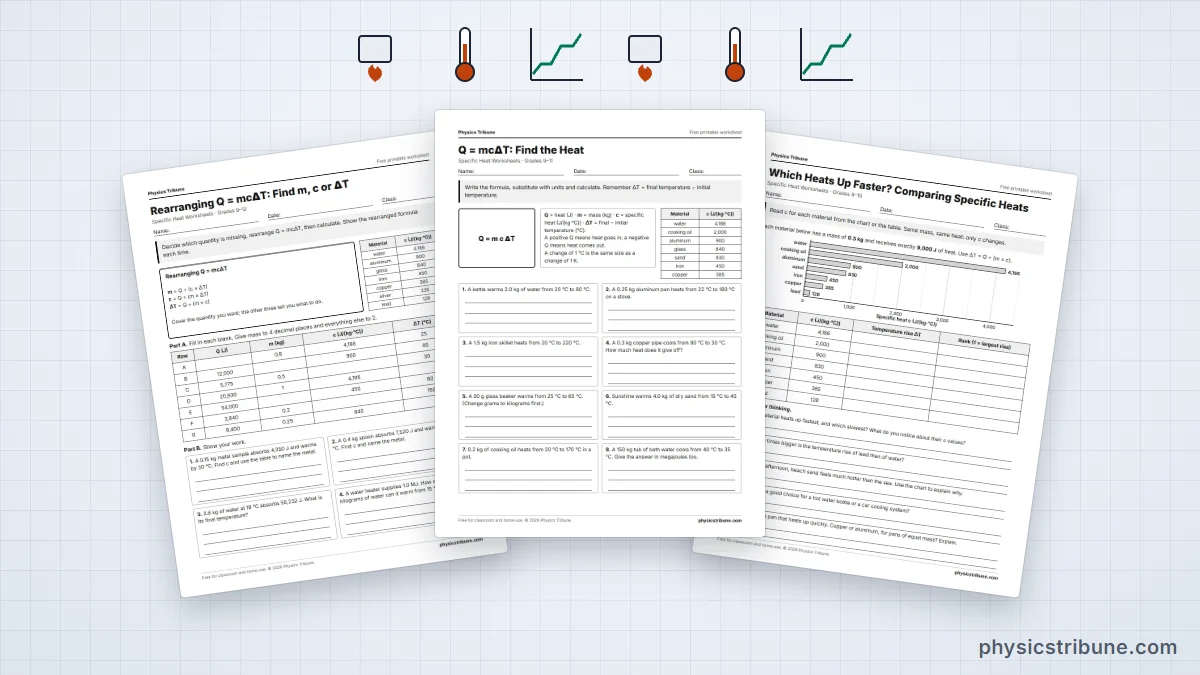 worksheetsSpecific Heat Worksheets
 compareHeat vs Temperature
 physicistsLudwig Boltzmann