At a Glance
Internal energy (U) is the sum of the random kinetic and potential energies of all the particles in a system, measured in joules. For a monatomic ideal gas it depends only on temperature, U = 3/2 n R T, and it changes according to the first law of thermodynamics, ΔU = Q − W.
- Symbol
- U (change written ΔU)
- SI unit
- joule (J)
- Ideal monatomic gas
- U = 3/2 nRT
- How it changes
- ΔU = Q − W (first law)
- Type of quantity
- Scalar, extensive, state function
On this page
- What Is Internal Energy?
- Internal Energy Explained Simply
- What Is the Formula for Internal Energy?
- How Can You Change Internal Energy?
- How Is Internal Energy Related to Temperature?
- Is Internal Energy the Same as Heat?
- Why Does Internal Energy Rise When Ice Melts?
- What Are Some Examples of Internal Energy?
- Going Deeper: Why Is Internal Energy a State Function?
- Practice Internal Energy Problems
- Common Misconceptions
- Key Facts
- Quiz
- FAQ
What Is Internal Energy?
Every piece of matter is made of particles that never sit still. Gas molecules fly about and collide, atoms in a liquid slide past one another, and atoms in a solid jiggle around fixed spots. Internal energy, written U, is the total of all that hidden activity inside a system.
It has two parts. The kinetic part is the energy of random motion: molecules moving from place to place, spinning and vibrating. The potential part is the energy stored in the attractions and repulsions between particles, including chemical bonds. In a gas the particles are far apart and the kinetic part dominates; in solids and liquids both parts matter.
Internal energy does not include the motion of the system as a whole or its position in a gravitational field. A thermos of coffee in a moving car has the same internal energy as the same thermos on a kitchen table at the same temperature. Only the energy inside the system counts.
Internal Energy Explained Simply
Think of a crowded dance floor. Even if the crowd as a whole stays in one place, every dancer is moving, spinning and bumping into others. Add up all of that motion and you get something like the internal energy of the room. Turn up the music and everyone moves faster, so the total goes up.
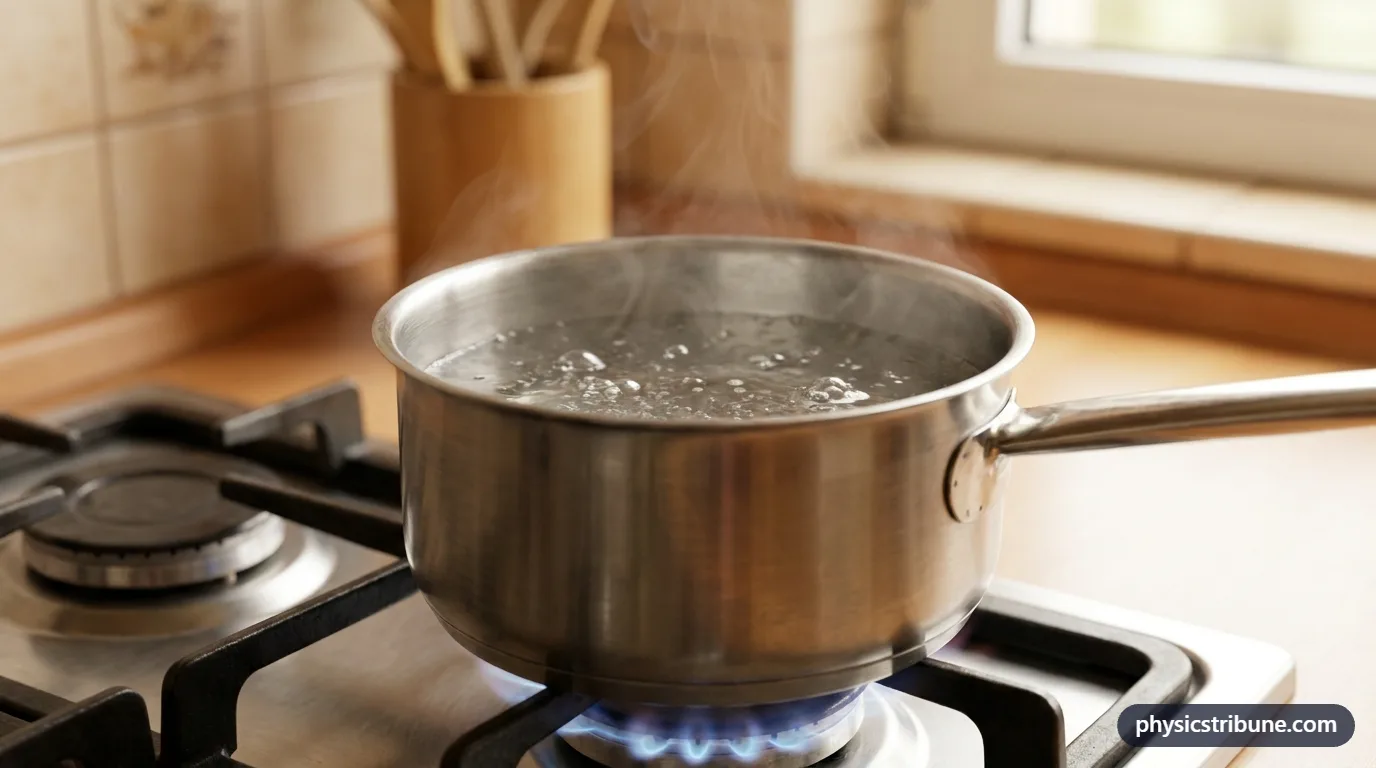
Heating a pot of soup works the same way. The stove does not make the pot fly across the kitchen; it makes the molecules inside move faster. That extra energy is hidden in the random motion, and you notice it as a rise in temperature. When the soup cools, the molecules slow down and the internal energy flows out as heat.
What Is the Formula for Internal Energy?
There is no single formula for the internal energy of every material, because liquids and solids have complicated forces between their particles. For the simplest case, a monatomic ideal gas, the result is clean:
The formula comes from the kinetic theory of gases. Each atom carries an average kinetic energy of
Molecules made of two atoms, like nitrogen and oxygen, can also spin, which gives them two more shares. Near room temperature their internal energy is close to
For a monatomic ideal gas, such as helium or argon at ordinary pressures, internal energy depends only on the amount of gas and its absolute temperature.
| Symbol | Quantity | SI unit |
|---|---|---|
| internal energy | joule (J) | |
| amount of gas | mole (mol) | |
| ideal gas constant (8.314 J/(mol·K)) | joule per mole kelvin (J/(mol·K)) | |
| absolute temperature | kelvin (K) |
Rearranged to find another variable:
Valid for: monatomic ideal gas only (diatomic near room temperature: 5/2 nRT).
Example 1 Helium in a party balloon
A balloon holds 2 mol of helium at 300 K. Treating helium as a monatomic ideal gas, what is the internal energy of the gas? Use R = 8.314462618 J/(mol·K).
- Given:
- amount of gas:
- ideal gas constant:
- absolute temperature:
- amount of gas:
- Formula:
- Substitute:
- Answer:
This energy is the random motion of roughly 1.2 × 10²⁴ helium atoms, not any motion of the balloon as a whole.
How Can You Change Internal Energy?
There are only two ways to change the internal energy of a closed system: transfer heat or do work. The first law of thermodynamics puts them together as
Heat flows in when the system touches something hotter, like a pan on a burner. Work changes internal energy through mechanical action: pumping up a bike tire squeezes the air and warms the pump, and rubbing your hands together turns muscle work into warmth. When a gas expands and pushes a piston, it does work and its internal energy drops unless heat flows in to replace it.
The sign rule matters. Heat into the system is positive, and work done by the system is positive in this form of the law. Some chemistry books write
Example 2 Gas in a cylinder with a piston
Gas trapped under a piston absorbs 500 J of heat from a flame and, as it expands, does 200 J of work pushing the piston up. What is the change in the internal energy of the gas?
- Given:
- net heat added TO the system:
- net work done BY the system:
- net heat added TO the system:
- Formula:
- Substitute:
- Answer:
A positive answer means the gas ends up with more internal energy, so its temperature rises.

How Is Internal Energy Related to Temperature?
Temperature measures the average kinetic energy of the particles, while internal energy is a total. A bathtub of warm water and a cup of hot tea show the difference. The tea is hotter, so its molecules move faster on average, yet the bathtub holds far more internal energy because it contains thousands of times more molecules.
For an ideal gas, internal energy depends on temperature alone. Squeeze the gas or let it expand at a fixed temperature and its internal energy stays the same, which is why an isothermal process has
To see the related ideas side by side, read temperature vs thermal energy and heat vs temperature.
Example 3 Finding the temperature of a gas sample
A sealed container holds 0.5 mol of argon, a monatomic gas, with an internal energy of 1,900 J. What is the temperature of the gas in kelvin? Use R = 8.314462618 J/(mol·K).
- Given:
- internal energy:
- amount of gas:
- ideal gas constant:
- internal energy:
- Formula:
- Substitute:
- Answer:
Subtract 273.15 to convert to degrees Celsius; this sample is close to room temperature.
| Temperature (K) | Temperature (°C) | U for 1 mol (J) | U for 2 mol (J) |
|---|---|---|---|
| 100 | −173.15 | 1,247.2 | 2,494.3 |
| 200 | −73.15 | 2,494.3 | 4,988.7 |
| 273.15 | 0 | 3,406.6 | 6,813.3 |
| 300 | 26.85 | 3,741.5 | 7,483.0 |
| 500 | 226.85 | 6,235.8 | 12,471.7 |
| 1,000 | 726.85 | 12,471.7 | 24,943.4 |
| Source: Computed with U = 3/2 nRT, R = 8.314462618 J/(mol·K) (NIST CODATA 2022) · Retrieved October 2026 | |||
Is Internal Energy the Same as Heat?
No. Internal energy is something a system has; heat is energy that moves between systems because of a temperature difference. A hot stone holds a lot of internal energy, but it holds no heat. Heat exists only while energy is crossing a boundary.
The everyday phrase "thermal energy" usually refers to the part of internal energy tied to temperature, the random kinetic energy of the particles. Internal energy is broader, since it also includes the potential energy between particles and the energy in chemical bonds. Our thermal energy page looks at that narrower idea.

Why Does Internal Energy Rise When Ice Melts?
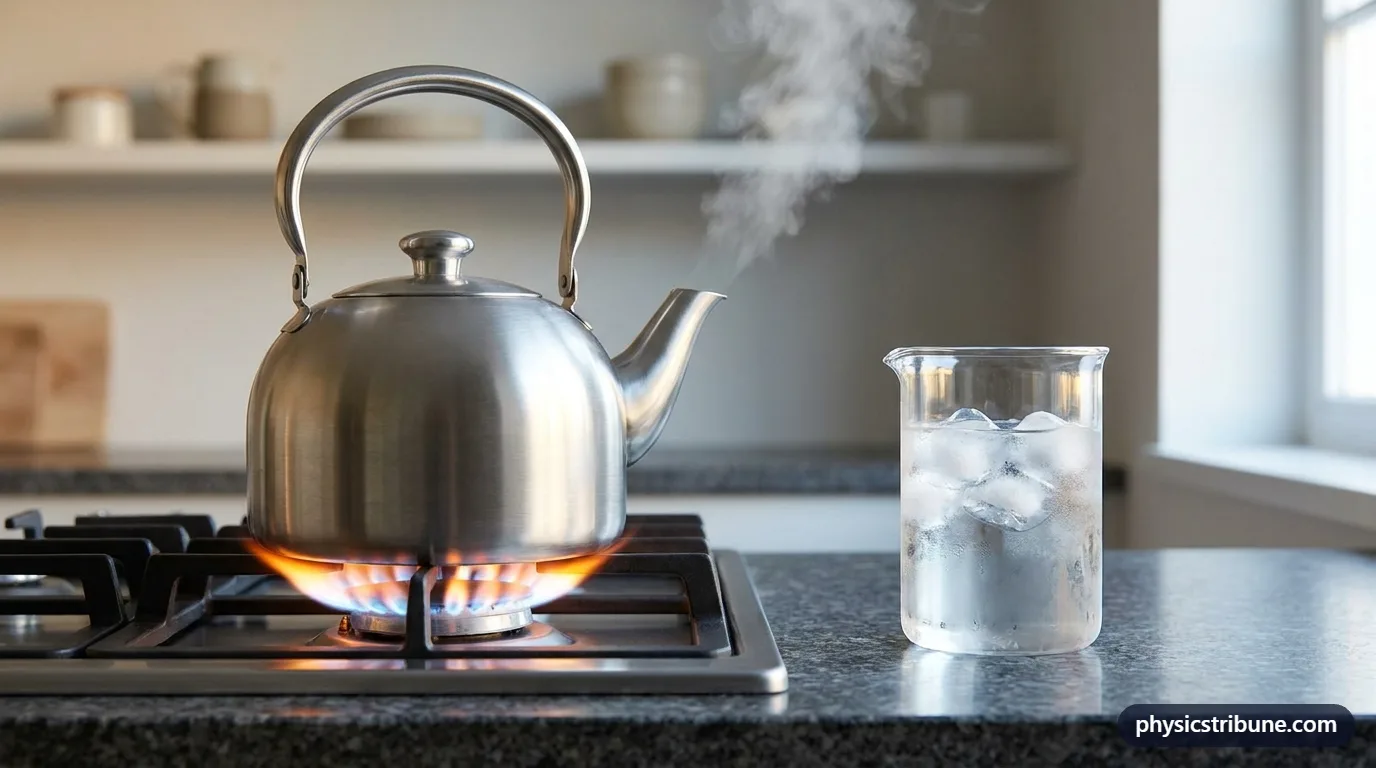
When ice melts at 0 °C, its temperature stays put, yet it keeps absorbing heat. The extra energy does not speed up the molecules; it pulls them apart from the rigid crystal and raises their potential energy. Melting 0.1 kg of ice takes about 33,400 J, all of which becomes internal energy of the water.
The same happens, on a larger scale, when water boils. This is why a burn from steam at 100 °C is worse than one from water at 100 °C: the steam carries the extra internal energy it gained when it vaporized, and it releases that energy as it condenses on skin. The heat needed per kilogram is called latent heat.
What Are Some Examples of Internal Energy?
- Bike pump: pushing the handle does work on the trapped air, raising its internal energy, and the pump barrel gets warm.
- Aerosol can: spraying lets the gas expand and do work while the liquid propellant inside boils, both of which draw on internal energy, so the can feels cold.
- Car brakes: friction turns the car's kinetic energy into internal energy of the pads and discs, which can get very hot.
- Hot water bottle: water stores a large amount of internal energy per degree, then releases it slowly as heat.
- Batteries and food: chemical bonds hold internal energy that a reaction can release as heat or electrical work.
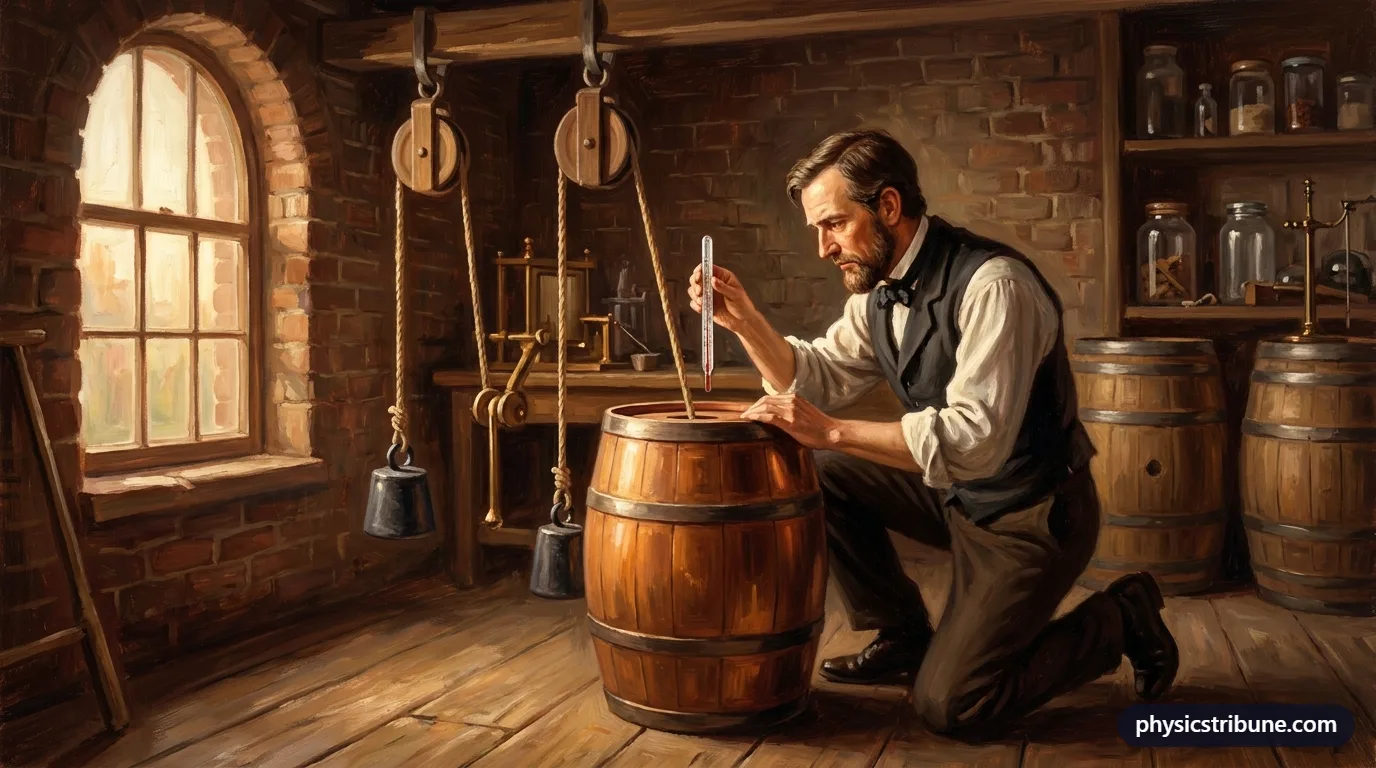
In the 1840s James Joule showed that a set amount of mechanical work always produces the same rise in the internal energy of water, linking work and heat for good. Read more on our James Prescott Joule page and in the paddle wheel experiment.

Going Deeper: Why Is Internal Energy a State Function?
Internal energy depends only on the current state of a system, such as its temperature, pressure, volume and composition, and not on how it got there. Take a gas from state A to state B by heating first and compressing second, or the other way round, and ΔU is the same. The amounts of heat and work along the two paths can be very different, but their difference, Q − W, is not.
This property is why we can tabulate internal energies and use them like bank balances. It also means a system that runs through a complete cycle and returns to its start, like the gas in an engine, has
Practice Internal Energy Problems
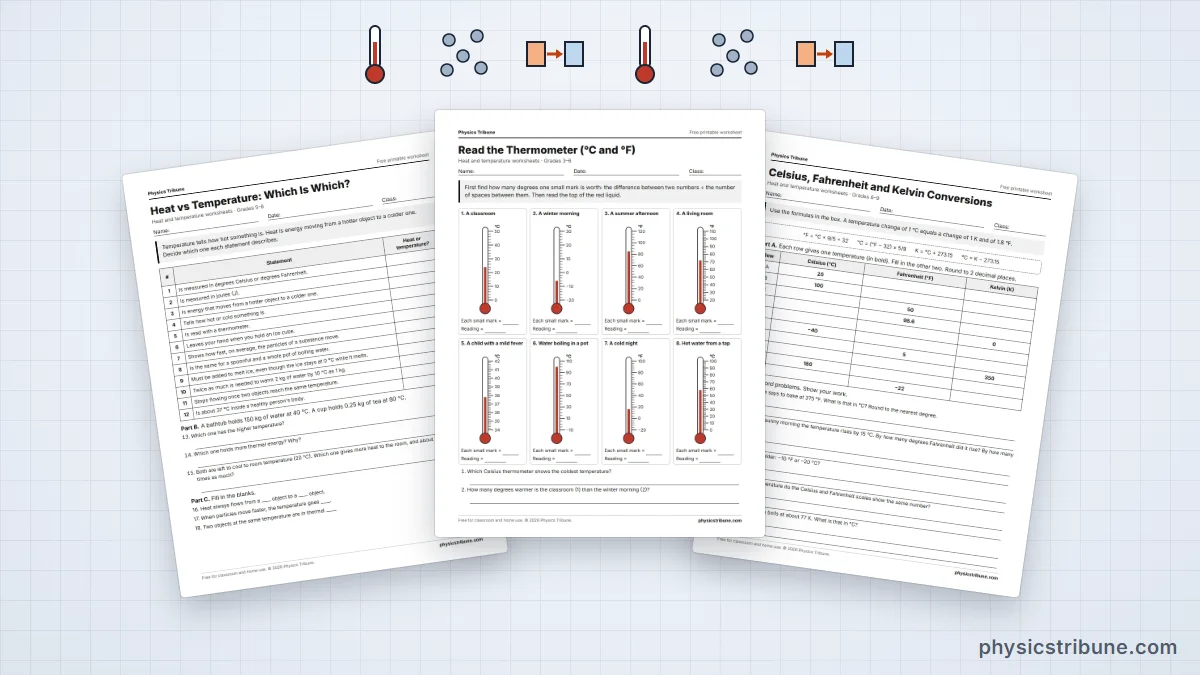
To build skill with heat, work and temperature changes, try our heat and temperature worksheets. For problems that need the amount of gas first, the ideal gas law calculator finds moles, pressure, volume or temperature in one step. Then test yourself with the quiz below.
Common Misconceptions
Myth: A hotter object always has more internal energy than a cooler one.
Physics: Internal energy also depends on how much material there is. A lukewarm swimming pool has far more internal energy than a hot cup of tea.
Myth: Internal energy and heat are the same thing.
Physics: Internal energy is stored in a system. Heat is energy transferred between systems because of a temperature difference.
Myth: If no heat is added, internal energy cannot change.
Physics: Work also changes internal energy. Compressing a gas quickly with no heat flow still warms it and raises U.
Myth: Adding heat always raises the temperature.
Physics: During a phase change, added heat raises the potential energy of the particles, so internal energy rises while the temperature stays the same.
Key Facts
- Internal energy is the total random kinetic energy and intermolecular potential energy of the particles in a system.
- Its symbol is U and its SI unit is the joule.
- For a monatomic ideal gas, U = 3/2 nRT, so internal energy depends only on temperature and amount of gas.
- Internal energy changes only through heat transfer and work, as stated by the first law, ΔU = Q − W.
- Internal energy is a state function: the change between two states does not depend on the path taken.
- During melting and boiling, internal energy rises while the temperature stays constant.
- Motion of the whole object and its height above the ground are not part of its internal energy.
Quick Quiz: How Well Do You Know Internal Energy?
6 questions. Tap an answer to check it.
What does internal energy include?
Internal energy is the energy of particle motion and particle interactions inside the system.
A gas absorbs 300 J of heat and does 120 J of work. What is ΔU?
ΔU = Q − W = 300 − 120 = 180 J.
For a monatomic ideal gas, which change doubles the internal energy?
U = 3/2 nRT, so U is proportional to absolute temperature.
Ice at 0 °C melts into water at 0 °C. What happens to its internal energy?
The absorbed heat raises the potential energy of the molecules even though the temperature does not change.
Which statement about heat and internal energy is correct?
Systems store internal energy, while heat is energy moving because of a temperature difference.
What is ΔU for a gas that completes a full cycle and returns to its starting state?
Internal energy is a state function, so returning to the same state means no net change.
Frequently Asked Questions
What is internal energy in simple terms?
Internal energy is all the energy hidden inside a substance because of the motion of its particles and the forces between them. Molecules are always moving, spinning and vibrating, and they pull and push on one another. Add up all of that energy and you have the internal energy. It goes up when you heat something or do work on it, and down when it cools or does work.
What is the formula for internal energy?
For a monatomic ideal gas, the formula is U = 3/2 nRT, where n is the number of moles, R is the gas constant 8.314462618 J/(mol·K) and T is the temperature in kelvin. For changes in any system, the first law gives ΔU = Q − W, where Q is heat added and W is work done by the system. Real liquids and solids need measured data.
What is the unit of internal energy?
The SI unit of internal energy is the joule (J), the same unit used for every form of energy. Large systems are often described in kilojoules or megajoules. In chemistry you will also see internal energy per mole, in joules per mole, and older books may use calories, where one calorie is defined as exactly 4.184 joules.
Does internal energy depend on temperature?
Yes. For an ideal gas it depends on temperature alone, which is why U = 3/2 nRT contains only n and T. For real substances, temperature is still the main factor, but the spacing of the particles also matters, so pressure, volume and the state of matter affect internal energy too. A phase change can raise internal energy with no change in temperature.
What is the difference between internal energy and thermal energy?
Thermal energy usually means the part of internal energy linked to the random motion of particles, the part you sense as temperature. Internal energy is the full total, which also includes the potential energy stored in the forces between particles and in chemical bonds. In everyday speech the two terms are often used loosely, but physicists treat internal energy as the broader quantity.
Can internal energy be negative?
The absolute value of internal energy depends on where you set the zero point, so it can be given as a negative number in some conventions, for example when bound particles are counted as having negative potential energy. What matters physically is the change, ΔU, which is negative whenever a system loses energy through heat flowing out or work done on its surroundings.
What happens to internal energy in an isothermal process?
For an ideal gas held at constant temperature, internal energy does not change, so ΔU = 0. The first law then says Q = W: any heat that flows in is used up as work done by the gas, and any work done on the gas leaves as heat. Real gases and liquids show small changes even at constant temperature because their particles attract one another.
Why is internal energy called a state function?
Internal energy depends only on the present condition of a system, such as its temperature, volume and composition, and not on its history. Two different routes from the same start to the same finish always give the same ΔU, even though the heat and work along each route differ. That is what makes internal energy a state function, while heat and work are path quantities.
Keep Exploring
 thermodynamicsFirst Law of Thermodynamics
 thermodynamicsThermal Energy
 thermodynamicsKinetic Theory of Gases
 thermodynamicsHeat (Thermal Energy Transfer)
 compareTemperature vs Thermal Energy
 formulasHeat and Thermodynamics Formulas
 worksheetsHeat and Temperature Worksheets
 calculatorsGas Law Calculator (ideal, Boyle, Charles, combined)
 physicistsJames Prescott Joule
Sources
Constants come from NIST CODATA 2022 (public domain) and unit definitions from the BIPM SI Brochure (CC BY 4.0). Text, diagrams and illustrations are original work by Physics Tribune.