
At a Glance
Sir Joseph John Thomson (born December 18, 1856, died August 30, 1940) was a British physicist who discovered the electron in 1897 and won the 1906 Nobel Prize in Physics. He bent cathode rays with electric and magnetic fields; a charge moving across a magnetic field follows a circle of radius r = m v / (|q| B).
- Born
- December 18, 1856, Cheetham Hill, Manchester, England
- Died
- August 30, 1940, Cambridge, England, age 83
- Nationality
- United Kingdom
- Known for
- Discovery of the electron; plum pudding model
- Nobel Prize
- Physics 1906
- Key equation
- r = m v / (|q| B) (charged particle in a magnetic field)
On this page
Who Was J. J. Thomson?
Joseph John Thomson, known to everyone as J. J., was the physicist who showed that the atom is not the smallest piece of matter. By measuring how cathode rays bend in electric and magnetic fields, he found that they are made of particles roughly two thousand times lighter than a hydrogen atom. Those particles are electrons, and every atom contains them.
He was a theorist by training who became the head of a great laboratory. As Cavendish Professor at Cambridge from 1884 to 1919, he turned the lab into a training ground for a generation of physicists, and several of his students and assistants went on to win Nobel Prizes of their own.
He also proposed one of the first models of the inside of the atom, and his work on positive rays gave the first evidence that ordinary elements come in different isotopes.
Early Life and Education
Thomson was born in Cheetham Hill, a district of Manchester in northern England. His father ran a business selling rare books. The family hoped he would become an engineer, and at only 14 he entered Owens College in Manchester, which later became the University of Manchester.
When his father died, the cost of an engineering apprenticeship was too high, so he switched to mathematics and physics. In 1876 he won a scholarship to Trinity College, Cambridge. He graduated in 1880 as Second Wrangler, meaning second in the university's demanding mathematics examination, and was soon elected a fellow of Trinity.
In 1884, aged 28, he was chosen to follow Lord Rayleigh as Cavendish Professor of Experimental Physics. The choice surprised many, since he was young and better known for mathematics than for experiments, but it proved a wise one.
| Year | Event |
|---|---|
| 1856 | Born in Cheetham Hill, Manchester, on December 18 |
| 1870 | Enters Owens College, Manchester, at age 14 |
| 1876 | Wins a scholarship to Trinity College, Cambridge |
| 1880 | Graduates as Second Wrangler in mathematics |
| 1884 | Becomes Cavendish Professor of Experimental Physics at 28 |
| 1897 | Shows cathode rays are tiny negative particles: the discovery of the electron |
| 1904 | Proposes the plum pudding model of the atom |
| 1906 | Wins the Nobel Prize in Physics |
| 1908 | Knighted |
| 1913 | With Francis Aston, finds two isotopes of neon |
| 1915 to 1920 | Serves as president of the Royal Society |
| 1918 | Becomes Master of Trinity College, Cambridge |
| 1940 | Dies in Cambridge on August 30, aged 83 |
| Source: Birth and death dates, birthplace and Nobel year from our physicists data file (Wikidata, CC0; Nobel Foundation); other years are standard biographical dates · Retrieved October 2026 | |
How Did J. J. Thomson Discover the Electron?
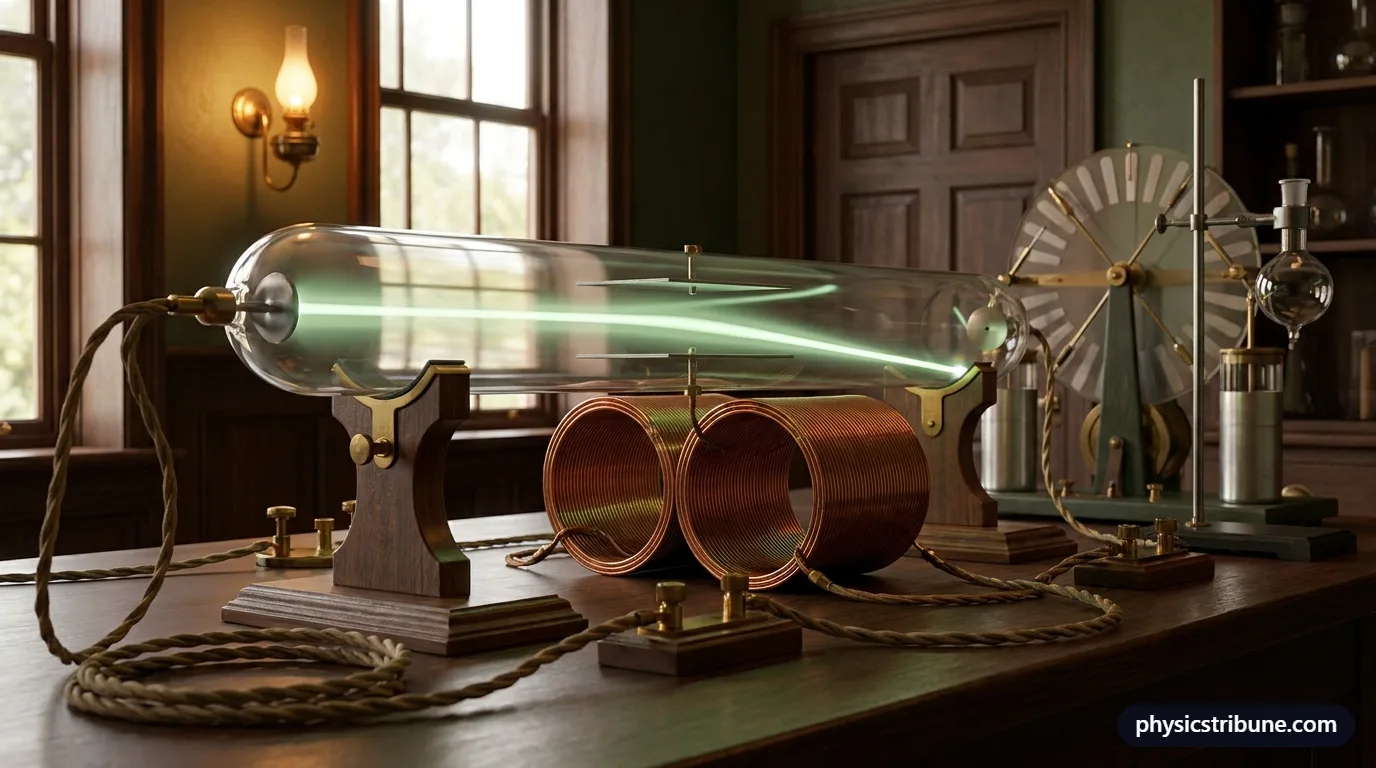
In the 1890s physicists argued about cathode rays, the glowing beams that appear in a glass tube when most of the air is pumped out and a high voltage is applied. Some thought they were waves in an invisible medium; others thought they were charged particles. Earlier attempts to bend the rays with electric plates had failed, which seemed to support the wave idea.
Thomson used a tube with a much better vacuum and showed that the rays do bend toward a positive plate, so they carry negative charge. He then balanced the electric push against a magnetic push to find the speed of the rays. From the speed and the bending he worked out their mass to charge ratio, which came out more than a thousand times smaller than for a charged hydrogen atom.
The result did not depend on the gas in the tube or the metal of the electrodes. He announced in 1897 that cathode rays are made of tiny particles common to all matter. You can follow the method step by step in our Thomson cathode ray experiment page.

Why Was the Charge to Mass Ratio So Important?
Thomson could not measure the mass or the charge of one particle directly. What he could measure was their ratio, because both the electric and the magnetic deflection depend on charge divided by mass. A very large charge to mass ratio meant either a huge charge or a tiny mass.
He argued for the tiny mass. Over the next two years his group measured the charge carried by ions in a cloud of droplets and found it was about the same size as the charge on a hydrogen ion. Then the mass had to be extremely small. The modern values in the table below show just how small.
The exact charge was later pinned down by Robert Millikan's oil drop experiment, and today the elementary charge is an exact defined value in the SI.
| Particle | Charge (C) | Mass (kg) | Charge to mass ratio (C/kg) |
|---|---|---|---|
| Electron | 1.602176634 × 10⁻¹⁹ (magnitude) | 9.1093837139 × 10⁻³¹ | 1.759 × 10¹¹ |
| Proton (hydrogen ion) | 1.602176634 × 10⁻¹⁹ | 1.67262192595 × 10⁻²⁷ | 9.579 × 10⁷ |
| Ratio electron to proton | 1 | 1 / 1836.15 | 1836.15 |
| Source: Charges and masses: NIST CODATA 2022 (physics.nist.gov) · public domain; ratios computed from those values · Retrieved October 2026 | |||
What Was Thomson's Plum Pudding Model?
If atoms contain light negative electrons but are neutral overall, there must be positive charge somewhere inside. In 1904 Thomson suggested that an atom is a sphere of evenly spread positive charge with electrons embedded in it, held in stable rings. Writers later compared it to plums in a pudding.
The model was a serious attempt to explain chemistry, such as why elements form repeating families. It was overturned within a decade by his former student Ernest Rutherford, whose gold foil results showed that the positive charge is packed into a tiny central nucleus.
Even so, the plum pudding picture was an important step. It was the first model to treat the atom as a structure with parts, and testing it led directly to the nuclear atom. Our page on atomic models traces the whole sequence.
Thomson's Key Equation
A charged particle moving at right angles to a uniform magnetic field feels a sideways force, so it travels in a circle. The radius of that circle grows with the particle's momentum and shrinks with its charge and the field strength. Thomson's magnetic deflection measurements rest on exactly this relationship.
Below we apply it to an electron beam in a modern teaching tube, then find the magnetic force on a moving charge that bends it. The electron mass and charge are the CODATA 2022 values.
This equation gives the radius of the circle a charged particle follows in a uniform magnetic field, with each variable and its unit.
| Symbol | Quantity | SI unit |
|---|---|---|
| radius of the circular path | meter (m) | |
| mass of the particle | kilogram (kg) | |
| speed (perpendicular to B) | meter per second (m/s) | |
| charge | coulomb (C) | |
| magnetic field | tesla (T) |
Rearranged to find another variable:
Valid for: velocity perpendicular to a uniform B field.
Example 1 Bending an electron beam into a circle
In a teaching tube, electrons move at 2.0 × 10^7 m/s at right angles to a uniform magnetic field of 1.5 × 10^-3 T. Using the electron mass 9.1093837139 × 10^-31 kg and the elementary charge 1.602176634 × 10^-19 C, what is the radius of their circular path?
- Given:
- mass of the particle:
- speed (perpendicular to B):
- charge:
- magnetic field:
- mass of the particle:
- Formula:
- Substitute:
- Answer:
A circle a few centimeters across fits easily inside a glass bulb, which is how classroom tubes show the electron's tiny mass to charge ratio.
Example 2 The sideways push on one electron
Using the same beam, an electron with charge 1.602176634 × 10^-19 C moves at 2.0 × 10^7 m/s through a 1.5 × 10^-3 T field, with an angle θ of 90° between its velocity and the field. What magnetic force acts on it?
- Given:
- charge:
- speed:
- magnetic field strength:
- angle between v and B:
- charge:
- Formula:
- Substitute:
- Answer:
The force is tiny, yet because the electron's mass is so small it produces a huge sideways acceleration and a tight curve.
Later Work, Honors and Legacy
Thomson won the 1906 Nobel Prize in Physics for his studies of how gases conduct electricity, was knighted in 1908 and served as president of the Royal Society from 1915 to 1920. Around 1912 and 1913, working with Francis Aston, he sent beams of positive neon ions through electric and magnetic fields and found two separate traces. Neon was a mix of atoms with two different masses, the first isotopes found in a stable element.
That technique grew into the mass spectrometer, now used everywhere from chemistry labs to airports. In 1918 Thomson became Master of Trinity College, and the next year he handed the Cavendish chair to Rutherford. He died in Cambridge in 1940, aged 83.
In a neat twist, his son George Paget Thomson shared the 1937 Nobel Prize for showing that electrons also behave as waves. The father proved the electron is a particle, and the son showed it can diffract like light.
Key Facts
- J. J. Thomson was born in Cheetham Hill, Manchester, on December 18, 1856, and died in Cambridge on August 30, 1940.
- In 1897 he showed that cathode rays are made of negatively charged particles much lighter than atoms: electrons.
- He measured the particles' charge to mass ratio by bending them with electric and magnetic fields.
- In 1904 he proposed the plum pudding model, with electrons embedded in a sphere of positive charge.
- He won the 1906 Nobel Prize in Physics and led the Cavendish Laboratory from 1884 to 1919.
- With Francis Aston he found two isotopes of neon, the first isotopes of a stable element.
Quick Quiz: How Well Do You Know J. J. Thomson?
6 questions. Tap an answer to check it.
What particle did J. J. Thomson discover in 1897?
He showed cathode rays are made of electrons, light negative particles found in all atoms.
Which quantity could Thomson measure for cathode ray particles?
Electric and magnetic deflection both depend on charge divided by mass, so that ratio was what he measured.
What did the plum pudding model say?
Thomson pictured electrons embedded in a uniform ball of positive charge.
Who replaced Thomson's model with the nuclear atom?
Rutherford's gold foil results showed the positive charge is concentrated in a nucleus.
If the magnetic field on an electron beam is doubled while speed stays the same, what happens to the circle's radius?
With r = m v / (|q| B), the radius is inversely proportional to B.
Which element did Thomson and Aston show had two isotopes?
Positive neon ions made two separate traces, revealing atoms of two different masses.
Frequently Asked Questions
What did J. J. Thomson discover?
Thomson discovered the electron in 1897. He showed that cathode rays are streams of negatively charged particles with a mass far smaller than any atom, and that the same particles appear no matter which gas or metal is used. He also proposed the plum pudding model of the atom and found the first evidence of isotopes in a stable element, neon.
How did J. J. Thomson discover the electron?
He used a well-evacuated glass tube in which cathode rays passed between charged metal plates and through a magnetic field. The rays bent toward the positive plate, proving they carry negative charge. By balancing the electric and magnetic forces he found their speed, and from the amount of bending he calculated a charge to mass ratio over a thousand times that of a hydrogen ion.
What is J. J. Thomson's atomic model called?
It is called the plum pudding model. Proposed in 1904, it pictured the atom as a ball of evenly spread positive charge with electrons scattered through it, like fruit in a pudding. Ernest Rutherford's gold foil experiments later showed that the positive charge is concentrated in a tiny nucleus, which replaced Thomson's model.
What does J. J. stand for in J. J. Thomson?
J. J. stands for Joseph John. Joseph John Thomson used his initials so consistently that colleagues, students and later textbooks all referred to him simply as J. J. He was knighted in 1908, so he is also correctly called Sir J. J. Thomson. His son, the physicist George Paget Thomson, is usually called G. P. Thomson.
Why did J. J. Thomson win the Nobel Prize?
He received the 1906 Nobel Prize in Physics for his theoretical and experimental investigations of how electricity passes through gases. That work included his measurements on cathode rays, which led to the discovery of the electron, and his studies of how gases become ionized and conduct current.
What is the charge to mass ratio of an electron?
Using CODATA 2022 values, the electron's charge divided by its mass is about 1.759 × 10^11 coulombs per kilogram. That is about 1,836 times larger than the ratio for a proton, because the electron carries the same size of charge with roughly 1/1836 of the mass. Thomson's 1897 measurements were the first estimate of this number.
Who were J. J. Thomson's famous students?
Many leading physicists trained or worked under him at the Cavendish Laboratory. The best known is Ernest Rutherford, who discovered the atomic nucleus and later succeeded Thomson as Cavendish Professor. Others include Francis Aston, who developed the mass spectrograph, and Charles Wilson, who invented the cloud chamber. Several of them won Nobel Prizes.
Did J. J. Thomson's son also win a Nobel Prize?
Yes. George Paget Thomson shared the 1937 Nobel Prize in Physics with Clinton Davisson for showing that electrons diffract, behaving as waves. It is a striking pair of results: the father showed the electron is a particle, and the son showed it also has wave properties, as quantum physics predicts.
Keep Exploring
 nuclear physicsElectron
 experimentsJ. J. Thomson's cathode ray experiment
 modern physicsHistory of Atomic Models (Dalton to Schrödinger)
 constantsMass of an Electron
 constantsElementary Charge (e)
 magnetismMagnetic Force on a Moving Charge (Lorentz Force)
 physicistsErnest Rutherford
 physicistsRobert A. Millikan
 questionsWho discovered the electron?
Sources
Constants come from NIST CODATA 2022 (public domain) and unit definitions from the BIPM SI Brochure (CC BY 4.0). Text, diagrams and illustrations are original work by Physics Tribune.