
At a Glance
The model of the atom changed five main times: Dalton's indivisible spheres, Thomson's plum pudding with electrons in a positive blob, Rutherford's tiny dense nucleus, Bohr's fixed electron orbits and the quantum mechanical model, where electrons are waves described by orbitals. In that final model an electron's wavelength is λ = h / (m v), which is why it forms a cloud rather than a path.
- First scientific model
- John Dalton, early 1800s
- Electron discovered
- J. J. Thomson, 1897
- Nucleus discovered
- Ernest Rutherford, 1911
- Energy levels
- Niels Bohr, 1913
- Current model
- Quantum mechanical (Schrödinger), 1926
- Key formula of the modern model
- λ = h / (m v)
On this page
- What Is an Atomic Model?
- Atomic Models Explained Simply
- What Was Dalton's Atomic Model?
- What Was Thomson's Plum Pudding Model?
- What Did Rutherford's Gold Foil Experiment Show?
- How Did the Bohr Model Improve on Rutherford's?
- What Is the Quantum Mechanical Model of the Atom?
- How Did the Neutron Complete the Picture?
- Why Do Scientific Models of the Atom Keep Changing?
- Common Misconceptions
- Key Facts
- Quiz
- FAQ
What Is an Atomic Model?
An atomic model is a simplified description of an atom's inner structure that explains what experiments show. Atoms are far too small to see directly with light, so every model has been a reasoned guess, tested against evidence and replaced when new results did not fit.
That is why the history of atomic models is really a history of experiments. Chemical reactions, glowing tubes of gas, beams of particles fired at metal foil and the colors of light from hot gases each forced a change in the picture. Each new model kept what still worked and fixed what did not.
Today's picture is described on our page about the structure of the atom. This page follows how scientists got there, one model at a time.
Atomic Models Explained Simply
Think of five drawings of the same mystery object, each made by someone with a better flashlight. The first person sees only a smooth ball. The next notices tiny bits stuck in it, like raisins in a muffin. The third finds that almost all the weight is in a speck at the very center.
The fourth sees the bits racing around that speck on set tracks. The fifth realizes the bits are not on tracks at all but spread out like a blurry cloud. None of the earlier drawings was useless; each was the best picture the evidence allowed at the time.
| Year | Scientist | Model | Key evidence | What it could not explain |
|---|---|---|---|---|
| Early 1800s | John Dalton | Solid, indivisible spheres | Fixed mass ratios in compounds | Electrons, ions, charge |
| 1904 | J. J. Thomson | Plum pudding: electrons in a positive sphere | Discovery of the electron (1897) | Large-angle scattering from gold foil |
| 1911 | Ernest Rutherford | Nuclear atom: tiny dense positive center | Gold foil scattering (from 1909) | Why electrons do not spiral into the nucleus |
| 1913 | Niels Bohr | Electrons on fixed orbits with set energies | Hydrogen's sharp spectral lines | Atoms with more than one electron |
| 1926 | Erwin Schrödinger | Quantum mechanical model with orbitals | Electron waves (de Broglie, 1924) | Still in use; refined by later theories |
| 1932 | James Chadwick | Neutron added to the nucleus | Neutral radiation from beryllium | Completed the three-particle picture |
| Source: Dates from our experiments and physicists data sets (data/experiments.json, data/physicists.json) · Retrieved October 2026 | ||||
What Was Dalton's Atomic Model?
In the early 1800s, the English chemist John Dalton turned the ancient Greek idea of atoms into science. The philosopher Democritus had argued around 400 BC that matter is made of tiny uncuttable pieces, but he had no way to test it. Dalton had data: elements always combine in fixed ratios by mass, as if whole numbers of small units were joining.
His model treated each atom as a solid, indivisible sphere. All atoms of one element were identical in mass, atoms of different elements differed, and chemical reactions simply rearranged atoms without creating or destroying them. This explained the conservation of mass and the fixed proportions found in compounds.
Dalton's spheres had no inner parts, and that was the assumption that would fall first. The model still survives in chemistry whenever atoms are drawn as simple balls joined by sticks.
What Was Thomson's Plum Pudding Model?
In 1897 J. J. Thomson showed that the rays inside glowing vacuum tubes are made of particles more than a thousand times lighter than a hydrogen atom, carrying negative charge. His cathode ray experiment had discovered the electron, and it proved atoms have smaller parts.
Since atoms are normally neutral, the negative electrons had to be balanced by positive charge somewhere. In 1904 Thomson proposed that the positive charge fills the whole atom like a soft sphere, with electrons scattered through it. The British called it the plum pudding model, after a dessert studded with fruit.
The model explained why atoms are neutral and how they could lose electrons to form ions. It predicted, though, that fast particles should pass through an atom with only tiny deflections, because the positive charge is spread so thin. That prediction could be tested, and it failed. Read more about the scientist on our J.J. Thomson page.
What Did Rutherford's Gold Foil Experiment Show?
Starting in 1909, Hans Geiger and Ernest Marsden, working under Ernest Rutherford in Manchester, fired positively charged alpha particles at gold foil far thinner than a sheet of paper. Most went straight through, as Thomson's model expected. A very small fraction, however, bounced off at large angles, and a few came almost straight back.
No spread-out positive charge could do that. In 1911 Rutherford concluded that all the positive charge and nearly all the mass must sit in a tiny, dense center, which he later called the nucleus, with electrons somewhere around it. An alpha particle that happened to pass very close to a nucleus felt a huge repulsion and swung sharply aside. The full story is on our gold foil experiment page.
Rutherford's nuclear model showed that the atom is mostly empty space. Its weakness was stability: a classical electron circling a nucleus should radiate energy and spiral inward almost instantly. Learn more about him on our Ernest Rutherford page.
Example 1 How small is a gold nucleus?
Estimate the radius of a gold-197 nucleus with R = R0 A^(1/3), taking the typical value R0 = 1.2 × 10⁻¹⁵ m and A = 197.
- Given:
- constant:
- mass number:
- constant:
- Formula:
- Substitute:
- Answer:
A gold atom is about 0.3 nm across, so its nucleus is tens of thousands of times smaller than the atom itself, which is exactly what Rutherford's scattering pattern implied.


How Did the Bohr Model Improve on Rutherford's?
In 1913 Niels Bohr kept Rutherford's nucleus and added a quantum rule: electrons can only travel on certain allowed orbits with fixed energies, and they do not radiate while on them. Light is emitted or absorbed only when an electron jumps between orbits, carrying the exact energy difference.
The rule explained why hydrogen glows at a handful of sharp wavelengths rather than a smooth rainbow, and it reproduced the measured hydrogen lines with striking accuracy. It also gave the size of the hydrogen atom from basic constants. For the formulas and its limits, see our full page on the Bohr model and the scientist's page, Niels Bohr.
The Bohr model could not handle atoms with more than one electron, and it offered no reason why only certain orbits were allowed. Those gaps pointed toward an entirely new kind of physics.

What Is the Quantum Mechanical Model of the Atom?
In 1924 Louis de Broglie proposed that electrons, like light, have a wave nature, with a wavelength
In 1926 Erwin Schrödinger wrote the equation that governs these matter waves. In his model the electron has no definite path. Its wave function instead gives the probability of finding it at each point, and the regions of high probability are called orbitals. A year later Werner Heisenberg's uncertainty principle confirmed that sharp orbits cannot exist.
This quantum mechanical model, sometimes called the electron cloud model, explains the energies of every element, the shapes of molecules and the layout of the periodic table. See our page on Erwin Schrödinger for the person behind it.
The quantum model starts from the de Broglie relation, which gives every moving particle a wavelength. Here it is with each symbol and its SI unit.
| Symbol | Quantity | SI unit |
|---|---|---|
| de Broglie wavelength | meter (m) | |
| Planck constant (6.626 × 10⁻³⁴ J·s (exact: 6.62607015 × 10⁻³⁴)) | joule second (J·s) | |
| momentum | kilogram meter per second (kg·m/s) | |
| mass | kilogram (kg) | |
| speed | meter per second (m/s) |
Rearranged to find another variable:
Valid for: p = mv valid for v << c; otherwise use relativistic momentum.
Example 2 The wavelength of an electron in hydrogen
In the lowest Bohr orbit of hydrogen, the electron moves at about 2.19 × 10⁶ m/s. Using h = 6.626 070 15 × 10⁻³⁴ J·s and the electron mass 9.109 383 7139 × 10⁻³¹ kg, what is its de Broglie wavelength?
- Given:
- Planck constant:
- mass:
- speed:
- Planck constant:
- Formula:
- Substitute:
- Answer:
This matches the length of the first Bohr orbit, about 0.33 nm around, so exactly one electron wavelength fits the circle. That fit is the wave explanation of Bohr's allowed orbits.
How Did the Neutron Complete the Picture?
One puzzle remained inside the nucleus. Most atoms weigh roughly twice what their protons alone would give, or more. In 1932 James Chadwick showed that the nucleus also holds neutral particles about as heavy as protons, the neutrons, in his discovery of the neutron.
With protons and neutrons in the nucleus and electrons described by orbitals, the modern atom was in place. Later work showed that protons and neutrons are themselves made of quarks, but the overall structure has held for nearly a century.
Why Do Scientific Models of the Atom Keep Changing?
Each model was replaced because an experiment produced a result it could not explain. That is how science is supposed to work: a model earns trust by making predictions, and it is revised the moment a careful measurement disagrees.
Older models were not thrown away entirely. Dalton's balls are still handy for balancing chemical equations, and Bohr's orbits still give the right hydrogen energies for a quick estimate. Scientists simply choose the simplest model that is accurate enough for the question. For a broader view of the shift from older to newer physics, see classical vs quantum physics, and practice with our atomic structure worksheets.
Common Misconceptions
Myth: Each new atomic model proved the previous one completely wrong.
Physics: Each model kept what still worked. Bohr kept Rutherford's nucleus, and the quantum model reproduces Bohr's hydrogen energies.
Myth: Rutherford's experiment showed electrons orbit in circles.
Physics: The gold foil experiment revealed the nucleus. It said nothing definite about how electrons move, which is the gap Bohr tried to fill.
Myth: The electron cloud means electrons are smeared out like fog.
Physics: The cloud shows where an electron is likely to be found. When measured, an electron always shows up as a whole particle at one place.
Myth: Dalton invented the idea of the atom.
Physics: Greek thinkers such as Democritus proposed atoms around 400 BC. Dalton was the first to back the idea with quantitative chemical evidence.
Key Facts
- Atomic models changed as new experiments revealed details that older models could not explain.
- John Dalton's early-1800s model treated atoms as solid, indivisible spheres.
- J. J. Thomson discovered the electron in 1897 and proposed the plum pudding model in 1904.
- Rutherford's 1911 analysis of the gold foil experiment revealed a tiny, dense, positive nucleus.
- Niels Bohr's 1913 model added fixed energy levels and explained hydrogen's line spectrum.
- The quantum mechanical model of 1926 replaced orbits with orbitals, regions of probability.
- James Chadwick's discovery of the neutron in 1932 completed the modern picture of the atom.
Quick Quiz: How Well Do You Know History of Atomic Models (Dalton to Schrödinger)?
6 questions. Tap an answer to check it.
Which atomic model described electrons embedded in a sphere of positive charge?
Thomson pictured electrons scattered through a positive sphere, like fruit in a pudding.
What did the gold foil experiment reveal?
Large-angle scattering showed the positive charge and mass are concentrated in a tiny center.
What was new in the Bohr model?
Bohr allowed electrons only on orbits with specific energies.
In the quantum mechanical model, what replaces electron orbits?
Orbitals are regions where an electron is likely to be found.
Which particle was discovered last, in 1932?
James Chadwick discovered the neutron in 1932.
Why does an electron's wave nature explain Bohr's allowed orbits?
An electron wave reinforces itself only if a whole number of wavelengths matches the orbit's length.
Frequently Asked Questions
What are the 5 atomic models in order?
The five main atomic models, in order, are Dalton's solid sphere model from the early 1800s, Thomson's plum pudding model of 1904, Rutherford's nuclear model of 1911, Bohr's planetary model of 1913 and the quantum mechanical model developed by Schrödinger and others in 1926. Each one was introduced to explain experimental results that its predecessor could not account for.
What is the current model of the atom?
The current model is the quantum mechanical model, also called the electron cloud model. It places protons and neutrons in a tiny nucleus and describes electrons with wave functions rather than paths. Orbitals show where electrons are most likely to be found, and their energies follow from the Schrödinger equation. It explains the periodic table, chemical bonding and atomic spectra.
Why was the plum pudding model rejected?
It was rejected because of the gold foil experiment. If positive charge were spread evenly through the atom, fast alpha particles would only be nudged slightly as they passed through. Instead, a small number bounced off at large angles and some came nearly straight back, which could only happen if the positive charge and mass were concentrated in a tiny nucleus.
What was wrong with Rutherford's model of the atom?
Rutherford's model could not explain why atoms are stable. Classical physics says an electron moving in a circle around a nucleus should continuously give off light, lose energy and spiral into the nucleus in a tiny fraction of a second. It also could not explain why elements emit light only at particular wavelengths. Bohr's energy levels addressed both problems.
What is the difference between the Bohr model and the quantum model?
The Bohr model puts electrons on sharp circular orbits with fixed radii and energies. The quantum model keeps the fixed energies but drops the orbits, describing each electron as a wave spread over a region called an orbital. The quantum model works for every element and explains details such as electron spin and orbital shapes, while Bohr's works only for hydrogen-like atoms.
Who discovered the nucleus of the atom?
Ernest Rutherford identified the nucleus in 1911 by interpreting experiments carried out by Hans Geiger and Ernest Marsden in his Manchester laboratory. They found that a few alpha particles fired at gold foil bounced back sharply, which Rutherford showed meant the atom's positive charge and mass are packed into a tiny central core.
Why do scientists use models of the atom?
Atoms are far too small to see in ordinary detail, so scientists build models that explain and predict what experiments show. A good model lets you calculate things such as the colors of light an element emits or how atoms bond. Simple models are kept for quick estimates, while the full quantum model is used when precision matters.
What did Dalton's atomic theory say?
Dalton's theory said that all matter is made of tiny indivisible atoms, that atoms of one element are identical in mass, that different elements have different atoms, and that chemical reactions rearrange atoms without creating or destroying them. Later discoveries showed atoms can be split and that isotopes of one element differ in mass, but the core idea of atoms survived.
Keep Exploring
 modern physicsStructure of the Atom
 modern physicsPlum Pudding Model
 modern physicsBohr Model of the Atom
 experimentsRutherford gold foil experiment (Geiger-Marsden experiment)
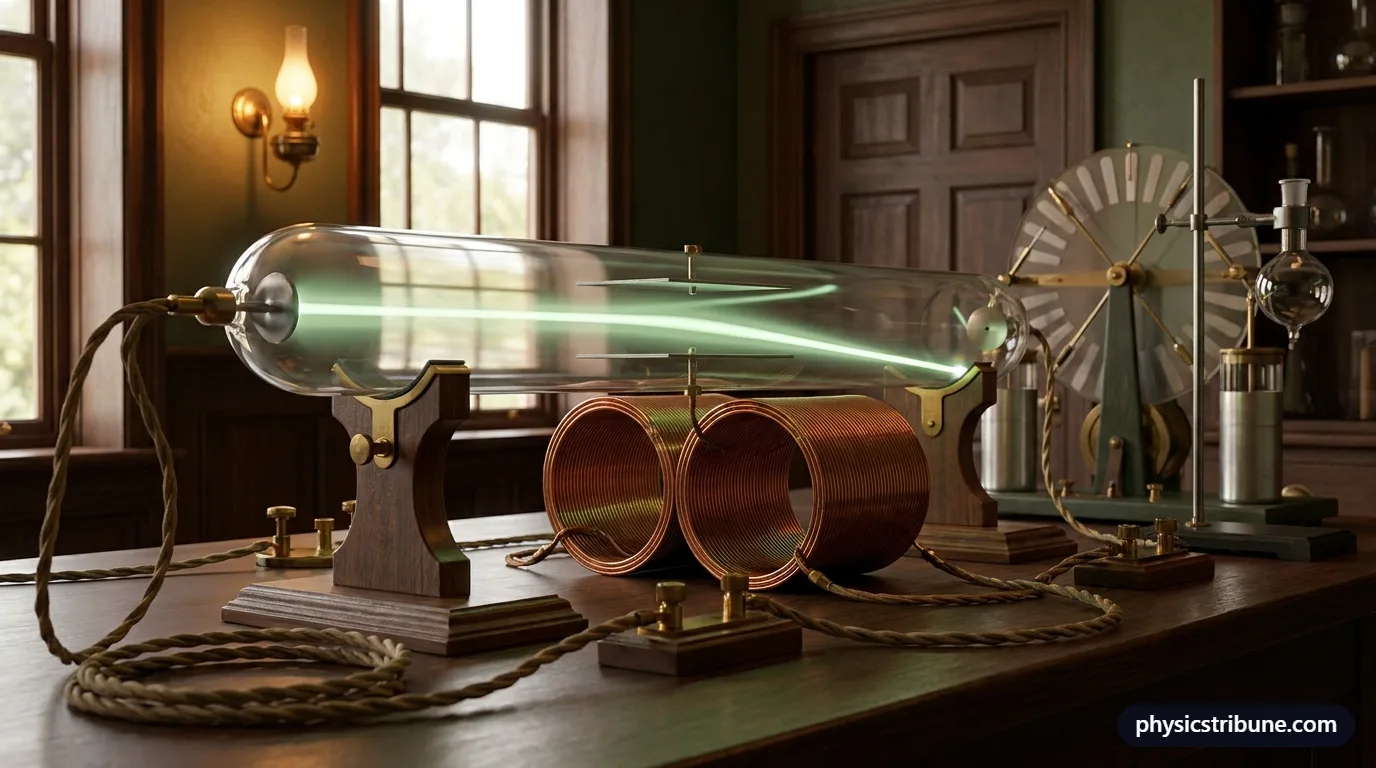 experimentsJ. J. Thomson's cathode ray experiment
 modern physicsDe Broglie Wavelength (Matter Waves)
 physicistsErnest Rutherford
 compareClassical vs Quantum Physics
 worksheetsAtomic Structure Worksheets
Sources
Constants come from NIST CODATA 2022 (public domain) and unit definitions from the BIPM SI Brochure (CC BY 4.0). Text, diagrams and illustrations are original work by Physics Tribune.