
At a Glance
An electron is a fundamental particle with charge -e, where e = 1.602 176 634 × 10^-19 C, and mass m_e = 9.109 383 7139 × 10^-31 kg, about 1/1836 of a proton's mass. Any charge made of electrons follows q = n e, so charge always comes in whole-number steps of e.
- Symbol
- e− (or β− when emitted by a nucleus)
- Charge
- -1.602 176 634 × 10-19 C (exact)
- Mass
- 9.109 383 7139 × 10-31 kg = 0.511 MeV/c²
- Particle family
- Lepton (a fermion with spin ½)
- Charge formula
- q = n e
- Discovered
- 1897, by J. J. Thomson
On this page
- What Is an Electron?
- The Electron Explained Simply
- What Is the Charge of an Electron?
- How Much Does an Electron Weigh?
- Where Are Electrons Found in an Atom?
- How Do Electrons Carry Electric Current?
- Who Discovered the Electron?
- How Does an Electron Compare With a Proton and a Neutron?
- Going Deeper: Does the Electron Have an Antiparticle?
- Common Misconceptions
- Key Facts
- Quiz
- FAQ
What Is an Electron?
An electron is one of the basic building blocks of ordinary matter. Every atom has a dense, positive nucleus at its center, and electrons fill the space around it. A neutral atom has exactly as many electrons as it has protons, so the negative and positive charges cancel.
Physicists call the electron an elementary particle. Protons and neutrons are made of smaller quarks, but no experiment has ever found anything inside an electron. Collider tests treat it as a point, with any internal size smaller than about 10-18 m if it exists at all.
The electron belongs to a family called leptons, particles that do not feel the strong nuclear force. It is also a fermion, which means two electrons cannot share exactly the same quantum state. That single rule shapes the whole periodic table.
The Electron Explained Simply
Think of an atom as a tiny solar system with a heavy center and very light, fast-moving companions around it. The electrons are those light companions. They are so small and light that almost all of an atom's mass sits in the center, while the electrons decide how big the atom is and how it behaves.
Electrons carry a small amount of negative charge each. When you rub a balloon on your hair, some electrons jump from your hair to the balloon. Now the balloon has a few too many electrons and your hair has a few too few, so they pull on each other.
When electrons drift along a copper wire, that drift is electric current. Your phone charger, the lights in your room and every computer chip depend on pushing electrons around in a controlled way.
What Is the Charge of an Electron?
The electron carries a charge of
Charge on everyday objects comes in whole-number lumps of
One coulomb is a huge amount of charge by this measure. It takes about 6.24 × 10¹⁸ electrons to make a single coulomb, which is roughly the charge that flows through a 1 A circuit every second. Our page on electric charge covers the bigger picture.
Every charge you can measure on an object is a whole number of electron charges, which is what this short formula says.
| Symbol | Quantity | SI unit |
|---|---|---|
| total charge | coulomb (C) | |
| number of elementary charges (integer) | dimensionless (1) | |
| elementary charge (1.602 × 10⁻¹⁹ C) | coulomb (C) |
Rearranged to find another variable:
Example 1 Counting the extra electrons on a rubbed balloon
After being rubbed on a wool sweater, a party balloon carries a negative charge with a size of 4.8 nC (4.8 × 10^-9 C). How many extra electrons sit on its surface?
- Given:
- total charge:
- elementary charge:
- total charge:
- Formula:
- Substitute:
- Answer:
Billions of electrons sound like a lot, yet they are a vanishing fraction of the electrons already inside the rubber.

How Much Does an Electron Weigh?
The electron mass is 9.109 383 7139 × 10-31 kg according to CODATA 2022. A proton is about 1,836 times heavier, so in a hydrogen atom the electron adds only about 0.05 percent of the total mass.
Because the number is so awkward in kilograms, particle physicists usually quote it as energy using
The ratio of charge to mass matters a great deal in practice. An electron has a large charge for its tiny mass, so electric and magnetic fields can steer it easily. That is what made old television tubes, electron microscopes and particle accelerators possible.
Example 2 The rest energy locked in one electron
Using E = mc², find the rest energy of a single electron with mass 9.109 383 7139 × 10^-31 kg, in mega-electronvolts (MeV).
- Given:
- rest mass:
- speed of light in vacuum:
- rest mass:
- Formula:
- Substitute:
- Answer:
This is why particle physicists quote the electron mass as about 0.511 MeV/c², and why an electron meeting a positron releases two gamma photons of that energy.

Where Are Electrons Found in an Atom?
Electrons do not follow neat circular paths. Quantum mechanics describes each one with a cloud of probability called an orbital, which tells you where it is likely to be found. Orbitals are grouped into shells at increasing distances and energies from the nucleus.
The outermost electrons, called valence electrons, do the chemistry. Atoms share or trade them to form bonds, which is why sodium gives up one electron so readily and chlorine grabs one. Our guide to atomic structure walks through shells, subshells and how they fill.
Each electron also has an intrinsic angular momentum called spin, with two possible orientations. Two electrons can share an orbital only if their spins point opposite ways. This pairing rule explains why elements line up in the rows and columns of the periodic table.
How Do Electrons Carry Electric Current?
In a metal, the outer electrons of each atom are not tied to one atom. They wander through the whole crystal as a kind of electron sea. Apply a voltage and the sea drifts in one direction, which is an electric current.
The drift itself is surprisingly slow, often well under a millimeter per second in a household wire. The signal travels far faster because the push spreads through the electron sea almost at once. A useful picture is a tube already packed with marbles: push one in at one end and one pops out the other end immediately.
Electrons in a vacuum behave differently. With no atoms in the way, a voltage accelerates them freely, and even a few hundred volts sends them to millions of meters per second. The electric field figure shows how field lines point inward toward a negative charge such as an electron.
Example 3 How fast is an electron after a 150 V push?
An electron starts at rest and is accelerated through a potential difference of 150 V, so it gains 150 eV of kinetic energy. Its mass is 9.109 × 10^-31 kg. How fast is it moving?
- Given:
- kinetic energy:
- mass:
- kinetic energy:
- Formula:
- Substitute:
- Answer:
That is a few percent of the speed of light from a modest voltage, which shows how little mass an electron has to push around.

Who Discovered the Electron?
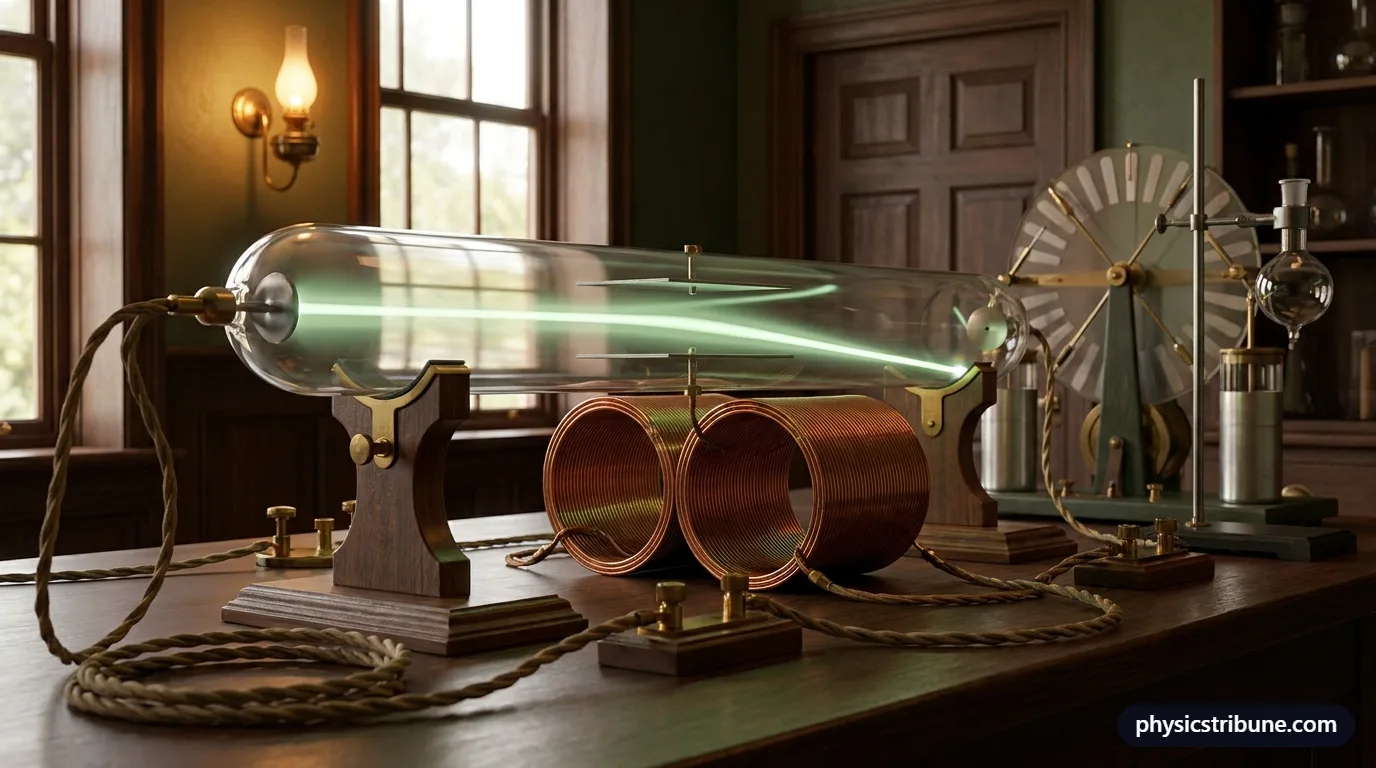
J. J. Thomson identified the electron in 1897 at the Cavendish Laboratory in Cambridge. He bent glowing cathode rays with electric and magnetic fields and found that they were streams of negative particles far lighter than any atom. His cathode ray experiment was the first time anyone had caught a piece of an atom.
Thomson received the 1906 Nobel Prize in Physics for his work on electricity in gases. Millikan pinned down the charge itself a few years later, and the mass followed from combining the two results. Read more on our J. J. Thomson biography or the short answer to who discovered the electron.
How Does an Electron Compare With a Proton and a Neutron?
The three particles that make up atoms differ sharply in mass and in what they are made of. The proton and electron carry equal and opposite charges, which is why a neutral atom balances so neatly. The neutron has no charge but nearly the same mass as the proton.
The table below sets the main numbers side by side. Notice that the electron is the only one of the three that is truly elementary. For the other two, see our pages on the proton and the neutron.
| Property | Electron | Proton | Neutron |
|---|---|---|---|
| Charge (in units of e) | -1 | +1 | 0 |
| Charge (C) | -1.602 × 10⁻¹⁹ | +1.602 × 10⁻¹⁹ | 0 |
| Mass (kg) | 9.109 × 10⁻³¹ | 1.673 × 10⁻²⁷ | 1.675 × 10⁻²⁷ |
| Mass relative to the electron | 1 | 1,836 | 1,839 |
| Rest energy | 0.511 MeV | 938.3 MeV | 939.6 MeV |
| Location in the atom | Around the nucleus | In the nucleus | In the nucleus |
| Made of smaller parts? | No, elementary | Yes, three quarks | Yes, three quarks |
| Particle family | Lepton | Baryon | Baryon |
| Stable on its own? | Yes | Yes | No, mean lifetime about 15 minutes |
| Source: Masses, charge and mass ratio from NIST CODATA 2022 (public domain); rest energies computed with E = mc²; free neutron lifetime is a typical value · Retrieved October 2026 | |||
Going Deeper: Does the Electron Have an Antiparticle?
Yes. The positron has the same mass as the electron but a positive charge. Paul Dirac predicted it from his relativistic equation for the electron, and it was spotted in cosmic rays a few years later.
When an electron and a positron meet, they annihilate. Their combined rest energy, about 1.022 MeV, usually leaves as two gamma photons of 0.511 MeV each flying in opposite directions. Hospital PET scanners detect exactly these photon pairs to map where a tracer has gathered in the body.
Electrons can also be born inside a nucleus. In beta-minus decay a neutron turns into a proton and shoots out a fresh electron plus an antineutrino. That is why a beta particle and an electron are the same thing; only the origin differs.
Common Misconceptions
Myth: Electrons orbit the nucleus in neat circles like planets.
Physics: Electrons occupy orbitals, regions of probability with fuzzy edges. The planetary picture is a useful cartoon but does not match what quantum mechanics predicts or what experiments show.
Myth: Electrons in a wire race along at nearly the speed of light.
Physics: Their average drift is very slow, often a fraction of a millimeter per second. The electrical signal is fast because the push travels through the whole electron sea almost instantly.
Myth: A beta particle is a different kind of particle from an electron.
Physics: A beta-minus particle is simply an electron that was created in a nucleus during radioactive decay. Once it leaves, it is identical to any other electron.
Myth: Electric current flows in the direction electrons move.
Physics: By convention, current points from positive to negative, which is opposite to the motion of electrons. Both descriptions predict the same results in circuits.
Key Facts
- An electron carries a charge of -1.602 176 634 × 10^-19 C, a value fixed exactly in the SI since 2019.
- The electron mass is 9.109 383 7139 × 10^-31 kg, about 1/1836 of the proton mass.
- Electrons are elementary leptons with spin ½ and no known internal structure.
- Every measured charge on an object is a whole number of electron charges, q = ne.
- J. J. Thomson discovered the electron in 1897 by bending cathode rays with fields.
- Electric current in metals is a slow drift of free electrons pushed by a voltage.
- The electron's antiparticle is the positron, and the two annihilate into gamma photons.
Quick Quiz: How Well Do You Know Electron?
6 questions. Tap an answer to check it.
What is the electric charge of an electron?
The electron carries one negative elementary charge, -e.
About how many times heavier is a proton than an electron?
The CODATA proton-to-electron mass ratio is about 1836.
Which scientist discovered the electron in 1897?
Thomson identified electrons as the particles in cathode rays.
An object has a charge of 3.2 × 10^-19 C in size. How many elementary charges is that?
Dividing 3.2 × 10^-19 C by 1.6 × 10^-19 C gives 2.
What happens when an electron meets a positron?
Matter and antimatter annihilate, usually into two 0.511 MeV gamma photons.
To which particle family does the electron belong?
The electron is a lepton, a fundamental particle that ignores the strong force.
Frequently Asked Questions
What is an electron in simple terms?
An electron is a tiny particle with a negative charge that is found around the center of every atom. It is much lighter than the protons and neutrons in the nucleus. Electrons hold atoms together into molecules, carry current through wires and make static electricity happen when they jump from one material to another.
What is the charge of an electron?
The charge of an electron is -1.602 176 634 × 10^-19 coulombs. Since the 2019 redefinition of the SI, this value is exact by definition. Physicists often just write it as -e, where e is the elementary charge. All everyday charges are whole-number multiples of this amount, either more or fewer electrons than protons.
What is the mass of an electron?
An electron has a mass of 9.109 383 7139 × 10^-31 kilograms, the CODATA 2022 value. That is about 1/1836 of a proton's mass. In particle physics the same mass is usually written as 0.511 MeV/c², which is the rest energy you get from E = mc² divided by the speed of light squared.
Who discovered the electron?
J. J. Thomson discovered the electron in 1897 at the Cavendish Laboratory in Cambridge, England. He showed that cathode rays could be bent by electric and magnetic fields and were made of negatively charged particles far lighter than atoms. He was awarded the Nobel Prize in Physics in 1906 for this line of research.
Is an electron smaller than an atom?
Yes, by an enormous margin. An atom is about 10^-10 m across, and that size is set by the space the electrons occupy. The electron itself behaves as a point particle in every experiment so far. If it has any size at all, it must be smaller than about 10^-18 m, a hundred million times smaller than an atom.
Can an electron be destroyed?
An electron on its own is stable and has never been seen to decay. It can disappear only by meeting its antiparticle, the positron, in which case both vanish and their energy leaves as gamma photons. Electrons can also be absorbed by a nucleus in a process called electron capture, which turns a proton into a neutron.
Why is the electron negative?
The sign is a historical choice. In the 1700s Benjamin Franklin called one kind of charge positive and the other negative without knowing which one moved. When Thomson found the electron more than a century later, it turned out to carry the kind Franklin had labeled negative, and the convention stuck.
Are electrons waves or particles?
They behave as both. An electron hits a detector at a single point like a particle, yet a beam of electrons passing through two slits builds up an interference pattern like a wave. Its wavelength depends on its momentum, which is why electron microscopes can see much finer detail than light microscopes.
How many electrons are in one coulomb?
One coulomb contains about 6.24 × 10^18 electron charges, found by dividing 1 C by the elementary charge. That same number of electrons passes any point in a circuit each second when the current is 1 ampere. It shows how small a single electron's charge is compared with everyday electrical quantities.
Keep Exploring




Sources
Constants come from NIST CODATA 2022 (public domain) and unit definitions from the BIPM SI Brochure (CC BY 4.0). Text, diagrams and illustrations are original work by Physics Tribune.